



 by Tom Gurney
Tom Gurney BSc (Hons) is an art history expert with over 20 years experience
Published on June 19, 2020 / Updated on October 29, 2026
Email: tomgurney1@gmail.com / Phone: +44 7429 011000
Cat: Introduction
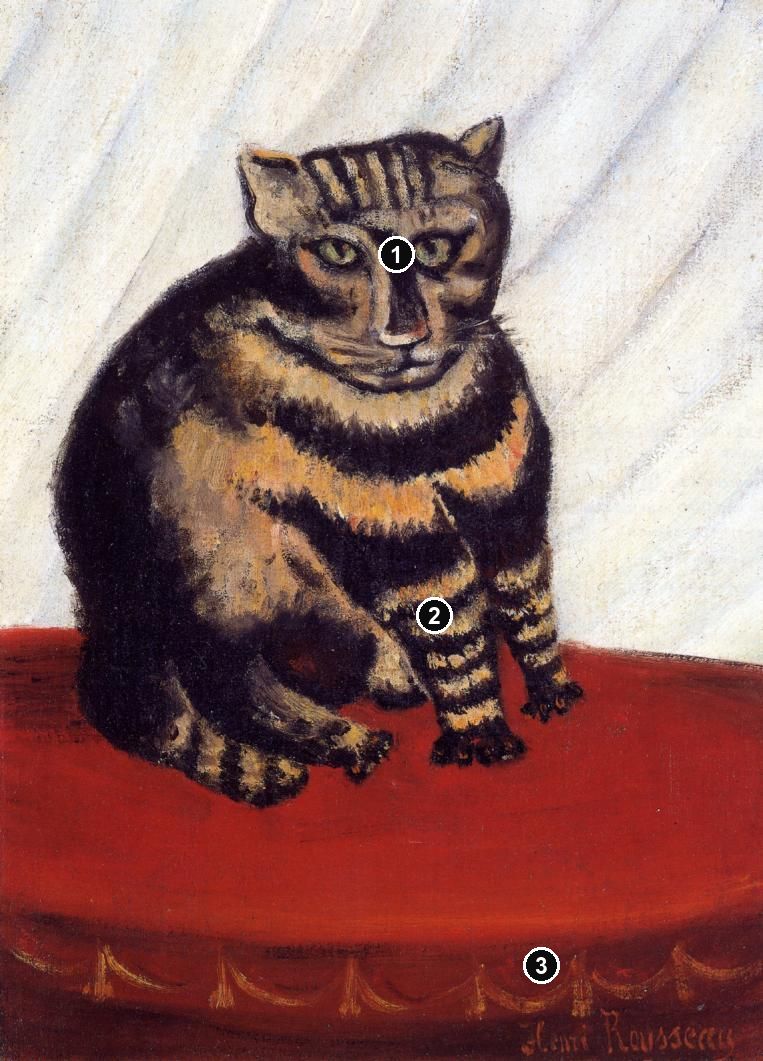
Henri Rousseau’s Cat sits squarely on a red, oval-topped base, its striped body gathered beneath a face that looks towards the viewer. Large greenish eyes, a long dark nose and small pointed ears give the animal an unusually concentrated presence. The pale background offers almost nothing to distract from it. Catalogued by Christie’s as Le chat tigre, this small oil painting measures 32 × 23 cm; the auction record supplies no execution date.[1]
At a Glance
- ArtistHenri Rousseau
- SubjectCat
- ExploreA cat occupying the whole picture; Stripes that describe and decorate
This work across Henri Rousseau’s career
Carnival Evening
1886 [2]The Merry Jesters
1906 [7]The Snake Charmer
1907 [8]Cat (current article)
Not recorded [1]Contents
- A cat occupying the whole picture
- Stripes that describe and decorate
- Red below, pale space behind
- A small painting and its recorded history
- Annotated details
A cat occupying the whole picture
The upright canvas gives the animal room to sit at nearly its full height within the composition. Its ears rise into the pale upper field, while its feet spread across the red surface below. Around the body, the remaining background forms a narrow border of light. This arrangement brings the cat close without requiring an enlarged setting or a scene of activity. The animal itself supplies the picture’s principal event.
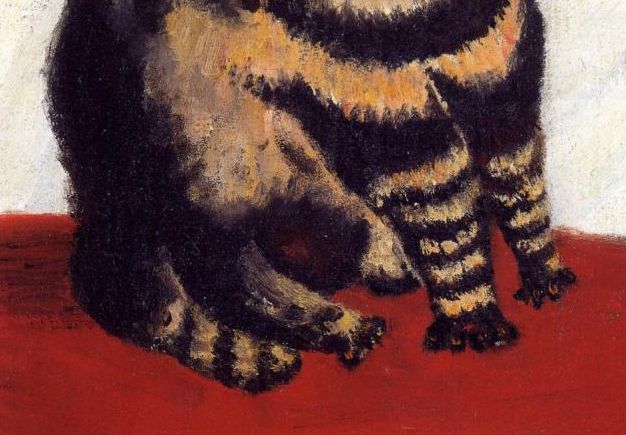
Its position is more intricate than the first, compact impression suggests. The rounded back swells towards the left edge, creating a dark, continuous outer curve. The two front legs descend on the right half of the body, with their narrow upright shapes providing a firmer rhythm than the folded forms beside them. Near the bottom left, tail and hindquarters form a cluster of striped curves. Their overlap is difficult to unravel in the available reproduction, but that compressed shape helps the seated animal feel substantial. Its weight appears gathered low against the red support.
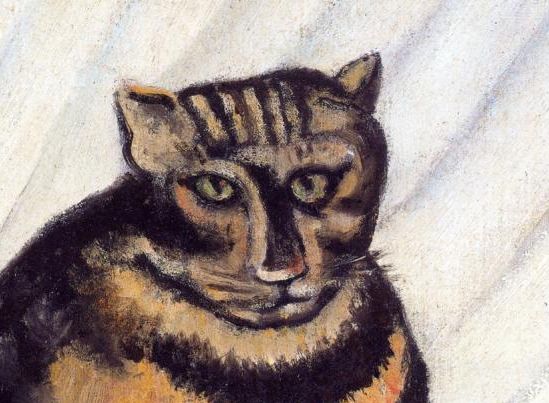
Above this uneven arrangement, the face establishes a steadier centre. The ears are small and slightly unequal in appearance; the eyes are set well apart on either side of the long bridge of the nose. The head seems held for sustained inspection. The body turns enough to reveal its rounded flank, while the face remains available to the spectator. That combination gives the composition something of the character of a portrait.
The gaze makes this comparison especially persuasive. Each greenish iris contains a dark pupil, and heavy dark outlines increase the eyes’ visibility against the lighter patches of the face. Their direction draws attention out towards the person standing before the painting. A viewer might read watchfulness, reserve or curiosity into that look. The visible evidence is simpler: the eyes are open, prominent and turned towards us, while the mouth is closed. The painting leaves considerable room for our response to those few features.
Stripes that describe and decorate
Dark bands give the cat its distinctive pattern. Across the forehead they form a sequence of short vertical strokes, separated by narrow strips of lighter fur. Around the eyes, the pattern changes direction, helping to frame the face. The nose extends down through this arrangement as a strong central shape, ending above the pale curved muzzle. Fine lines at the sides of the muzzle add a more delicate movement to an otherwise heavily outlined head.
The chest carries broader bands. A light curve beneath the chin is followed by dark and ochre passages that spread around the upper body. Lower down, the stripes become shorter and more closely packed on the front legs. This change of scale matters: the pattern that crosses the broad chest contracts as it reaches the slender limbs. It helps distinguish one part of the animal from another even where the dark colours merge.
The markings also create a second way of reading the surface. Seen as a whole, the cat is a rounded seated body; followed stripe by stripe, it becomes a network of alternating shapes. Some bands bend around a limb and suggest its volume. Others seem to lie close to the surface of the canvas, joining the repeated decoration below. The eye can move between these readings without settling entirely on either. The animal feels solid, yet its coat remains insistently patterned.
Light fur contributes as much as the black markings. Cream and warm ochre passages break through the darker body at the shoulder, chest and face. Against the pale background, the almost black outer edge of the back is easy to follow; within that outline, the lighter patches keep the form from becoming a single silhouette. Around the front legs, small divisions of dark and light make the lower body busier. This contrast between a broad outer contour and closely worked interior shapes gives the cat much of its visual energy.
The French title Le chat tigre accompanies this striped domestic subject in Christie’s catalogue. The catalogue itself describes the theme as domestic.[1] The coat’s bands provide the obvious visual connection with the title. Nothing in the image or that description establishes a particular breed, a named pet or the animal’s sex. The details that individualise this cat are pictorial ones: its broad eyes, angular nose, striped chest and compact seated pose.
Red below, pale space behind
The support beneath the cat occupies roughly the lower third of the canvas. Its red top curves forwards in a wide oval, introducing a horizontal shape beneath the upright body. The surface extends beyond the animal on both sides, so the cat appears placed and supported rather than suspended against the background. Towards the front edge, the red darkens and turns down into a decorative band.
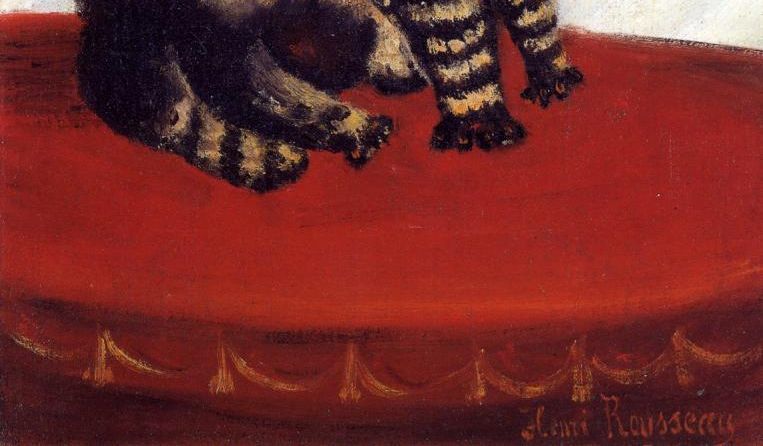
Along this band runs a gold-coloured pattern of repeated scallops and small hanging forms. These ornaments add a measured rhythm below the irregular stripes of the coat. Their curves also echo the rounded seat-like top, carrying its movement across the bottom of the picture. Rousseau’s signature appears at the lower right over the darker front band, where Christie’s records it.[1] The lettering belongs to the same narrow zone as the ornament, leaving the upper part of the painting to the animal and its pale surroundings.
The exact furnishing is difficult to identify. Its oval top and decorated front can suggest a cushioned seat or platform, but the painting does not give a clear view of legs or a wider room. Its colour is decisive: warm and expansive below the cat, it sets off the greenish eyes and lighter fur while anchoring the whole composition.
Behind the animal, diagonal grey streaks cross an almost white field. They bring a little movement into an otherwise quiet area and give the pale ground a varied texture. They could suggest folds or the shading of a backdrop, although the image offers no secure architectural explanation. There is no view through a window and no surrounding furniture to establish the space. The cat’s dark contour remains the clearest boundary in this upper field. The setting has enough substance to present the animal, while offering few clues to a location.
Annotated Details from Cat
The numbered points identify visible features discussed in this article. Return from each detail to the whole composition. Henri Rousseau, Cat (Le chat tigre). Undated in the cited Christie’s sale record; present owner unidentified. Image via WikiArt; listed upstream source: The Athenaeum. Image source. Public domain. Numbers added to a separate resized overview. Three broad excerpts cropped directly from the published original without enlargement, sharpening, recolouring or retouching.
Details from CAT
Move from the cat’s frontal face to the changing scale of its stripes, then follow the broad red oval and repeated ornament below.
A face held towards the viewer
The greenish eyes sit wide apart beside a long dark nose. Short stripes frame the forehead, while pale curves distinguish the closed muzzle; small uneven ears complete the compact head.
Broad chest bands become narrow leg stripes
Dark and ochre bands spread across the chest, then contract around the two front legs. The compact paws and folded forms at the left gather the animal’s weight low against the red surface.
Paws above the red oval and ornament
The red surface extends beyond the paws before turning into a darker front band. Gold-coloured scallops repeat along that edge, giving the support a measured rhythm below the irregular striped body.
A small painting and its recorded history
At 32 × 23 cm, Cat is an intimate object. Its frontal address and close framing can be encountered at short range; the decorative band and the divisions within the coat reward that closer attention. The Musée de l’Orangerie’s 2026 exhibition texts describe Rousseau’s broader practice of varying subjects and formats for buyers, including small canvases suited to modest interiors.[12] That account provides a useful context for the scale of Cat. The available record does not identify its first purchaser or establish that it was made for a particular home. Its size alone cannot supply the missing commission history.
Christie’s lists the Galerie de l’Effort Moderne, associated with Léonce Rosenberg in Paris, in the painting’s provenance. It also records the work in the exhibition 1866–1960, Peintres naïfs de Rousseau à Demonchy at the Halles Saint-Pierre, Paris, from October 1994 to February 1995.[1] These entries give the painting a documented history of circulation and exhibition, although they do not constitute a complete account of its movements. In particular, the brief provenance line supplies no date for the gallery’s involvement.
The lot essay further states that the painting was sold with a photo-certificate from Dora Vallier dated 17 March 1995 in Paris.[1] This is the auction catalogue’s description of an accompanying document; the certificate itself is not reproduced in the material available here. The reference therefore belongs to the painting’s historical sale documentation. It does not establish a present owner or provide a new assessment of the object.
Henri Rousseau artworks directory
This directory brings together works covered on this site and other works documented in the cited museum records and catalogues. Alternate titles share one entry; distinct versions remain separate. Historical dates for works without an article follow the cited catalogues. This is not a catalogue raisonné.
Frequently Asked Questions
The Christie’s record used here gives no execution date. An exact year cannot be established from that source.[1]
Christie’s catalogues it as Le chat tigre. Its striped animal is described in the catalogue as a domestic subject.[1]
A red oval-topped surface with a darker, gold-patterned front band. The image suggests a seat-like support, but its exact furniture type and materials are uncertain.
The auction catalogue gives 32 × 23 cm and identifies the medium as oil on canvas.[1]
Discussion
Look again at the images and ideas explored in Cat. These editorial prompts invite your observations.
Reader Insights
How do the cat’s stripes help you see a rounded body, and where do they read as flat decoration?
What changes when you look first at the eyes, then at the red oval underneath the animal?
Which visible details make the composition feel like a portrait?
Join the Conversation
Share a detail, comparison or question about Cat below.
References
- Christie’s. Henri ‘le Douanier’ Rousseau, Le chat tigre, historical sale catalogue, 2001, lot 247; details, provenance, exhibition history and lot essay. Accessed 23 October 2026. View source.
- Philadelphia Museum of Art, Carnival Evening,1963-181-64,object59593. View source.
- Musée de l’Orangerie / Juliette Degennes, Henri Rousseau,L’ambition de la peinture: Un artiste dans son époque (in French). View source.
- National Gallery, Surprised!, NG6421. View source.
- Musée d’Orsay, La Guerre,RF19461 (in French). View source.
- MoMA, The Sleeping Gypsy. View source.
- Philadelphia Museum of Art, The Merry Jesters, 1950-134-176, object51097. View source.
- Musée d’Orsay, La Charmeuse de serpents, RF 1937 7 (in French). View source.
- Musée de l’Orangerie, La Carriole du Père Junier, RF 1960 26 (in French). View source.
- Solomon R. Guggenheim Museum / Cornelia Lauf, The Football Players,60.1583: current collection record. View source.
- MoMA, The Dream, 252.1954. View source.
- Musée de l’Orangerie. Henri Rousseau, l’ambition de la peinture, exhibition texts, 25 March–20 July 2026, “Variations et déclinaisons. À la recherche du marché.” Accessed 23 October 2026. View source. (in French).
- The Museum of Modern Art, Henri Rousseau: Essays (1985), selected catalogue entries, chronology and notes on early devotees. View source. Selected entries, chronology (pp.91–95) and early-devotee notes (pp.262–264) were consulted. Historical collection credits do not establish present ownership.
- Daniel Catton Rich, Henri Rousseau (The Museum of Modern Art, 1942), selected drawings and landscape studies; historical catalogue. View source. The dated 1942 publication is used for the two Quai d’Auteuil ink views; its Malakoff date differs from the 1985 catalogue.
- MANAS, Laval, Henri Rousseau, dit le Douanier, urban landscapes and preparatory study (in French). View source.
- National Gallery of Art, Self-Portrait (1895), pen-and-ink drawing, accession 1995.47.66. View source.
- The Museum of Modern Art, War (published January 1895), lithograph, accession 684.1943. View source.
- Barnes Foundation, Landscape and Four Young Girls, object 5521, BF855. View source.


 Henri Rousseau.jpg)


 Henri Rousseau.jpg)