


 by Tom Gurney
Tom Gurney BSc (Hons) is an art history expert with over 20 years experience
Published on June 19, 2020 / Updated on October 29, 2026
Email: tomgurney1@gmail.com / Phone: +44 7429 011000
Landscape with the Dirigible République and a Wright Airplane: Introduction
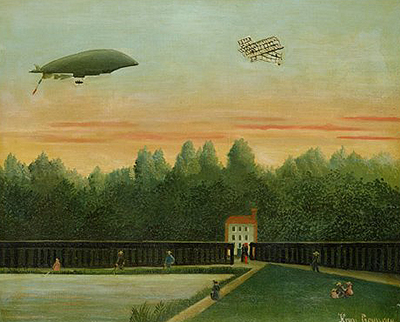
A green airship floats above a riverbank while a fragile-looking biplane approaches from the other side of the sky. Below, people fish, walk and sit together on the grass. Henri Rousseau gives the machines an immense expanse of air, yet allows them to share the picture with these small pleasures. Painted in 1909, Landscape with the Dirigible République and a Wright Airplane belongs to the Pola Museum of Art. It is an oil on canvas measuring 59.8 × 73.1 cm.[1]
At a Glance
- ArtistHenri Rousseau
- SubjectLandscape with the Dirigible République and a Wright Airplane
- ExploreA riverbank beneath an enormous sky; Two kinds of flying machine
This work across Henri Rousseau’s career
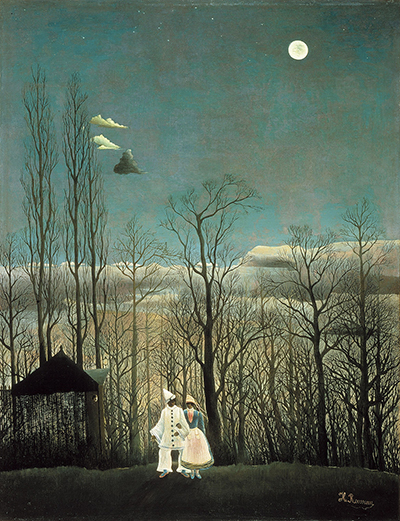
Carnival Evening
1886 [2]The Merry Jesters
1906 [7]The Snake Charmer
1907 [8]Contents
- A riverbank beneath an enormous sky
- Two kinds of flying machine
- People with their own occupations
- From an aviation newspaper to a painted landscape
- What the date tells us
A riverbank beneath an enormous sky
The Pola Museum identifies the setting as the banks of the Marne, east of Paris, and draws attention to Rousseau's decisive cropping of a bend in the river.[12] That bend shapes our entrance into the scene. Pale water fills the lower left corner, while an ochre path cuts diagonally from the bottom edge towards a little house. The grassy bank opens on the right. Together, water and path carry the eye into a landscape which initially seems to consist of horizontal strips.
The strongest of those strips is the dark railing running across the lower part of the picture. Its narrow upright bars repeat with an almost counting rhythm. Behind it, the trees form a deep green screen; in front, the figures have space for their separate occupations. A break in the railing reveals the cream-coloured house, its red roof and tall chimney. The building is modest in size but exceptionally conspicuous. Its light wall interrupts the dark band and gives the converging paths a destination.[1]
Rousseau makes this small opening do considerable work. The river bend leads towards it, two standing figures mark it, and the trees rise on either side. There is very little architecture elsewhere to compete for attention. Even the house's windows are reduced to a few dark marks, sufficient to establish its inhabited character without drawing us into a particular household. The distant landscape remains largely closed to us. We look along the water and grass more easily than we look through the trees.
Above that leafy barrier, the space suddenly expands. Soft green tree crowns reach into a yellow sky crossed by long orange strokes. Higher up, the colour becomes a pale green-grey. The narrow warm bands have a different rhythm from the crowded foliage: they stretch sideways and leave broad intervals of quiet colour between them. The picture suggests changing light without requiring us to identify a precise hour. Its warmth is concentrated at the horizon; the cooler water holds the foreground open.[1]
This arrangement produces an unusual sense of distance. The far trees are softened, the nearest foliage is darker and more densely worked, and the riverbank has clear diagonal edges. Yet each zone also remains readable as a shape across the canvas. Sky, trees, railing and water offer different kinds of surface. The aircraft occupy the simplest one, so that their small silhouettes can hold their own against the thick vegetation beneath them.
Two kinds of flying machine
The airship at upper left is a solid, elongated green body. Its underside is dark, with a tiny suspended gondola; a small French tricolour hangs near the left end. The broad shape sits comfortably against the pale sky, almost like a detached piece of the landscape's green mass. At upper right, the biplane is assembled from thin dark lines and pale wing surfaces. Sky seems to pass through its open structure. Rousseau has made the difference between the two machines immediately legible.[1]
Their positions create a second contrast. The airship extends across the canvas with a smooth, unbroken contour; the biplane turns its tiers of wings and connecting supports at an angle. One appears weighty and enclosed, the other intricate and exposed. The eye can take in the airship almost at once, then linger over the little compartments of the aeroplane. Their handling gives each a distinct presence without supplying the information of a technical drawing.
Pola reads their opposing directions—the République towards the right, the Wright-type aircraft towards the left—as a symbolic pairing of newer and older generations of aviation technology.[12] Visually, the two approach the open centre of the sky from different heights. They do not meet. The large empty interval between them holds them apart and makes their relationship something we consider across the whole upper half of the painting.
The machines also establish a horizontal movement unlike the path's diagonal pull. Our imagined route along the bank runs towards the house; their routes stretch across the sky. A walker can occupy one small patch of ground while a flying machine seems to possess the entire distance above it. Rousseau's scale makes that difference tangible. The aircraft are small enough to remain airborne objects in a landscape, but large enough for their structures to demand attention.
The biplane's framework has a faint echo in the railing below. Both depend on repeated uprights held between long horizontal members. At ground level, this pattern forms a dense black barrier; overhead, it is a delicate structure surrounded by light. Following that resemblance connects two otherwise distant parts of the canvas. It also sharpens the contrast between the regular built forms and the trees, whose outlines rise and fall freely behind the railing.[1]
There are no painted trails, blurred propellers or sharply slanting bodies to insist on speed. The airship and biplane seem held in place, available for inspection. That suspension is part of the painting's peculiar calm. We can follow a new form of movement while standing, as it were, beside people who have settled down for a leisurely afternoon.
People with their own occupations
The figures are easy to overlook on a small reproduction. Along the far bank of the water, little patches of pink, brown and blue resolve into hats, clothes and bodies. A darker figure stands nearer us beside the diagonal path. On the grass at lower right, a seated group forms a compact cluster, its pale hats picked out against green. The museum describes fishing, walking and picnicking here.[12]
Each activity has its own pace. The seated group gathers into a single place, the walkers are spread along the railing, and the figures near the water attend to its edge. None makes an emphatic upward gesture. Their dispersal matters: there is no crowd assembled beneath the aircraft and no single spectator through whom we are told to experience them. We are free to notice the flying machines before the people, then to discover how much continues below.
The brightest human accents also bind the foreground together. The blue clothing near the middle, a reddish mark at the house and the warmer colours of the picnic group punctuate an otherwise green and black lower zone. These touches prevent the railing from becoming a purely impersonal boundary. It measures a public space used by people who have different reasons to be there.
Rousseau has left a generous area of grass around the picnic group. Their gathering occupies only a small part of it, giving the scene an ease that a larger, more central group might have lost. The tiny figures make us look closely; the open sky encourages us to step back. Alternating between those distances is one of the pleasures of the painting. Its subject emerges through both the named aircraft and the ordinary actions taking place beneath them.
From an aviation newspaper to a painted landscape
Pola credits the Rousseau scholar Henri Certigny with identifying a wheeled aircraft on the cover of Le Petit Journal, illustrated supplement no. 981, dated 5 September 1909, as a model for the painter's Wright-type aeroplane.[12] The cover survives in a scan from the François Denoncin collection, reproduced by ReimsAvant. Its heading celebrates La Grande Semaine d'Aviation, and the caption names the plain of Bétheny.[13]
The newspaper image fills the sky with flying machines, some cut by the border, others diminishing towards the horizon. Large biplanes show their stacked wings, wheels and struts; smaller aircraft scatter through the remaining space. At the bottom, spectators raise hats towards them. A grandstand rises at the right, and French flags add bright patches of colour. The crowded illustration gives aviation the scale of a public spectacle.[13]
Set beside Rousseau's canvas, the cover clarifies the transformation involved in his landscape. The newspaper directs its spectators' attention upwards and leaves little aerial space unused. Rousseau places only two aircraft above a quiet bank. The waving crowd has no equivalent among his dispersed figures. His railing, house and picnic establish another centre of interest below. An aircraft image that could command excitement on a newspaper cover has become one element in a carefully spaced world.
Certigny's identification is reported by the museum; the cover alone cannot establish which particular aircraft supplied Rousseau's contours or whether he possessed that issue. The comparison is most useful when it keeps the whole compositions in view. It shows how differently a painter and an illustrated newspaper can organise the encounter between people and flight. The source argument concerns the aeroplane: this cover contains no airship.[12][13]
What the date tells us
Pola also recalls that the French military airship République crashed on 25 September 1909, placing the picture within that month's intense press interest in aviation.[12] The painting's recorded year is 1909. Those facts supply a historical setting, but they do not establish that Rousseau completed it after the crash or intended a memorial. The tranquil sky offers no independent evidence of either conclusion.
The Musée de l'Orangerie's 2026 exhibition text provides a broader context for this interest. It describes Rousseau's observations of the changing Paris outskirts and connects his pictures with the Wright biplane flights of 1908.[14] This helps explain why an aeroplane belongs beside a suburban riverbank within his range of subjects. The earlier year concerns the aviation context; the Pola canvas itself retains its 1909 date.
Rousseau brings that context into the picture through economical means. Almost everything above the trees depends on a few contours and the colour of the sky. Below them, he offers many more small incidents and repeated marks. The novelty of flight receives space; familiar leisure receives detail. Across the canvas, a river bend, a gap in a railing and two machines moving in opposite directions hold together a landscape in which modern life has several speeds.
Henri Rousseau artworks directory
This directory brings together works covered on this site and other works documented in the cited museum records and catalogues. Alternate titles share one entry; distinct versions remain separate. Historical dates for works without an article follow the cited catalogues. This is not a catalogue raisonné.
Frequently Asked Questions
It belongs to the Pola Museum of Art. The museum dates it to 1909 and records its medium as oil on canvas, with dimensions of 59.8 × 73.1 cm.[1]
The evidence discussed here does not establish a witnessed flight. The painting combines a riverbank landscape with aircraft imagery, and Pola reports a newspaper-source identification for the aeroplane.[12]
The airship has a broad, enclosed green body, while the biplane consists of pale wings joined by an exposed framework. Their contrasting shapes remain clear against the spacious sky.[1]
Discussion
Look again at the images and ideas explored in Landscape with the Dirigible République and a Wright Airplane. These editorial prompts invite your observations.
Reader Insights
How does the picture change when you look first at the picnic group and then at the aircraft?
What does the small gap in the railing contribute to your sense of space?
Compare the newspaper cover's waving spectators with Rousseau's figures. How does each image invite you to respond to flight?
Join the Conversation
Share a detail, comparison or question about Landscape with the Dirigible République and a Wright Airplane below.
References
- Pola Museum of Art. Landscape with the Dirigible "Republique" and a Wright Airplane, collection record 006-0230, current English metadata and painting reproduction, accessed 23 October 2026. View source.
- Philadelphia Museum of Art, Carnival Evening,1963-181-64,object59593. View source.
- Musée de l’Orangerie / Juliette Degennes, Henri Rousseau,L’ambition de la peinture: Un artiste dans son époque (in French). View source.
- National Gallery, Surprised!, NG6421. View source.
- Musée d’Orsay, La Guerre,RF19461 (in French). View source.
- MoMA, The Sleeping Gypsy. View source.
- Philadelphia Museum of Art, The Merry Jesters, 1950-134-176, object51097. View source.
- Musée d’Orsay, La Charmeuse de serpents, RF 1937 7 (in French). View source.
- Musée de l’Orangerie, La Carriole du Père Junier, RF 1960 26 (in French). View source.
- Solomon R. Guggenheim Museum / Cornelia Lauf, The Football Players,60.1583: current collection record. View source.
- MoMA, The Dream, 252.1954. View source.
- Pola Museum of Art. 飛行船「レピュブリック号」とライト飛行機のある風景, collection record 006-0230, Japanese commentary reprinted from the exhibition catalogue アンリ・ルソー:パリの空の下で, 2010; accessed 23 October 2026. View source. (in Japanese).
- Le Petit Journal, supplément illustré. La Grande Semaine d'Aviation, no. 981, 5 September 1909, front cover; scan from the François Denoncin collection reproduced by ReimsAvant, 5 September 2022. View source. (in French).
- Musée de l'Orangerie. Henri Rousseau, l'ambition de la peinture, exhibition 25 March–20 July 2026, section “Variations et déclinaisons. À la recherche du marché.” View source. (in French).
- The Museum of Modern Art, Henri Rousseau: Essays (1985), selected catalogue entries, chronology and notes on early devotees. View source. Selected entries, chronology (pp.91–95) and early-devotee notes (pp.262–264) were consulted. Historical collection credits do not establish present ownership.
- Daniel Catton Rich, Henri Rousseau (The Museum of Modern Art, 1942), selected drawings and landscape studies; historical catalogue. View source. The dated 1942 publication is used for the two Quai d’Auteuil ink views; its Malakoff date differs from the 1985 catalogue.
- MANAS, Laval, Henri Rousseau, dit le Douanier, urban landscapes and preparatory study (in French). View source.
- National Gallery of Art, Self-Portrait (1895), pen-and-ink drawing, accession 1995.47.66. View source.
- The Museum of Modern Art, War (published January 1895), lithograph, accession 684.1943. View source.
- Barnes Foundation, Landscape and Four Young Girls, object 5521, BF855. View source.
 Henri Rousseau.jpg)
 Henri Rousseau.jpg)