


 Henri Rousseau.jpg)
 by Tom Gurney
Tom Gurney BSc (Hons) is an art history expert with over 20 years experience
Published on June 19, 2020 / Updated on October 29, 2026
Email: tomgurney1@gmail.com / Phone: +44 7429 011000
Scouts Attacked by a Tiger: Introduction
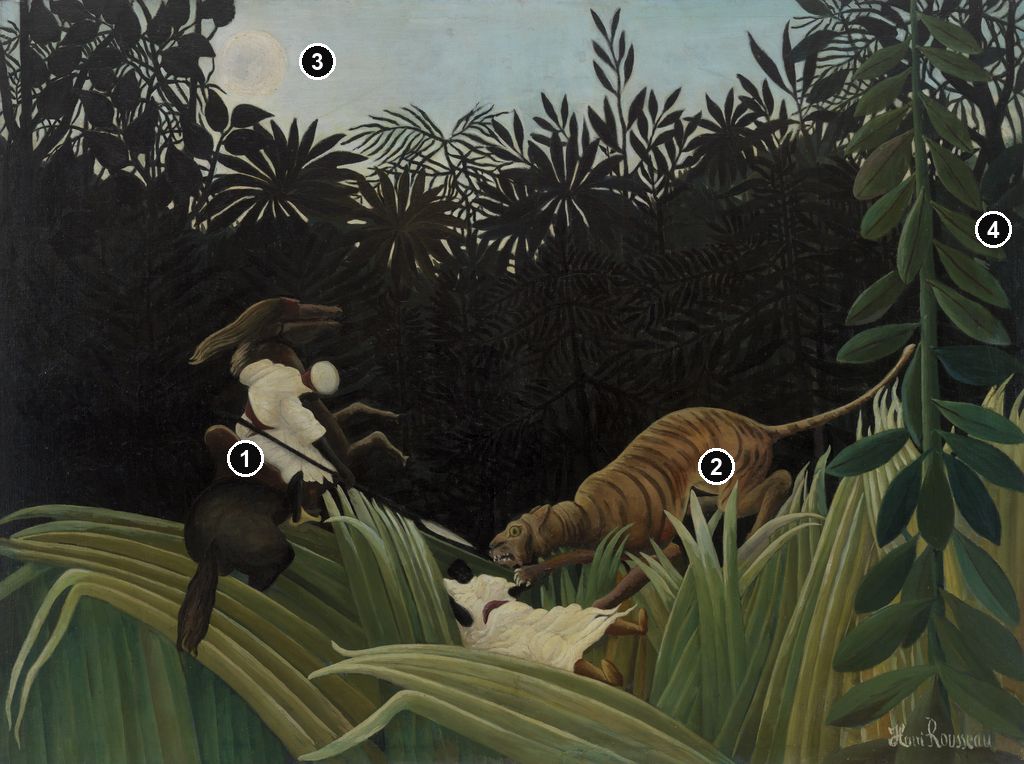
A dark horse rises above a bank of leaves while a tiger drives its head towards a fallen man. Between them, white clothing catches the eye with startling force. Henri Rousseau’s Scouts Attacked by a Tiger compresses its action into a narrow opening in a forest whose huge plants seem capable of swallowing the entire encounter. Painted in 1904, the oil on canvas measures 121.6 × 161.9 cm and belongs to the Barnes Foundation in Philadelphia, where its accession number is BF584.[1]
The struggle occupies the lower half of the picture beneath a dense wall of dark foliage, broken by thin glimpses of sky. Rousseau makes the incident immediately legible, then complicates our view of it: a leaf hides part of a body, another crosses the horse, and the tiger’s paws disappear into the same green tangle that frames its victim. Looking becomes a movement between recognition and obstruction.
At a Glance
- ArtistHenri Rousseau
- SubjectScouts Attacked by a Tiger
- ExploreA struggle in a crowded clearing; The horse’s unstable height
This work across Henri Rousseau’s career
Carnival Evening
1886 [2]The Merry Jesters
1906 [7]The Snake Charmer
1907 [8]Contents
- A struggle in a crowded clearing
- The horse’s unstable height
- The tiger’s lowered head
- Leaves that bend the view
- A dark wall beneath a pale sky
- The hanging stem on the right
- An imagined encounter before a public audience
- The painting’s material history
- Annotated details
A struggle in a crowded clearing
The composition divides around two opposing animals. On the left, the horse lifts its head and bends its forelegs in the air. On the right, the tiger lowers its head and extends its long body towards the centre. The horse’s upward movement meets the tiger’s downward thrust across the intervening white figure. Each animal gives the encounter a different direction, so the scene seems pulled apart even as the vegetation presses it together.
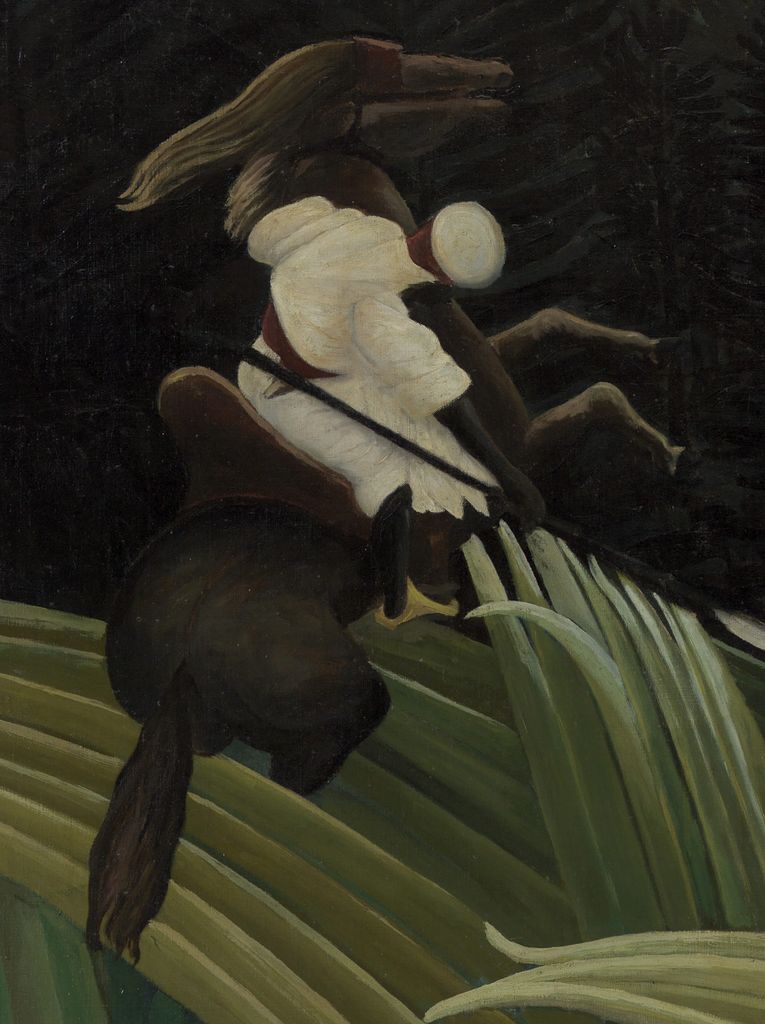
The mounted figure leans into this precarious arrangement. His pale clothes stand out against the horse and the blackish green behind him; the small light head covering helps locate a human presence within the larger animal silhouette. A long, dark diagonal passes across his clothing towards the central struggle. Its narrow straightness interrupts the soft folds and rounded limbs, adding another line along which the eye travels downwards.
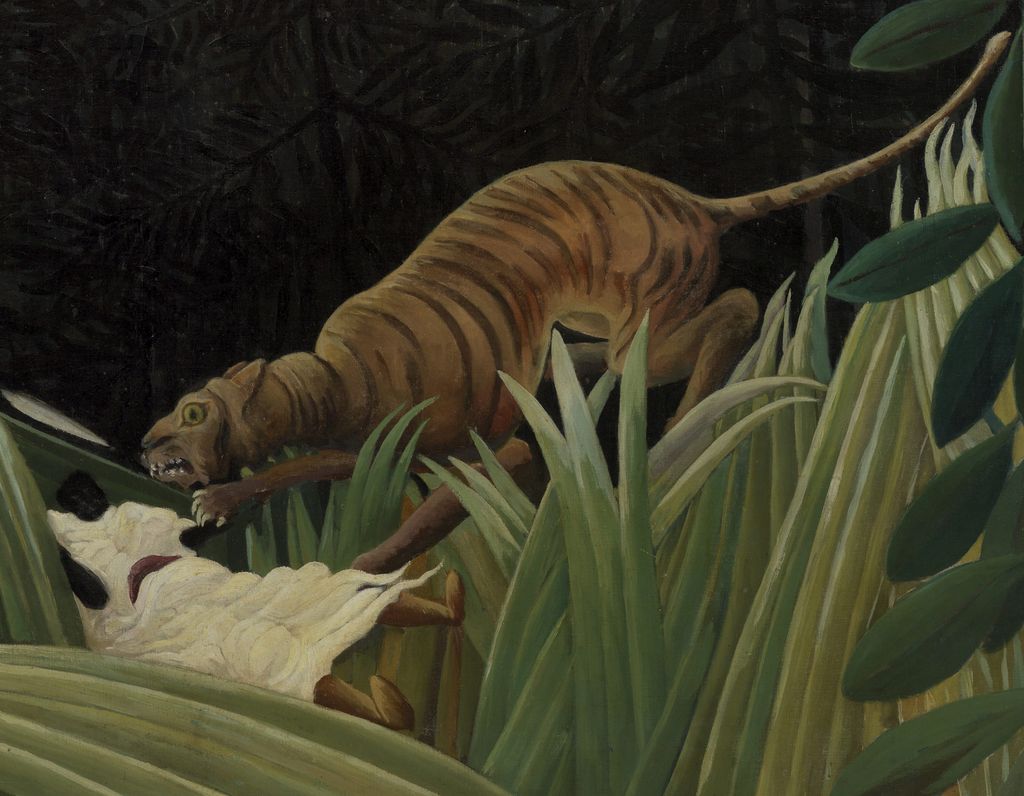
Below, the second figure lies diagonally among the plants. His white clothing forms a broken, irregular patch, with dark skin and a small red accent interrupting its brightness. An arm reaches into the space beside the tiger’s head, while a slender pale blade cuts across the surrounding greens. The closeness of hand, weapon and animal makes this the most anxious passage of the painting. We can identify an attack without being given a clear account of what happened immediately before it or what will happen next.
There is remarkably little empty ground. The bodies have no broad platform on which to perform their struggle. Instead, they enter and leave view through overlapping leaves. We look into a sudden disturbance through vegetation, unable to see every movement that would explain it.
The horse’s unstable height
The horse provides the picture’s strongest upward shape. Its neck and head rise into the dark middle zone, carrying a sweep of pale brown mane that streams towards the left. Below, its dark body is partly absorbed into the background. We read its posture through selected edges: the projecting head, the curved forelegs, the rounded haunch and the long hanging tail.
Those edges create an uneven rhythm. The lifted forelegs seem almost suspended, while the tail drops towards the lower edge with the weight of a pendulum. The mane travels sideways. Together these directions prevent the horse from becoming a simple upright column. Its body contains a series of competing pulls, appropriate to an animal caught in a moment of alarm.
The rider’s light costume makes the horse appear darker and more solid. At the same time, the rider is small enough to seem vulnerable against its neck and shoulders. His pale sleeve and bent body form a compact cluster near the top of the animal, separated from the fallen figure by an abrupt change of height. The distance between the two people is therefore felt vertically as well as across the canvas.
Much of the horse’s lower body is concealed. Rousseau lets a foreground leaf pass across it without opening a clear space around the legs. The overlap anchors the animal inside the thicket while making its rearing posture harder to settle into a stable arrangement of weight and ground. The visible fragments have to carry the whole impression of a body thrown upwards.
 in Detail Henri Rousseau.jpg)
Scouts Attacked by a Tiger — Henri Rousseau.
The tiger’s lowered head
The tiger’s body is easier to follow horizontally. Its orange and brown back emerges from the right, curves over the shoulders and descends towards the head. Dark stripes repeat across that curve, making the rounded body readable against the much flatter darkness behind it. The stripes also slow the eye: we register the animal as a series of marks before following its movement towards the fallen man.
At the head, the scale of the details changes. A small pale eye and the bright points of the teeth concentrate attention into a tight area. The mouth lies close to the human body and the extended arm. The surrounding leaves are vastly larger than those teeth, yet the teeth command a disproportionate amount of attention because the action depends on them.
The long tail lifts towards the right and narrows into the vegetation. Its upward curve echoes the bends of the broad foreground leaves. The tiger’s body belongs to the decorative rhythms of the forest while its head remains the focus of violence. Even the animal’s threatening movement is woven into a larger pattern of arcs and tapering points.
Rousseau gives the horse and tiger different kinds of visibility. The horse is a dark mass relieved by mane and rider; the tiger announces itself through warm colour and repeated stripes. Their encounter is therefore also a meeting of two visual languages, one largely dependent on silhouette and the other on internal marking. The white clothing between them makes that difference especially clear.
Leaves that bend the view
The largest leaves occupy the foreground, close to the viewer. Broad, pale green blades rise, bend and fall across the lower edge. Some carry long parallel lines that follow their curvature, so each blade seems both a flat strip and a surface turning through space. These veins make the curves emphatic: the eye follows them along a path that can end near the fallen figure or sweep away towards a corner.
Several leaves bend sharply enough to resemble folded ribbons. Their forms are distinct from the finer, feathered foliage above. This change in scale creates the sense of looking past a near barrier into a more distant thicket. Yet the barrier never becomes transparent. The foreground plants keep substantial parts of the figures hidden, reminding us how little clear space the struggle occupies.
The fallen man’s pale clothes sit within a cradle of green. A large blade crosses below him, while narrower upright leaves separate his body from the tiger. The enclosure can feel protective for a moment, until the animal’s head shows how thoroughly that apparent shelter has been penetrated. The plants offer concealment without establishing safety.
Near the bottom edge, the leaf curves continue beyond the limits of the canvas. Their cut-off ends suggest that the thicket extends into the space from which we are looking. There is no comfortable gap between spectator and foreground vegetation. We seem close enough to inspect the veins of a leaf while still being unable to grasp the whole human encounter behind it.
This combination of precision and obstruction is central to the picture’s effect. Rousseau supplies abundant information about surfaces, but withholds an easy route through them. The leaves remain individually clear while the space they occupy becomes difficult to measure.
A dark wall beneath a pale sky
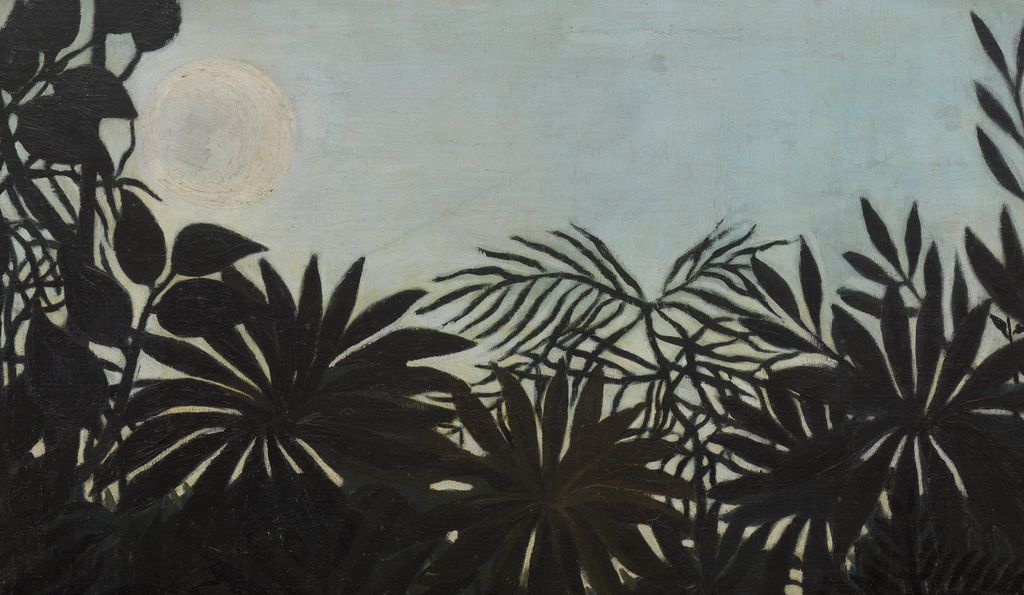
The upper foliage is built differently. Dark fronds and pointed leaves overlap in a dense screen, with their outermost tips cut sharply against the pale grey-blue sky. Some shapes spread like fans; others rise in narrow clusters. Between them, the sky appears in small, irregular openings whose contours can be followed as carefully as the leaves themselves.
A pale round disc hangs towards the upper left, partly enclosed by vegetation. Its simple shape and soft colour feel remote from the crowded action below. The disc offers a place for the eye to rest, although the branches around it keep that rest brief. Across the upper edge, the plant silhouettes continually break up the sky’s otherwise quiet surface.
The painting balances a low, concentrated incident against a high, cool, widely spread sky. The forest between them acts as a broad dark interval. Our eye must cross this interval to move from the struggle to the disc, and the distance makes the two areas feel emotionally separate.
The sky does not open into a visible horizon. There are no far hills or diminishing trees to carry the eye gently away. Instead, the foliage stands against it like an irregular screen. This arrangement strengthens the impression that the figures are enclosed within a shallow pocket of space, even though the slivers of sky suggest a world beyond the plants.
The hanging stem on the right
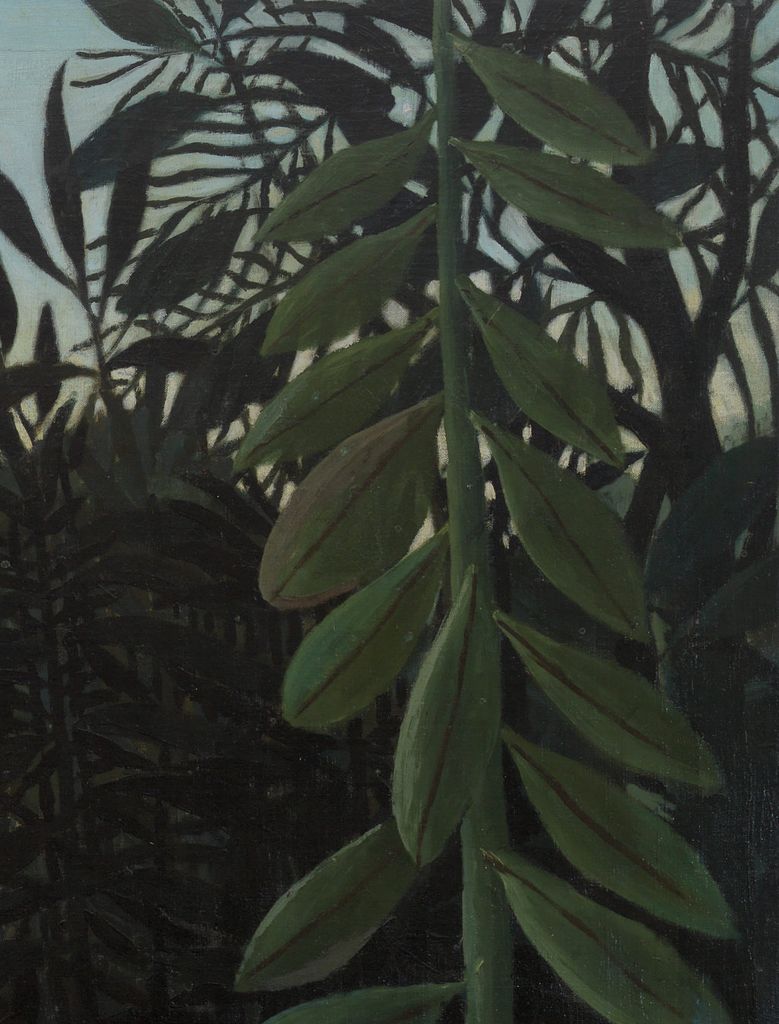
A long descending stem along the right edge provides a distinct counterweight to the horse. Paired, pointed leaves project from it at intervals, their surfaces broad enough to catch separate shifts of green. Unlike the restless curves across the foreground, this plant establishes a nearly continuous vertical line from the upper edge towards the ground.
Its leaves overlap the tiger’s territory. The raised tail approaches the stem, and the animal’s hindquarters sit partly behind the adjoining growth. The right edge thus becomes a place where the tiger both enters the scene and begins to disappear into vegetation. We can follow its attack more readily than we can establish the space from which it has come.
The hanging plant also prevents the warm-coloured body from carrying our eye straight out of the picture. Its darker shapes interrupt that movement and turn attention back towards the head and the white figure. On the opposite side, the horse’s neck performs a comparable enclosing role. The main action is held between two tall forms with very different textures.
Between these borders, the central gap feels temporary and fragile. The clearing exists because a few shapes have separated just enough to expose the struggle. Around it, the vegetation retains its almost continuous surface. Rousseau’s management of outline and overlap can be explored further through his style and technique; here, those devices determine how much of the danger we can see.
Annotated Details from Scouts Attacked by a Tiger
The numbered points identify visible features discussed in this article. Return from each detail to the whole composition. Henri Rousseau, Scouts Attacked by a Tiger, 1904. Barnes Foundation, Philadelphia, BF584. This museum-derived reproduction was published on Wikimedia Commons in 2018, before the documented 2023–24 conservation treatment. Image source. Public domain. Numbers added to the overview; details cropped from the historical published original. No recolouring or retouching.
Details from SCOUTS ATTACKED BY A TIGER
Compare the horse’s upward movement with the tiger’s lowered head, then follow the pale sky openings and the hanging leaves along the right edge.
The rearing horse and its rider
The horse rises while its pale mane streams sideways. The rider’s white clothing stands out against the dark body, and the long hanging tail carries the eye down through the broad foreground leaves.
The tiger beside the fallen figure
The striped back bends towards the lowered head beside the white-clad figure. The raised tail moves in the opposite direction, while pointed leaves interrupt the bodies and keep the outcome of the encounter unresolved.
A pale disc within the upper foliage
The round pale shape occupies a small opening in the sky. Broad dark leaves and finely divided fronds make contrasting edges around this quiet passage above the crowded struggle.
Pointed leaves along the right edge
A descending stem carries broad, pointed leaves against a much finer network of dark foliage. Their repeated intervals make the upper right edge distinct from the irregular openings around the sky.
An imagined encounter before a public audience
The Barnes lists the painting in the 1904 Salon des Indépendants and records subsequent exhibitions including Bernheim-Jeune in 1912 and Paul Rosenberg in 1923. Its museum commentary connects Rousseau’s jungle imagery with his study of plants and taxidermy in Paris’s natural-history museums. The Barnes also interprets these theatrical scenes of distant, violent territories in relation to colonial-era Parisian audiences.[1]
That curatorial perspective gives another dimension to the scene’s visual drama. The white-clad figures are conspicuous intrusions into the dense greens. Their small heads and exposed gestures make human control seem precarious beside the animals and the enormous leaves. The painting gives a viewer an intimate view of danger while keeping the place itself difficult to navigate.
The title identifies scouts, but the visible encounter leaves many narrative particulars open. Clothing, weapons and gestures establish human involvement in the attack without supplying the story of a named expedition. The uncertainty helps the composition hold its instant of suspense. Every return to the picture begins with the same unresolved meeting of lifted horse, lowered tiger and partially concealed body.
The painting’s material history
The Barnes’s 2023–24 annual report names Scouts Attacked by a Tiger among works examined using high-resolution XRF scanning and X-radiography. It also records a treatment begun in August 2023: conservators consolidated unstable paint and removed discoloured or mismatched retouching and discoloured, uneven varnish. Treatment finished in January 2024, when the canvas was reinstalled in the Collection Gallery.[12]
These interventions concern a picture whose impact depends on distinctions within darkness. The horse, the fine foliage and the deeper spaces between leaves occupy closely related tones, while the pale clothing and foreground blades carry much of the light. Even in a reproduction, looking carefully at those boundaries changes the experience of the scene. The apparently continuous black forest gradually resolves into overlapping fronds, separate edges and narrow openings.
The attack remains the point of entry, but the surrounding plants determine its duration. Their curves draw us away from the figures and return us along a different route. The horse strains upwards, the tiger reaches down, and the great leaves continue their slow bends around both. That difference between bodily crisis and the forest’s repeated forms gives this crowded encounter its enduring stillness.
Henri Rousseau artworks directory
This directory brings together works covered on this site and other works documented in the cited museum records and catalogues. Alternate titles share one entry; distinct versions remain separate. Historical dates for works without an article follow the cited catalogues. This is not a catalogue raisonné.
Frequently Asked Questions
The Barnes Foundation dates it to 1904. It is in the foundation’s Philadelphia collection.[1]
A rearing dark horse carries a white-clad figure on the left. A second figure lies amid large leaves below, close to the lowered head of a striped tiger approaching from the right.
It holds the encounter at a moment of immediate danger. The obscured bodies and restricted clearing leave the outcome unresolved.
Discussion
Look again at the images and ideas explored in Scouts Attacked by a Tiger. These editorial prompts invite your observations.
Reader Insights
How does the encounter change when you follow the leaf curves before looking at the figures?
Which creates greater tension for you: the horse’s upward movement or the tiger’s lowered head?
What does the pale disc add to your experience of the crowded scene below it?
Join the Conversation
Share a detail, comparison or question about Scouts Attacked by a Tiger below.
References
- Barnes Foundation. Scouts Attacked by a Tiger (Éclaireurs attaqués par un tigre), BF584, current collection record, metadata, commentary and exhibition history; accessed 23 October 2026. View source.
- Philadelphia Museum of Art, Carnival Evening,1963-181-64,object59593. View source.
- Musée de l’Orangerie / Juliette Degennes, Henri Rousseau,L’ambition de la peinture: Un artiste dans son époque (in French). View source.
- National Gallery, Surprised!, NG6421. View source.
- Musée d’Orsay, La Guerre,RF19461 (in French). View source.
- MoMA, The Sleeping Gypsy. View source.
- Philadelphia Museum of Art, The Merry Jesters, 1950-134-176, object51097. View source.
- Musée d’Orsay, La Charmeuse de serpents, RF 1937 7 (in French). View source.
- Musée de l’Orangerie, La Carriole du Père Junier, RF 1960 26 (in French). View source.
- Solomon R. Guggenheim Museum / Cornelia Lauf, The Football Players,60.1583: current collection record. View source.
- MoMA, The Dream, 252.1954. View source.
- Barnes Foundation. Annual Report 2023–24, “Conservation,” printed pp. 29–31, PDF pp. 16–17. View source.
- The Museum of Modern Art, Henri Rousseau: Essays (1985), selected catalogue entries, chronology and notes on early devotees. View source. Selected entries, chronology (pp.91–95) and early-devotee notes (pp.262–264) were consulted. Historical collection credits do not establish present ownership.
- Daniel Catton Rich, Henri Rousseau (The Museum of Modern Art, 1942), selected drawings and landscape studies; historical catalogue. View source. The dated 1942 publication is used for the two Quai d’Auteuil ink views; its Malakoff date differs from the 1985 catalogue.
- MANAS, Laval, Henri Rousseau, dit le Douanier, urban landscapes and preparatory study (in French). View source.
- National Gallery of Art, Self-Portrait (1895), pen-and-ink drawing, accession 1995.47.66. View source.
- The Museum of Modern Art, War (published January 1895), lithograph, accession 684.1943. View source.
- Barnes Foundation, Landscape and Four Young Girls, object 5521, BF855. View source.


 Henri Rousseau.jpg)


 Henri Rousseau.jpg)