



 by Tom Gurney
Tom Gurney BSc (Hons) is an art history expert with over 20 years experience
Published on June 19, 2020 / Updated on October 29, 2026
Email: tomgurney1@gmail.com / Phone: +44 7429 011000
The Repast of the Lion: Introduction
A lion feeds at the bottom of Henri Rousseau’s The Repast of the Lion, almost swallowed by the vegetation around it. Enormous flowers hang above its mane; broad, pointed leaves cross in front of its body. The animal looks towards us with its mouth against a spotted victim, while a pale disc appears through the trees. The scene offers a clear view of violence and very little room in which to approach it.
Painted around 1907, this oil on canvas belongs to the Metropolitan Museum of Art in New York. Its substantial size—113.7 by 160 centimetres—gives the forest room to spread, yet Rousseau keeps the animals close to the lower edge. The flowers and foliage command much of the surface, making the discovery of the lion feel strangely intimate within an expansive picture.[1]
At a Glance
- ArtistHenri Rousseau
- DateAbout 1907
- MediumOil on canvas
- Dimensions113.7 × 160 cm
- CollectionMetropolitan Museum of Art, New York
- Accession51.112.5
- AcquisitionBequest of Sam A. Lewisohn, 1951[1]
This work across Henri Rousseau’s career
Carnival Evening
1886 [2]The Merry Jesters
1906 [7]The Snake Charmer
1907 [8]Contents
- The lion behind the leaves
- Flowers on the scale of trees
- A pale disc and uncertain light
- An imagined forest made from Parisian sources
- A probable Salon appearance and a secure museum home
- Two other jungle encounters
- Annotated details
The lion behind the leaves
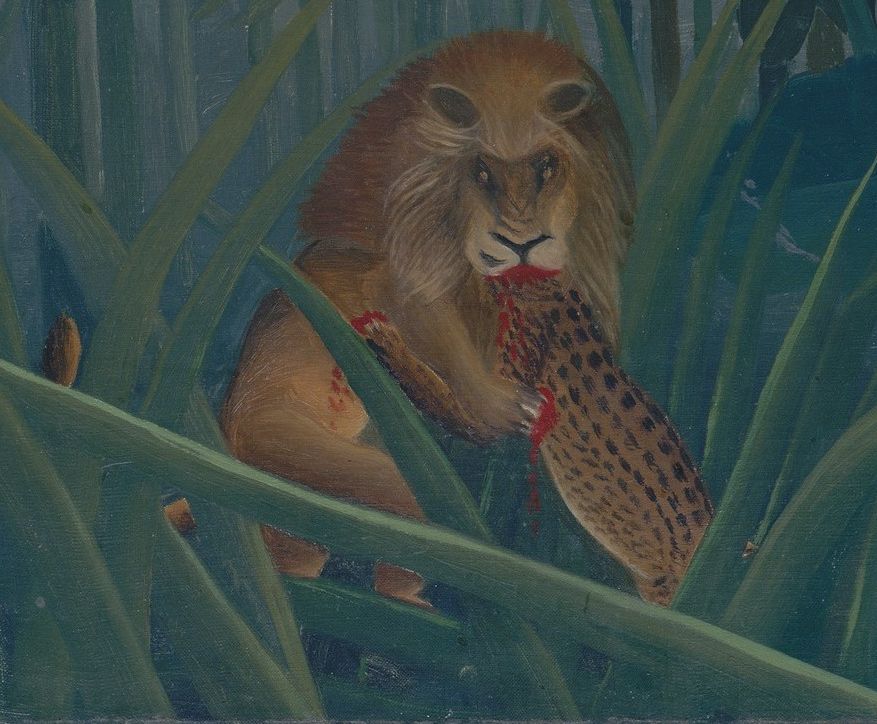
The lion occupies a narrow opening near the centre of the foreground. Its ochre body and brown mane stand out against the surrounding greens, but much of its chest and limbs remains hidden. Long leaves sweep across the space in which we would expect to see the animal’s weight settle on the ground. We meet its face before we can understand its posture.
That face gives the scene its unsettling directness. The eyes appear to address the viewer, even as the mouth remains engaged with the prey. A little red around the contact point makes the act legible. The spotted body descends diagonally from the lion’s jaws, adding a smaller, busier pattern to the great smooth leaves. Much of the victim is obscured; the painting gives us enough information to recognise feeding without making the encounter easy to disentangle.
The prey’s species need not be settled for the scene to work. Spots are visible, but the partly concealed body supplies no secure basis for a precise identification. Looking closely at what Rousseau actually shows preserves the peculiar imbalance of the encounter: the lion’s recognisable head confronts us, while the other animal becomes a fragment caught within the foliage.
The vegetation also controls our position. The closest leaves rise from beyond the lower edge and overlap one another like a barrier. There is no clear stretch of bare earth leading towards the animals. Our eyes can pass through the opening, but an imagined body could scarcely follow. The lion seems both near enough to face and protected by an enclosure we cannot enter.
Michel Hoog’s discussion in the 1985 Rousseau catalogue gives the animals a crucial place in the composition. Although the enormous plants dominate, he argues that the beasts’ colouring, low position and contrasting light make them essential to the picture’s structure. Following that observation, try covering the lion with a hand: the forest loses the warm point towards which its lower leaves converge.[12]
Flowers on the scale of trees
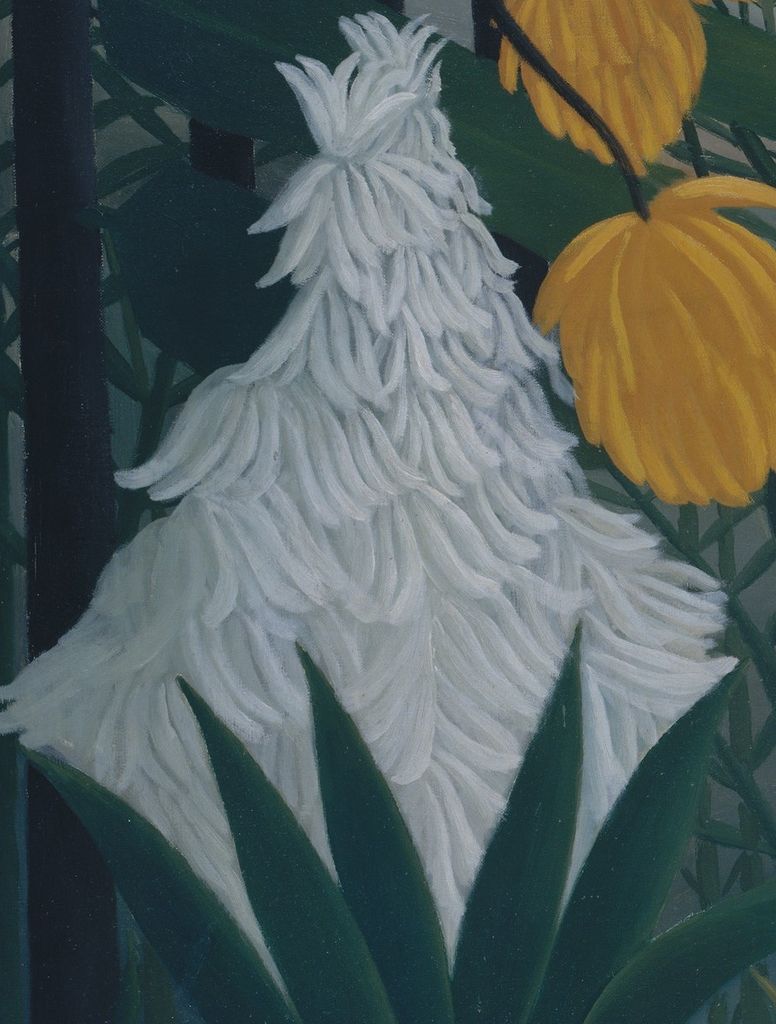
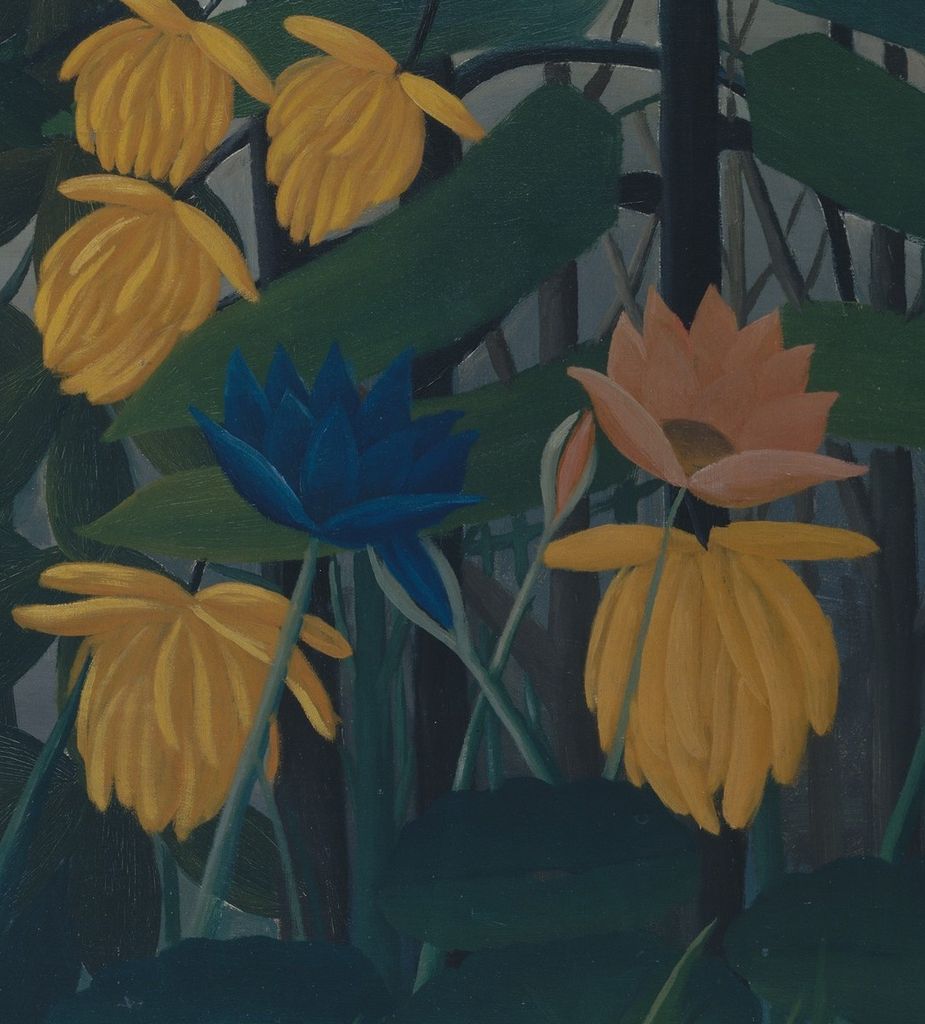
The great white flower on the left is the lion’s most striking rival for attention. Its overlapping, drooping parts build a pale cascade above a crown of pointed leaves. Yellow and orange blooms hang nearby and answer a larger cluster on the right. Two deep blue flowers punctuate the middle distance; farther right, a faded pink bloom opens above a yellow one. These separate colour accents help the eye travel across a scene that could otherwise become an unbroken wall of green.
Scale changes the relationship between these forms. A flower can seem more imposing than the lion’s head, while the broad foreground fronds suggest a shelter large enough to conceal the whole animal. We cannot reliably measure one thing by another. This uncertainty makes the forest feel expansive even though the front of the picture remains tightly closed.
Hoog emphasises the fanciful combination and exaggerated proportions of the vegetation. He sees the flowers as especially large fields of colour within Rousseau’s jungle repertoire. His account also cites the earlier Metropolitan Museum catalogue by Charles Sterling and Margaretta Salinger, whose comparison with tapestry draws attention to the crisply defined stems and motionless leaves. The analogy helps explain how the scene can remain so orderly while containing an act of killing.[12]
Look away from the flowers and the ordering becomes easier to see. Dark, upright stems at the outer sides hold the composition together. Narrower stems and pointed leaves crowd the opening towards the centre. Broad leaves stretch across these verticals, sometimes hiding them and sometimes revealing a short section before crossing them again. The forest has rhythms a viewer can follow even when its individual plants resist identification.
The two sides balance without matching. The white flower anchors the left, whereas the right gathers several smaller, more varied blossoms. A dense plant with rounded, dark leaves rises just right of centre and divides the lighter sky into irregular pieces. This shift from open, slender growth to compact masses prevents the symmetry of the surrounding trunks from becoming rigid. Each return to the picture reveals another overlap, another interruption in a stem, another small opening behind a leaf.
Annotated Details from The Repast of the Lion
The numbered points identify visible features discussed in this article. Return from each detail to the whole composition. Henri Rousseau, The Repast of the Lion, c. 1907. The Metropolitan Museum of Art, New York, 51.112.5. Bequest of Sam A. Lewisohn, 1951. Image source. CC0 / Public domain. Numbers added to the overview; detail views cropped from the original. No recolouring or retouching.
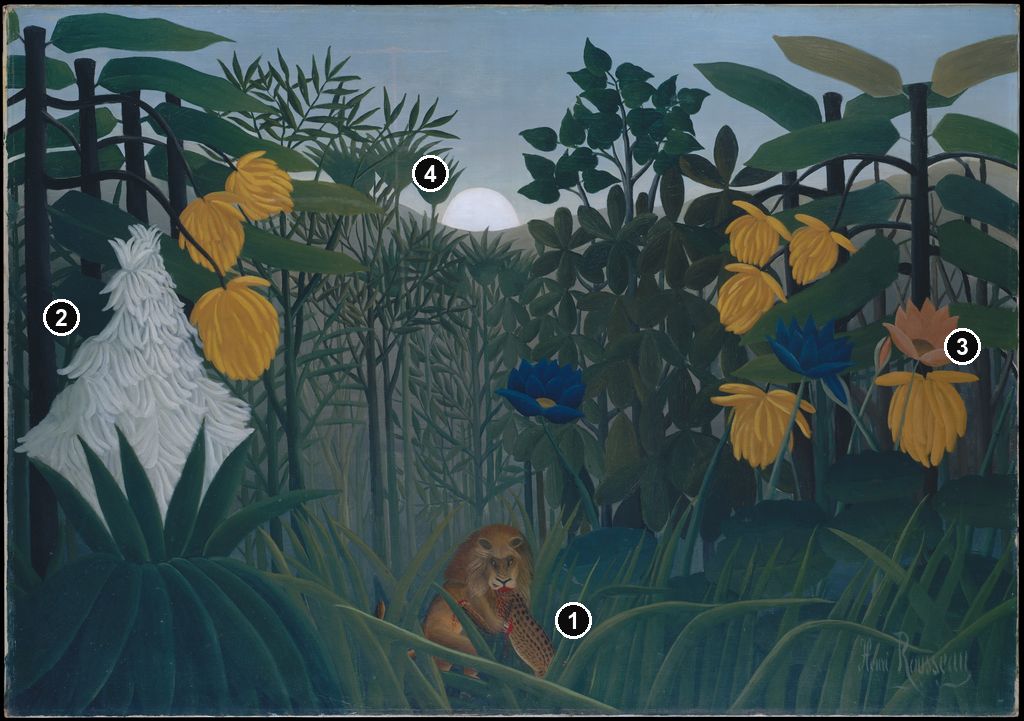
Details from THE REPAST OF THE LION
Compare the small feeding lion with the enormous flowers and the pale opening that gives the forest a more distant space.
The lion and the spotted prey
The lion looks forward while its mouth meets a partly hidden spotted body. Long leaves cross the animals, so the feeding remains visible without revealing either complete form.
A cascade of white petals
Pale pointed forms overlap down the left side of the forest. Their repeated curves make a large, bright shape against the dark upright stems and broad green leaves.
Blue and pink among hanging flowers
Pointed blue petals open beside a quieter pink flower. Yellow hanging forms above and below give these smaller blooms a surrounding rhythm of curved, drooping shapes.
The pale disc behind fine stems
A pale rounded form appears above the distant ridge. Slender stems and narrow leaves cross the lighter opening nearby, separating the distant space from the broad foreground growth.
A pale disc and uncertain light
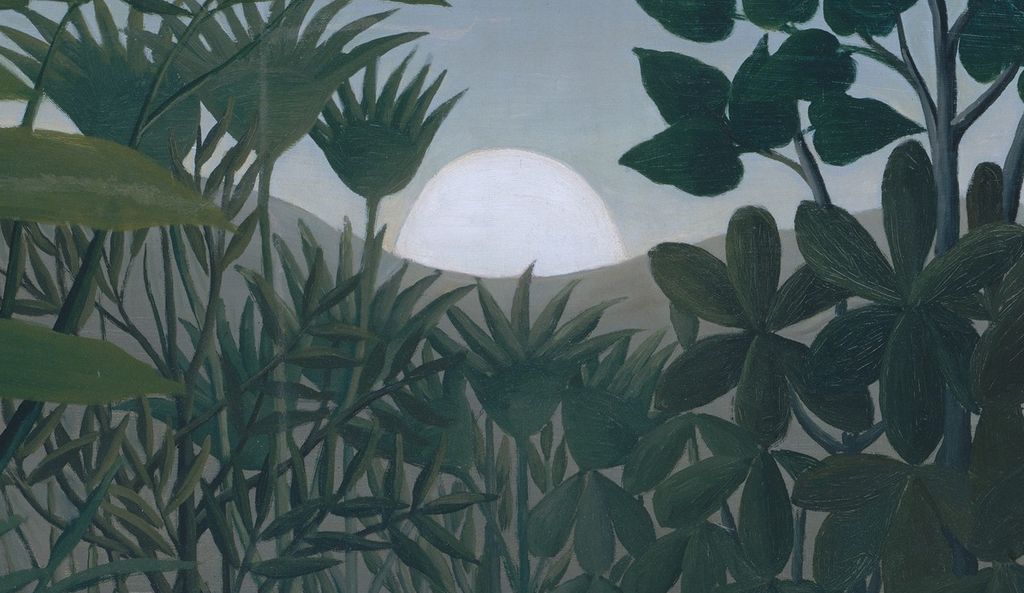
Above the lion, a whitish half-disc sits low against a distant grey-green ridge. The sky surrounding it is cool and relatively clear. Hoog asks whether this is the sun or the moon, leaving a question that the painting itself does little to resolve.[12] Its pallor can suggest moonlight, but the distinct flowers and strongly separated leaves do not demand a night scene. Keeping the light uncertain allows the image to retain its suspended atmosphere.
The pale disc also supplies a distant counterpart to the white flower. One is a simple rounded shape partly concealed by the horizon; the other is an elaborate vertical form built from many overlapping parts. Between them, fine stems appear in cooler, greyer greens. These slender forms suggest recession, giving the forest a depth that the giant foreground leaves repeatedly close off.
Rousseau places most of the warmth in the flowers and animals. The small red marks near the lion’s mouth are consequently more arresting than their size would suggest. The faded pink flower provides another restrained note within the cool setting. Neither colour turns the forest into a scene of general agitation. Leaves remain sharply outlined, blooms continue to hang, and the lion’s feeding proceeds within an extraordinary stillness.
An imagined forest made from Parisian sources
The Metropolitan Museum connects Rousseau’s jungle vegetation with studies in Paris’s botanical gardens and his wild animals with popular ethnographic journals and illustrated children’s books.[1] Such sources help explain the combination of close attention and improbable scale. The leaves have memorable shapes, and the flowers are carefully differentiated, while the whole assembly follows the demands of a painting rather than the growth of an identifiable forest.
The Musée de l’Orangerie’s 2026 exhibition account places this practice within a wider Parisian culture of exotic imagery. It describes Rousseau’s visits to the natural-history museum’s galleries and the Jardin des Plantes glasshouses, alongside the press and imagery circulated through the international exhibitions of French colonial power. It also rejects the familiar story that his jungles came from military travel in Mexico.[13] The setting of The Repast of the Lion therefore belongs to a repertoire assembled through observation, displayed specimens and printed pictures.
These sources help us understand the forest’s assembly without supplying a botanical key to every painted leaf. What holds our attention is the way separate forms have been brought together: the plants preserve their distinctive outlines while participating in larger patterns of height, colour and concealment. The wildness comes partly from their abundance, and partly from the impossibility of fitting them into familiar proportions.
Hoog also proposes a possible sequence of work. Reading the visible surface, he suggests that Rousseau began with dark green trunks, filled the intervals with a greyer green, then added flowers and leaves; he identifies apparent reworking on the right. This is his visual reconstruction of the painting’s making.[12] It encourages us to notice the forest as a succession of overlapping decisions: a stem establishes a division, a leaf covers part of it, and a flower brings light to the resulting dark mass.
A probable Salon appearance and a secure museum home
The Met dates the painting to about 1907 and states that it was probably exhibited at that year’s Salon d’Automne. Both qualifications matter: the approximate date and the probable exhibition history leave room for uncertainty. They nevertheless place the picture within Rousseau’s later development of the jungle theme. The 1985 catalogue separately records its appearance in a Paris exhibition of 1911, as number 21.[1][12]
At more than a metre high, the painting offers a forest large enough to confront the viewer with great individual leaves. The feeding lion remains a relatively small discovery within that broad field. Seen from a distance, the flowers organise the surface; nearer to it, the creature’s direct gaze becomes harder to avoid.
The painting entered the Metropolitan Museum through Sam A. Lewisohn’s bequest in 1951.[1] That firmly documented arrival gives the work a clear place in an American public collection. Its identity rests in this particular arrangement of cool foliage, pale light, immense flowers and a low, half-concealed predator—features that distinguish it from Rousseau’s other scenes of animal combat.
Two other jungle encounters
The closest comparison is The Hungry Lion Throws Itself on the Antelope, in the Fondation Beyeler collection at Riehen/Basel. The institution dates that much larger canvas 1898/1905 and gives its dimensions as 200 by 301 centimetres.[14] Its central victim is stretched horizontally across the scene, watched by other creatures amid a wider spread of foliage. A red sun burns above the encounter.
In The Repast of the Lion, the visible action has contracted. The lion’s face is turned towards us, its victim drops from the jaws, and the great flowers occupy the spaces that might otherwise contain watching animals. The pale disc supplies a cooler focus above. Comparing the pictures makes clear how much Rousseau can change the emotional pressure of a jungle through placement alone: an extended spectacle becomes an obstructed, concentrated encounter.
Earlier still, Surprised!, painted in 1891 and now in London’s National Gallery, shows a tiger caught among leaves under driving rain.[4] Its diagonal weather gives the vegetation a sense of movement. Here, upright stems and hanging flowers hold their positions around the lion. The violence has become local, almost enclosed, while the surrounding forest maintains its absorbing composure.
Henri Rousseau artworks directory
This directory brings together works covered on this site and other works documented in the cited museum records and catalogues. Alternate titles share one entry; distinct versions remain separate. Historical dates for works without an article follow the cited catalogues. This is not a catalogue raisonné.
Frequently Asked Questions
The Metropolitan Museum dates it to about 1907. The museum also says it was probably shown at the Salon d’Automne that year; the exhibition is not certain.[1]
It may be. Hoog explicitly leaves open whether Rousseau painted the sun or moon, and the scene does not establish an exact time of day.[12]
It belongs to the Metropolitan Museum of Art, New York, accession 51.112.5, acquired through Sam A. Lewisohn’s bequest in 1951.[1]
Discussion
Look again at the images and ideas explored in The Repast of the Lion. These editorial prompts invite your observations.
Reader Insights
What do you notice first: the white flower, the pale disc or the lion’s face? How does your route through the painting change on a second look?
How would the scene feel if the foreground leaves revealed the lion’s whole body?
Compare this painting with The Hungry Lion. What changes when other watching animals are removed from a feeding scene?
Join the Conversation
Share a detail, comparison or question about The Repast of the Lion below.
References
- Metropolitan Museum of Art. The Repast of the Lion, accession 51.112.5, current object record and curatorial commentary, accessed 23 October 2026; accompanying collection image. View source.
- Philadelphia Museum of Art, Carnival Evening,1963-181-64,object59593. View source.
- Musée de l’Orangerie / Juliette Degennes, Henri Rousseau,L’ambition de la peinture: Un artiste dans son époque (in French). View source.
- National Gallery, London. Surprised!, NG6421, current collection record, description and key facts, accessed 23 October 2026. View source.
- Musée d’Orsay, La Guerre,RF19461 (in French). View source.
- MoMA, The Sleeping Gypsy. View source.
- Philadelphia Museum of Art, The Merry Jesters, 1950-134-176, object51097. View source.
- Musée d’Orsay, La Charmeuse de serpents, RF 1937 7 (in French). View source.
- Musée de l’Orangerie, La Carriole du Père Junier, RF 1960 26 (in French). View source.
- Solomon R. Guggenheim Museum / Cornelia Lauf, The Football Players,60.1583: current collection record. View source.
- MoMA, The Dream, 252.1954. View source.
- Michel Hoog. Catalogue entry 49, “The Repast of the Lion,” in Henri Rousseau, Museum of Modern Art, 1985, printed p. 210, PDF p. 215. Includes discussion of Charles Sterling and Margaretta Salinger’s 1967 catalogue, p. 167. View source.
- Musée de l’Orangerie. Henri Rousseau, l’ambition de la peinture, exhibition texts, 25 March–20 July 2026, section “Un style à soi,” accessed 23 October 2026. View source. (in French).
- Fondation Beyeler. The Lion Is Hungry…, media release, 9 October 2020, pp. 2–3, object identification and dimensions. View source.
- The Museum of Modern Art, Henri Rousseau: Essays (1985), selected catalogue entries, chronology and notes on early devotees. View source. Selected entries, chronology (pp.91–95) and early-devotee notes (pp.262–264) were consulted. Historical collection credits do not establish present ownership.
- Daniel Catton Rich, Henri Rousseau (The Museum of Modern Art, 1942), selected drawings and landscape studies; historical catalogue. View source. The dated 1942 publication is used for the two Quai d’Auteuil ink views; its Malakoff date differs from the 1985 catalogue.
- MANAS, Laval, Henri Rousseau, dit le Douanier, urban landscapes and preparatory study (in French). View source.
- National Gallery of Art, Self-Portrait (1895), pen-and-ink drawing, accession 1995.47.66. View source.
- The Museum of Modern Art, War (published January 1895), lithograph, accession 684.1943. View source.
- Barnes Foundation, Landscape and Four Young Girls, object 5521, BF855. View source.


 Henri Rousseau.jpg)


 Henri Rousseau.jpg)