



 by Tom Gurney
Tom Gurney BSc (Hons) is an art history expert with over 20 years experience
Published on June 19, 2020 / Updated on October 29, 2026
Email: tomgurney1@gmail.com / Phone: +44 7429 011000
Rendez-Vous in the Forest: Introduction
Two riders lean together in a forest that almost swallows them. Their embrace occupies a small patch of Henri Rousseau’s Rendez-Vous in the Forest, while dark trunks and interlacing branches spread across the whole canvas. Finding the couple changes the experience of looking: what first appears to be a thicket becomes a place of intimacy. Painted in 1889, this oil on canvas measures 92 × 73 cm and belongs to the National Gallery of Art in Washington.[1]
At a Glance
- ArtistHenri Rousseau
- SubjectRendez-Vous in the Forest
- ExploreFinding the rendezvous; The architecture of the trees
This work across Henri Rousseau’s career
Carnival Evening
1886 [2]The Merry Jesters
1906 [7]The Snake Charmer
1907 [8]Contents
- Finding the rendezvous
- The architecture of the trees
- A forest built from leaves
- The riders and their interrupted silhouettes
- Light above and behind the thicket
- Period costume and an open-ended story
- From a Paris gift to Washington
- Annotated details
Finding the rendezvous
The lovers sit below and to the left of the centre, a surprising position for the apparent subject of a painting. There is no broad clearing around them and no foreground path leading directly to their horses. The eye must pick its way through upright stems, leaf clusters and darker stretches of vegetation. A flash of red, the pale curve of a face and the gold decoration on a jacket gradually resolve into people.
Rousseau gives this search an uneven pace. The immense dark tree on the right is immediately legible, with a trunk that divides into strongly outlined branches. The riders need a second, closer look. Once recognised, their faces become difficult to overlook, despite the many competing marks around them. The scene can therefore hold two quite different scales of attention: the sweep of the woodland and the small movement of one person towards another.
Their position also puts the viewer outside the encounter. We look through vegetation rather than sharing an unobstructed space with the riders. That makes their meeting feel private, although privacy in the composition cannot establish that the couple are concealing an affair. The painting supplies an embrace; the circumstances remain open. Its title offers just enough of a story to draw us towards the figures without explaining their journey or telling us what follows.
There is pleasure in returning to the whole image after studying this detail. The couple have not grown larger, yet they now seem to organise the surrounding wood. Branches that initially looked like independent patterns become obstacles between their small world and ours.
The architecture of the trees
The two large foreground trees give the painting its principal structure. On the left, a trunk rises close to the edge before dividing into slender limbs. On the right, the heavier tree reaches higher and sends long branches across the sky. Their unequal sizes prevent the composition from settling into a simple, symmetrical frame. The right tree bears down on the centre, while the left leaves more space for the riders below.
Many branches travel sideways for a considerable distance before turning upward. Their curves carry the eye across the canvas, cutting against the vertical rhythm of the trunks. Some nearly meet; others cross or disappear among leaf sprays. The resulting network has the delicacy of fine drawing at the top and the weight of a barrier lower down. A single tree can perform both roles as its thick trunk narrows into the smallest twigs.
The branches do not form a clean arch over the lovers. They intrude across the space between us and them. A diagonal limb passes close to the figures, and thin stems continue in front of their clothing and horses. Rousseau leaves the woodland frame imperfectly open, so that the act of looking through it remains part of the subject.
At ground level, the strongest trunks merge with a fringe of grass. Their dark bases are easy to locate, but the earth around them offers little open surface. This makes the foreground feel close and crowded. Above, those same trees extend into a sky with far fewer interruptions. The eye moves from compressed growth at our feet towards increasingly spacious intervals between branches.
A forest built from leaves
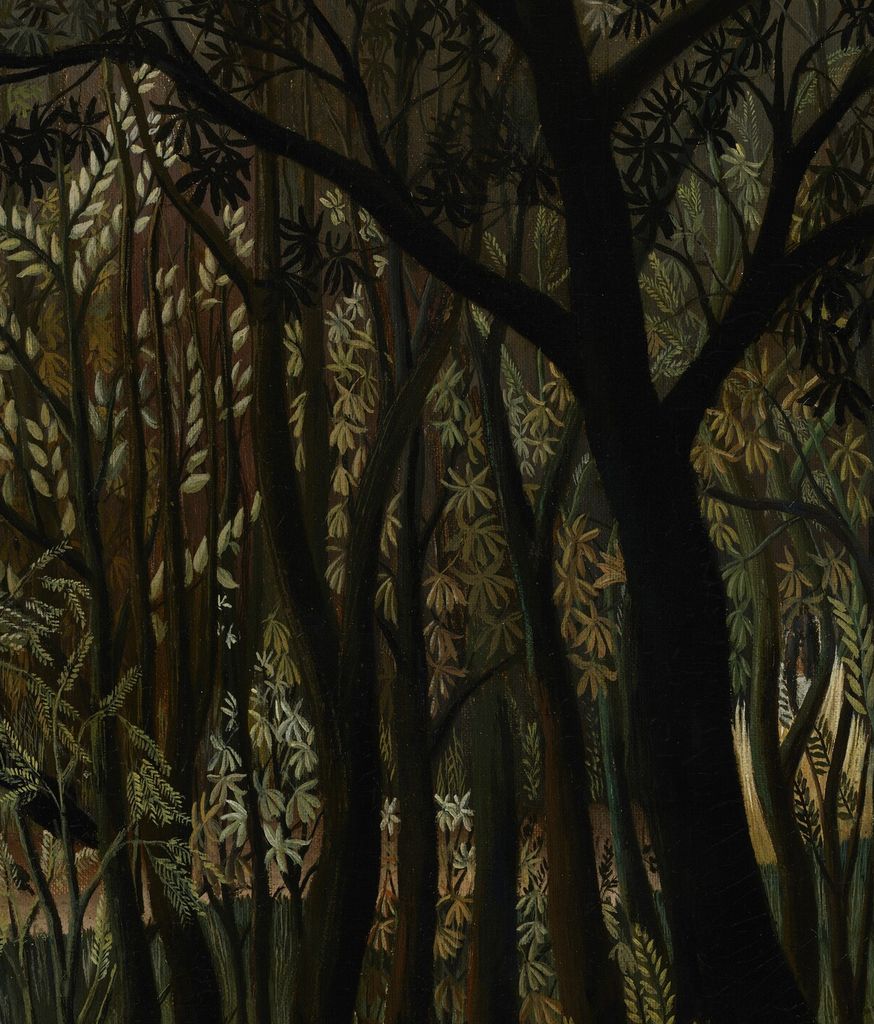
The vegetation has several rhythms. Long sprays of narrow leaves rise on either side of the riders. Smaller, more rounded clusters hang from the upper branches. Behind them stand repeated vertical strokes, suggesting further trunks with only brief openings between them. Looking from one area to another is like changing the scale of a pattern: a broad mass of green breaks into stems, then into separate leaves.
Rousseau keeps many of these small shapes distinct even where they overlap. Near the couple, pale leaves are set against deeper green, making their edges unusually clear. Elsewhere, dark leaf clusters lie across lighter growth. These reversals help the forest remain readable without giving every part of it the same emphasis. Some passages invite inspection leaf by leaf; others gather into a dim, almost continuous surface.
The greens also vary more than the initial darkness suggests. There are greyish and yellowish passages, cooler deep tones, and patches that approach brown. Their differences become easier to see beside the near-black trunks. The pale foliage around the figures separates the clothes from the background without surrounding them with empty space.
Depth develops through these successive overlaps. A branch crosses a spray of leaves, which covers a rider, who appears in front of more upright stems. Yet the repeated shapes also draw attention to the flat surface of the painting. We can follow the forest inward and then find ourselves looking across an arrangement of marks. This shifting attention gives the woodland much of its absorbing quality. For a broader discussion of such visual construction, see Rousseau’s style and technique.
The riders and their interrupted silhouettes
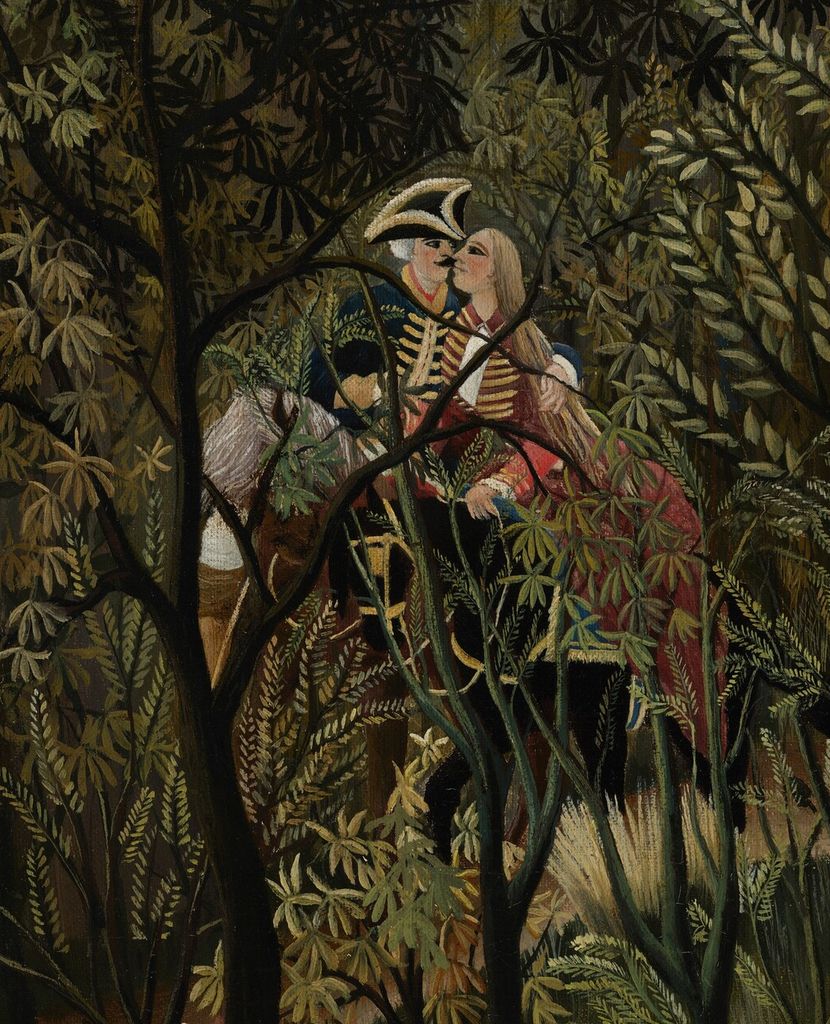
The embrace is compact. The two heads turn towards one another, bringing a small area of pale flesh into the surrounding green. One arm curves around the companion’s shoulders. The angle of the faces and the enclosing arm make the relationship readable before every detail of costume or posture has been worked out. The gesture needs very little space.
Clothing adds a different kind of detail. Light braiding runs across dark fabric, and red brings warmth to a scene otherwise dominated by greens, browns and a cool sky. The trim on the jackets echoes the forest’s fine lines, although its regular arrangement belongs to a different world. Among the branching stems and scattered leaves, the repeated bands briefly suggest order and ceremony.
The horses are harder to assemble visually. Their heads, necks and portions of their bodies emerge between plants, while other parts disappear. The riders’ lower bodies are similarly difficult to follow. Rousseau gives enough information to establish a mounted couple, then allows the foliage to interrupt their outlines. Following a rein or an edge of clothing can lead the eye directly into another stem.
This broken visibility affects the sense of movement. We can imagine the horses carrying their riders through the wood, yet no clear stride dominates the scene. The embrace seems to suspend the journey. Around it, the straight trunks stand motionless and the upper branches spread without any obvious gust bending them together. The encounter occupies a still interval, with the animals and the vegetation holding its small human action in place.
Annotated Details from Rendez-Vous in the Forest
The numbered points identify visible features discussed in this article. Return from each detail to the whole composition. Henri Rousseau, Rendez-Vous in the Forest, 1889. National Gallery of Art, Washington, 1972.9.20. Gift of the W. Averell Harriman Foundation in memory of Marie N. Harriman. Image source. CC0 / Public domain. Numbers added to the overview; detail views cropped from the original. No recolouring or retouching.
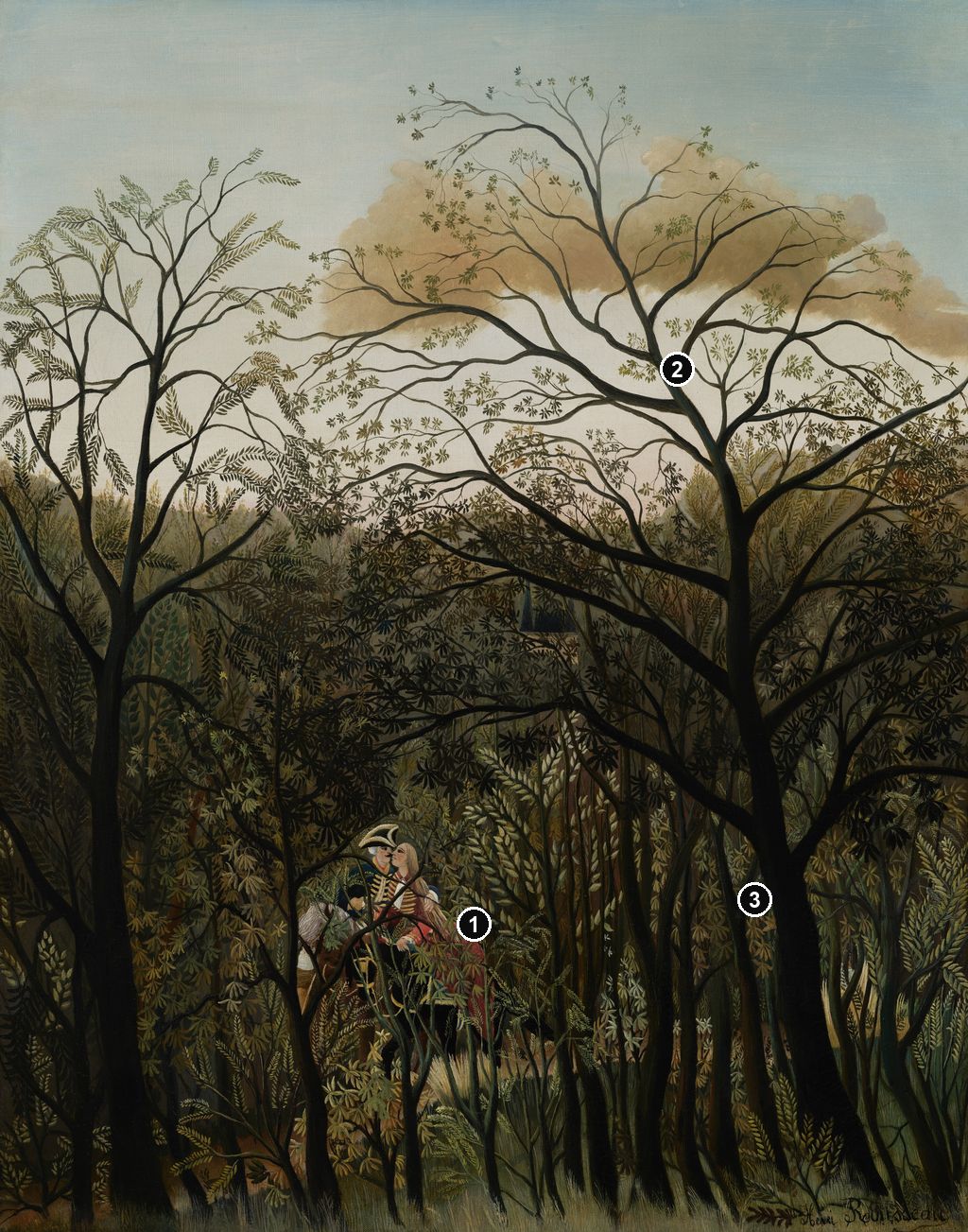
Details from RENDEZ-VOUS IN THE FOREST
Locate the riders within the whole forest, then follow the dark branches and smaller leaves that alternately reveal and conceal them.
The riders inside the thicket
The two faces meet below a pale-edged hat. Gold lines cross dark and red clothing, while branches and leaves interrupt the riders and the horses beneath them.
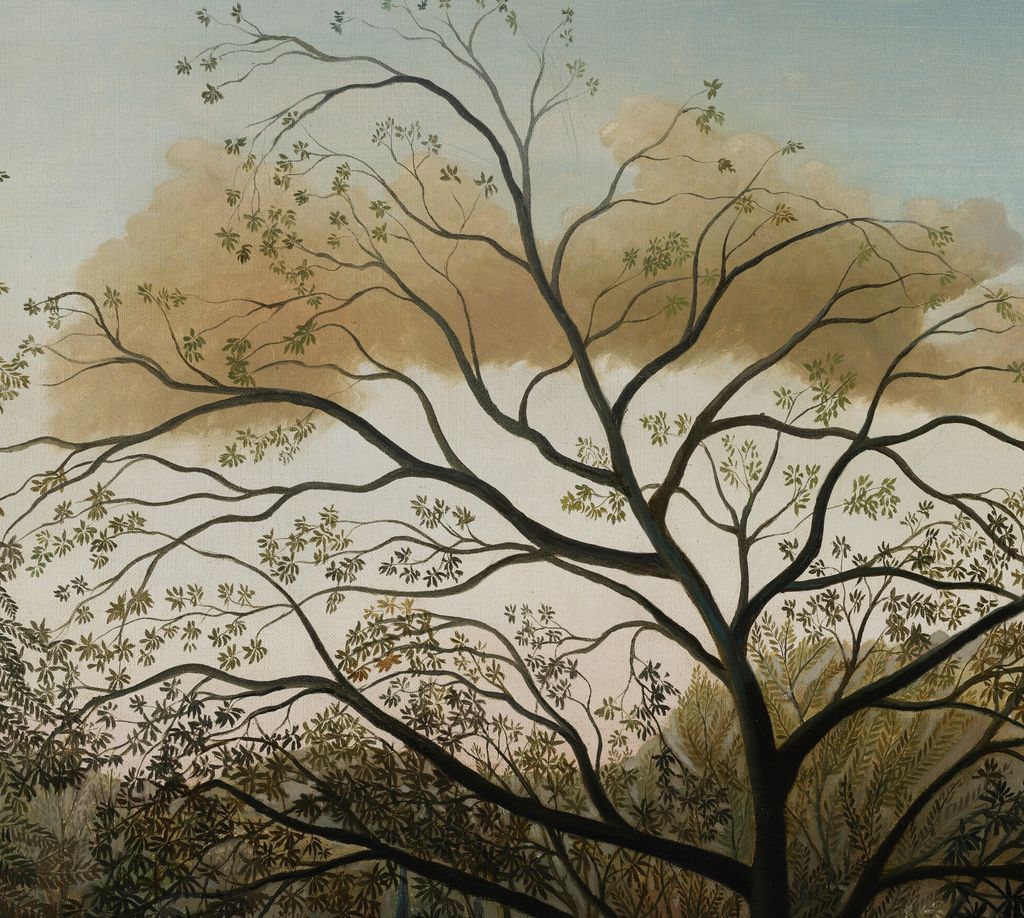
Branches spread across the sky
Thick dark branches divide into thinner curves against the pale sky and warm cloud. Small clusters of leaves leave much of this upper framework exposed.
A screen of different leaves
Upright stems carry small repeated leaves in several directions. Their overlaps make a dense screen, broken by narrow glimpses of lighter ground behind.
Light above and behind the thicket
The sky takes up much of the upper canvas, but branches divide it into irregular compartments. Near the horizon it is pale and creamy; higher up, it takes on a cooler green-blue cast. A broad, warm cloud sits behind the upper trees. Its soft, uneven contour differs from the firm edges of the branches passing across it.
The cloud gives the sparse foliage a particularly clear backdrop. Tiny leaves can be seen separately against its warmer colour, while the longest bare stretches of branch remain exposed. Towards the top, the tree almost dissolves into a few small marks. The change from thick trunk to scattered leaf tips becomes visible across the full height of the canvas.
Lower down, the light is less expansive. Narrow pale spaces appear between trunks and behind the riders, suggesting somewhere farther into the forest. They offer glimpses rather than a continuous view. The sky lets the eye range widely, while the woodland makes it negotiate one opening at a time.
The pale faces and gold trim connect the couple to these scattered lights. Their small brightnesses keep the embrace from vanishing into the vegetation. The painting’s intimacy depends partly on that restraint. If the figures were illuminated across their whole bodies, they would be much easier to separate from their surroundings. Here, the forest and the riders remain closely interwoven.
Period costume and an open-ended story
The 1985 Rousseau exhibition catalogue describes the riders’ dress as eighteenth-century costume and states that its source had not been identified. It places the painting within the scène galante tradition of costumed courtship, mentioning Diaz and Adolphe Monticelli as context. This is a comparison of pictorial traditions, rather than an identification of a particular borrowed composition.[12]
That context helps explain the scene’s air of distance from ordinary experience. The braided clothes and conspicuous hat make the meeting look staged or imagined. They encourage us to see a romantic episode, but they do not provide names for its participants. Nothing in the visible encounter tells us whether these are portraits, fictional characters or anonymous figures chosen for the scene.
The balance between elaborate setting and minimal action leaves room for several emotional responses. The surrounding trees can feel protective because they enclose the couple. Their size can also make the people seem vulnerable or remote. The tender gesture holds its meaning through either reading. Rousseau has made a recognisable human attachment the smallest, most concentrated element in a much larger world.
From a Paris gift to Washington
According to the National Gallery’s provenance, Rousseau gave the painting to his Paris baker in 1889. The record later places it with Bela Hein, who sold it to Marie and W. Averell Harriman in June 1931. It entered the National Gallery in 1972 through the W. Averell Harriman Foundation, in memory of Marie N. Harriman.[1]
The museum also records its appearance in MoMA’s 1942 Rousseau exhibition and the 1984–85 retrospective.[1] Those exhibitions brought the small encounter before successive audiences. The painting still rewards the private scale of attention suggested by its subject: standing back to take in the trees, then moving closer to find the embrace caught among them.
Henri Rousseau artworks directory
This directory brings together works covered on this site and other works documented in the cited museum records and catalogues. Alternate titles share one entry; distinct versions remain separate. Historical dates for works without an article follow the cited catalogues. This is not a catalogue raisonné.
Frequently Asked Questions
They have no securely established identities. The 1985 catalogue leaves the costume source and precise meaning of the scene unresolved.[12]
They occupy a small area below the centre, and stems cross their clothes and horses. Their pale faces, red fabric and gold trim help the eye locate them within the foliage.
It is in the National Gallery of Art, Washington, accession 1972.9.20.[1]
Discussion
Look again at the images and ideas explored in Rendez-Vous in the Forest. These editorial prompts invite your observations.
Reader Insights
What did you notice first: the embrace, the large trees or the cloud?
Does the forest seem to shelter the riders or keep them at a distance from us?
How would the mood change if the horses and riders were fully visible?
Join the Conversation
Share a detail, comparison or question about Rendez-Vous in the Forest below.
References
- National Gallery of Art. Rendezvous in the Forest, artwork 53138, accession 1972.9.20; overview, provenance and exhibition history, accessed 23 October 2026. View source.
- Philadelphia Museum of Art, Carnival Evening,1963-181-64,object59593. View source.
- Musée de l’Orangerie / Juliette Degennes, Henri Rousseau,L’ambition de la peinture: Un artiste dans son époque (in French). View source.
- National Gallery, Surprised!, NG6421. View source.
- Musée d’Orsay, La Guerre,RF19461 (in French). View source.
- MoMA, The Sleeping Gypsy. View source.
- Philadelphia Museum of Art, The Merry Jesters, 1950-134-176, object51097. View source.
- Musée d’Orsay, La Charmeuse de serpents, RF 1937 7 (in French). View source.
- Musée de l’Orangerie, La Carriole du Père Junier, RF 1960 26 (in French). View source.
- Solomon R. Guggenheim Museum / Cornelia Lauf, The Football Players,60.1583: current collection record. View source.
- MoMA, The Dream, 252.1954. View source.
- Museum of Modern Art. Henri Rousseau: Essays, 1985, catalogue entry 2, printed p. 100 (PDF p. 105). View source.
- The Museum of Modern Art, Henri Rousseau: Essays (1985), selected catalogue entries, chronology and notes on early devotees. View source. Selected entries, chronology (pp.91–95) and early-devotee notes (pp.262–264) were consulted. Historical collection credits do not establish present ownership.
- Daniel Catton Rich, Henri Rousseau (The Museum of Modern Art, 1942), selected drawings and landscape studies; historical catalogue. View source. The dated 1942 publication is used for the two Quai d’Auteuil ink views; its Malakoff date differs from the 1985 catalogue.
- MANAS, Laval, Henri Rousseau, dit le Douanier, urban landscapes and preparatory study (in French). View source.
- National Gallery of Art, Self-Portrait (1895), pen-and-ink drawing, accession 1995.47.66. View source.
- The Museum of Modern Art, War (published January 1895), lithograph, accession 684.1943. View source.
- Barnes Foundation, Landscape and Four Young Girls, object 5521, BF855. View source.


 Henri Rousseau.jpg)


 Henri Rousseau.jpg)