



 by Tom Gurney
Tom Gurney BSc (Hons) is an art history expert with over 20 years experience
Published on June 19, 2020 / Updated on October 29, 2026
Email: tomgurney1@gmail.com / Phone: +44 7429 011000
Henri Rousseau: Biography: Introduction
In June 1884, a forty-year-old employee of the Paris toll service wrote to the minister responsible for the fine arts. Henri Rousseau explained that he had worked hard at a painting, missed an exhibition deadline and received encouragement from established artists. Time and money were short. He wanted someone to buy his work so that he could paint on a larger scale. The letter already contains the driving concerns of his career: independence, painstaking labour and a determination to be recognised as a professional artist.[1]
Over the next quarter-century, Rousseau exhibited almost every year, painted his neighbours and the changing outskirts of Paris, taught music and drawing, and constructed the tropical forests for which he is best known. His career joined the everyday world of a municipal employee to the increasingly experimental art of Paris. Sympathetic notices appeared beside ridicule, financial difficulties continued alongside growing demand, and official recognition remained an ambition even as younger artists began to celebrate him.[2]
At a Glance
- Born21 May 1844, Laval.[3]
- Paris octroiEmployed from 1871; retired in 1893.[2]
- First Indépendants exhibition1886.[2]
Henri Rousseau in context
Impressionist exhibition context
1886: the final Impressionist group exhibition [4]Neo-Impressionist exhibition context
1886: Seurat’s La Grande Jatte at the Indépendants [4]Fauve exhibition context
1905: the Salon d’Automne [4]Der Blaue Reiter
1912: the almanac reproduces Rousseau’s works [4]Guillaume Apollinaire
1880–1918 · poet and advocate [4]Robert Delaunay
1885–1941 · painter and collector [4]Pablo Picasso
1881–1973 · painter and collector [4]Wassily Kandinsky
1866–1944 · later admirer [4]Carnival Evening
1886 [5]Contents
- Laval, Angers and the beginnings of an artist
- Paris, marriage and the octroi
- Learning, copying and seeking a place to exhibit
- The career Rousseau described for himself
- Retirement in 1893 and the pursuit of official recognition
- Painting the Republic and asking it to buy
- The room on the rue Perrel
- Jungles, exhibitions and new supporters after 1905
- Legal trouble and the banquet of 1908
- Rousseau's place in modern art
Laval, Angers and the beginnings of an artist
Henri Rousseau was born in Laval, in northwestern France, on 21 May 1844. His father was a tinsmith, and the family experienced serious financial setbacks during his childhood. The chronology published in the Museum of Modern Art's 1985 exhibition catalogue records his father's bankruptcy in 1851 and the family's eventual move to Angers in 1861. These provincial beginnings remained part of Rousseau's later identity: Laval would recur in his correspondence and in the connections that helped bring the young writer Alfred Jarry into his life.[3][2]
At school in Laval, drawing and music were among Rousseau's strengths. The same catalogue records runner-up prizes in both subjects, though his wider academic performance was undistinguished. His education ended without the professional artistic training available through an academy. The combination of drawing and music nevertheless proved durable. Long after he had become an exhibiting painter, the violin, musical composition and teaching would remain practical parts of his working life.[2]
The early record also includes a criminal conviction. While working in an attorney's office in Angers, Rousseau was involved in a petty theft of stamps and money. Roger Shattuck's biographical essay, drawing on the research of Henry Certigny, describes his enlistment in December 1863 and a subsequent month's imprisonment. He served in the infantry in France and was discharged in 1868 after his father's death. The episode belongs to the surviving account of his youth, before he established a working life in Paris.[2]
Military service eventually became entangled with the best-known story about his jungles: the claim that he had visited Mexico with the French expedition supporting Emperor Maximilian. Rousseau did no such overseas service. The 1985 chronology suggests that he encountered soldiers who had returned from Mexico, while the Musée de l'Orangerie's recent account places the visual sources of his tropical pictures firmly in Paris. Stories of travel helped give his paintings an exotic personal history, and Apollinaire helped circulate them. Their actual setting was a city rich in botanical displays, natural-history specimens, illustrated publications and colonial spectacle.[2][15]
Four stages of Henri Rousseau’s career
These periods group related developments; subjects and ways of working overlap across their boundaries.
Figures, landscapes and a professional identity
Rousseau began showing at the Salon des Indépendants in 1886. Carnival Evening, his 1890 self-portrait and Surprised! established very different ambitions before he left the Paris octroi in 1893. [4]

 Henri Rousseau.jpg)
Allegory, portraiture and civic ambition
After leaving municipal employment, Rousseau pursued painting and public recognition. War and The Sleeping Gypsy belong to these years, alongside unsuccessful entries for town-hall decorations at Vincennes in 1898 and Asnières in 1900. [4]


Teaching, smaller pictures and ambitious exhibitions
Teaching formed part of Rousseau’s livelihood while he continued landscapes, portraits and large compositions. The Hungry Lion attracted attention at the 1905 Salon d’Automne; The Merry Jesters followed there in 1906. [4]


New buyers and a forest with a sofa
Robert Delaunay, Wilhelm Uhde, Picasso and other admirers entered Rousseau’s later collecting history. The Snake Charmer was painted in 1907, and The Dream appeared at the 1910 Indépendants, the year of Rousseau’s death. [4]


Paris, marriage and the octroi
Rousseau moved to Paris in 1868 and married Clémence Boitard the following year. In 1871 he entered the octroi, the municipal service that collected duties on goods entering Paris. This employment supplied the nickname by which he became famous, Le Douanier. The duties belonged to the city's toll system, rather than to the national border customs service. For more than twenty years, his public employment ran alongside his developing interest in painting.[2]
The work also brought him into contact with the city's edges. Gates, quays, riverside settlements and the partly rural suburbs became subjects to which he returned throughout his career. The Laval museum, MANAS, describes his urban and river views as interpretations developed from observation and studies made outdoors. Such pictures often arrange chimneys, houses, bridges and figures with an order more exact than the geography. Rousseau found a continuing subject in the places where the capital met fields, market gardens and industry.[16]
The precise moment at which painting became a sustained activity is difficult to establish. In an autobiographical note dated 10 July 1895, Rousseau placed his entry into art in 1885 and explained that his family's limited means had first obliged him to pursue another occupation. This was his retrospective account of his vocation. The surviving 1884 letter already shows him revising a substantial picture, seeking opinions and trying to enter exhibitions. The beginnings of his practice therefore preceded the public career he chose to emphasise.[1][15]
His family life involved losses that should be allowed their weight without being made into explanations of every canvas. Clémence died in 1888. Rousseau later wrote, in a June 1910 letter to the president of an arts orphanage, of having lost almost all his children and of being moved by the children he had seen at its festivities. The letter is direct evidence of bereavement remembered near the end of his life. It also shows him responding to an institution's social and musical activities, offering hospitality and describing a busy working routine.[2][1]
Learning, copying and seeking a place to exhibit
In 1884 Rousseau obtained permission to copy in the Louvre, the Luxembourg and Versailles museums. He admired established academic painters and repeatedly invoked their encouragement. His 1895 autobiographical note names Jean-Léon Gérôme and Félix-Auguste Clément as sources of advice; his earlier ministerial appeal also refers to favourable opinions from Gérôme, Clément and a drawing professor, Pélissier. These statements tell us how he sought authority for his work and whom he wished officials to associate with it.[2][1]
Rousseau's status as a self-taught painter needs that context. He looked at paintings in museums, sought professional advice and worked to improve his pictures. His education was an accumulation of encounters and sustained practice, whose exact extent is only partly documented. The confidence of his letters coexists with admissions of defects and descriptions of revision. He wanted criticism that would help him advance, and he hoped that recognised painters' approval would open doors.[1][15]
An important door opened at the Salon des Indépendants. Rousseau made his first submission there in 1886, with four paintings including A Carnival Evening. The society's exhibition offered artists a way to show without the selection system of the official Salon. It brought his work before the public in the same exhibition culture that accommodated major experiments by Georges Seurat and other independent painters. Rousseau continued to contribute almost annually; the 1985 chronology identifies 1899 and 1900 as exceptions.[2][15]
He understood the value of this freedom. In the autobiographical note, he defended the artist's liberty to produce and thanked journalists who had supported him during discouraging periods. His notebook of press cuttings made criticism something to preserve and deploy. Reviews were evidence that his work mattered, useful both to his own sense of progress and to the applications he addressed to officials. The public career developed through repeated submissions, attention to responses and another season's work.[1][15]
The career Rousseau described for himself
Rousseau's autobiographical note of July 1895 was written in the third person for a projected collection of portraits of contemporary figures. Its form matters. He was preparing an account that someone else might publish, arranging his beginnings, achievements and appearance into a recognisable professional identity. After describing his limited means and eventual entry into art, he listed paintings, named advisers, defended artistic freedom and thanked supportive journalists. Even the mention of his bushy beard helped make the artist into a person a reader could picture.[1]
The range of titles is striking. Carnival scenes stand beside poverty, departure, suicide, patriotic subjects and his own portrait. He also claimed some two hundred drawings in pen, ink and pencil, together with landscapes of Paris and its surroundings. This was the breadth of activity he wanted recorded by 1895. The number belongs to his own inventory and cannot be treated as a census of surviving works, but it gives drawing a place in the career that the famous late jungles can obscure.[1]
He described himself as becoming a leading realist painter. The word can seem surprising beside his altered proportions and impossible forests. Within his self-description, however, it expressed confidence that his pictures gave substantial form to what he saw and imagined. He did not present his unusual manner as a joke or an exercise requiring indulgence. The note asks its reader to recognise a serious artist who has developed an original approach through repeated effort.[1]
That public identity helps explain the persistence of his correspondence. The same person who praised his progress could admit that a picture contained faults and describe working to correct them. His confidence was attached to a continuing practice. A favourable notice, a successful exhibition or a useful introduction could be retained and offered as evidence in the next appeal. Across the years, the documents show him learning how to make his own career legible to other people.[1]
The self-portrait and the first jungle
By 1890 Rousseau could picture himself as an artist on a commanding scale. Myself: Portrait–Landscape presents a full-length figure equipped with palette and brush, with Paris behind him. The work made his professional identity visible in the exhibition space. The Musée de l'Orangerie treats it as the starting point for a recurring portrait method: a strongly outlined sitter stands against a landscape whose details contribute to the person's identity. Rousseau later claimed to have invented the portrait-landscape, a bold statement of originality within his own account of his art.[15][17]
His confidence did not require him to choose a single kind of subject. Portraits, suburban landscapes, allegories and scenes of encounter belonged to the same expanding practice. The self-portrait was especially useful because it joined two of those interests. It offered a recognisable person and a world arranged around him. For an artist still employed at the octroi, the figure's public bearing gave visible form to the identity he was asking others to acknowledge.[15]
In 1891, Surprised! brought a tiger and a storm into that public career. Shown at the Indépendants, it was the first of Rousseau's jungle paintings. The tiger crouches amid densely layered plants, while diagonal rain draws the animal, foliage and sky into a single patterned surface. The National Gallery describes the plants as a mixture of tropical varieties and domestic houseplants, transformed from things Rousseau could see in Paris. The picture opened an imaginative territory that he would develop much more extensively in his last years.[7]
Félix Vallotton's response that year has become famous. He recognised Rousseau's seriousness despite the laughter around his pictures, and described the tiger in strikingly enthusiastic terms. Yet praise had already appeared in earlier notices. The significance of 1891 lies in the strength and specificity of Vallotton's attention, rather than in a sudden discovery of an artist whom no one had previously noticed. From early in his exhibiting life, Rousseau's audience included sympathetic viewers as well as spectators who found his work comic or awkward.[2][7]
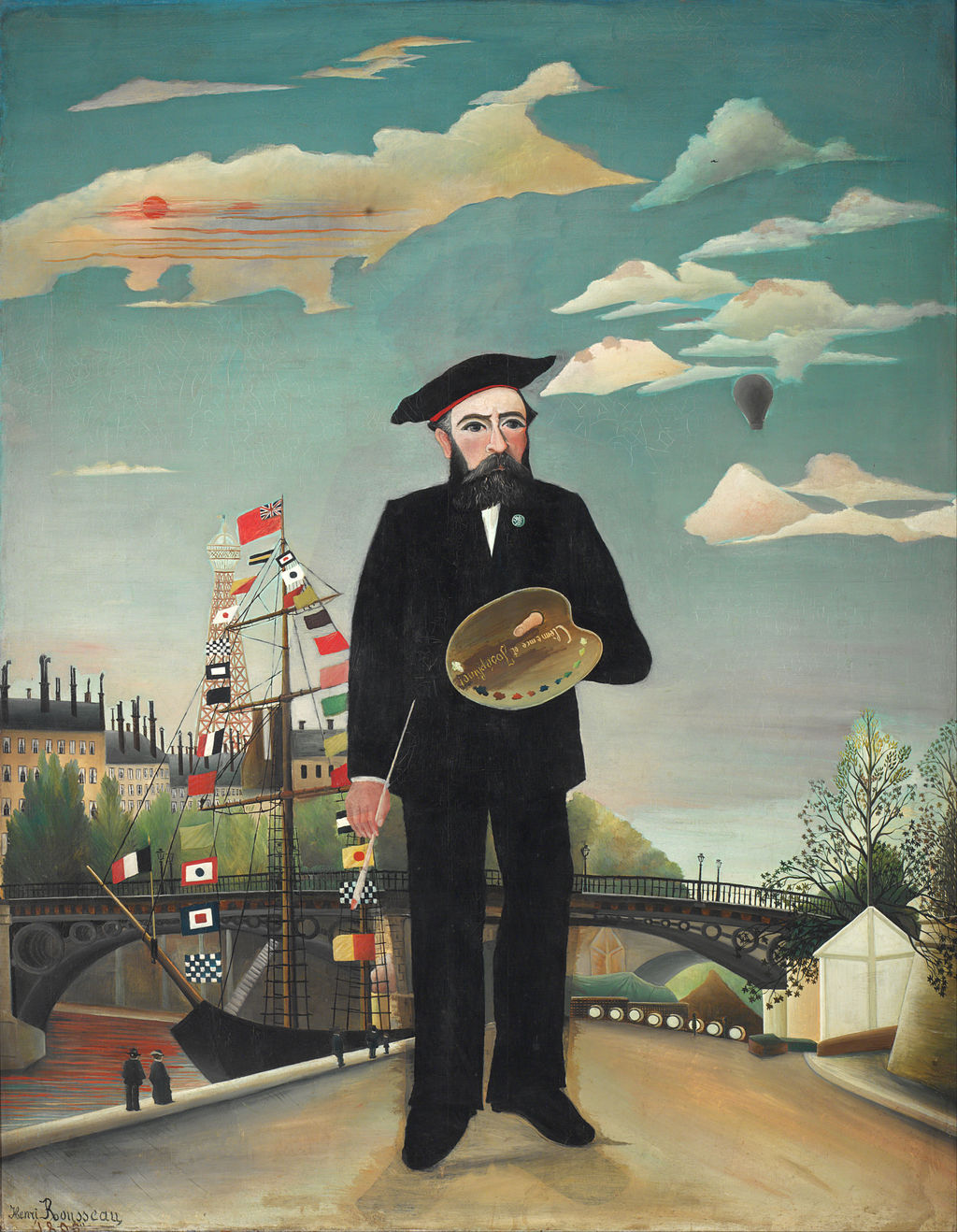
Henri Rousseau, Myself, Portrait–Landscape, 1890. National Gallery Prague, O 3221. Palette and brush declare his identity as a painter against a Parisian landscape. Google Art Project reproduction via Wikimedia Commons. Image source. Public domain. Resized only; the full supplied painting is retained.
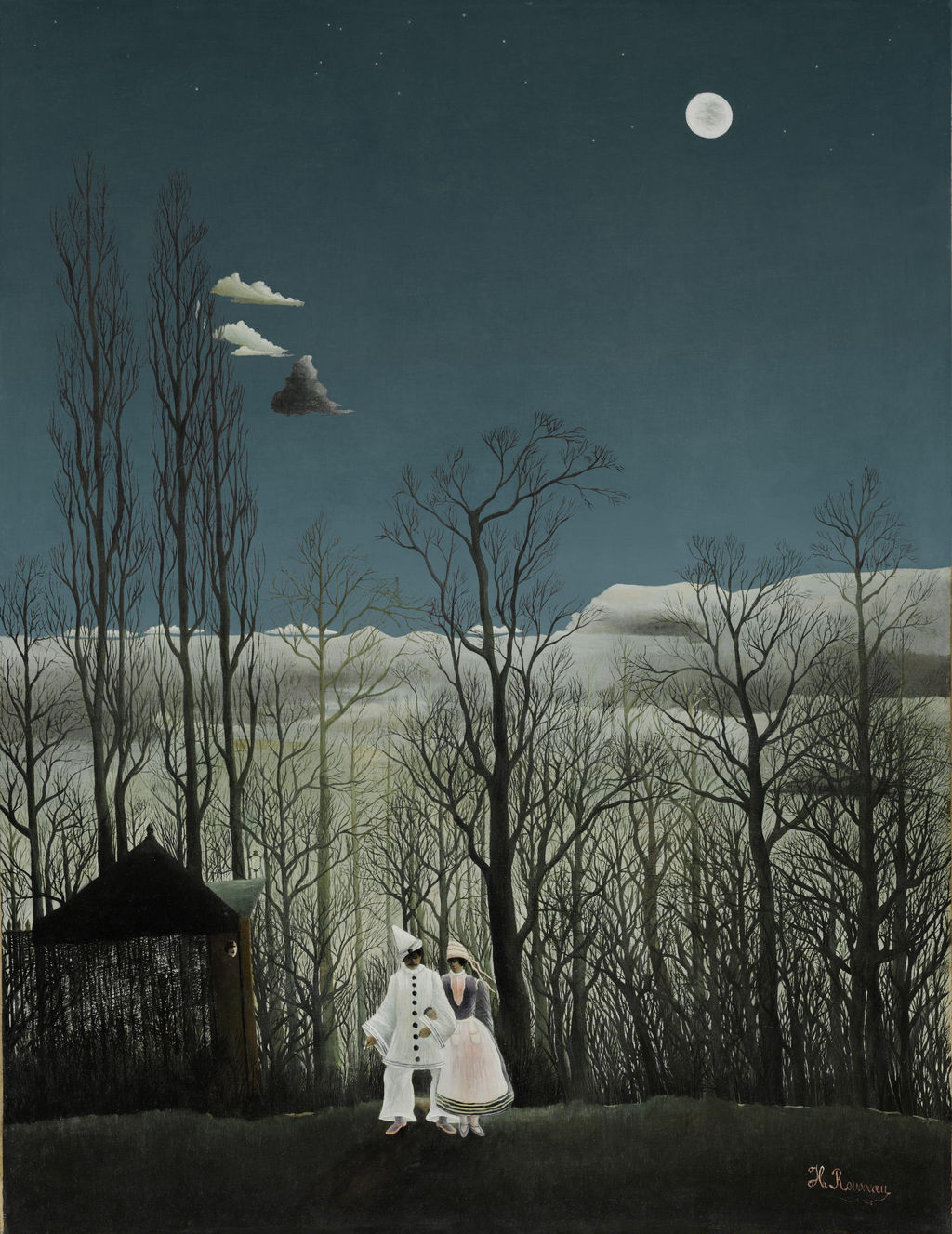
Carnival Evening, 1886. Philadelphia Museum of Art, The Louis E. Stern Collection, 1963, 1963-181-64. One of the works with which Rousseau began exhibiting at the Salon des Indépendants. Image source. Public domain. Resized only; complete supplied painting retained.
Retirement in 1893 and the pursuit of official recognition
On 1 December 1893 Rousseau resigned from the octroi. He was forty-nine. Retirement gave him more time to paint, with a modest pension behind him, but it did not produce financial security. Debts to his supplier of canvas and colours persisted. He had committed a greater share of his time and resources to an artistic career whose rewards were still uncertain.[2]
His ambitions reached well beyond the independent exhibition. In June that year he appealed to the president of the Republic for help obtaining a teaching post and for the purchase of a painting. The letter presented him as a man who had served the state and the city, worked hard at his art and sought an honourable position from which to support his family. Such appeals joined professional aspiration to the language of civic service. He wanted his art to have a recognised place in public life.[1]
The municipal decoration competitions offered another route. Rousseau entered those for Bagnolet in 1893, Vincennes in 1898 and Asnières in 1900, without winning a commission. According to the Orangerie's account, he adapted unsuccessful proposals into independent pictures that could be offered for sale. The competitions therefore formed part of his working practice as well as his search for employment. A rejected project could become material for the next exhibition or purchaser.[15]
In 1898 he offered The Sleeping Gypsy, exhibited the previous year, to the mayor of Laval. The offer was declined. Rousseau saw a place for an unusual, dreamlike picture in his native city’s collection, just as he saw a place for civic allegories in official exhibitions. His approach to potential purchasers remained direct: he described the work, named a price or requested an acquisition, and invited a public authority to take an interest.[2]
His exhibition paintings likewise embraced subjects associated with public seriousness: national anniversaries, the Republic, military service and war. War, shown at the Indépendants in 1894, brings devastation into a sweeping allegorical scene. Its survival and later fame can overshadow the practical setting in which Rousseau made it: an artist trying to command attention through a large, consequential picture. He continued to ask the state to acquire such works, including jungle scenes, long after his links with the avant-garde had begun to grow.[2][1]
Painting the Republic and asking it to buy
The public ambition becomes visible in A Centennial of Independence, dated 1892. Dancers join hands beneath a tree surrounded by flags, while conspicuously dressed figures occupy the foreground. The central ring converts a civic occasion into a pattern of linked bodies and alternating colours. The painting gives collective celebration the clarity of an image that can be understood across an exhibition room.[18]
The tree divides and gathers the scene. Its trunk anchors the centre; its branching canopy spreads over the dancers; the flags repeat their colours across the upper half. At the front, the larger figures interrupt our access to the circle, making us spectators before participants. Rousseau could organise a populous scene through distinct silhouettes and clear intervals, a capacity that would later serve quite different gatherings in his forests.
His letters to officials describe a remarkably sustained sales practice. In April 1901 he supplied catalogue numbers for works at the Indépendants, directing a potential state purchaser towards portraits of seasonal effects and places near Vincennes as well as Unpleasant Surprise. His appeal of March 1904 identified Scouts Attacked by a Tiger, gave dimensions including the frame, and explained his financial distress following his wife's long illness. A large jungle picture could therefore be offered with the same practical precision as a local landscape.[1]
Further requests concerned The Hungry Lion in 1905, Liberty Inviting Artists and The Merry Jesters in 1906, and four Salon d'Automne pictures in 1907. The latter letter noted that a possible sale of The Snake Charmer was already being negotiated. Rousseau was seeking public patronage while other kinds of buyer came into view. An application to the state was one part of his continuing effort to place paintings, finance materials and begin the next important canvas.[1]
The documents also make the exhibition a practical meeting point. A title and catalogue number allowed an official to locate a picture without visiting the studio first. Rousseau's professional signature, teaching credentials and record of public service supplied reasons to take that picture seriously. His appeals can be read as a repeated attempt to connect artistic independence with civic usefulness, and personal need with the possibility of public recognition.[1]
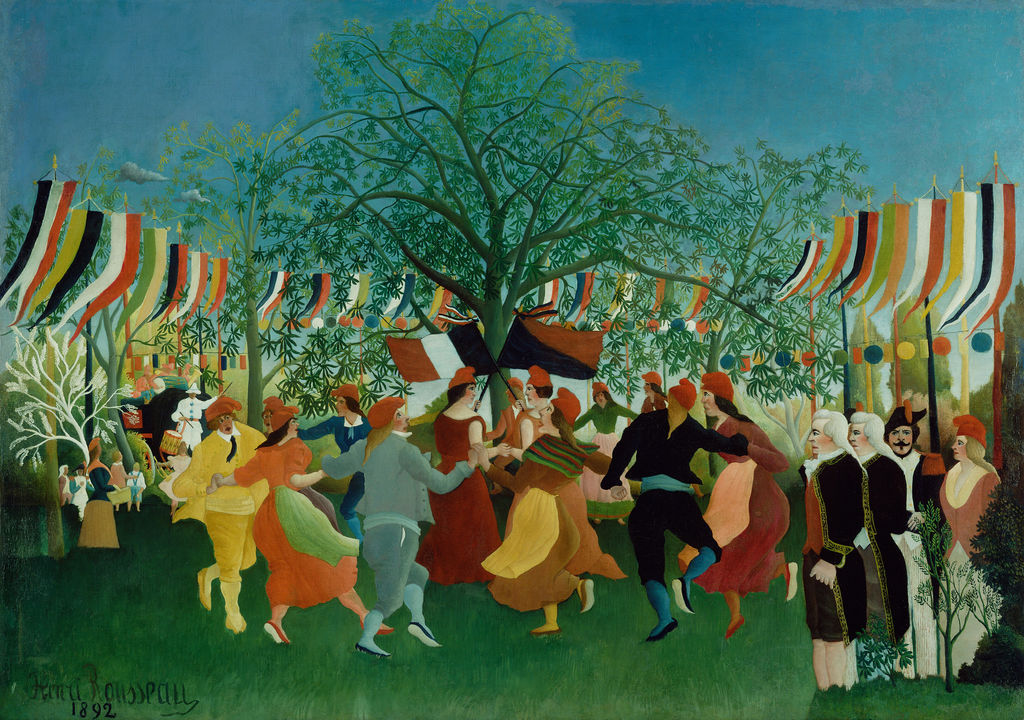
A Centennial of Independence, 1892. J. Paul Getty Museum, Los Angeles, 88.PA.58. The linked dancers, flags and central tree show Rousseau organising a large civic celebration. Image source. CC0 / Public domain. Resized only; complete painted surface retained.
Jarry, Fargue and the world of printed images
Rousseau's friendship with Alfred Jarry developed in the mid-1890s, rooted partly in their shared connection with Laval. A letter of 26 June 1894, discussed by Laurent de Freitas, already establishes friendly relations and work on Jarry's portrait. The younger writer's interest gave Rousseau an advocate in literary circles. By then the painter had been exhibiting for years, with an established manner and a history of public responses behind him.[19][20]
Jarry's response also had an artistic substance. With Remy de Gourmont, he founded L'Ymagier, a magazine concerned with printed images and popular traditions. Having admired War, the editors commissioned a lithograph, which appeared in January 1895. The painting and print are distinct works, connected by this act of collaboration. Henri Béhar's essay sees the friendship in the context of Jarry's interest in folk imagery, simplified forms and the expressive possibilities of an art outside academic conventions.[19]
The connection moved between criticism, portraiture and ordinary assistance. Jarry stayed with Rousseau from August to November 1897. Rousseau also painted Léon-Paul Fargue, whose portrait is dated 1896 and reappeared in 2000. In Le Piéton de Paris, published in 1939, Fargue remembered meeting Rousseau with Jarry and recalled the railway behind him in his portrait. That recollection was written decades after the sittings; the dated painting and surviving correspondence provide firmer chronological anchors than the remembered scene alone.[19][20]
Rousseau's own use of words belongs beside these collaborations. He attached inscriptions or verses to paintings and wrote plays. A Visit to the 1889 Fair drew on the great Paris exhibition; The Revenge of a Russian Orphan was submitted unsuccessfully to the Châtelet theatre in 1899. Both painting and writing gave him room for elaborate scenes, moral drama and public address. Béhar notes affinities with Jarry's theatrical interests while declining to claim a demonstrable influence from Rousseau's plays on Jarry's work.[2][19]
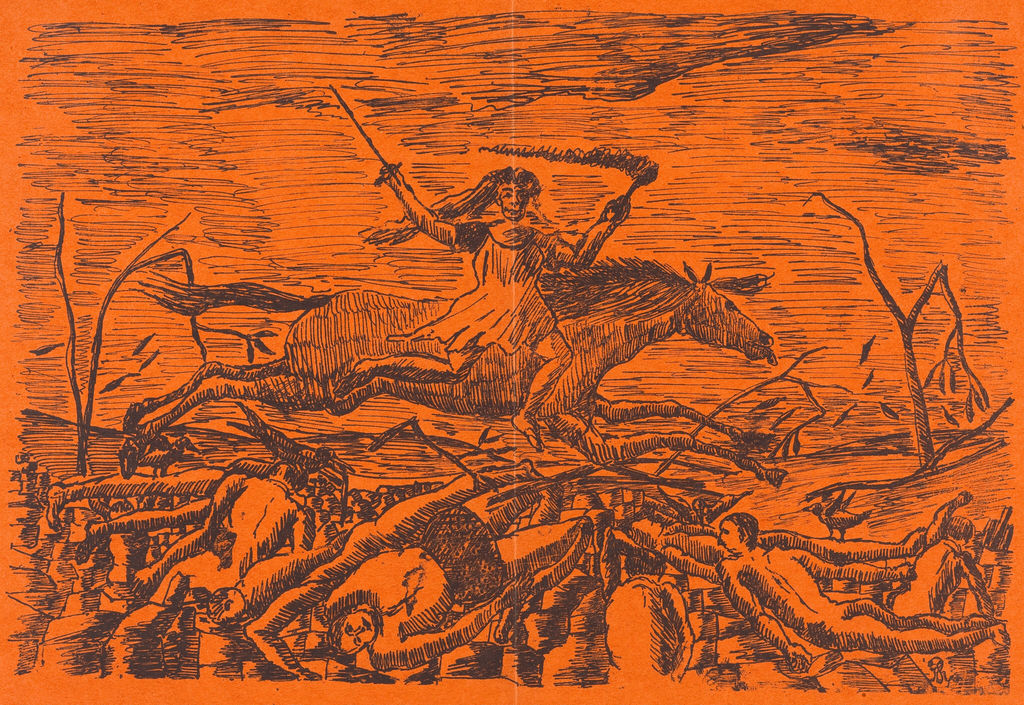
La Guerre (The War), 1894 (published 1895), original lithograph on orange wove paper. This is the National Gallery of Art’s impression, 1964.8.1502, of the print made for L’Ymagier. Rosenwald Collection; Courtesy National Gallery of Art, Washington. Image source. CC0 / Public domain. Resized only; original printed composition and visible paper features retained.
A household, a teaching practice and a local market
In 1899 Rousseau married Joséphine Noury, a widow. She died in 1903. The years of their marriage were financially difficult, and the catalogue records several attempts to supplement his income: lessons, newspaper distribution work and participation in an amateur orchestra. Joséphine tried selling his paintings through a stationery shop. These activities place his art within a household economy in which time, materials and sales had to be managed alongside other work.[2]
Music offered both income and companionship. Rousseau taught it, played the violin and composed; his waltz Clémence was published in 1904. His connection with the Philotechnic Association, an adult-education organisation, gave a more formal setting to teaching. The chronology lists him as a teacher of drawing and painting on china and porcelain from 1901 to 1904, followed by an appointment as professor of drawing in 1904. He also offered lessons at home. A court order requiring repayment of his art-supply debts in 1904 shows how close these efforts remained to the immediate problem of financing his materials.[2]
He took these credentials seriously. In his appeal concerning The Hungry Lion in October 1905, Rousseau cited his teaching, public service and published music as parts of the same professional record. His artistic identity could accommodate several forms of work. The man who painted imagined forests also prepared lessons, advertised courses and played for gatherings. His domestic studio served as a place where those pursuits met.[1][2]
The people immediately around him supplied commissions and subjects. The Orangerie's account describes portraits celebrating weddings, births, baptisms and family outings, sometimes exchanged in settlement of bills. Smaller landscapes and still lifes suited the means and rooms of artisans, shopkeepers and modest middle-class purchasers. These were an important part of his output. An account confined to the celebrated large jungles would miss much of the practice through which Rousseau sought to sustain himself.[15]
La Carriole du Père Junier, dated 1908, makes that local network particularly tangible. Junier sold vegetables, was a longstanding friend, and had recently acquired a horse; his wife cooked for Rousseau. The painter owed him money, and a picture was agreed upon. Working from a photograph, Rousseau reorganised the scene, notably the size and position of its dogs. A transaction between neighbours became a carefully staged image of an outing, with the figures facing us and the horse poised above the road.[12]
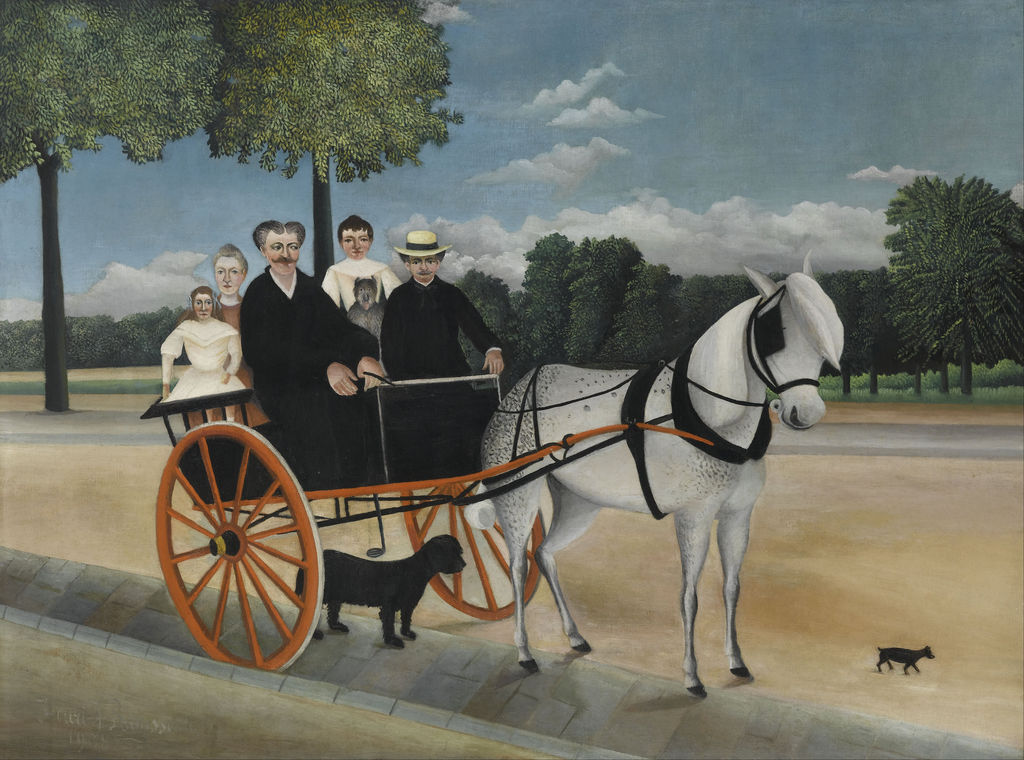
La Carriole du Père Junier, 1908. Musée de l’Orangerie, Paris, RF 1960 26. A commission rooted in Rousseau’s neighbourhood relationships, developed from a photograph. Google Art Project reproduction via Wikimedia Commons. Image source. Public domain. Resized only; complete supplied painting retained.
The room on the rue Perrel
Uhde's German monograph of 1921 brings the reader into Rousseau's neighbourhood through the rue de la Gaîté and rue Vercingétorix, then into the small street where the painter lived above a plaster caster's premises. He remembered a sign advertising diction, music, painting and solfège. The range of lessons makes the studio's activities concrete: the room was a working place for several arts, within a neighbourhood of small trades and modest households.[21]
In Uhde's account, visitors gather around a jungle picture that takes up much of the room. They offer opinions about its leaves and compare it with a previous exhibition painting. Rousseau asks what they think, listens, and intends to make further changes before the work is shown. Uhde turns the visit into a lively scene, supplying remembered dialogue and contrasting personalities. The passage is best read as a friend's crafted recollection. Its value lies in the social setting and the picture of a painter testing a composition before viewers.[21]
The same room changes function for an evening gathering. Uhde describes a folding bed put away, chairs arranged around the walls, wine on a table and a carpet acquired in exchange for paintings. Pupils, neighbours, young painters and writers enter the account together. Space and possessions have to be rearranged so that hospitality can occur. The studio's celebrated sociability depended on these ordinary adjustments.[21]
Rousseau's own letter to the arts orphanage in June 1910 provides a different kind of evidence. He specified morning and afternoon visiting hours, regretted that work prevented him from travelling freely, and invited the recipient to one of his literary and musical evenings. Unlike Uhde's reconstructed scene, the letter is a dated act of arranging contact. Together they show a painter whose days contained work, teaching, appointments and the preparation of gatherings.[1]
This setting also gives the local portrait commissions a fuller significance. A neighbour could be a customer, a sitter, a pupil or someone providing food and credit. Pictures moved through relationships sustained at close quarters. The later collector who encountered a Rousseau in a dealer's gallery saw an object whose earlier life might have begun within that dense web of ordinary exchanges.[12][21]
Jungles, exhibitions and new supporters after 1905
The Salon d'Automne of 1905 brought a new degree of visibility. Rousseau exhibited The Hungry Lion, a large jungle composition, in the season that made the Fauves notorious. Reviews and reproductions placed his work in an increasingly prominent contemporary setting. He exhibited at the Salon d'Automne again in 1906 and 1907, while maintaining his loyalty to the Indépendants. His late success developed through more than one exhibition platform.[2]
The jungles became a sustained late repertoire. Rousseau combined plants and animals studied or encountered in Paris with forms available through illustrations. The Jardin des Plantes, museum galleries and glasshouses made unfamiliar life visible within the city. Illustrated journalism and the great exhibitions circulated images shaped by colonial expansion. In his paintings, this material became forests that could enclose a violent struggle, a quiet gathering of monkeys or a mysterious human presence. He varied his subjects as interest from buyers increased.[15]
Among those drawn into his circle were Robert Delaunay, Sonia Delaunay, the critic and collector Wilhelm Uhde, and the American painter Max Weber. The precise dates of some introductions vary between accounts; the relationships are well established by the later years of the decade. Delaunay's mother, Berthe, commissioned The Snake Charmer, exhibited in 1907. Weber became a friend and purchaser. Uhde would play an important role in organising exhibitions and in shaping Rousseau's reputation through the first monograph.[22]
Uhde later recalled watching Rousseau work on The Snake Charmer and hearing him weigh changes to its colour and composition. Published in Uhde’s 1938 memoir, the account presents a painter testing the balance of a large picture: whether to lighten or darken it, whether to add or remove a form. It is a late recollection, yet a particularly useful one because it attends to the decisions made at the easel rather than to the artist’s celebrated manner in company.[22]
Dealers also mattered. Ambroise Vollard became a principal buyer near the end of Rousseau's life; Joseph Brummer was another supporter. The painter Serge Férat and his sister, the Baroness d'Oettingen, purchased work, as did the Italian writer and artist Ardengo Soffici. These relationships broadened the market beyond the neighbours and tradespeople who had bought or commissioned pictures earlier. Sales and recognition grew together, although prices and the irregular arrival of payment left the painter vulnerable.[22][2]
The coexistence of ambition and shortage is especially clear in his correspondence. While painting Apollinaire and Marie Laurencin in The Muse Inspiring the Poet, he asked for advances and explained the difficulty of paying for materials and living through a picture that took months to complete. A pension did not remove those pressures. The letters offer a practical view of his labour: a major painting consumed time, and its maker needed support before it could be finished.[2]
A patron becomes a sitter
The Portrait of Joseph Brummer, commissioned in 1909 and now in London's National Gallery, gives one of those new supporters a commanding presence. Brummer sits in a red-covered wicker chair with a cigarette in his right hand, surrounded by carefully separated layers of vegetation. The young dealer's direct gaze and settled posture make the portrait feel assured.[23]
Brummer dealt in African art and supported Rousseau through purchases as well as the commission. The portrait joins the two men within the work itself: a patron receives an image of his own status, while Rousseau applies the portrait-landscape arrangement he had already used to assert his identity as an artist. The setting surrounds an individual with an invented world whose order belongs recognisably to its painter.[23]
Its later history also shows how this circle was dispersed. Uhde acquired the portrait in 1912; the French government confiscated it as German-owned property during the First World War, and it was sold in 1921. Friendship, collecting and the movement of pictures became entangled with international events after Rousseau's death.[23]
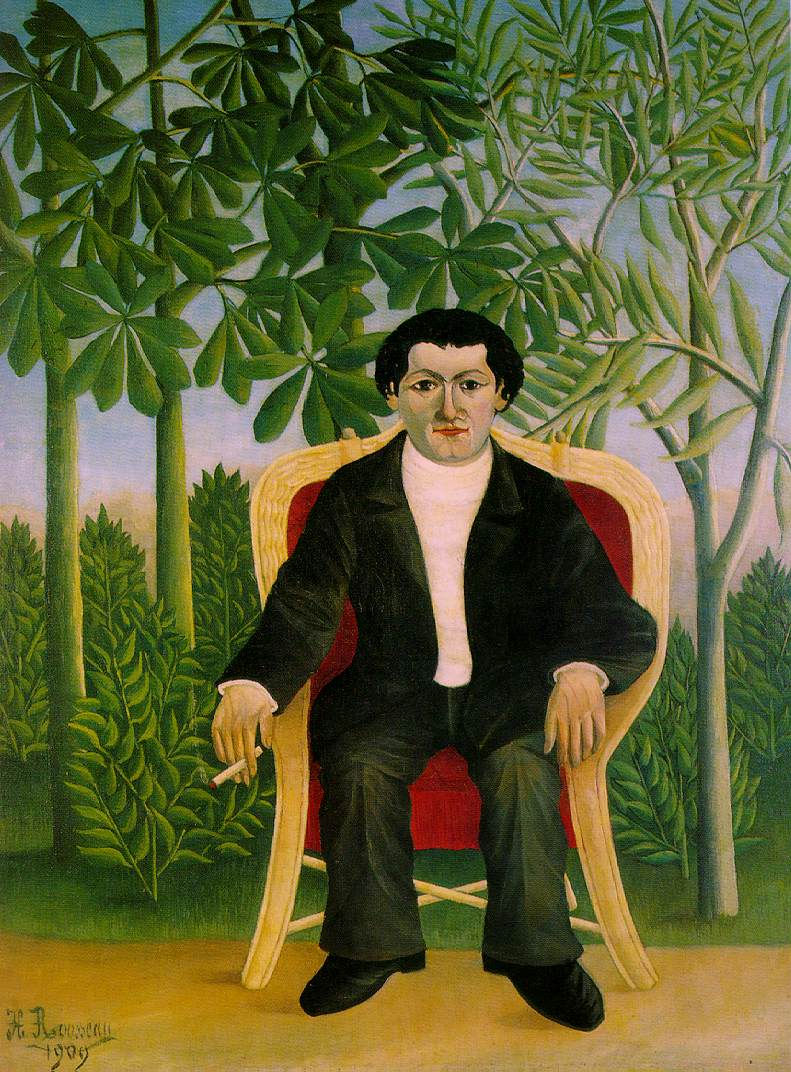
Portrait of Joseph Brummer, 1909. National Gallery, London, NG6699. Bequeathed by Simon Sainsbury, 2006; entered the Collection in 2023. Public-domain reproduction via Wikimedia Commons. Image source. Public domain. Re-encoded only; complete supplied image retained at native pixel dimensions.
Legal trouble and the banquet of 1908
These years also brought a serious prosecution. In 1907 Rousseau became involved in a bank fraud organised by Louis Sauvaget, an acquaintance from an amateur orchestra. Shattuck's account describes the use of an assumed identity and forged banking documents. Rousseau spent several weeks in prison in December 1907, obtained release while awaiting trial, and received a suspended sentence of two years' imprisonment in January 1909. The arrest, subsequent release and eventual sentence were separate stages extending across more than a year.[24]
Later accounts often tell the case as a demonstration of his innocence of worldly affairs, recounting an amused courtroom and an advocate appealing for indulgence towards an exceptional artist. The conviction and the sentence remain the essential facts. Explanations of what Rousseau understood, or how completely Sauvaget deceived him, require more caution than the picturesque retellings usually allow. The contrast between the guilty verdict and the indulgent stories surrounding it became part of his public reception.[24]
In 1908 Picasso bought a large portrait by Rousseau and organised the famous banquet in his honour at the Bateau-Lavoir. Apollinaire, Marie Laurencin, Fernande Olivier, Georges Braque, Gertrude and Leo Stein, and other members of the Paris artistic circle were among those associated with the evening. The event has come down through repeated recollections, combining decoration, music, drinking, poetry and the celebration of a much older painter.[2][22]
Its mixture of comedy and admiration resists a simple description. Some participants enjoyed Rousseau's grand manner, and later writers differed over the balance of homage and practical joke. His pictures had become something these artists wanted to live with and discuss. Picasso's purchase gave that interest a material form. The banquet made the relationship memorable, but it was one evening within a larger network of looking, friendship and collecting.[2][22]
Rousseau was himself a host. At his studio in the rue Perrel he arranged family and artistic evenings that brought pupils, neighbours, performers, writers and painters together. Surviving programmes, described by Shattuck, set out musical contributions and advertised his lessons. Weber's departure from Paris in December 1908 was marked by such a gathering. The studio's social life gives a fuller picture of Rousseau than the single celebrated occasion at Picasso's: he also made occasions, selected music and invited others into his own working world.[2][22]
The final season and an expanding reputation
In 1910 Rousseau exhibited The Dream at the Indépendants. A reclining woman on a sofa inhabits a dense tropical forest, joining the domestic interior to the imagined landscape with extraordinary assurance. It was one of the culminating pictures of his last season, when demand was increasing and favourable criticism had become more substantial. Hostile responses continued too. The change in his fortunes was real, though incomplete.[2]
The June letter to the arts orphanage shows him working, welcoming visitors at specified hours and planning another musical evening. It records a life still in motion. Shattuck also cites his correspondence with Soffici as evidence that commissions were accumulating. Rousseau's final months therefore belong to a developing career: he had further pictures to make, relationships to maintain and sales to fulfil.[1][2]
He died in Paris on 2 September 1910, aged sixty-six, after a leg infection, and was buried at Bagneux. Delaunay and his landlord Queval helped secure his grave. Apollinaire composed the epitaph, whose imagined gifts of painting materials continued the friends' conversation with him beyond death. His remains were transferred to Laval in 1947. The small funeral described in the catalogue marks a poignant ending, while his exhibitions, letters and purchasers show how much recognition had already changed during his lifetime.[3][2]
The work began travelling into a wider public almost immediately. Max Weber's pictures and drawings formed the basis of an exhibition at Alfred Stieglitz's gallery in New York late in 1910. A retrospective followed at the Indépendants in 1911, the year Uhde published his first monograph, and a larger Paris exhibition was held at Bernheim-Jeune in 1912. Personal advocacy became an increasingly organised posthumous reputation.[22]
The German-speaking avant-garde became an important audience too. Kandinsky’s interest deepened in 1911–12 after he received Uhde’s book. Through Delaunay he acquired two Rousseau paintings, and the 1912 Blaue Reiter almanac reproduced seven works. Reproduction and correspondence carried the pictures into debates beyond Paris, allowing artists who had not shared Rousseau’s daily life to encounter the force of his arrangements.[22]
Collectors and museums extended it. The National Gallery in Prague acquired Myself: Portrait–Landscape in 1923. The Orangerie's 2026 chronology records Albert Barnes's first Rousseau purchase through Paul Guillaume in the same year, beginning a major collection. The Snake Charmer passed through Jacques Doucet's collection into the French national collections through his bequest, which took effect in 1936. Such histories transformed pictures made under precarious conditions into central works in public accounts of modern art.[17][25]
Friends, witnesses and the making of a legend
The people who preserved Rousseau's work also shaped the story by which it was understood. Uhde's 1921 book makes this unusually clear. Near the beginning, he admits how little exact information was available and imagines important paintings still hanging unnoticed in modest homes and workplaces. A complete chronology and catalogue, he explains, belong to a future undertaking. His immediate purpose is to testify to the quality of the man and the art he had known.[21]
That testimony mixes valuable observation with errors and idealisation. The book repeats the story of military service in Mexico, even though later research established that Rousseau never went there. It also presents the artist through an emphatic language of childhood, purity, faith and love. These descriptions helped readers admire a painter whom academic standards had made difficult to accommodate. They also encouraged the impression that his work flowed from an exceptional innocence outside ordinary history.[21][2]
The publication's opening belongs to the aftermath of the First World War. Uhde addresses Rousseau's grave and contrasts the artist's generosity with the destructive ambitions of the surrounding world. He recalls being shown a German flag beside the French tricolour during a visit on the national holiday. Written in 1921, the passage makes an international moral example of the friendship. It is a revealing part of Rousseau's posthumous reception, rather than a neutral introduction to his life.[21]
Reading such accounts beside the letters changes the balance. The letters disclose a man who planned, advertised, negotiated and insisted upon his credentials. The memoirs preserve affection, atmosphere and the ways his friends remembered him. Both have a place, provided their different kinds of evidence remain visible. Rousseau's biography becomes richer when the practical artist can be seen alongside the figure his admirers created.[1][21]
Rousseau's place in modern art
Rousseau's dates matter to his historical position. Born in 1844, he belonged to the generation of Monet, Cézanne and Redon, although he became close to artists several decades younger. Michel Hoog emphasised this in his essay Rousseau in His Time. The older painter's late arrival in avant-garde circles can otherwise make him seem to have emerged from nowhere around Picasso. His career had grown within the exhibition world and visual culture of the late nineteenth century.[26]
His work gave younger artists something unusually direct to consider: a composition could be convincing through its colour, rhythm, proportions and imaginative unity even when it departed sharply from academic perspective. Portraits, factory suburbs and tropical forests all supplied examples. The breadth of his subjects also matters. The paintings include modest views and intimate commissions beside the large exhibition canvases; each kind of work had its own place in the career.[15][26]
Recent technical research has made the labour behind the images more visible. The Orangerie's 2026 exhibition booklet describes scientific examination of supports, pigments, underlying drawing and changes made during execution. Its radiograph of Portrait of a Woman in a Landscape reveals an earlier child portrait beneath the composition. Reuse and revision place fresh evidence beside the written record of a painter who spoke repeatedly about reworking and perseverance.[25]
The scale of recent investigation also matters. The Barnes Foundation reported that its 2021–24 research identified five underlying paintings, eight reworked compositions and five revised dates among the works studied. Such findings make changes of purpose and composition part of the material record of the career. A confident final outline can conceal several earlier decisions.[27]
Its 2025 annual report describes infrared and multispectral examination of Portrait of a Woman in a Landscape and Outskirts of Paris, together with infrared imaging of The Rabbit's Meal and The Family. It also records the treatment of Unpleasant Surprise, including work on unstable paint, old retouching and uneven varnish. These are investigations of particular objects; their results need to stay attached to those objects. They give the biography a firmer account of labour, alteration and survival without supplying a universal recipe for every Rousseau painting.[28]
Those letters give Rousseau's biography its most dependable centre. He asked for purchases, described his work, named his supporters, sought teaching appointments and explained what it cost to keep painting. Around that record gather the portraits of friends, the official projects, the music and the forests. Together they reveal a working artist who spent years building the conditions in which his imagination could become public.[1]
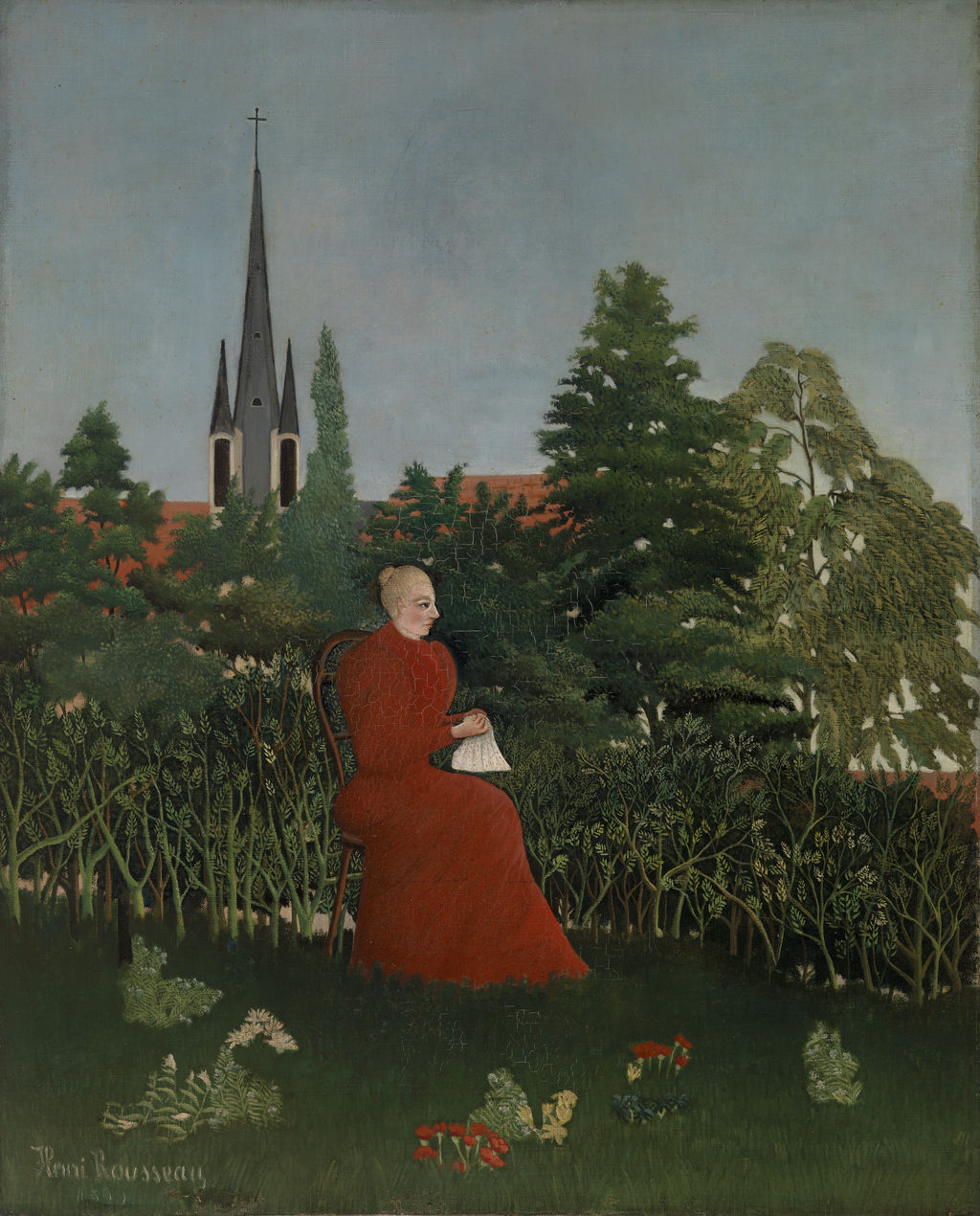
Portrait of a Woman in a Landscape, 1899. Barnes Foundation, BF260. Examination has revealed an earlier child portrait beneath this composition; the image shows the visible painting. Image source. Public domain. Resized only; complete supplied painting retained.
Henri Rousseau artworks directory
This directory brings together works covered on this site and other works documented in the cited museum records and catalogues. Alternate titles share one entry; distinct versions remain separate. Historical dates for works without an article follow the cited catalogues. This is not a catalogue raisonné.
Frequently Asked Questions
Rousseau was born in Laval, France, on 21 May 1844. He died in Paris on 2 September 1910.[3]
The nickname refers to his employment at the Paris octroi, which collected municipal duties on goods entering the city. He worked there from 1871 until his retirement in December 1893.[2]
Discussion
Look again at the images and ideas explored in Henri Rousseau: Biography. These editorial prompts invite your observations.
Reader Insights
How does knowing about Rousseau's teaching and musical work change the figure suggested by his jungle paintings?
What does Myself: Portrait–Landscape communicate about the professional identity he wanted to establish?
How might his small suburban views and his large exhibition pictures have spoken to different audiences?
Join the Conversation
Share a detail, comparison or question about Henri Rousseau: Biography below.
References
- Henri Rousseau. Autobiographical note and letters, translated by Richard Miller, in Henri Rousseau: Essays, Museum of Modern Art, 1985, pp. 256–261; especially letters of 25 June 1884, 7 June 1893, 16 October 1905 and 14 June 1910. View source.
- Museum of Modern Art. “Chronology,” pp. 91–95, and Roger Shattuck, “Object Lesson for Modern Art,” pp. 11–22, in Henri Rousseau: Essays, 1985. Early life: pp. 12–13 and 91; exhibition career and retirement: pp. 13–17 and 92–94; final season: pp. 21–22 and 95; catalogue entry 66, The Dream, pp. 250–254. View source.
- Bibliothèque nationale de France. “Rousseau, Henri (1844–1910)”, authority record FRBNF11922875, birth and death fields. View source. (in French).
- The Museum of Modern Art, Henri Rousseau: Essays (1985), selected catalogue entries, chronology and notes on early devotees. View source. Selected entries, chronology (pp.91–95) and early-devotee notes (pp.262–264) were consulted. Historical collection credits do not establish present ownership.
- Philadelphia Museum of Art, Carnival Evening,1963-181-64,object59593. View source.
- Musée de l’Orangerie / Juliette Degennes, Henri Rousseau,L’ambition de la peinture: Un artiste dans son époque (in French). View source.
- National Gallery, London. Henri Rousseau, Surprised!, NG6421, 1891, “In-depth” discussion of the painting, its Parisian sources and reception at the Salon des Indépendants. View source.
- Musée d’Orsay, La Guerre,RF19461 (in French). View source.
- MoMA, The Sleeping Gypsy. View source.
- Philadelphia Museum of Art, The Merry Jesters, 1950-134-176, object51097. View source.
- Musée d’Orsay, La Charmeuse de serpents, RF 1937 7 (in French). View source.
- Musée de l'Orangerie. La Carriole du Père Junier, 1908, RF 1960 26, collection commentary on the commission and photographic source. View source. (in French).
- Solomon R. Guggenheim Museum / Cornelia Lauf, The Football Players,60.1583: current collection record. View source.
- MoMA, The Dream, 252.1954. View source.
- Musée de l'Orangerie. Henri Rousseau, l'ambition de la peinture, exhibition texts, 2026, sections “Moi-même, peintre,” “Rousseau et son cercle,” “Variations et déclinaisons,” “L'ambition de la peinture officielle,” “Aux origines d'un style” and “Un style à soi.” View source. (in French).
- MANAS, Musées de Laval. “Henri Rousseau, dit le Douanier”, biography and discussions of Le Pont de Grenelle and Vue de l'île Saint-Louis prise du pont Henri IV. View source. (in French).
- National Gallery Prague. “International Customs Day | Customs Official Rousseau”, discussion of Myself: Portrait–Landscape, 1890, and its 1923 acquisition. View source.
- J. Paul Getty Museum, Henri Rousseau, A Centennial of Independence, 1892, collection record; composition independently inspected in the museum’s open-content reproduction. View source.
- Henri Béhar. “Jarry, Rousseau, and Popular Tradition,” in Henri Rousseau: Essays, Museum of Modern Art, 1985, pp. 23–27, especially pp. 24–25 on L'Ymagier, the War lithograph and Jarry's 1897 stay. View source.
- Laurent de Freitas. “Léon-Paul Fargue et Alfred Jarry : autour d'une même passion pour la peinture, 1892–1894,” L'Étoile-Absinthe, nos. 103–104, hiver 2004, published 2005, pp. 7–30; Rousseau section pp. 26–28. Discusses Rousseau's letter of 26 June 1894 and quotes Fargue's 1939 recollection. View source. (in French).
- Wilhelm Uhde, Henri Rousseau, Dresden: Rudolf Kaemmerer, 1921, printed pp. 11–14, 22–30 and 44–45. German edition: retrospective studio scenes, admission of incomplete documentation, postwar tribute and erroneous Mexico narrative; these are distinguished from dated correspondence. View source.
- Museum of Modern Art. “Notes on Early Devotees of Henri Rousseau,” in Henri Rousseau: Essays, 1985, pp. 262–264; Roger Shattuck, “Object Lesson for Modern Art,” same volume, pp. 17–19. Includes later recollections by Uhde and Weber, identified as such in the catalogue. View source.
- National Gallery, London, Henri Rousseau, Portrait of Joseph Brummer, 1909, NG6699, current commentary, key facts and provenance, consulted 24 October 2026. View source.
- Roger Shattuck. “Object Lesson for Modern Art,” p. 20, and “Chronology,” p. 94, in Henri Rousseau: Essays, Museum of Modern Art, 1985, accounts of the 1907 bank fraud, imprisonment and January 1909 sentence. View source.
- Musée de l'Orangerie. Henri Rousseau, l'ambition de la peinture: programme de salle, March 2026, unnumbered eight-page PDF, printed pp. 6–9: collecting chronology, “Les tableaux manifestes” and “La matérialité de l'œuvre d'Henri Rousseau.” View source. (in French).
- Michel Hoog. “Rousseau in His Time,” in Henri Rousseau: Essays, Museum of Modern Art, 1985, pp. 28–34, especially pp. 29–33 on his generation, varied subjects and modern artistic context. View source.
- Barnes Foundation, “Barnes Foundation Presents World Premiere of Landmark Exhibition Henri Rousseau: A Painter’s Secrets”, 7 August 2025, research conducted 2021–24 and summary of underlying compositions, revisions and changed dates. Retirement-age error in the release is not adopted. View source.
- Barnes Foundation, FY25 Annual Report, “Conservation and Exhibitions,” printed p. 27 (PDF p. 15), object-specific Rousseau imaging and treatment activities in 2024. View source.
- Daniel Catton Rich, Henri Rousseau (The Museum of Modern Art, 1942), selected drawings and landscape studies; historical catalogue. View source. The dated 1942 publication is used for the two Quai d’Auteuil ink views; its Malakoff date differs from the 1985 catalogue.
- National Gallery of Art, Self-Portrait (1895), pen-and-ink drawing, accession 1995.47.66. View source.
- The Museum of Modern Art, War (published January 1895), lithograph, accession 684.1943. View source.
- Barnes Foundation, Landscape and Four Young Girls, object 5521, BF855. View source.
 Henri Rousseau.jpg)