


 Henri Rousseau.jpg)
 by Tom Gurney
Tom Gurney BSc (Hons) is an art history expert with over 20 years experience
Published on June 19, 2020 / Updated on October 29, 2026
Email: tomgurney1@gmail.com / Phone: +44 7429 011000
Outskirts of Paris (Environs de Paris): Introduction
A broad brown street bends around a group of pale houses. Four small figures and a dark buggy occupy its far edge, beneath telephone wires drawn almost horizontally across the picture. Above them, an immense bank of clouds makes the roofs look low. Henri Rousseau's Outskirts of Paris (Environs de Paris) gives this modest street an unexpected scale: its everyday traffic is tiny, while the walls, houses and sky command the view. The Barnes Foundation dates the oil painting to about 1906–10 and identifies it as BF844.[1]
At a Glance
- ArtistHenri Rousseau
- SubjectOutskirts of Paris (Environs de Paris)
- ExploreA street with two different edges; Four figures and a hooded buggy
This work across Henri Rousseau’s career
Carnival Evening
1886 [2]The Merry Jesters
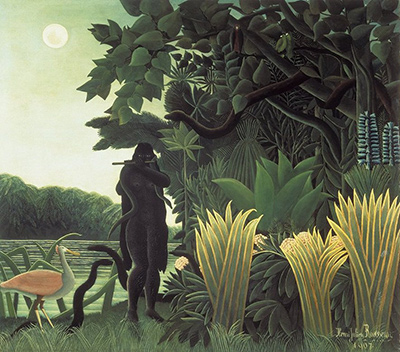
1906 [7]The Snake Charmer
1907 [8]Contents
- A street with two different edges
- Four figures and a hooded buggy
- Wires, poles and chimneys
- A large sky above a narrow human world
- An unnamed neighbourhood and a graphic imagination
- Annotated details
A street with two different edges
The road provides the viewer's point of entry. It spreads across the bottom of the canvas, leaving a generous open space before any person or building is reached. Its warm brown colour continues towards the right, where the houses conceal the route ahead. We can follow the bend without seeing its destination. This gives the picture a quiet forward movement, even though the tiny people offer few signs of hurried activity.
On the left, a long peach-coloured wall holds the street's far boundary. Its top slopes gently down towards the right, carrying the eye towards the bend. A darker strip at its foot separates the walking space from the road. Above it, shrubs obscure the ground around a low white house with a red roof. The wall therefore gives us a clear direction along the street while hiding most of the land behind it. A distant green rise is visible, but access to that space remains blocked.
The buildings on the right establish a different sort of boundary. Their cream façades turn towards us and then retreat around the corner. Dark windows, pale shutters and a slanting roof edge help distinguish their separate faces. A black iron fence curves through the lower-right foreground, bringing a much sharper pattern close to the viewer. We stand between two kinds of enclosure: a broad, nearly unbroken wall across the middle distance and an articulated sequence of houses and railings beside us.
Look from the wall's left end to the right-hand fence and the importance of this arrangement becomes clear. The road's open surface is framed by objects that limit what can be seen beyond it. The picture allows an imagined walk through the neighbourhood, yet withholds the gardens, interiors and continuation of the street. Its interest lies partly in these successive limits to our view.
Four figures and a hooded buggy
The Barnes describes four people and a buggy in the street.[1] Their scale encourages a closer look. At the left, two figures overlap so tightly that they initially read as one compact red-and-black shape. Near the centre, a dark figure with a broad hat carries a slender stick. Farther right, another small figure stands close to the corner, with a patch of red beside the dark clothing. Faces and gestures remain too small to supply a confident account of who these people are or how they know one another.
Their spacing matters more to the composition than an invented story would. The pair at the left forms the largest human group. The central walker supplies a separate vertical accent. The right-hand figure sits close to the point where the road disappears. Together they measure the length of the wall in uneven intervals. The larger gap around the central walker leaves that person conspicuously alone against the pale surface, while the figures nearer the ends seem more closely attached to their surroundings.
The buggy introduces a different silhouette between the walker and the far-right figure. Its tall grey hood rises above a nearly black opening, with dark wheels marking its lower sides. Against the wall, it resembles a small upright niche. This is an effect of shape and contrast; the vehicle's diminutive rendering does not reveal its occupants or justify a detailed account of its construction. Its broad dark centre gives the eye a firm stopping point in a row otherwise made from very narrow human marks.
Because all these forms remain close to the wall, the foreground road feels especially spacious. Rousseau leaves its surface largely uninterrupted. We look across that space towards the figures, rather than joining a dense crowd in their midst. This distance contributes to the scene's reserve: people are present and the street is inhabited, but their private concerns remain beyond our reach.
Wires, poles and chimneys
The thin lines crossing the view are telephone wires, as the Barnes identifies them.[1] They pass above the red roof of the low house and continue towards the buildings on the right. Two slender poles stand beside the wall, one darker and longer than the other. Their plain verticals are easy to overlook beside the brighter clothing and roofs, yet they tie the lower street to the space overhead.
Follow the wires across the painting and several disconnected parts begin to belong to one visual system. The poles rise from the pedestrian strip; the wires traverse shrubs and open sky; the right-hand roofs interrupt their course. Their near-horizontal direction also answers the upper edge of the wall below. The wall is broad, opaque and earthy in colour. The wires repeat its general direction with almost no weight at all. Looking between them makes the different densities of Rousseau's forms particularly apparent.
On the right, the chimneys provide sturdier vertical accents. Their pale shafts and red pots step upwards with the rising roofline. Below, the fence divides the foreground into a closely spaced series of dark bars. Poles, chimney stacks and railings thus establish three distinct rhythms: isolated uprights across the street, larger blocks above the houses, and a quick succession of bars near our feet. The eye can move between them without depending on the road alone to explain the depth.
The telephone equipment is also a concrete part of the neighbourhood represented. Its presence makes this a street with connections extending beyond the picture. Rousseau gives those connections a visible graphic form: a few taut lines spanning an otherwise enclosed view.
A large sky above a narrow human world
The cloud bank occupies much of the upper canvas. Its pale rounded masses rise on both sides and dip around the middle, beneath a cooler blue-grey strip of sky. Lower down, softer grey passages seem to settle behind the trees and roofs. These broad shapes press the inhabited strip towards the bottom of the picture. The street may be our route into the scene, but it occupies only a small part of the world presented above it.
The nearest contrast is between clouds and wires. One has swelling edges and tonal transitions; the other consists of fine, almost straight strokes. The wires cross in front of the pale bank without diminishing its bulk. As a result, the same stretch of sky can be read at two scales: as a huge atmospheric mass and as the background for a small piece of street infrastructure. That change in scale gives an ordinary view much of its visual drama.
Colour creates quieter connections below. Red roof tiles recur in the little patches of clothing along the wall, while red chimney pots carry the colour upwards on the right. These small repetitions bring the figures into the architecture's colour pattern. Cream walls and façades occupy a wider range of the surface, between the brown road and grey-white sky. Black windows, foliage, clothing and railings punctuate those pale areas with varying degrees of sharpness.
The tall dark tree behind the low red roof is particularly useful to the eye. Its irregular outline interrupts the wires and rises towards the clouds, bridging the low house and the large sky. Near the far-right edge, another mass of foliage breaks the geometric order of the nearest façade. These interruptions keep the built forms from closing into a completely regular arrangement.
Annotated Details from Outskirts of Paris (Environs de Paris)
The numbered points identify visible features discussed in this article. Return from each detail to the whole composition. Henri Rousseau, Outskirts of Paris (Environs de Paris), c. 1906–1910. Barnes Foundation, Philadelphia, BF844. Museum-derived reproduction published on Wikimedia Commons in 2018. Image source. Public domain. Numbers added to the overview; details cropped from the published original. No recolouring or retouching.
.jpg)
Details from OUTSKIRTS OF PARIS (ENVIRONS DE PARIS)
Locate the small street figures and buggy, follow the telephone wires, then compare the nearest shutters, chimneys and railings.
Small figures along the wall
The overlapping pair at the left and the separate hatted walker mark uneven intervals along the peach-coloured wall. Their small scale leaves the open foreground road remarkably spacious.
 Detail 01 small-figures-along-the-wall.jpg)
A dark buggy beneath a tall hood
The buggy’s grey hood rises above a dark opening and narrow wheels. A separate figure stands closer to the bend, adding another small upright accent against the wall.
 Detail 02 a-dark-buggy-beneath-a-tall-hood.jpg)
Fine wires above a red roof
Near-horizontal telephone wires cross the low red roof and pale sky. The dark tree and small steeple interrupt this span, linking the low buildings with the much larger cloud bank.
 Detail 03 fine-wires-above-a-red-roof.jpg)
Shutters, chimneys and curving railings
Pale shutters and dark windows divide the nearest façades. Chimney stacks step above the sloping roofs, while closely spaced iron bars curve around the foreground edge of the street.
 Detail 04 shutters-chimneys-and-curving-railings.jpg)
An unnamed neighbourhood and a graphic imagination
The title places the scene around Paris without identifying an exact street. The Barnes suggests that Rousseau may have represented the neighbourhood where he worked. That remains a possibility, rather than a documented location. The museum also identifies a church steeple beyond the wall, a small distant feature within the much larger arrangement of vegetation and sky.[1] Together, the title and these details give the place a plausible everyday character while leaving its precise geography open.
The Barnes connects Rousseau's dramatic graphic effects with his interest in popular visual culture, including postcards and adventure-novel covers.[1] Here that interpretation directs attention to the legibility of the main shapes: the wall's long band, the road's open wedge, the dark buggy hood and the emphatic roof slopes. Each survives as a distinct form even when the reproduction is small. The museum's broader argument does not identify a particular postcard or cover as the model for this painting.
The street's buildings, people and utility equipment provide recognisable particulars, while their arrangement makes the whole view clear and compact. A viewer can read the major divisions quickly, then spend longer discovering the small intervals between figures, the changing directions of house walls and the wires crossing above them. Further discussion of Rousseau's style and technique can begin with this practical question: how much of a place can be conveyed by a few strongly separated shapes?
At 38 × 46 centimetres, the canvas holds this extensive sequence of barriers and connections within a modest format.[1] The bend in the road offers a route forward; the wall screens the landscape; the windows suggest interiors; the wires continue across the view. Each element gives a little information and keeps something back. That balance allows the street to feel specific without turning its inhabitants or buildings into an explanatory story.
Henri Rousseau artworks directory
This directory brings together works covered on this site and other works documented in the cited museum records and catalogues. Alternate titles share one entry; distinct versions remain separate. Historical dates for works without an article follow the cited catalogues. This is not a catalogue raisonné.
Frequently Asked Questions
The painting belongs to the Barnes Foundation in Philadelphia, where its inventory number is BF844.[1]
The Barnes dates it to about 1906–10. It is oil on canvas and measures 38 × 46 centimetres.[1]
The Barnes proposes this as a possibility. An exact street or workplace has not been established in its published description.[1]
The Barnes discusses postcards and adventure-novel covers as part of the popular visual culture informing his graphic approach. Its description does not name a particular source image for this painting.[1]
Discussion
Look again at the images and ideas explored in Outskirts of Paris (Environs de Paris). These editorial prompts invite your observations.
Reader Insights
Trace the road, wall and telephone wires separately. Which offers the strongest route through the picture?
How would the street's scale change if the figures were larger or moved into the foreground?
Which details make the neighbourhood feel accessible, and which keep the viewer outside?
Join the Conversation
Share a detail, comparison or question about Outskirts of Paris (Environs de Paris) below.
References
- Barnes Foundation. Outskirts of Paris (Environs de Paris), Henri Rousseau, BF844, current object record, identity fields and complete short description; accessed 23 October 2026. View source.
- Philadelphia Museum of Art, Carnival Evening,1963-181-64,object59593. View source.
- Musée de l’Orangerie / Juliette Degennes, Henri Rousseau,L’ambition de la peinture: Un artiste dans son époque (in French). View source.
- National Gallery, Surprised!, NG6421. View source.
- Musée d’Orsay, La Guerre,RF19461 (in French). View source.
- MoMA, The Sleeping Gypsy. View source.
- Philadelphia Museum of Art, The Merry Jesters, 1950-134-176, object51097. View source.
- Musée d’Orsay, La Charmeuse de serpents, RF 1937 7 (in French). View source.
- Musée de l’Orangerie, La Carriole du Père Junier, RF 1960 26 (in French). View source.
- Solomon R. Guggenheim Museum / Cornelia Lauf, The Football Players,60.1583: current collection record. View source.
- MoMA, The Dream, 252.1954. View source.
- The Museum of Modern Art, Henri Rousseau: Essays (1985), selected catalogue entries, chronology and notes on early devotees. View source. Selected entries, chronology (pp.91–95) and early-devotee notes (pp.262–264) were consulted. Historical collection credits do not establish present ownership.
- Daniel Catton Rich, Henri Rousseau (The Museum of Modern Art, 1942), selected drawings and landscape studies; historical catalogue. View source. The dated 1942 publication is used for the two Quai d’Auteuil ink views; its Malakoff date differs from the 1985 catalogue.
- MANAS, Laval, Henri Rousseau, dit le Douanier, urban landscapes and preparatory study (in French). View source.
- National Gallery of Art, Self-Portrait (1895), pen-and-ink drawing, accession 1995.47.66. View source.
- The Museum of Modern Art, War (published January 1895), lithograph, accession 684.1943. View source.
- Barnes Foundation, Landscape and Four Young Girls, object 5521, BF855. View source.
 Henri Rousseau.jpg)
 Henri Rousseau.jpg)