



 by Tom Gurney
Tom Gurney BSc (Hons) is an art history expert with over 20 years experience
Published on June 19, 2020 / Updated on October 29, 2026
Email: tomgurney1@gmail.com / Phone: +44 7429 011000
Monkeys and Parrot in the Virgin Forest: Introduction
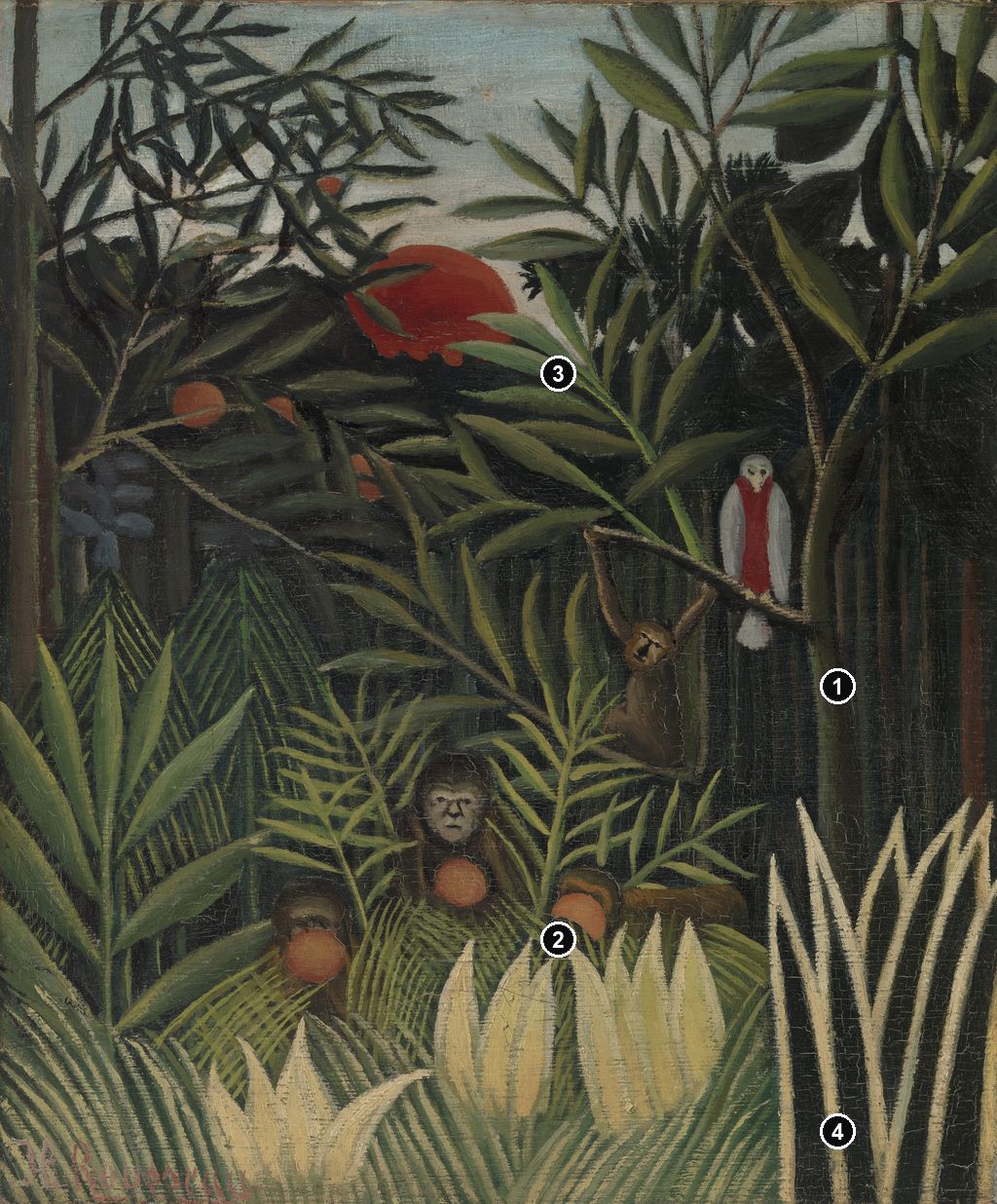
A white and red bird stands above a monkey suspended from a branch. Below them, other faces emerge through an intricate screen of leaves. In Henri Rousseau's Monkeys and Parrot in the Virgin Forest, recognition comes in stages: the eye catches a bright shape, follows its outline, then discovers an animal among forms it had taken for vegetation. The great red sun seems immediately legible, yet leaves cross its face too. Almost everything is partly withheld. Painted around 1906–1909, this small vertical canvas belongs to the Barnes Foundation in Philadelphia.[1]
At a Glance
- ArtistHenri Rousseau
- SubjectMonkeys and Parrot in the Virgin Forest
- ExploreA forest pressed close; Leaves that reveal and conceal
This work across Henri Rousseau’s career
Carnival Evening
1886 [2]The Merry Jesters
1906 [7]The Snake Charmer
1907 [8]Contents
- A forest pressed close
- Leaves that reveal and conceal
- Finding the monkeys
- The red sun and the smaller warm colours
- An encounter in uncertain light
- A Parisian imagination of the forest
- Annotated details
A forest pressed close
The Barnes identifies the work as Monkeys and Parrot in the Virgin Forest (Singes et perroquet dans la forêt vierge), oil on canvas, accession number BF397. Its measurements are 56.2 centimetres high by 47.3 centimetres wide.[1] That upright format matters to the experience of the scene. Trunks run towards the top edge, leaves crowd in from both sides, and the foreground plants rise high enough to conceal much of the animals' bodies. There is little room to look around an obstacle. A viewer has to look between things.
A pale grey opening spreads across the upper part of the picture. Branches divide it into irregular patches, while pointed leaves reach into it from either side. Beneath this opening, the forest becomes so dense that a route through it is difficult to imagine. No path or long recession invites the eye towards a distant clearing. Instead, overlapping forms establish successive shallow intervals: a bright leaf before a dark trunk, an animal behind a frond, a branch passing across another cluster of leaves.
The bird and the monkeys seem close, but the plants prevent an unobstructed encounter. Their proximity makes the concealment more unsettling. We can inspect a face without gaining a clear account of the body or the space surrounding it. Even the dark areas remain active, filled with narrow lines that suggest further stems and trunks beyond the more visible vegetation.
Leaves that reveal and conceal
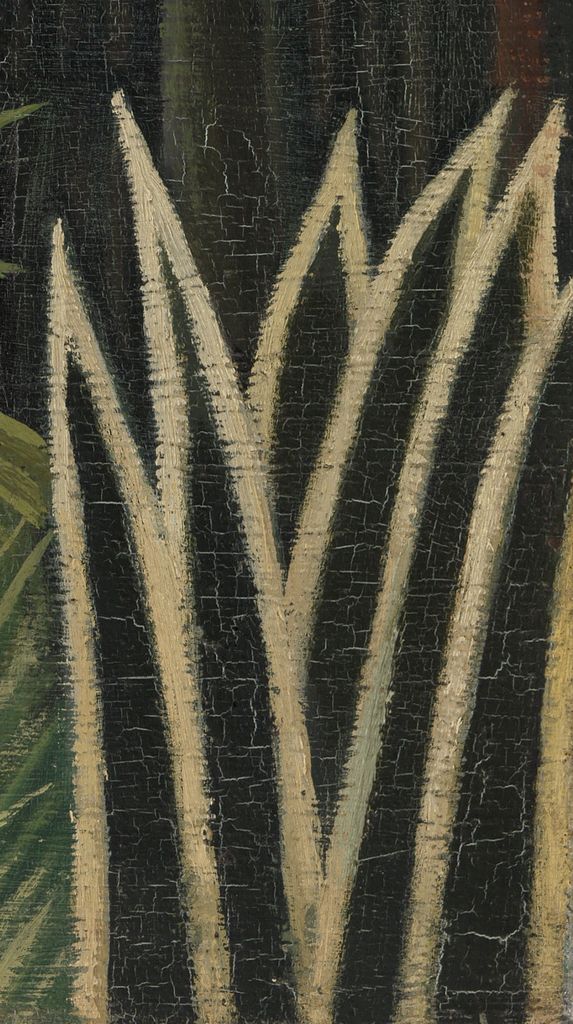
Cream-coloured blades open into pointed clusters across the foreground, rising sharply against the black-green forest behind them. Their edges are unusually easy to follow. At the lower right, a tall spray separates into long, narrow points, each held clear against darkness. Near the centre, broader pale leaves form a fan. Together they give the lower edge a bristling, almost radiant appearance.
These plants also interrupt access to the animals. A brown body or a round orange form may appear above the pale leaves, while the rest disappears behind them. Their brightness draws attention forwards just where the viewer might otherwise continue looking deeper into the picture. Following the tips upward brings us to another tier of vegetation and then, unexpectedly, to a monkey's face. The plants control the order of discovery.
Elsewhere, Rousseau varies the rhythm. Slender yellow-green fronds spread across the lower left like closely spaced ribs. Larger olive leaves cross the middle on strong diagonals. The upper branches carry narrow, darker leaves whose silhouettes form a loose lattice against the sky. These differences in width, spacing and angle prevent the forest from becoming a continuous green mass. A crowded surface remains readable because one kind of shape repeatedly gives way to another.
The leaves reach, fork and overlap; the darker trunks on the right hold their places behind them. That relatively steady background makes the foreground's changes of direction more conspicuous. The diagonal branch beneath the bird crosses this upright structure like a bar across a screen. It provides a perch, supports a hanging animal and gives the eye a firm line to follow through the foliage.
Finding the monkeys
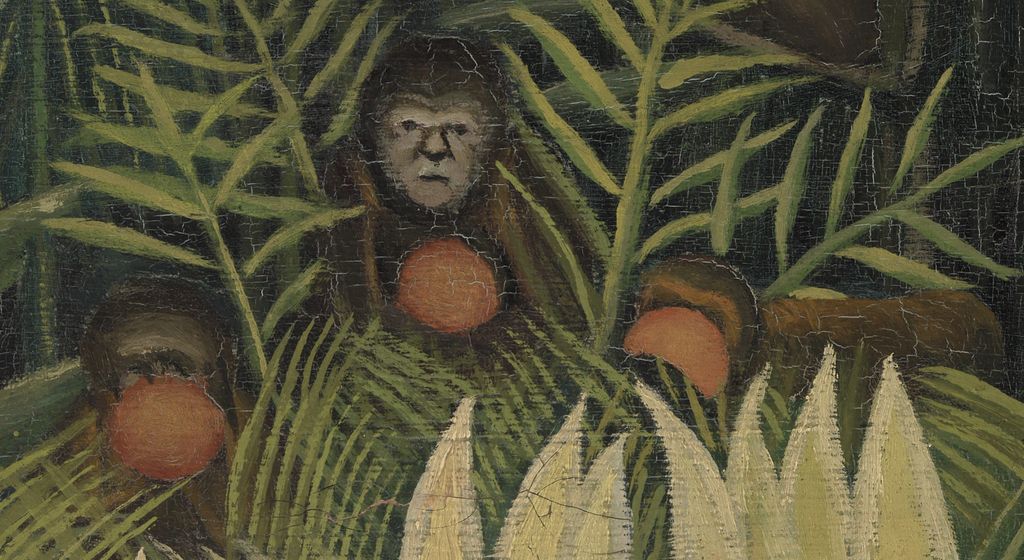
The pale face near the lower centre is the clearest invitation to look back into the forest. It faces outwards, with dark features set inside a light grey shape. An orange round form sits immediately beneath it. Around the head, fine leaves and dark fur approach similar tones, making the face appear briefly detached from its body. Once noticed, it becomes an anchor among the surrounding diagonals.
Lower to either side, brown faces and partial bodies are harder to distinguish. Orange fruit-like forms help locate them. The eye registers the warm circles before it has fully separated hands, heads and vegetation. A second look changes the apparent population of the picture: what seemed a plant-filled foreground becomes a space shared by animals. Because some bodies remain obscured, a precise inventory is less useful than attending to this process of recognition.
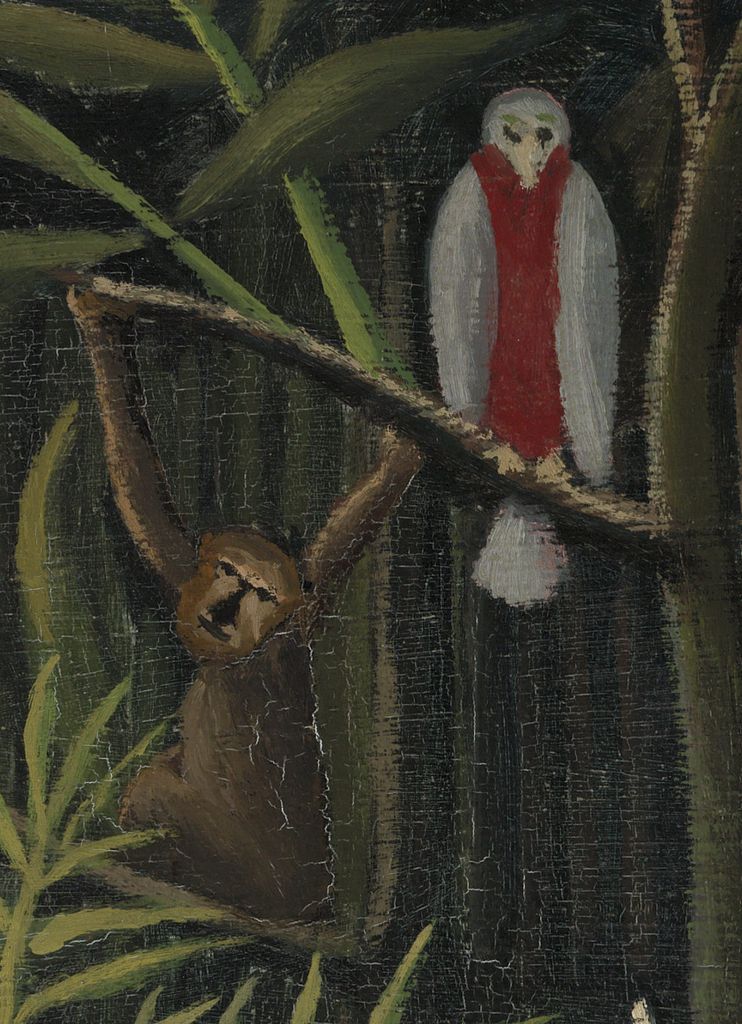
The suspended monkey offers a different kind of visibility. Its raised arms reach to the branch beneath the parrot, describing an open shape against the dark background. Its body hangs below, and its head turns within that framework. Where the lower monkeys are compressed into the foliage, this animal occupies a clearer interval between branch and leaves. The gesture makes the branch's supporting role tangible. It also links two levels of the scene, from the conspicuous bird above to the concealed animals below.
Several faces seem directed towards us, giving the encounter a reciprocal quality. We discover the animals while feeling that they may already have noticed us. Their expressions, however, remain difficult to settle. A frontal face can appear watchful, solemn or simply still. Nothing in the painting requires a single account of their feelings, and the hanging posture alone cannot tell us whether that monkey is bolder or more curious than its companions.
The parrot is easier to distinguish because of its pale body and strong red centre. Its compact head sits above a long, almost columnar body, with white extending down beside the red. Against the surrounding dark greens, it appears remarkably exposed. Yet it shares the monkeys' stillness. The scene contains varied poses without resolving into a single action; the animals hold separate positions within the same dense enclosure.
The red sun and the smaller warm colours
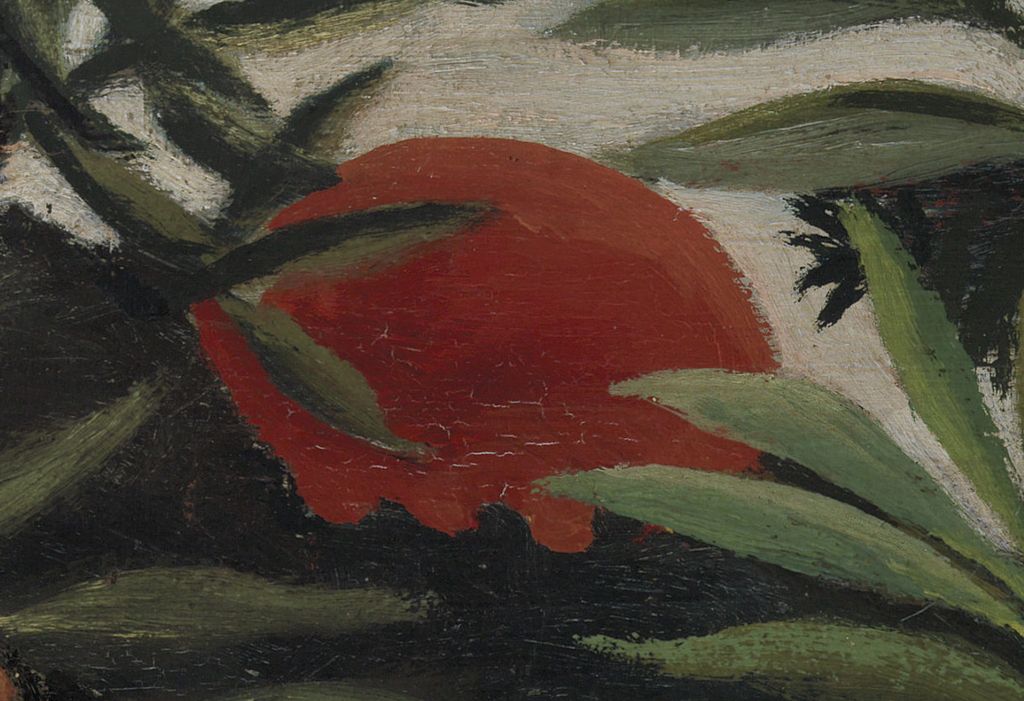
Above and to the left of the bird, the sun forms a large red disc behind crossing leaves. Its scale and colour make it one of the first things we see. It has a rounded simplicity that stands apart from the numerous pointed forms around it, although foliage breaks its contour and cuts across its surface. The brightest celestial shape is subject to the same screening as the animals.
The bird's red breast creates a smaller, more elongated echo on the other side of the composition. Farther down, orange circles mark the animals' positions; additional warm dots appear among the leaves on the left. These colours make a scattered chain through the greens. Looking from sun to bird to fruit carries the eye across the picture and down into the foreground, repeatedly changing the scale of attention.
The warm colours bind together objects separated by the vegetation. The great disc belongs to the sky, the red and white bird to its branch, and the orange forms to the lower tangle. Their warmth holds them in conversation across those divisions. It also makes the darker passages feel deeper by comparison, even where the arrangement provides little conventional distance.
The red sun has a quiet strangeness because it does not flood the whole landscape with red. The pale foreground, grey sky and dark interior maintain distinct appearances. Light seems concentrated in selected places. Rather than giving a consistent weather report, the colour arrangement sustains several simultaneous sensations: an open sky above, heavy shadow within the trees and startling brightness close to the viewer.
Annotated Details from Monkeys and Parrot in the Virgin Forest
The numbered points identify visible features discussed in this article. Return from each detail to the whole composition. Henri Rousseau, Monkeys and Parrot in the Virgin Forest, c. 1906–1909. Barnes Foundation, Philadelphia, BF397. Museum-derived reproduction published on Wikimedia Commons in 2018. Image source. Public domain. Numbers added to the overview; details cropped from the published original. No recolouring or retouching.
Details from MONKEYS AND PARROT IN THE VIRGIN FOREST
Find the bird and hanging monkey, search the lower foliage for faces, then compare the red sun with the pale foreground leaves.
A perched bird and a hanging monkey
The pale bird’s red centre stands out above the diagonal branch. Beneath it, the monkey reaches upwards with both arms, opening a clearer interval between the dark trunks and overlapping leaves.
Faces and orange forms among the fronds
A pale central face appears above an orange round form. Lower faces and bodies emerge less clearly to either side, as narrow fronds and pointed leaves interrupt their outlines.
A red disc crossed by leaves
Pointed leaves screen the large rounded red sun. Its warm colour remains conspicuous despite the broken contour, linking this upper opening with the smaller red and orange accents below.
Pale blades before dark trunks
Long cream-coloured points rise in front of the forest’s nearly black verticals. Their brightness pulls the eye towards the foreground, while sharp edges keep separate leaves legible within the crowded surface.
An encounter in uncertain light
The Barnes Foundation interprets the foreground's brightness through the imagined presence of a visitor's lantern. Its commentary also places the looming red sun in the final hours of a tropical night.[1] This reading makes sense of the dramatic difference between the pale near leaves and the recesses behind them. It encourages us to imagine arriving suddenly, with light revealing animals that have been hidden in darkness.
The lantern is a comparison offered by the museum; no lantern is depicted. Nor does the image fix an exact hour. The grey opening above the trees remains pale, while the red disc and deep shadows pull the atmosphere in another direction. Rousseau allows those features to coexist without supplying a plainly visible source for every illuminated shape. That uncertainty keeps the scene suspended between an observed moment and an imagined encounter.
Seen through the museum's interpretation, the foreground becomes the edge of a temporary revelation. The pale leaves occupy the zone nearest the arriving viewer, and faces appear farther back in the shadow. Seen simply as a colour construction, the same contrasts make those faces easier to discover while preserving much of their concealment. Both approaches return attention to the painting's carefully uneven visibility: some things announce themselves, others emerge slowly, and much remains covered.
A Parisian imagination of the forest
Rousseau's opportunities to study animals and plants help place this imagined encounter. The Barnes describes him as a Paris tax collector who taught himself to paint, and records his regular visits to the Jardin des Plantes, with its aviary and monkey house. It also states that he never visited an actual jungle.[1] Those circumstances provide a useful background without identifying a particular bird, monkey or plant as a direct model for this canvas. More about his working life can be found in the biography of Henri Rousseau.
Here, the compelling invention lies in the arrangement of the encounter. The jungle becomes a series of screens through which living creatures can be glimpsed. The hanging monkey's open gesture, the lower animals' partly concealed faces and the bird's bright upright body offer different degrees of exposure. Looking moves continually between them. The longer we attend to the painting, the less its abundant vegetation feels like a background: every leaf participates in deciding what we can see.
Henri Rousseau artworks directory
This directory brings together works covered on this site and other works documented in the cited museum records and catalogues. Alternate titles share one entry; distinct versions remain separate. Historical dates for works without an article follow the cited catalogues. This is not a catalogue raisonné.
Frequently Asked Questions
The Barnes Foundation currently dates the painting to around 1906–1909.[1]
It belongs to the Barnes Foundation in Philadelphia, where its accession number is BF397. It is an oil painting on canvas measuring 56.2 × 47.3 centimetres, with the height first.[1]
No lantern is visible. The Barnes uses an imagined visitor's lantern to explain the effect of the brightly lit foreground against the shadowy forest.[1]
The Barnes states that Rousseau never travelled to an actual jungle. Its commentary points instead to his visits to the Jardin des Plantes in Paris, including its aviary and monkey house.[1]
Discussion
Look again at the images and ideas explored in Monkeys and Parrot in the Virgin Forest. These editorial prompts invite your observations.
Reader Insights
Which animal did you notice first, and which details helped the others become visible?
How does the painting change when you follow the warm colours from the sun down to the orange forms among the monkeys?
Does the museum's imagined lantern make the scene feel more immediate, or do you prefer to leave its lighting unexplained?
Join the Conversation
Share a detail, comparison or question about Monkeys and Parrot in the Virgin Forest below.
References
- Barnes Foundation. Monkeys and Parrot in the Virgin Forest (Singes et perroquet dans la forêt vierge), object 5515, accession BF397; current collection record, image and short commentary, accessed 23 October 2026. View source.
- Philadelphia Museum of Art, Carnival Evening,1963-181-64,object59593. View source.
- Musée de l’Orangerie / Juliette Degennes, Henri Rousseau,L’ambition de la peinture: Un artiste dans son époque (in French). View source.
- National Gallery, Surprised!, NG6421. View source.
- Musée d’Orsay, La Guerre,RF19461 (in French). View source.
- MoMA, The Sleeping Gypsy. View source.
- Philadelphia Museum of Art, The Merry Jesters, 1950-134-176, object51097. View source.
- Musée d’Orsay, La Charmeuse de serpents, RF 1937 7 (in French). View source.
- Musée de l’Orangerie, La Carriole du Père Junier, RF 1960 26 (in French). View source.
- Solomon R. Guggenheim Museum / Cornelia Lauf, The Football Players,60.1583: current collection record. View source.
- MoMA, The Dream, 252.1954. View source.
- The Museum of Modern Art, Henri Rousseau: Essays (1985), selected catalogue entries, chronology and notes on early devotees. View source. Selected entries, chronology (pp.91–95) and early-devotee notes (pp.262–264) were consulted. Historical collection credits do not establish present ownership.
- Daniel Catton Rich, Henri Rousseau (The Museum of Modern Art, 1942), selected drawings and landscape studies; historical catalogue. View source. The dated 1942 publication is used for the two Quai d’Auteuil ink views; its Malakoff date differs from the 1985 catalogue.
- MANAS, Laval, Henri Rousseau, dit le Douanier, urban landscapes and preparatory study (in French). View source.
- National Gallery of Art, Self-Portrait (1895), pen-and-ink drawing, accession 1995.47.66. View source.
- The Museum of Modern Art, War (published January 1895), lithograph, accession 684.1943. View source.
- Barnes Foundation, Landscape and Four Young Girls, object 5521, BF855. View source.


 Henri Rousseau.jpg)


 Henri Rousseau.jpg)