



 by Tom Gurney
Tom Gurney BSc (Hons) is an art history expert with over 20 years experience
Published on June 19, 2020 / Updated on October 29, 2026
Email: tomgurney1@gmail.com / Phone: +44 7429 011000
Landscape with Cattle: Introduction
A great dark cow fills Henri Rousseau’s Landscape with Cattle, standing so close that the village behind it seems scarcely larger than a toy. A woman waits beside its flank; another cow faces it from the right. The Philadelphia Museum of Art dates this oil painting to 1895–1900. Its quiet pasture becomes an arresting encounter through the sheer presence of the animal at its centre.[1]
At a Glance
- ArtistHenri Rousseau
- SubjectLandscape with Cattle
- ExploreA cow on the scale of a landscape; The woman beside the animal
This work across Henri Rousseau’s career
Carnival Evening
1886 [2]The Merry Jesters
1906 [7]The Snake Charmer
1907 [8]Contents
- A cow on the scale of a landscape
- The woman beside the animal
- Leaves, houses and the distant ridge
- An everyday subject in Rousseau’s painting
- From the Arensbergs to Philadelphia
- Annotated details
A cow on the scale of a landscape
The nearer cow stands broadside, with its head turned towards the right. Its body stretches across most of the lower half of the picture, carrying the eye from the hanging tail on the left to the pale muzzle on the right. Above its back, the dark ridge rises towards a peak. Below its belly, short legs descend into a fringe of leaves. The animal’s long horizontal form gathers together a scene that might otherwise separate into small incidents at either edge.
Rousseau gives this cow a remarkable weight. Its deep brown coat has enough changes of tone to suggest the swell of the belly, the shoulder and the hanging skin beneath the neck. Those gradual transitions keep the body from becoming a single dark silhouette, although the outline remains unusually firm. The head looks compact beside the huge torso. Bright horns lift away from it, drawing attention to a small area of the painting that would otherwise disappear against the hillside.
The cow’s udder is visible beneath the body, and the tip of its pale muzzle catches the light. These details reward a closer look, although its scale is the stronger impression. The woman beside it scarcely reaches its back, while the houses beyond are lower than its shoulders. Distance partly explains these differences, yet the arrangement gives the cow an almost monumental authority. It occupies the field as completely as a building might occupy a town square.
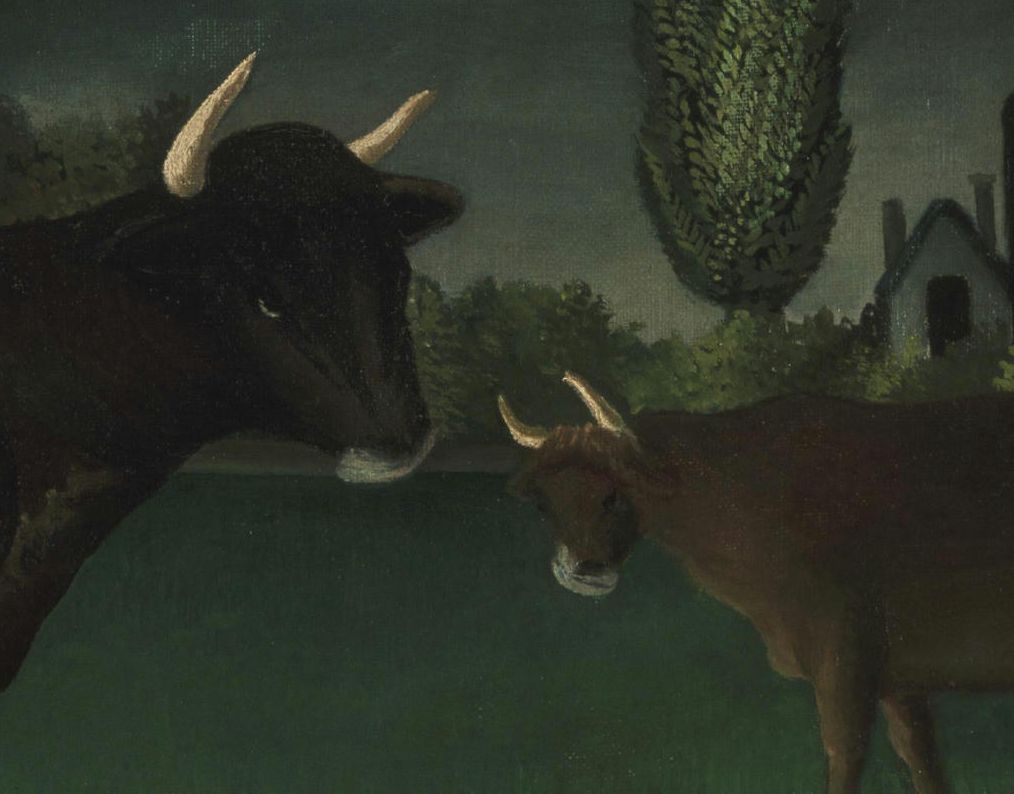
The smaller cow at the right faces back towards the first. Its head dips slightly, bringing the two pale muzzles and sets of horns into a loose exchange. A patch of open pasture separates them. Each keeps a distinct outline, and the space between their heads gives the meeting an unhurried rhythm. The nearer cow’s mass holds the composition still; the smaller one gently turns attention inward again.
The woman beside the animal
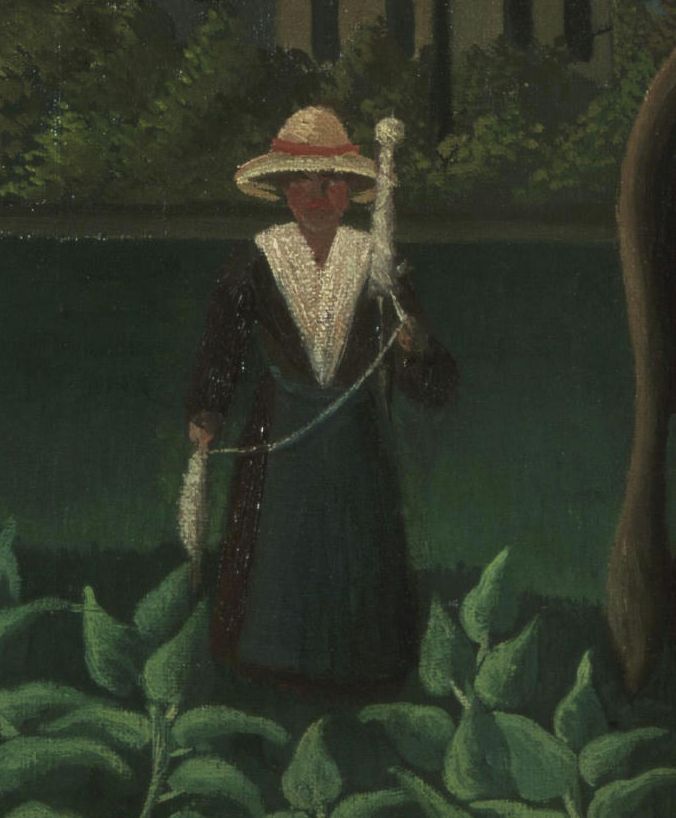
At the left stands a woman in a long dark dress, a pale scarf or collar spread across her chest, and a broad straw-coloured hat with a reddish band. She holds a slender staff upright near her face. Her clothing has a crisp, almost formal arrangement, with the light fabric forming a pointed shape against the dark dress. Even beside the enormous cow, she remains easy to find because those pale details stand out so clearly.
Her pose is frontal, whereas the cow extends sideways. The meeting of these two directions gives the left side of the picture a quiet firmness. The staff reinforces her upright stance and draws a narrow line through the surrounding greens. There is little visible gesture to turn her presence into an anecdote. We can see her beside the cattle; the painting supplies no name or explanation of her relationship to them.
She has her own clear place, set just far enough from the cow’s flank for its outline to remain continuous. Hat, scarf and staff make her a carefully articulated figure within a much larger arrangement. She also gives the viewer a human measure against which to feel the animal’s size. The unequal pairing lends the scene a solemnity: both figures stand with a stillness that invites us to linger over their shapes.
Light connects her to the rest of the picture. The pale hat and scarf answer the cow’s horns and muzzle, then the much larger white band of cloud above the ridge. These accents take the eye through different levels of the scene. They prevent the dark foreground from closing in on itself, while keeping the woman involved in the same visual pattern as the animals and the sky.
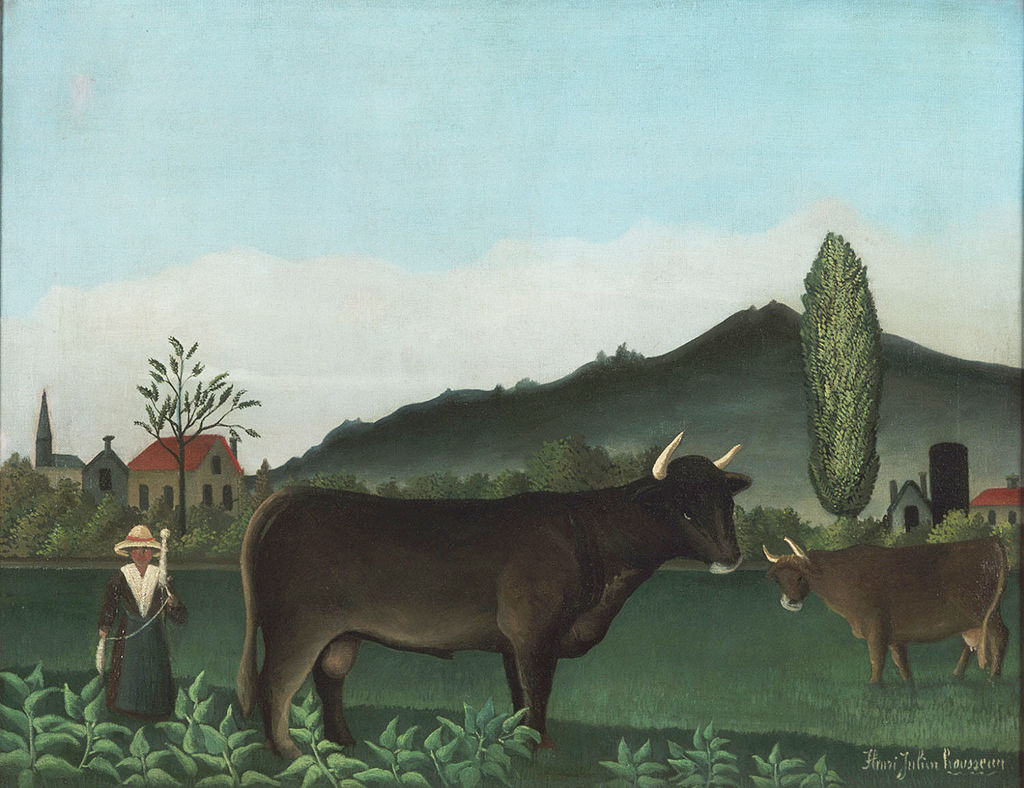
Landscape with Cattle — Henri Rousseau.
Leaves, houses and the distant ridge
Across the bottom edge, long pointed leaves rise in overlapping groups. Some reach between the cow’s legs, and others spread around the hem of the woman’s dress. Their separate tips are sharply readable against the darker pasture. This foliage forms a threshold: before reaching the animals, the eye passes over a near screen of plants. Several feet are partly concealed, so the figures appear rooted in the field without every point of contact with the ground being exposed.
Behind the cow lies a broad, comparatively empty stretch of green. It gives relief from the repeated leaf shapes along the bottom. The smaller animal stands within this open area, with its legs visible against the grass. Rousseau has made the foreground dense and the middle distance spare. That difference helps establish depth even where the sizes of the figures and buildings feel surprising. The picture offers several ways of judging distance, and they do not all produce the same result.
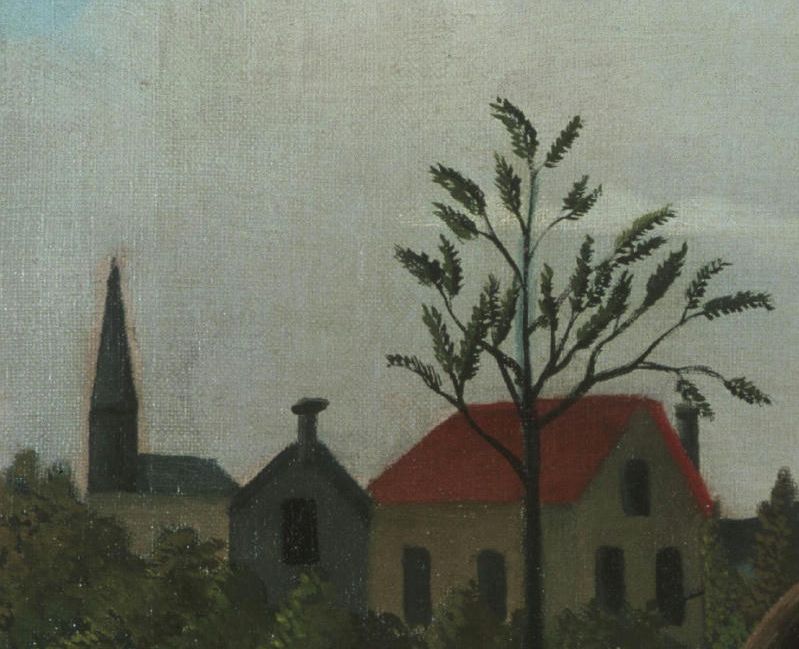
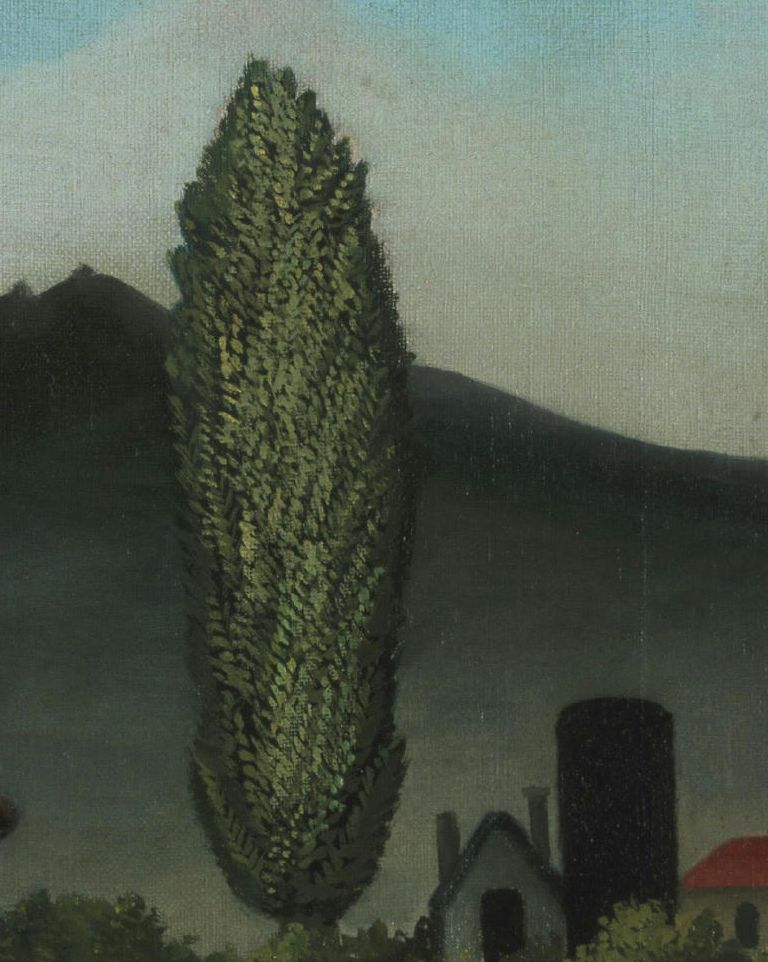
At the left, pale houses with dark openings and red roofs cluster near a church spire. A thin tree rises in front of them, displaying its few branches and little groups of leaves against the cloud. Across the field, another group of buildings appears beneath a tall, narrow tree. Beside them is a dark cylindrical form whose precise function is difficult to establish from the image. These structures suggest a settled countryside, but they do not identify a town or a particular farm.
The two trees are conspicuously different. The left one is open and branching, letting the pale sky show through. The right one has a close, elongated crown, built from numerous small light and dark marks. Its dense vertical form rises well above the houses and interrupts the hillside. It also balances the upright woman and staff across the picture. These are visual correspondences rather than perfect symmetries: the tree stands farther back and reaches much higher, allowing the scene to remain varied.
The ridge provides a long dark backing to all these smaller forms. Its highest point sits a little right of centre, close to the narrow tree, and its slopes travel towards both edges. A pale haze softens the lower part of the hill, but its upper contour stays clear against the clouds. Above it, the blue-green sky occupies a generous area of the canvas. This expanse makes the heavy animal below feel less confined. The cow dominates the inhabited ground, while the sky allows the whole scene room to breathe. At the lower right, Rousseau’s full-name signature appears in pale lettering against the dark field, another small bright element along the edge.
Annotated Details from Landscape with Cattle
The numbered points identify visible features discussed in this article. Return from each detail to the whole composition. Henri Rousseau, Landscape with Cattle, 1895–1900. Philadelphia Museum of Art, The Louise and Walter Arensberg Collection, 1950, 1950-134-175. Museum-derived reproduction published on Wikimedia Commons in 2022. Image source. Public domain. Numbers added to the overview; details cropped from the published original. No recolouring or retouching.
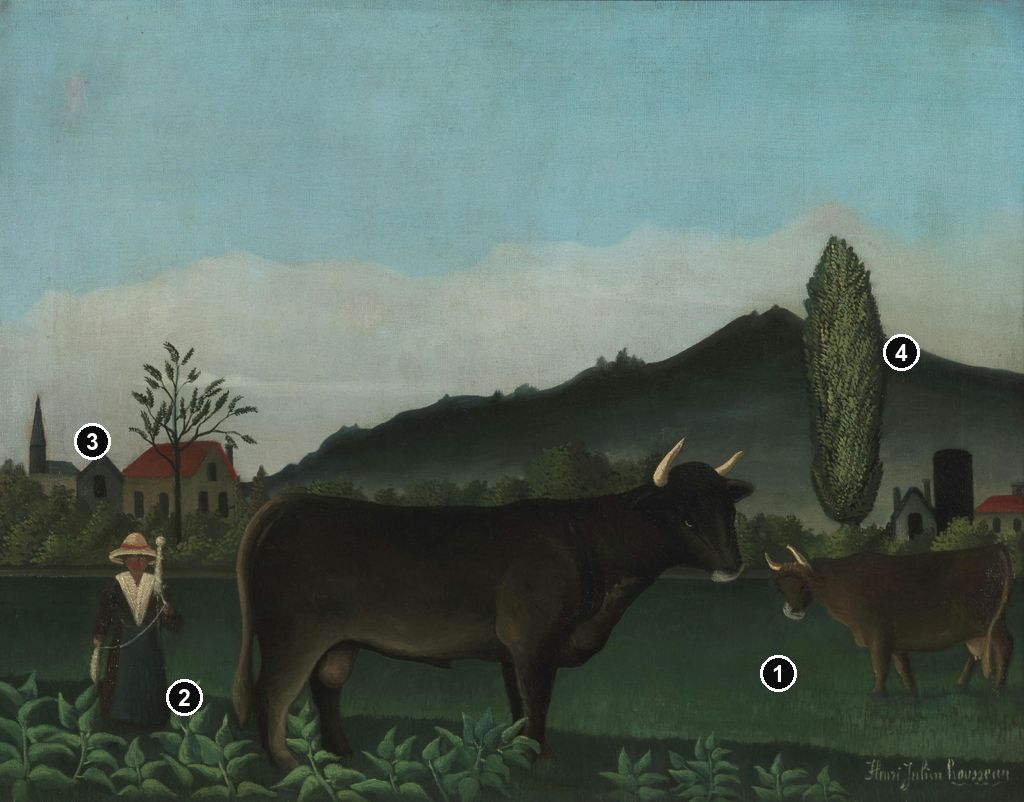
Details from LANDSCAPE WITH CATTLE
Compare the two heads, look closely at the woman, then follow the distant houses and contrasting trees.
Two heads turned towards one another
Pale horns and muzzles pull the two dark heads out of the hillside and pasture. The smaller cow turns inward towards the much larger animal, holding the open space between them.
Hat, scarf and upright staff
The woman stands frontally beside the broadside cow. Her pale hat and pointed scarf make her easy to find, while the slender staff strengthens her upright pose among the pointed foreground leaves.
A village beneath an open tree
A church spire, red roof and small dark openings establish the distant settlement. The lightly branching tree lets the pale cloud show through, contrasting with the dense narrow tree across the field.
A tall tree against the ridge
Many small light and dark leaf marks build the tree’s close elongated crown. Its strong vertical form interrupts the long ridge and rises above the small buildings at the right.
An everyday subject in Rousseau’s painting
The combination of an ordinary rural subject and an unusual organisation of scale is part of this painting’s appeal. Cattle, a woman with a staff, houses and trees are readily recognisable. Their relationships make the view distinctive. Rousseau places the cow close enough to command attention, then builds a sequence of smaller forms around its body. The landscape becomes legible through outlines, intervals and repeated colours, as well as through the recession towards the hill.
The Musée de l’Orangerie’s 2026 exhibition account places Rousseau’s varied subjects and formats within his effort to find buyers. It describes smaller landscapes and decorative pictures suited to modest homes, alongside his ambitious exhibition paintings. That wider practice gives useful context for a canvas measuring 51 × 66 cm, although it does not establish who commissioned Landscape with Cattle or what Rousseau charged for it.[12][1] Within the range of his paintings, this view rewards attention to the familiar: a pasture becomes memorable through the disproportionate importance of a single animal.
From the Arensbergs to Philadelphia
The painting is now in the Philadelphia Museum of Art, where its collection number is 1950-134-175. The museum credits it to the Louise and Walter Arensberg Collection, 1950, and records its medium as oil on canvas and its dimensions as 51 × 66 cm.[1]
The documented collecting history reaches back to approximately 1918. According to the museum’s provenance note, the painting appears in a photograph Charles Sheeler took around that date of the interior of the Arensbergs’ New York apartment. The museum records their move to Los Angeles in 1921. The photograph supplies evidence that the picture was already with them by about 1918, rather than an exact date of purchase.[1]
Earlier ownership remains uncertain. The same museum note reports that Henry Certigny’s 1984 catalogue raisonné names no first owner, while Wilhelm Uhde’s 1911 monograph reproduces the painting without an owner’s name. Those gaps leave the route from Rousseau’s studio to the Arensbergs incomplete.[1]
Henri Rousseau artworks directory
This directory brings together works covered on this site and other works documented in the cited museum records and catalogues. Alternate titles share one entry; distinct versions remain separate. Historical dates for works without an article follow the cited catalogues. This is not a catalogue raisonné.
Frequently Asked Questions
The Philadelphia Museum of Art dates it to 1895–1900, a range rather than a single confirmed year.[1]
It belongs to the Philadelphia Museum of Art, in the Louise and Walter Arensberg Collection. The oil on canvas measures 51 × 66 cm and has the collection number 1950-134-175.[1]
The museum’s record identifies the painting as made in France but does not name the countryside shown. The buildings and ridge alone do not establish a specific location.[1]
Its closeness, broad body and clear outline give it dominance over the small figures and buildings. The unusual effect comes from their painted relationships; no documentary explanation of Rousseau’s intention is established here.
Discussion
Look again at the images and ideas explored in Landscape with Cattle. These editorial prompts invite your observations.
Reader Insights
How does the woman’s presence change your sense of the cow’s size and character?
What happens to the balance of the picture if you cover the open sky or the smaller cow at the right?
Which details make the countryside feel close, and which carry your eye into the distance?
Join the Conversation
Share a detail, comparison or question about Landscape with Cattle below.
References
- Philadelphia Museum of Art. Landscape with Cattle, current object record, object 51096, collection number 1950-134-175; Object Details, image and Provenance, including note 1. Accessed 23 October 2026. View source.
- Philadelphia Museum of Art, Carnival Evening,1963-181-64,object59593. View source.
- Musée de l’Orangerie / Juliette Degennes, Henri Rousseau,L’ambition de la peinture: Un artiste dans son époque (in French). View source.
- National Gallery, Surprised!, NG6421. View source.
- Musée d’Orsay, La Guerre,RF19461 (in French). View source.
- MoMA, The Sleeping Gypsy. View source.
- Philadelphia Museum of Art, The Merry Jesters, 1950-134-176, object51097. View source.
- Musée d’Orsay, La Charmeuse de serpents, RF 1937 7 (in French). View source.
- Musée de l’Orangerie, La Carriole du Père Junier, RF 1960 26 (in French). View source.
- Solomon R. Guggenheim Museum / Cornelia Lauf, The Football Players,60.1583: current collection record. View source.
- MoMA, The Dream, 252.1954. View source.
- Musée de l’Orangerie. Henri Rousseau, l’ambition de la peinture, exhibition texts, 25 March–20 July 2026, section “Variations et déclinaisons. À la recherche du marché.” Accessed 23 October 2026. View source. (in French).
- The Museum of Modern Art, Henri Rousseau: Essays (1985), selected catalogue entries, chronology and notes on early devotees. View source. Selected entries, chronology (pp.91–95) and early-devotee notes (pp.262–264) were consulted. Historical collection credits do not establish present ownership.
- Daniel Catton Rich, Henri Rousseau (The Museum of Modern Art, 1942), selected drawings and landscape studies; historical catalogue. View source. The dated 1942 publication is used for the two Quai d’Auteuil ink views; its Malakoff date differs from the 1985 catalogue.
- MANAS, Laval, Henri Rousseau, dit le Douanier, urban landscapes and preparatory study (in French). View source.
- National Gallery of Art, Self-Portrait (1895), pen-and-ink drawing, accession 1995.47.66. View source.
- The Museum of Modern Art, War (published January 1895), lithograph, accession 684.1943. View source.
- Barnes Foundation, Landscape and Four Young Girls, object 5521, BF855. View source.


 Henri Rousseau.jpg)


 Henri Rousseau.jpg)