



 by Tom Gurney
Tom Gurney BSc (Hons) is an art history expert with over 20 years experience
Published on June 19, 2020 / Updated on October 29, 2026
Email: tomgurney1@gmail.com / Phone: +44 7429 011000
View of the Fortifications: Introduction
A lone figure stands beneath an enormous grey sky in View of the Fortifications by Henri Rousseau. A pale wall stretches in from the left, while rows of trees draw together around an open strip of ground. The Hiroshima Museum of Art’s collection checklist of 23 June 2023 identifies the painting under this title and dates it 1909.[1] A narrow path, two tall poles and a small dark silhouette carry much of the scene’s movement.
At a Glance
- ArtistHenri Rousseau
- SubjectView of the Fortifications
- ExploreA sky that gives small things weight; The wall and its changing levels
This work across Henri Rousseau’s career
Carnival Evening
1886 [2]The Merry Jesters
1906 [7]The Snake Charmer
1907 [8]View of the Fortifications (current article)
1909 (2023 checklist) [1]Contents
- A sky that gives small things weight
- The wall and its changing levels
- Two poles and a bent upright
- Two contrasting rows of trees
- Following the curve around the hedge
- The solitary figure and the large signature
- Grey, green and a few warm accents
- Annotated details
A sky that gives small things weight
The sky takes up most of the picture, rising far above the wall and the distant ground. Its grey contains faint patches of warmth and soft horizontal changes of tone. These variations offer little help in fixing a precise hour or weather event. Instead, they make a broad, gently uneven field against which each thin branch becomes legible. Even the distant trees can hold their place without a strong outline along the horizon.
The uneven heights of the trees prevent that expanse from becoming a simple rectangle. On the left, the crowns form a low, broken slope towards the middle. At the right, much taller branches rise almost to the top of the picture. Between these unequal sides, the sky reaches down towards the open ground, leaving the centre unusually exposed. The eye can travel a long way upward from the little figure without encountering a roof or a heavy mass of foliage.
That openness changes the force of the narrow objects within it. The paired poles near the centre have the visual prominence that a much larger building might claim in a crowded street scene. Their almost uninterrupted dark lines stand out at once. Looking from them to the highest right-hand branches reveals two different kinds of upright: one compact and blunt, the other spreading into many fine ends. The sky gives both enough room to be read separately.
The wall and its changing levels
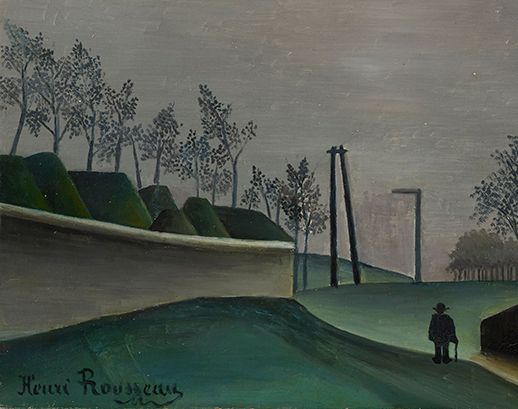
The wall is the largest continuous built form. Its upper edge begins at the left border and descends slightly towards the centre, marked by a thin, pale strip. Below it, the broad grey face grows narrower as it recedes. This simple change in width establishes distance before the viewer has followed the path or found the smallest trees. The wall supplies a stable route into the picture, with a brighter edge that remains easy to trace.
Above it sit dark green, angular masses of rising ground. Their sloping sides and abrupt changes of level introduce a rhythm of projecting shapes. They are quite unlike the softly mottled sky: here the meeting of neighbouring areas matters more than gradual shading. Some slopes catch a lighter green; others sink towards black. Together they make the wall feel embedded in a larger structure of banks and raised earth, even though the painting provides no detailed explanation of its construction.
A second bank fills the near left foreground. Its crest rises below the wall’s far end, then curves down towards the figure. The two edges lead in different directions: the wall carries the gaze away, while the nearer bank sweeps across the lower picture. The strip between them is essential. Through it, the far ground becomes visible and the landscape gains an opening beyond the heavy foreground. These broad, connected shapes make the space readable without filling it with small landmarks.
Two poles and a bent upright
Near the wall’s end, two long dark poles rise into the sky. They are close together at the top, where a short crosspiece joins them, and farther apart towards the ground. Their slight lean introduces a wavering quality into an otherwise emphatic shape. The space between them remains open, showing the same grey as the surrounding sky. The narrow opening lets the pair register as two separate lines.
A thinner grey upright stands to their right, turning left at its upper end. Its low horizontal arm makes a small angular echo of the wall’s long edge. The poles are darker and taller; the bent upright is paler, shorter and less immediately conspicuous. The difference draws attention to an area that initially seems almost empty. Close to the distant ground, a few understated shapes can produce considerable variety simply through height, spacing and tone.
Their particular functions remain uncertain. What can be followed confidently is their place in the composition. The pair holds the left side of the central opening, while the bent post occupies the interval before the right-hand trees. Each measures the open space around it, giving substance to the distance between wall and trees.
Two contrasting rows of trees
The trees above the left bank have small, relatively rounded crowns. Fine trunks lift them clear of the dark green slopes, and clusters of leaves leave frequent gaps of sky. Their size varies as the row recedes, with some crowns merging into uneven groups. The effect is loose enough to avoid a rigid procession, yet the recurring trunks keep a steady relationship with the wall. They make its long boundary feel inhabited by growth.
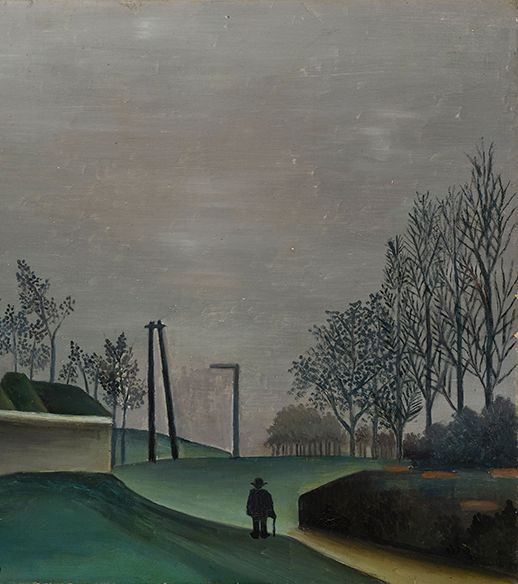
Across the opening, the right-hand row has a different character. Slender trunks branch into long forks, and the highest trees carry only sparse marks of foliage. Their many exposed divisions create a fine network against the grey. Lower, fuller crowns appear towards the middle distance, where the row becomes smaller and more compressed. Following those changes inward gives the right side its own route towards the centre, balancing the recession of the wall on the left.
Below these airy branches, a dense dark hedge closes the near right corner. Its upper edge has a blunt, irregular profile, and its largely unbroken mass contrasts with the tree row above it. Small pale ochre and reddish strips appear beyond or beside this dark area. They add modest interruptions without competing with the tall branches. The right side therefore works at two distinct scales: a light, complicated mesh overhead and a low, solid barrier next to the path.
Following the curve around the hedge
The path enters from the lower right and bends around that barrier towards the centre. Its warm ochre colour distinguishes it from the green ground, but the turn does much of the work of suggesting depth. The broad near portion narrows as it passes the hedge. Beyond the bend, the open ground and the distant trees offer room for the eye to continue, even though the route’s further course is not clearly drawn.
The hedge conceals some of this transition. It interrupts the ground immediately beside the figure and gives the path an edge to follow. On the opposite side, the descending bank curves towards the same area. Two substantial foreground masses thus guide attention into a comparatively small gap. The space feels accessible because the path reaches the bottom edge, yet partly withheld because the dark vegetation prevents a complete view of where it leads.
The direction of looking changes the experience of this space. Entering along the path brings the figure into focus first; tracing the left wall leads past the poles towards the trees. Looking up from either route opens the great field of sky. The landscape feels spacious as the eye keeps changing direction, moving across the ground, into the distance and upward through the branches.
The solitary figure and the large signature
The person near the bend wears a dark hat and holds a thin stick or cane. A tiny pale area suggests the face, but the features are indistinct. The outline separates the figure clearly from the lighter ground behind it. Its still, compact shape provides a useful measure for the surrounding height: the paired poles tower above it, and the right-hand trees reach higher again. Human scale enters the picture through a single small presence.
There is little visible action to turn that presence into a story. The cane offers one clear detail, while the figure’s purpose and destination remain open. Its position matters more immediately than an imagined identity. Set near the meeting of the foreground curves, it draws attention to the place where the route passes into the open middle distance. The surrounding emptiness can make the person feel isolated, although that feeling belongs to a viewer’s response to the arrangement.
At the lower left, the large dark Henri Rousseau signature introduces another kind of human mark. Its spreading letters occupy a conspicuous patch of green, much nearer the viewer than the little person. The comparison is striking: a painted name can claim more width than the body represented within the scene. The lettering also asks the eye to read across the surface just where the bank encourages it to move inward. It briefly brings awareness back to the picture’s flat lower edge.
Annotated Details from View of the Fortifications
The numbered points identify visible features discussed in this article. Return from each detail to the whole composition. Henri Rousseau, View of the Fortifications, 1909. Hiroshima Museum of Art. Date follows the museum’s 2023 collection checklist. Image: Hiroshima Museum of Art, via Wikimedia Commons. Image source. Public domain. Numbers added to a separate resized overview. Details cropped directly from the published original without enlargement, sharpening, recolouring, cleaning or retouching.
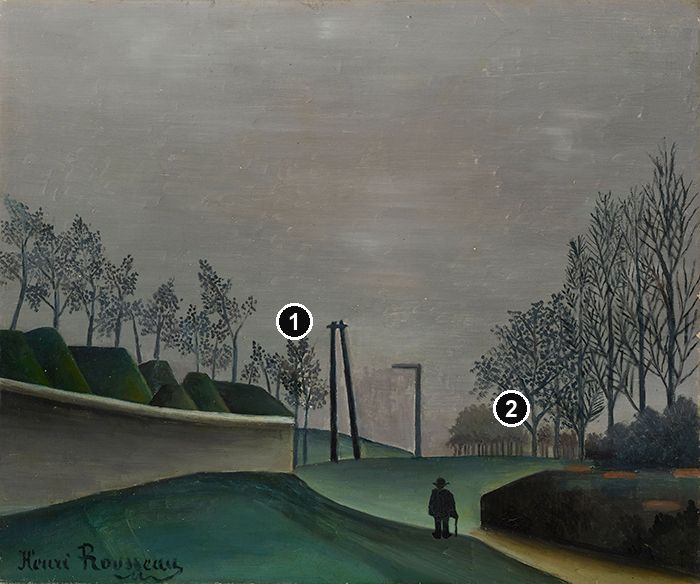
Details from VIEW OF THE FORTIFICATIONS
Compare the pale wall and open pole pair with the right-hand branches, then return to the small figure beside the path.
The wall leading towards two poles
The pale wall narrows towards a pair of dark poles. Their open interval contains no sequence of ladder rungs, distinguishing this version from the Hermitage painting.
Bare branches above the path
The tall right-hand trees rise above a dense hedge and the curving path. A single small figure gives the broad ground and branching silhouettes a human scale.
Grey, green and a few warm accents
Most of the painting depends on restrained differences between grey and green. The wall is cooler and more continuous than the broken banks above it; the near ground is deeper in tone than the open area behind the figure. The darkest accents gather in the hedge, the poles and the person. Their separation keeps any one of them from absorbing the whole composition. Each dark form has its own shape and amount of pale space around it.
The path and the thin upper edge of the wall offer contrasting kinds of brightness. One is a warm, widening surface underfoot; the other is a narrow line carried towards the distance. Together they help the gaze find a way through the subdued colours. This interplay of broad colour areas, fine silhouettes and repeated uprights offers a particularly clear subject for exploring Rousseau’s style and technique. Here, much of the landscape’s character comes from the precise places where one quiet shape meets another.
Henri Rousseau artworks directory
This directory brings together works covered on this site and other works documented in the cited museum records and catalogues. Alternate titles share one entry; distinct versions remain separate. Historical dates for works without an article follow the cited catalogues. This is not a catalogue raisonné.
Frequently Asked Questions
They appear as a pair of dark poles joined by a short piece at the top. Their function is unclear. The visible opening between them is uninterrupted by a series of rungs.
One solitary figure stands near the curving path, wearing a dark hat and holding a cane or stick. The small face does not allow a secure identification.
Follow the wall’s pale upper edge, then compare the small rounded tree crowns on the left with the tall, forked branches on the right. These contrasting rows lead back towards the same open middle ground.
Discussion
Look again at the images and ideas explored in View of the Fortifications. These editorial prompts invite your observations.
Reader Insights
How does your sense of distance change when you follow the wall rather than the path?
Does the large expanse of sky make the solitary figure seem smaller, more noticeable, or both?
What changes when you notice the size of the signature beside the tiny person?
Join the Conversation
Share a detail, comparison or question about View of the Fortifications below.
References
- Hiroshima Museum of Art. Collection on display, 23 June 2023–, 2023, PDF p. 1, Gallery 2, item 27: Henri Rousseau, View of the Fortifications, 1909. View source.
- Philadelphia Museum of Art, Carnival Evening,1963-181-64,object59593. View source.
- Musée de l’Orangerie / Juliette Degennes, Henri Rousseau,L’ambition de la peinture: Un artiste dans son époque (in French). View source.
- National Gallery, Surprised!, NG6421. View source.
- Musée d’Orsay, La Guerre,RF19461 (in French). View source.
- MoMA, The Sleeping Gypsy. View source.
- Philadelphia Museum of Art, The Merry Jesters, 1950-134-176, object51097. View source.
- Musée d’Orsay, La Charmeuse de serpents, RF 1937 7 (in French). View source.
- Musée de l’Orangerie, La Carriole du Père Junier, RF 1960 26 (in French). View source.
- Solomon R. Guggenheim Museum / Cornelia Lauf, The Football Players,60.1583: current collection record. View source.
- MoMA, The Dream, 252.1954. View source.
- The Museum of Modern Art, Henri Rousseau: Essays (1985), selected catalogue entries, chronology and notes on early devotees. View source. Selected entries, chronology (pp.91–95) and early-devotee notes (pp.262–264) were consulted. Historical collection credits do not establish present ownership.
- Daniel Catton Rich, Henri Rousseau (The Museum of Modern Art, 1942), selected drawings and landscape studies; historical catalogue. View source. The dated 1942 publication is used for the two Quai d’Auteuil ink views; its Malakoff date differs from the 1985 catalogue.
- MANAS, Laval, Henri Rousseau, dit le Douanier, urban landscapes and preparatory study (in French). View source.
- National Gallery of Art, Self-Portrait (1895), pen-and-ink drawing, accession 1995.47.66. View source.
- The Museum of Modern Art, War (published January 1895), lithograph, accession 684.1943. View source.
- Barnes Foundation, Landscape and Four Young Girls, object 5521, BF855. View source.


 Henri Rousseau.jpg)


 Henri Rousseau.jpg)