



 by Tom Gurney
Tom Gurney BSc (Hons) is an art history expert with over 20 years experience
Published on June 19, 2020 / Updated on October 29, 2026
Email: tomgurney1@gmail.com / Phone: +44 7429 011000
Landscape with Watermill: Introduction
A cream-coloured mill rises above a blue-green river, its red roofs bright against a bank of trees. Below it, a man leads a horse and covered cart along an ochre road. Henri Rousseau’s Landscape with Watermill, dated 1879 by Göteborgs konstmuseum, gives an ordinary working landscape an unusually composed stillness. Water spills beside the building and the little procession crosses the foreground, yet the mill seems almost monumental. The oil painting measures just 32.5 × 55.5 cm and belongs to the museum in Gothenburg.[1]
At a Glance
- ArtistHenri Rousseau
- SubjectLandscape with Watermill
- ExploreA landscape from Rousseau’s early years; The mill, its roofs and its trees
This work across Henri Rousseau’s career
Carnival Evening
1886 [2]The Merry Jesters
1906 [7]The Snake Charmer
1907 [8]Contents
- A landscape from Rousseau’s early years
- The mill, its roofs and its trees
- Water and the road: two kinds of movement
- How the painting reached Gothenburg
- Annotated details
A landscape from Rousseau’s early years
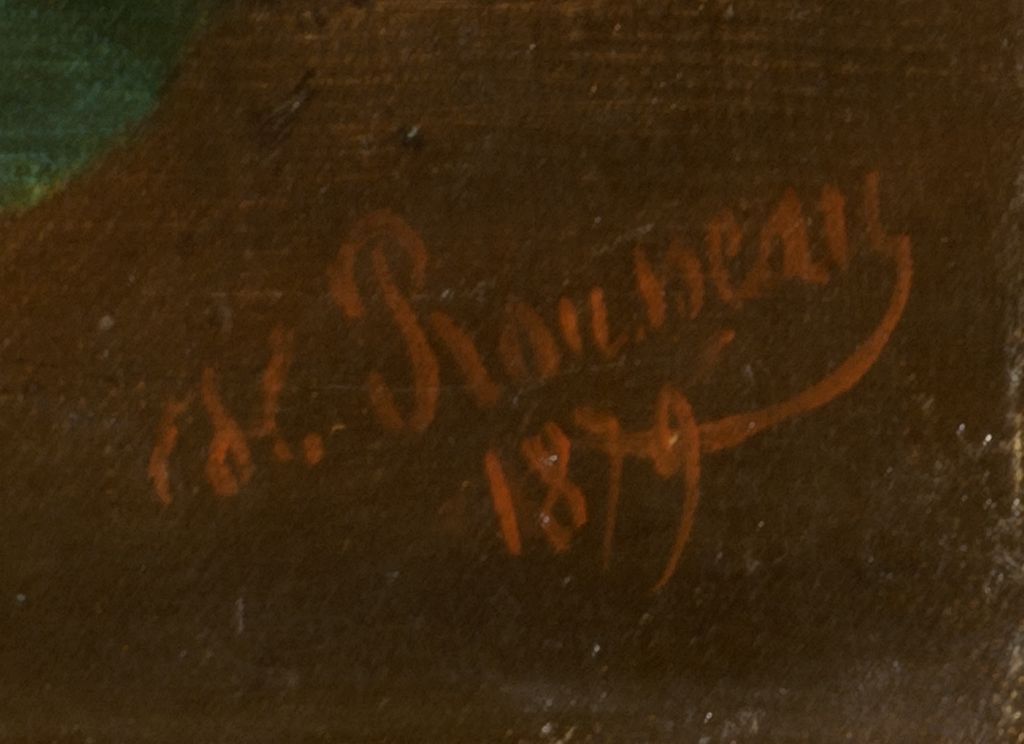
The museum’s Swedish title is Landskap med vattenkvarn. Its record identifies the canvas as inventory GKM 0735 and transcribes the inscription at the lower right as “H. Rousseau 1879”. The reddish signature and date are visible against the dark corner of the road. Both the inscription and the museum’s dating place the picture early in Rousseau’s career. Per Dahlström’s collection commentary, reproduced by the museum, describes it as one of the artist’s earliest surviving paintings.[1]
The Musée de l’Orangerie dates Rousseau’s first submission to the Salon des Indépendants to 1886, seven years after the date on this canvas. Landscape with Watermill therefore offers a view of his painting before that documented public milestone.[12]
The title supplies a subject rather than a precise address. A mill stands beside water, with a road on the near bank and a small settlement across the river. The museum record does not name the river or identify the building.[1] The painting’s character depends on the relation between its structures, trees and waterways, whether or not the view could eventually be attached to a particular place.
Its wide format establishes that relation immediately. The mill fills the right half, while the river opens out towards the left. The eye can move from a densely assembled group of buildings into a quieter stretch of water and sky. The scene has both weight and breathing space, with the near road running beneath the two halves to bind them together.
The mill, its roofs and its trees
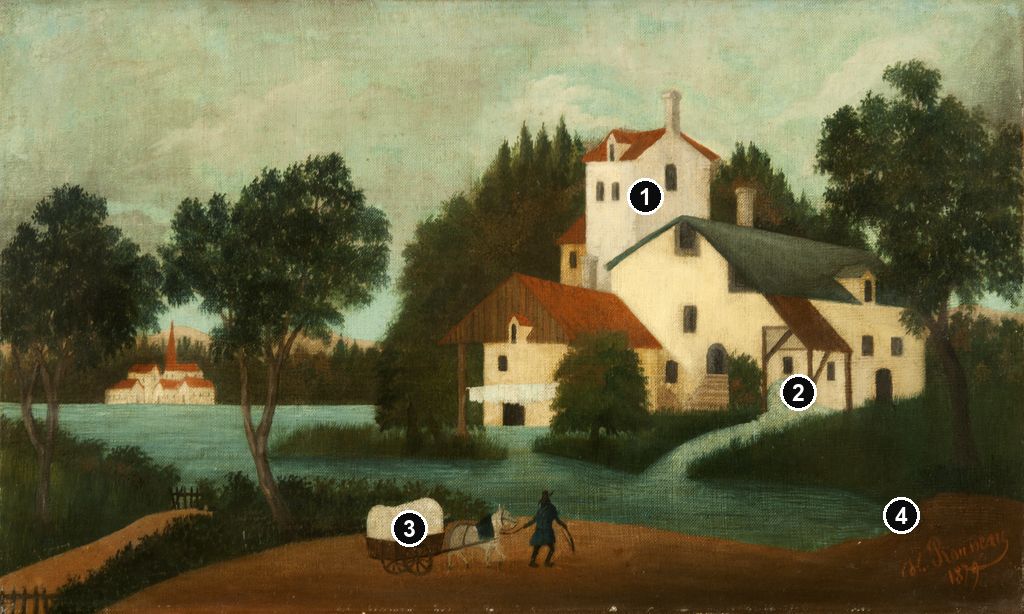
The mill is a complex of adjoining volumes. A tall cream block rises at the back, topped by red roof slopes and a pale chimney. In front, a long grey roof covers a lower building, and a smaller red-roofed structure projects towards the river. The roof edges give each part a clear outline. Looking through the ensemble, one passes from triangle to rectangle, from a low annex to the high tower-like block behind it.
Dark windows punctuate the pale walls. Several are small and square, while others have rounded tops; the central arch is especially noticeable against the cream façade. Their irregular spacing keeps the buildings from becoming a simple repeating pattern. Shadows along the walls and beneath the roofs help distinguish one surface from another, giving the complex some solidity even where its parts fit together with an unfamiliar neatness.
The trees offer a softer set of shapes. Tall, narrow forms gather behind the mill, while broader crowns spread at the right and across the left bank. The foliage encloses the buildings on three sides, making the bright walls appear more prominent. At the left, exposed trunks divide the water into separate glimpses. One forked trunk rises from the road almost in front of the distant settlement, providing a slim vertical answer to the substantial architecture opposite.
Red travels across the composition in a series of smaller echoes. It appears on the mill’s upper roof, on the low waterside building and again on the far-left cluster of cream buildings. A pointed red spire gives that distant group its most conspicuous accent. These scattered roof shapes draw the eye across the river without making every part of the view equally emphatic. The distant settlement remains small enough to preserve the mill’s commanding scale.
The sky occupies a generous part of the canvas. Pale cloud shapes spread through a soft blue field, leaving space above the roofs and trees. The mill’s chimney rises into this lighter area, clearly separated from the darker vegetation below. It is one of several places where Rousseau makes a contour easy to follow: a vertical shaft against sky, a roof against foliage, a pale wall beside a dark opening.
Water and the road: two kinds of movement
At the right of the mill, wooden supports frame a covered area around the wheel. Pale blue and white water emerges beside it and curves diagonally towards the foreground. This is the most visibly active passage in the river. The light streaks break up the darker bank, giving the water a different texture from the broad, comparatively level surface farther left.
Following that channel leads the eye away from the building and around the projecting green bank. The river then spreads across the picture in long horizontal bands. Pale marks on its surface suggest small changes of light and movement, while the islands or tongues of vegetation interrupt its course. The water joins the mill to the open landscape, but its two treatments also divide the scene: a concentrated rush beside the wheel and a spacious reach towards the far shore.
The road follows another rhythm. It forms a broad, warm strip across the bottom of the picture, widening at the right and bending away at the left. A low dark fence appears near the left edge, and bushes mark the boundary between road and river. This foreground band gives the landscape a firm base. Its ochre and brown colours also set off the cooler blue-green water immediately behind it.
The horse, cart and man occupy only a small part of this road. The cart has a pale rounded cover above a darker wooden body and visible wheels. Its grey horse faces right, with the man walking ahead in a dark blue coat. A curved line extends from his hand towards the animal; another dark curve falls beside him. The thin limbs and narrow lines of the harness make this group delicate beside the substantial shapes of the mill.
Their size changes our sense of the buildings. Against the tiny procession, the mill becomes an imposing presence, although it remains part of a modest landscape. The figure supplies a human measure without drawing attention away from the place. He has an activity and a direction, but no facial detail invites a story about his identity. The picture holds him within the larger arrangement of road, river and architecture.
Water and travellers thus carry the eye through the painting along different routes. The channel brings it forward from the mill; the procession carries it sideways along the near bank. Neither movement disturbs the clear outlines of the whole. That balance between activity and composure is one of the picture’s most engaging qualities: a working mill and a passing cart become elements in a landscape that feels carefully held in place.
Annotated Details from Landscape with Watermill
The numbered points identify visible features discussed in this article. Return from each detail to the whole composition. Henri Rousseau, Landscape with Watermill, 1879. GKM0735, Gift of Gustaf Werner, 1923. Göteborgs konstmuseum (Gothenburg Museum of Art). Photo: Hossein Sehatlou. Museum photograph published on Wikimedia Commons in 2021. Image source. CC BY 4.0. Numbers added to the resized overview; details cropped from the original museum photograph. Overview and crops: CC BY 4.0. No recolouring or retouching.
Details from LANDSCAPE WITH WATERMILL
Compare the stacked buildings with the sheltered wheel, then use the small horse-cart and dated signature to explore the near road.
Roofs and walls in interlocking blocks
The tall cream building rises behind lower wings with red and grey-green roofs. Dark openings separate the pale walls into distinct surfaces, while the chimney stands clearly against the sky.
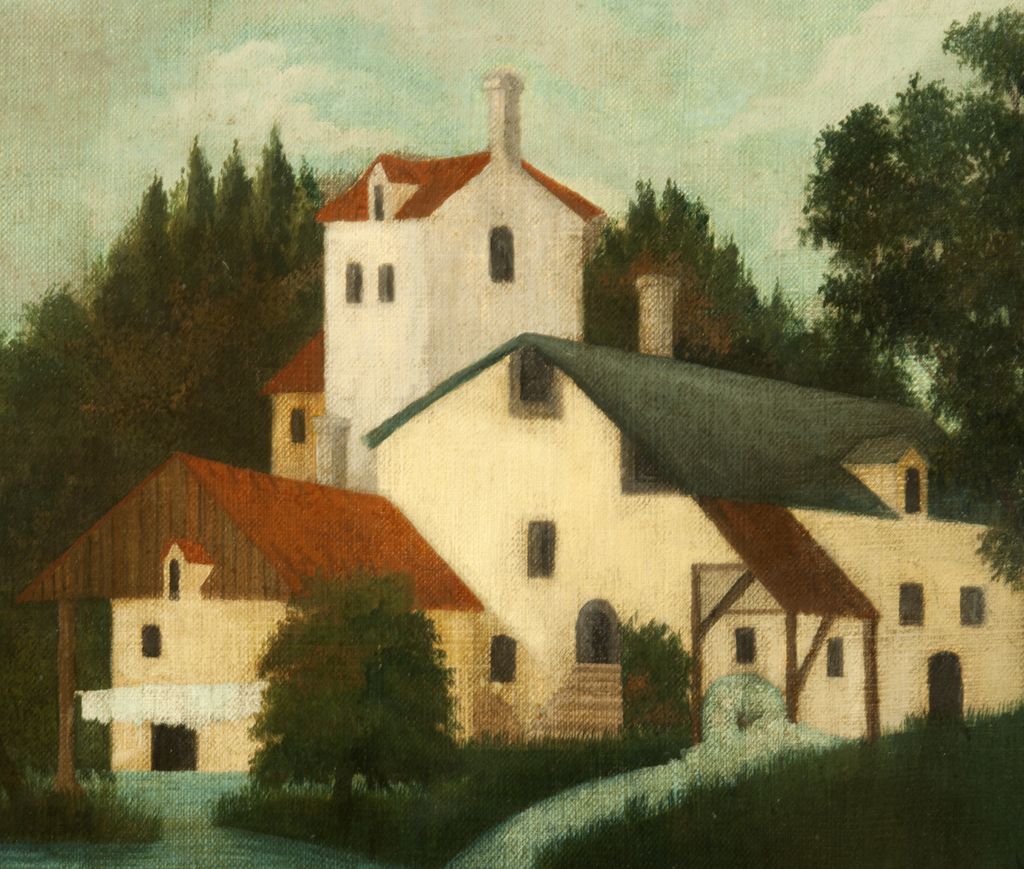
The wheel and its rush of water
Wooden supports carry a small shelter over the wheel. Pale blue and white water spills beside it, turning diagonally towards the broader, more level river.
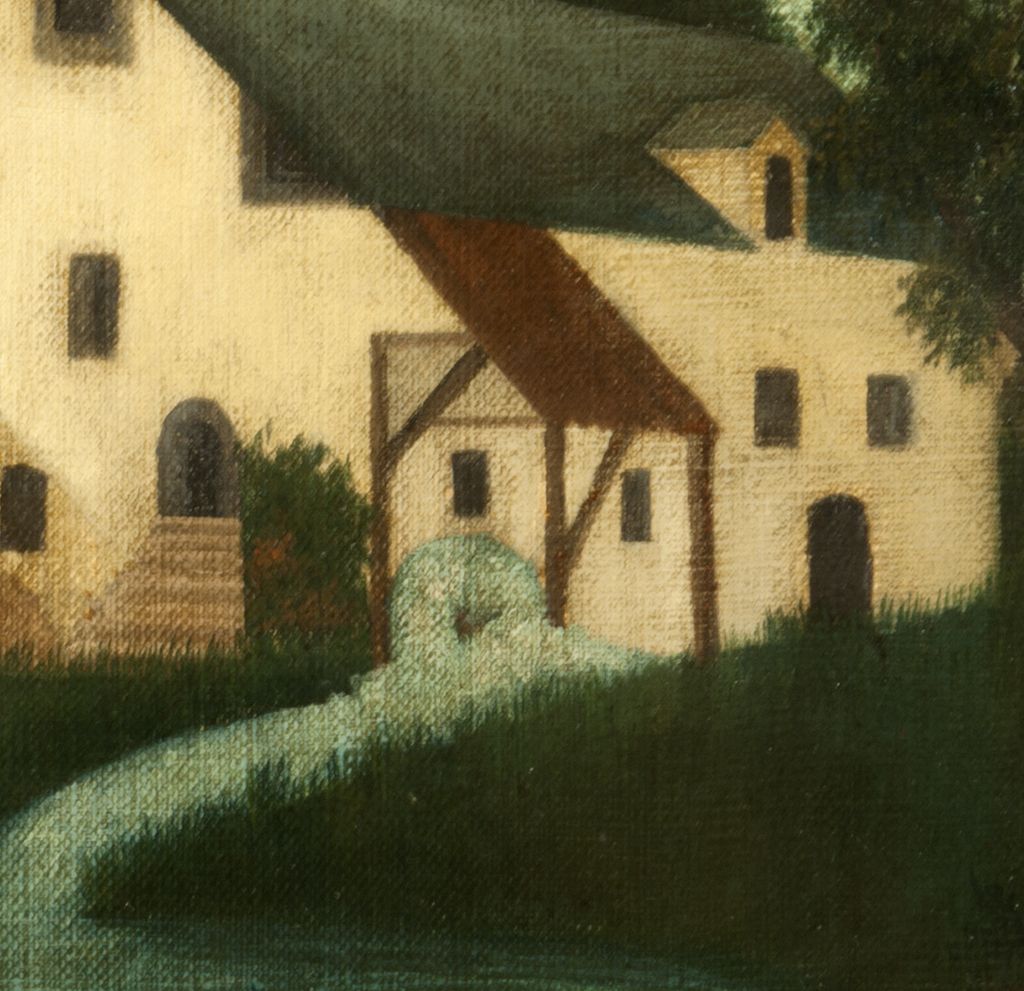
A covered cart on the near road
A small grey horse pulls a cart with a rounded pale cover. The blue-coated person walks ahead, linked to the animal by a thin curved line; the whole procession fits beneath the mass of the mill.
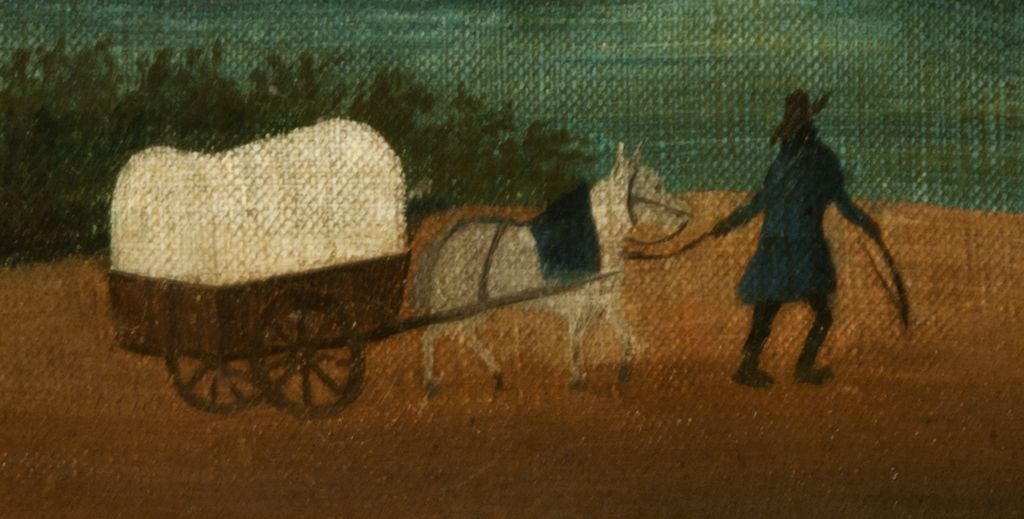
A signature dated 1879
Reddish script and the date occupy the darker lower-right corner. The warm lettering sits within the road's broad colour, away from the pale buildings and cooler water.
How the painting reached Gothenburg
The canvas also has a documented place in the formation of Gothenburg’s French collection. The museum’s history in Skiascope 5 explains that the collector Conrad Pineus encountered financial difficulties and had to sell his French paintings. Most of the works went abroad. Gustaf Werner secured two for the museum: Claude Monet’s Village Street, Vétheuil and Rousseau’s Landscape with Watermill.[13]
The current object record gives the precise acquisition as a gift from Werner in 1923. The collection history supplies the circumstances behind that entry: a private collection was being dispersed, and Werner’s intervention helped retain this Rousseau in Gothenburg. Together, the two museum accounts establish a useful part of the painting’s journey without supplying a complete chain of ownership back to the artist.[1][13]
The painting later appeared in Cézanne till Picasso. Fransk konst i svensk ägo at Liljevalchs in Stockholm, from 3 September to 10 October 1954, as catalogue number 334. The museum’s exhibition record places this small landscape within a wider presentation of French art in Swedish ownership. Its public history extends beyond its arrival in Gothenburg, even though the mill itself remains unidentified.[1]
Dahlström’s museum commentary sets Rousseau’s later appeal within the European fascination with “primitivism” around 1900. In that historical outlook, artists and audiences sought qualities they understood as authenticity and originality, including in work made outside academic training. The commentary connects Rousseau with the young artists around Picasso who responded to his paintings.[1] That account describes a history of reception. In this landscape, the visible qualities are more particular: strongly outlined buildings, rounded masses of foliage, small figures and a space organised into lucid bands.
Henri Rousseau artworks directory
This directory brings together works covered on this site and other works documented in the cited museum records and catalogues. Alternate titles share one entry; distinct versions remain separate. Historical dates for works without an article follow the cited catalogues. This is not a catalogue raisonné.
Frequently Asked Questions
Göteborgs konstmuseum dates it to 1879 and records the lower-right signature as “H. Rousseau 1879”. Its commentary describes the canvas as one of Rousseau’s earliest surviving paintings.[1]
It belongs to Göteborgs konstmuseum in Gothenburg, Sweden, where its inventory number is GKM 0735. The museum records it as a gift from Gustaf Werner in 1923.[1]
The oil painting on canvas measures 32.5 × 55.5 cm, excluding its frame.[1]
The museum’s current record does not identify a specific mill or river. The title describes the subject, and the picture should not be assigned a precise location on that evidence alone.[1]
Discussion
Look again at the images and ideas explored in Landscape with Watermill. These editorial prompts invite your observations.
Reader Insights
How does the small size of the man and cart change your impression of the mill?
Follow the red roofs from right to left. How do they connect the near buildings with the distant shore?
Where does the river look most active, and how does that passage affect the stillness of the rest of the landscape?
Join the Conversation
Share a detail, comparison or question about Landscape with Watermill below.
References
- Göteborgs konstmuseum. Landskap med vattenkvarn, current collection record, inventory GKM 0735; object data, signature, exhibition history and Per Dahlström’s commentary reproduced from Samlingen. Göteborgs konstmuseum (2014), p. 277. Accessed 23 October 2026. View source.
- Philadelphia Museum of Art, Carnival Evening,1963-181-64,object59593. View source.
- Musée de l’Orangerie / Juliette Degennes, Henri Rousseau,L’ambition de la peinture: Un artiste dans son époque (in French). View source.
- National Gallery, Surprised!, NG6421. View source.
- Musée d’Orsay, La Guerre,RF19461 (in French). View source.
- MoMA, The Sleeping Gypsy. View source.
- Philadelphia Museum of Art, The Merry Jesters, 1950-134-176, object51097. View source.
- Musée d’Orsay, La Charmeuse de serpents, RF 1937 7 (in French). View source.
- Musée de l’Orangerie, La Carriole du Père Junier, RF 1960 26 (in French). View source.
- Solomon R. Guggenheim Museum / Cornelia Lauf, The Football Players,60.1583: current collection record. View source.
- MoMA, The Dream, 252.1954. View source.
- Musée de l’Orangerie. Henri Rousseau, l’ambition de la peinture, exhibition texts, 25 March–20 July 2026, section “Aux origines d’un style”. View source. (in French).
- Göteborgs konstmuseum. Skiascope 5, 2012, printed pp. 148–151, particularly p. 148 (Swedish) and p. 151 (English), on Conrad Pineus’s collection and Gustaf Werner’s acquisition of the Rousseau and Monet paintings. View source.
- The Museum of Modern Art, Henri Rousseau: Essays (1985), selected catalogue entries, chronology and notes on early devotees. View source. Selected entries, chronology (pp.91–95) and early-devotee notes (pp.262–264) were consulted. Historical collection credits do not establish present ownership.
- Daniel Catton Rich, Henri Rousseau (The Museum of Modern Art, 1942), selected drawings and landscape studies; historical catalogue. View source. The dated 1942 publication is used for the two Quai d’Auteuil ink views; its Malakoff date differs from the 1985 catalogue.
- MANAS, Laval, Henri Rousseau, dit le Douanier, urban landscapes and preparatory study (in French). View source.
- National Gallery of Art, Self-Portrait (1895), pen-and-ink drawing, accession 1995.47.66. View source.
- The Museum of Modern Art, War (published January 1895), lithograph, accession 684.1943. View source.
- Barnes Foundation, Landscape and Four Young Girls, object 5521, BF855. View source.


 Henri Rousseau.jpg)


 Henri Rousseau.jpg)