



 by Tom Gurney
Tom Gurney BSc (Hons) is an art history expert with over 20 years experience
Published on June 19, 2020 / Updated on October 29, 2026
Email: tomgurney1@gmail.com / Phone: +44 7429 011000
War: Introduction
A black horse stretches across the sky above a field of bodies. Its rider carries a sword and a smoking torch; her white dress flies out in sharp points, answering the broken branches around her. In Henri Rousseau's War, almost everything seems caught between violent movement and terrible stillness. The painting, dated about 1894, belongs to the Musée d'Orsay. Its broad canvas, 114.5 × 195 centimetres, gives this nightmare room to spread.[1] Look first at the rider, then follow the crows downwards: the picture's real weight lies with those who cannot escape her passage.
At a Glance
- ArtistHenri Rousseau
- DateAbout 1894
- MediumOil on canvas
- Dimensions114.5 × 195 cm
- CollectionMusée d'Orsay, Paris, RF 1946 1
- Alternative titleLa Chevauchée de la Discorde — the ride of Discord.[1]
This work across Henri Rousseau’s career
Carnival Evening
1886 [2]War (current article)
c. 1894 [1]The Merry Jesters
1906 [6]The Snake Charmer
1907 [7]Contents
- A rider above a ruined world
- How the allegory works
- History remembered through an invented scene
- Possible sources, and the freedom to change them
- Louis Roy and Alfred Jarry respond
- The original lithograph of 1895
- From private ownership to the national collection
- Annotated details
A rider above a ruined world
The horse moves from left to right, its forelegs reaching into the space between the trees. Its long, narrow head pushes ahead while the tail streams behind. The belly, legs and neck form a powerful dark shape against the sky. There is little sense of a hoof finding the ground. The animal seems to travel through the air, carrying its rider above the consequences of their movement.
Rousseau makes the woman both conspicuous and difficult to settle into a familiar role. Her face turns towards us, although her mount surges sideways. Her hair fans out; one bare leg hangs against the black flank. The pale dress appears torn into strips, and its spreading hem gives her body an oddly jagged outline. Sword and torch extend her reach on either side. She occupies the centre like the principal figure of a ceremonial procession, but the ceremony has become destructive.
The horse's body is almost a horizontal dividing line. Above it, pink clouds gather against a blue sky. Below it, human limbs lie tangled across the ground. The arrangement encourages us to see two conditions at once: the rider's continuing passage and the victims' immobility. Her journey goes on while their lives have been brought to a halt. Even the repeated lengths of the bodies cannot match the horse's uninterrupted sweep.
The trees tighten that division. On the left, black branches fork across the sky and behind the rider. On the right, a pale trunk presses close to the edge, its broken limbs extending inwards. These upright forms give the galloping animal something to push against visually. They also enclose the victims. The landscape offers no broad, inviting path that would lead us out of the scene.
Individual bodies emerge slowly from the mass. A white shirt catches the eye near the foreground. Elsewhere a bent arm, a turned head or a pair of legs makes a separate person momentarily legible. Clothes and bare skin alternate, disrupting any simple pattern. The crowded surface requires us to look repeatedly, distinguishing one figure from another even as the painting gathers them into a common catastrophe.
The crows make that looking more uncomfortable. Some perch among the bodies; others open their wings above them. Their black forms connect the ground to the airborne horse and the dark branches. A bird's movement is small beside the rider's, yet it brings the aftermath into the immediate present. Destruction continues through these feeding creatures after the human struggle has ended.
Annotated Details from War
The numbered points identify visible features discussed in this article. Return from each detail to the whole composition. Henri Rousseau, War (La Guerre), c.1894. Musée d’Orsay, Paris, RF 1946 1. Published reproduction via Wikimedia Commons. Public-domain reproduction via Wikimedia Commons; published from the National Gallery of Art’s 2006 exhibition image. Image source. Public domain. Numbers added to a separate resized overview. Details cropped from the published original without enlargement, recolouring or retouching.
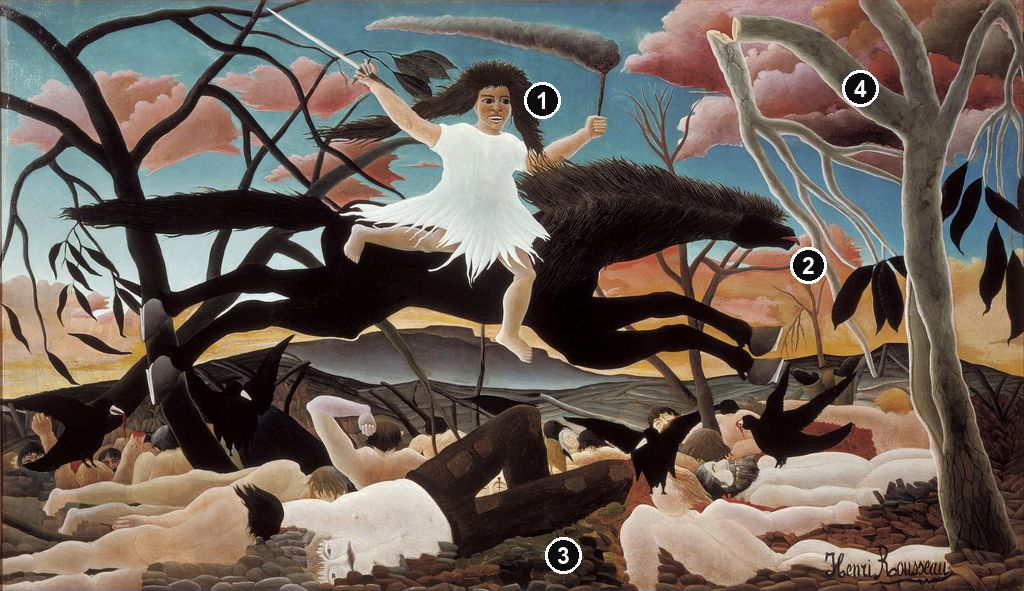
Details from WAR
Compare the rider’s continuing movement with the fallen bodies, then follow the sharp shapes through the horse and broken branches.
A rider between sword and torch
The rider turns her face towards us while extending her weapons to either side. Her pointed white dress and streaming hair break into sharp shapes against the sky and black horse.
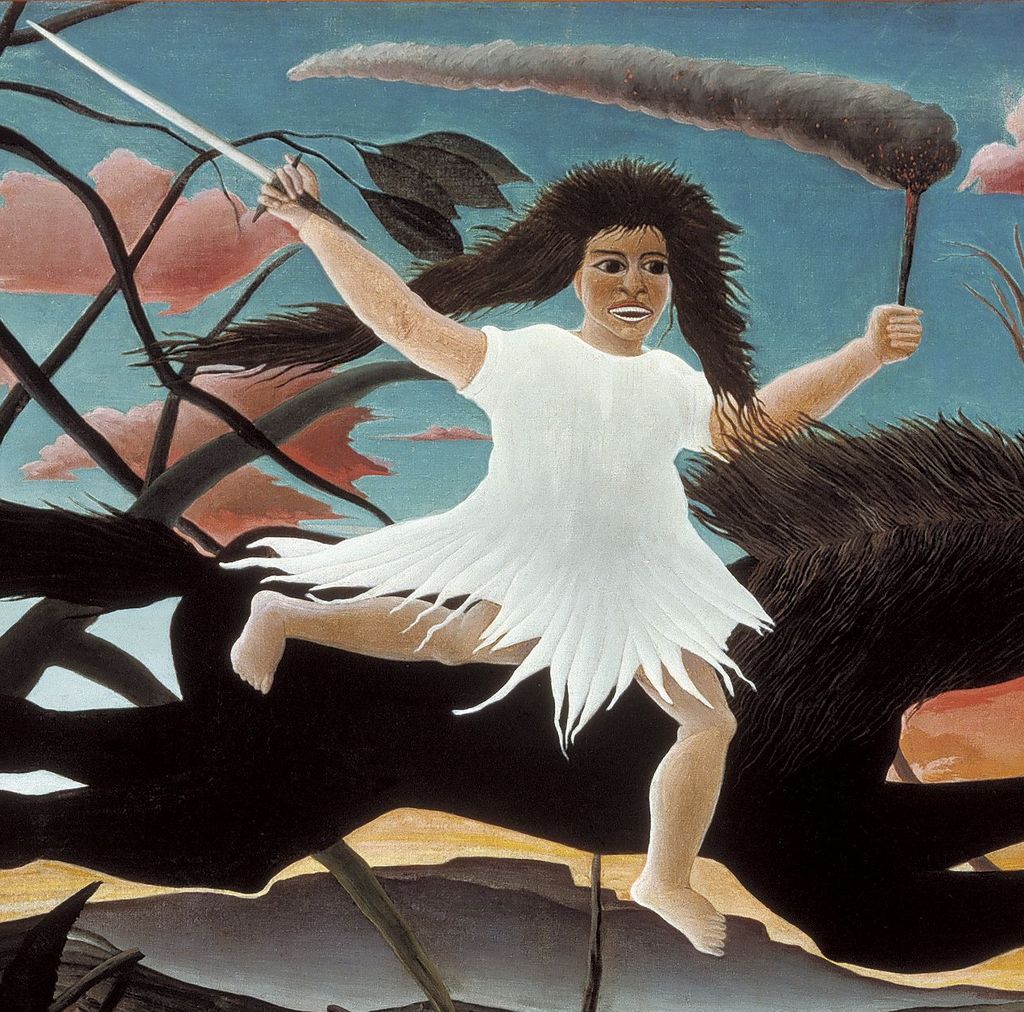
The horse’s forward reach
The long dark head and reaching forelegs carry the movement towards the right. The mane breaks the black silhouette into fine points, answering the rider’s hair and the jagged branches.
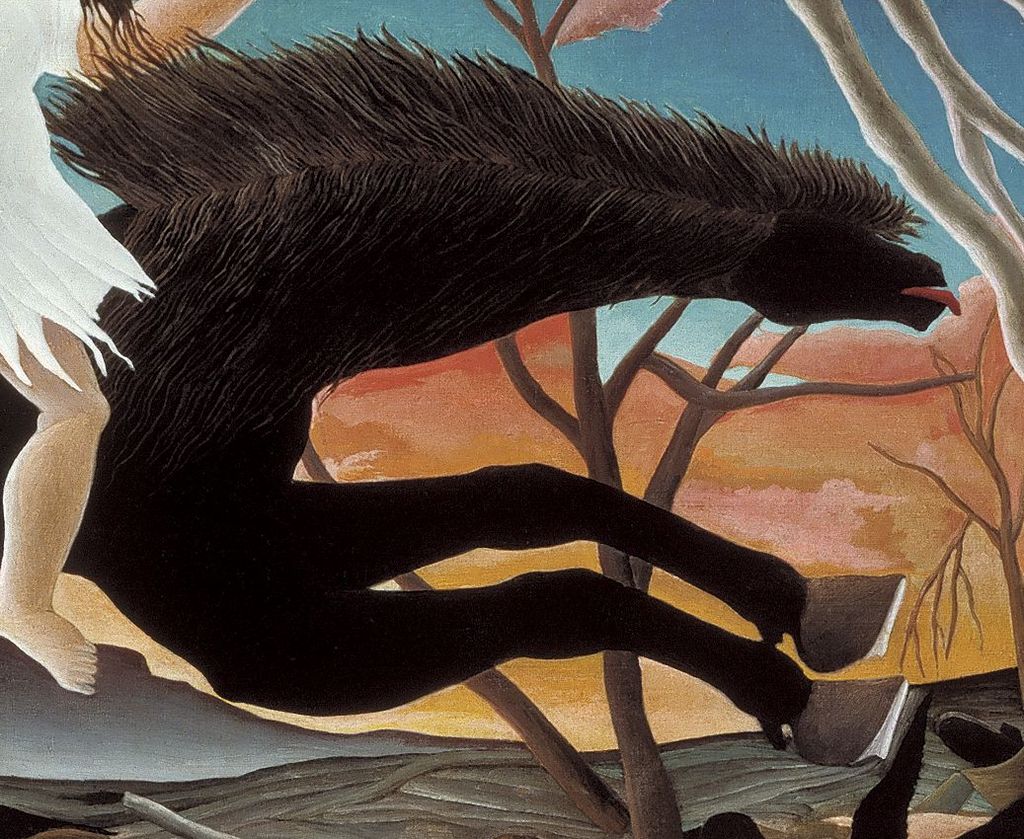
Crows among the fallen bodies
Pale limbs and a white shirt make separate bodies visible within the crowded ground. Black crows interrupt those light shapes, connecting the victims with the dark horse and trees above.
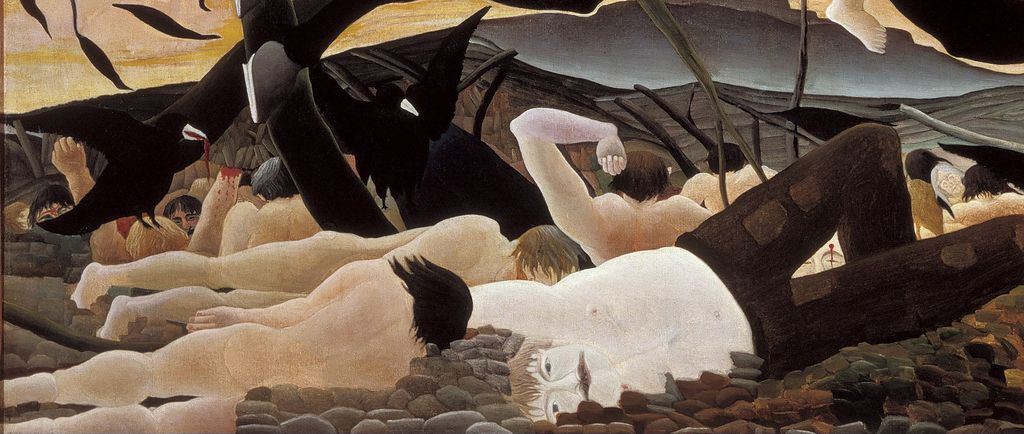
Broken branches against pink clouds
The pale tree sends angular limbs inward from the right edge. Its abrupt broken ends contrast with the rounded clouds, repeating the damage visible across the scene.
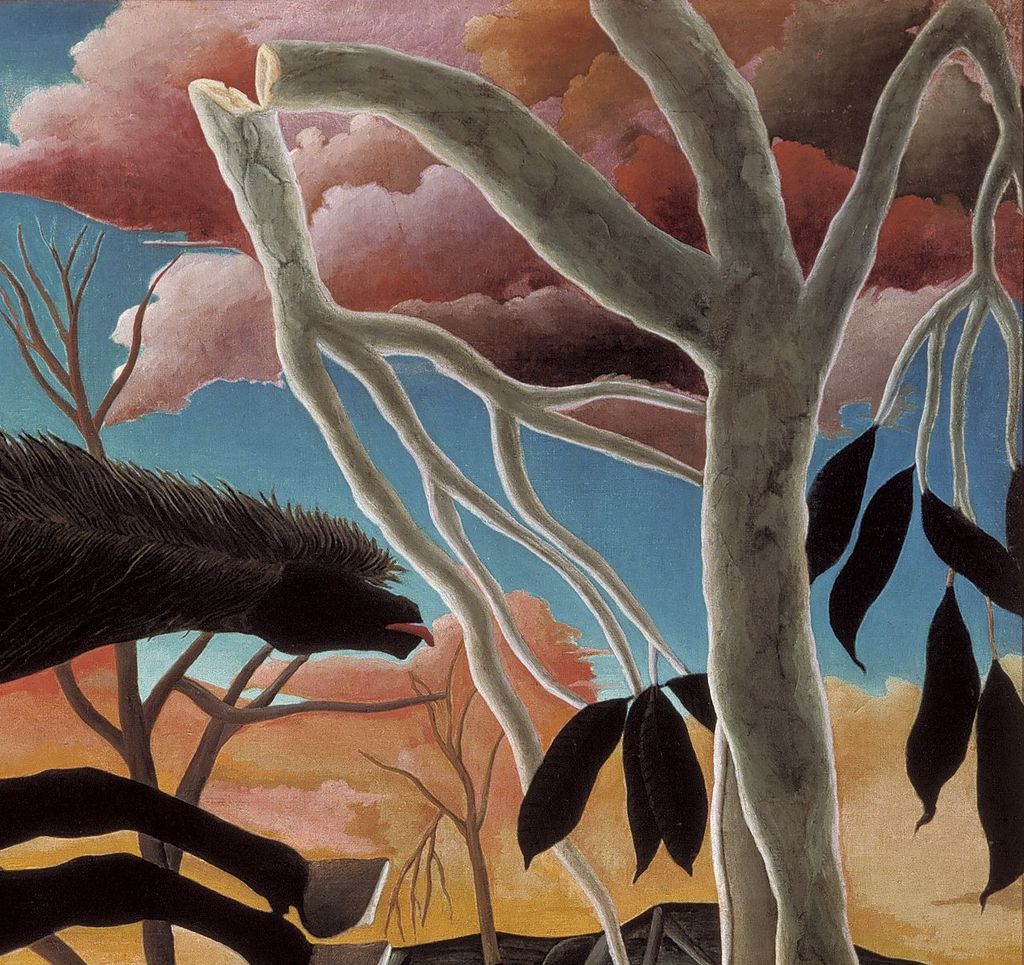
How the allegory works
Rousseau exhibited the canvas at the Salon des Indépendants in 1894. The accompanying catalogue caption described War passing terrifyingly and leaving despair, tears and ruin behind her; the current Orsay record identifies the exhibit as number 725.[1] The wording supplies a movement through time. We see what lies beneath the rider, and understand that she will carry the same devastation elsewhere.
That caption also helps explain the woman's identity. She personifies War. The 1985 Rousseau catalogue associates her with Bellona, the Roman war goddess, an identification also offered in Orsay's commentary.[11] Her weapons make the destructive role plain, while her strange face and disordered clothing prevent the figure from settling into calm classical dignity. She seems possessed by the force she embodies.
Allegory allows Rousseau to give that force a visible body without identifying a particular battlefield. We do not encounter a named commander, a recognisable manoeuvre or a sequence of military incidents. In the foreground, faces and limbs matter more than signs of rank. The catalogue observes that the victims have no military equipment to identify them as an army.[11] Their shared vulnerability occupies the space that uniforms and weapons might otherwise have used to distinguish opposing sides.
Colour gives the scene another kind of coherence. The black horse, birds and branches repeat across the canvas, while pale bodies and the white costume bring human flesh into sharp visibility. The clouds are softly rounded, yet their pink and reddish tones spread across a place where nothing below seems capable of flourishing. Their sweetness is disturbing beside the harsh forms beneath them. The sky does not release us from the foreground.
It is tempting to turn every colour into a fixed code. The immediate experience is more complicated. The white dress makes the rider stand out, but its pale brightness does not soften her weapons. Dark forms belong both to the creature carrying her and to the damaged landscape she crosses. Colours bind aggressor, victims and setting together, making the devastation feel pervasive rather than confined to one event.
The picture's emotional force also depends on a mismatch of expression and scale. The rider is small enough to seem almost doll-like, yet she commands the long animal beneath her and the entire width of the scene. Her power exceeds her physical presence. The bodies below occupy more of the foreground, but their greater number brings them no protection. The arrangement lets an abstract destructive force appear horribly disproportionate to the people it destroys.
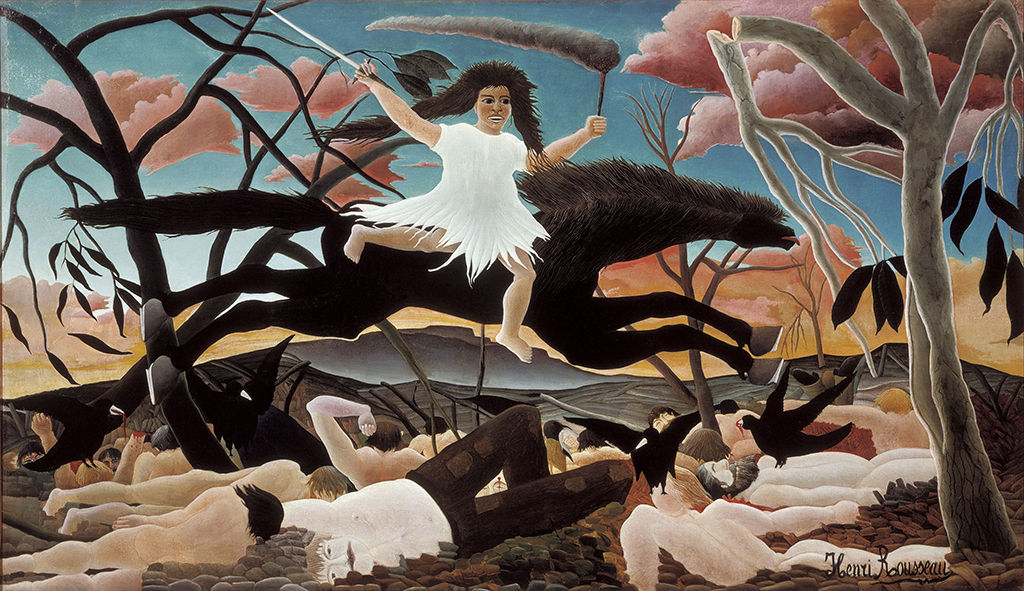
War — Henri Rousseau.
History remembered through an invented scene
Orsay places War against the continuing memory of the Franco-Prussian War of 1870 and the Paris Commune of 1871.[1] The interval matters: Rousseau exhibited the painting more than twenty years after those events. Its connection with historical violence passes through recollection, public imagery and allegory, rather than through an attempt to reconstruct a single moment before our eyes.
The 1985 catalogue dates its execution more narrowly to the winter of 1893–94.[11] Within the canvas, however, there is no reassuring distance between past and present. The rider remains in motion, the birds continue to feed, and the figures below fill the space closest to us. We can place the work in the 1890s while still feeling how Rousseau has withheld the ordinary signs that would contain the disaster within one date or location.
That choice gives the painting an unusually direct relationship with its viewer. A battle narrative might ask us to follow which army advanced or who held a position. Here the first questions are more elementary: what has happened to these people, and what kind of power can pass above them so heedlessly? The sword and torch answer through threat and destruction. The broken trees extend the damage beyond the human body.
The scene's theatrical clarity does not make it emotionally simple. The woman's airborne progress is absurd as well as frightening. Her frontal face interrupts the sideways movement; the horse looks both purposeful and improbable. Those qualities can make a first glance uncertain. As the scattered bodies become clearer, the initial strangeness becomes inseparable from the horror. Rousseau makes the catastrophe memorable through a form that resists familiar expectations of solemn battle painting.
Possible sources, and the freedom to change them
Scholars have connected War with several very different kinds of image. The 1985 catalogue compares the horse's extended pose with the horses in Théodore Géricault's The Epsom Derby of 1821. It also proposes an analogy with Ferdinand Hodler's The Night, especially the arrangement of bodies and the atmosphere of death.[11] These are suggestions about how Rousseau might have developed his composition. They do not establish a complete chain of borrowing.
The range widens from exhibition painting to popular prints. The same entry discusses a battle image by François Georgin and the caricature The Tsar, published in 1889, the latter comparison having been proposed by Marie-Thérèse de Forges.[11] Such connections place the canvas near an image culture in which a rider, a symbolic figure or a dramatic group could carry an immediately readable message. Rousseau's painting could be ambitious while remaining open to resources outside prestigious easel painting.
These proposed relationships are useful when they lead us back to the object. The horse is an especially strong example. Its extended legs make a long, almost continuous gesture across the canvas. Whatever the pose's possible source, its function here is to carry the personification above the fallen bodies. The animal's stretched silhouette becomes the very form of War's passage.
The bodies perform a different task. Their repeated horizontal positions slow the eye and keep it near the ground. Together with the vertical trees, they make the rider's lateral movement unusually clear. Rousseau has organised movement, stillness and obstruction into a comprehensible structure. The scene can feel strange in its anatomy and space while remaining forcefully directed in its effect.
That balance brings us back to Rousseau's choices. A proposed source for a pose leaves much to explain about this conjunction of white costume, black animal, shattered trees and vulnerable people. The painting's distinct character lies in the way those elements meet.
Louis Roy and Alfred Jarry respond
The contemporary response contained both mockery and serious attention. Louis Roy's article in the Mercure de France of March 1895, reproduced in the 1985 catalogue, makes a particularly revealing defence. Roy acknowledged that the painting was neither a complete achievement nor a perfect work. He nevertheless recognised an ambitious attempt at symbolism and treated Rousseau's independence as a substantial artistic quality.[11]
Roy's argument begins from the very oddity that could provoke laughter. An unfamiliar picture, he reasoned, might seem strange because it did not recall something already known. He praised Rousseau for being “completely himself.”[11] This was a defence of invention that still allowed criticism. Roy did not need to make every awkwardness disappear before recognising a new artistic personality.
His response is valuable because it gives the painting an early audience capable of meeting its ambition. The serious reception of Rousseau did not wait until later generations had made him famous. In 1895, a critic could already describe this particular canvas as an important experiment in making a symbol visible.[11] The unsettling rider and the difficult arrangement of bodies were part of a contemporary discussion about what painting could do.
Alfred Jarry offered a more extravagant kind of attention. Henri Béhar's essay in the same catalogue records Jarry's encounter with War at the 1894 Salon and his writing about it that year. Jarry described the steed, mauve clouds and crows in language that turned the painting into another imaginative world, even comparing the victims with translucent amphibians.[12] His response enlarges the picture's strangeness rather than explaining it away.
Roy and Jarry therefore provide two distinct ways of approaching the work. Roy weighs the achievement and argues for its independence. Jarry allows its forms to generate startling verbal associations. Both give evidence of sustained attention. Their responses help us understand how a picture that unsettled expectations could attract viewers who found that very difficulty productive.
Jarry's interest also had a practical consequence. Béhar records that he encouraged Rémy de Gourmont to commission a lithograph of War for their review L'Ymagier.[12] Admiration became a route into publication. The painting's reception thus belongs to the history of a second object, made for a different scale and a different kind of encounter.
The original lithograph of 1895
MoMA owns an impression of Rousseau's War, a lithograph published in January 1895. The composition measures 22.2 × 33.1 centimetres; the museum records it as an anonymous gift, accession number 684.1943.[13] This is an original printed work connected with Rousseau's lifetime publication, quite distinct from a modern reproduction of the oil painting.
The 1985 catalogue identifies its first appearance in L'Ymagier and describes it as Rousseau's only known print.[14] Béhar explains the review's interest in popular imagery: Jarry and Gourmont sought to bring older graphic traditions into contemporary artistic life. In that setting, Rousseau's image joined an argument about the continuing vitality of prints, folk imagery and symbolic forms.[12]
At the smaller scale, the horse and rider remain immediately recognisable. Yet the change of medium changes the experience of looking. In MoMA's impression, dark strokes work across warm-toned paper. Closely spaced lines build the horse's flank and the sky; outlines clarify limbs and faces. The painting's large areas of contrasting colour give way to a surface in which the direction and density of marks carry much of the emphasis.
The trees are less enclosing. Slender trunks and a few angular branches leave a greater expanse of sky around the rider. Below her, the ground breaks into hard-looking blocks beneath the bodies. Several figures stretch their arms or arch their limbs, so that the lower part of the print seems more restless. These changes make the lithograph worth examining as a composition in its own right.
The catalogue quotes Charles Perussaux's comparison of the two versions, including his observations about the expanded sky, reduced trees and more agitated victims.[14] The visual differences are substantial enough to resist treating the print as a mechanically reduced image. Rousseau adapted the subject to an arrangement that could sustain its force on a page.
The exact working sequence has nevertheless been debated. Some writers regarded the lithograph as an early sketch; others considered it a later reduction of the painting. The catalogue's entry favours the latter interpretation while acknowledging a contrary view elsewhere in the same volume.[14] The securely stated dates are the canvas's exhibition in 1894 and the print's publication in January 1895. Publication history alone does not settle every stage of preparation.
Seen together, the versions reveal what could change while the subject remained legible. The contrast between airborne destruction and fallen humanity survives. Colour, the weight of the trees and the treatment of bodies change around that central relationship. Following those differences lets us see Rousseau making choices about emphasis as he adapts the subject from canvas to paper.
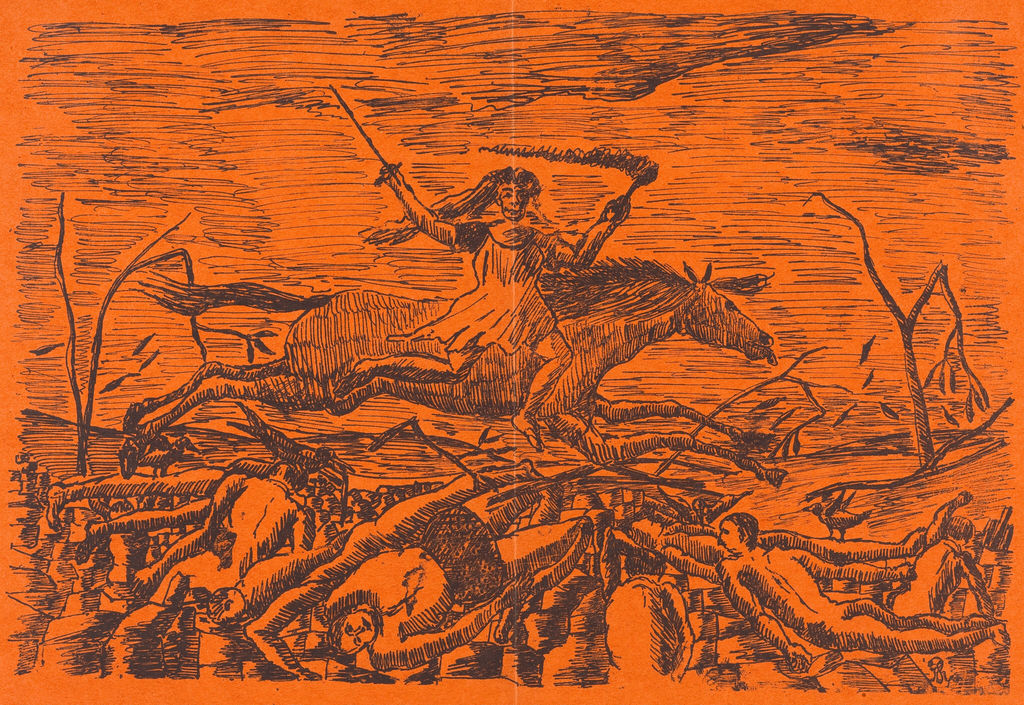
Henri Rousseau, La Guerre (The War), 1894 (published 1895), lithograph on orange wove paper. This is the National Gallery of Art’s impression, Rosenwald Collection, 1964.8.1502; the article also discusses MoMA’s separate impression. Rosenwald Collection; Courtesy National Gallery of Art, Washington. Image source. CC0 / Public domain. Resized only; the supplied paper colour and visible marks are retained.
From private ownership to the national collection
The canvas's later history contains a long interruption. The 1985 catalogue describes its disappearance from view for roughly fifty years. Orsay's provenance places it in a private collection in Louviers and records Louis Angué there in 1943.[11][1] Its return to public attention therefore belonged to a different world from the Salon where Roy and Jarry first encountered it.
The recorded sequence then becomes more precise: Galerie Terrisse in 1943–44, Galerie E. Bignou in 1944–46, and a French state purchase approved in January 1946. Assigned initially to the Louvre, it was at the Jeu de Paume from 1947 to 1986 and assigned to Orsay in 1986.[1] The state acquisition and the eventual Orsay destination are separate stages in the painting's history.
That passage into the national collections gives a particular resonance to Roy's early defence. A picture whose independence required an argument became a work preserved for a public audience. Its museum history should not smooth away the disquiet that first made it difficult. The horse still races above people who cannot rise; the woman still holds her weapons aloft.
Across Rousseau's paintings, War gives human violence an exceptionally stark form. The 1985 catalogue proposes The Snake Charmer as a kind of counterpart.[11] That association invites attention to how differently a central figure can govern a landscape. Here, the governing force leaves broken branches, scattered bodies and feeding birds in its wake. The longer we look, the more the rider's spectacular passage returns our attention to the people beneath her.
Henri Rousseau artworks directory
This directory brings together works covered on this site and other works documented in the cited museum records and catalogues. Alternate titles share one entry; distinct versions remain separate. Historical dates for works without an article follow the cited catalogues. This is not a catalogue raisonné.
Frequently Asked Questions
Discussion
Look again at the images and ideas explored in War. These editorial prompts invite your observations.
Reader Insights
Trace the black shapes from the horse through the trees and crows. How do they connect the rider with the damaged world beneath her?
What changes when you move your attention from the woman's face to one individual body in the foreground?
Compare the painting with the lithograph. Which change most affects the scene's sense of movement or enclosure?
Join the Conversation
Share a detail, comparison or question about War below.
References
- Musée d'Orsay. La Guerre, RF 1946 1, current object commentary, metadata, Salon-caption transcription, provenance and exhibition history; accessed 23 October 2026. View source. (in French).
- Philadelphia Museum of Art, Carnival Evening,1963-181-64,object59593. View source.
- Musée de l’Orangerie / Juliette Degennes, Henri Rousseau,L’ambition de la peinture: Un artiste dans son époque (in French). View source.
- National Gallery, Surprised!, NG6421. View source.
- MoMA, The Sleeping Gypsy. View source.
- Philadelphia Museum of Art, The Merry Jesters, 1950-134-176, object51097. View source.
- Musée d’Orsay, La Charmeuse de serpents, RF 1937 7 (in French). View source.
- Musée de l’Orangerie, La Carriole du Père Junier, RF 1960 26 (in French). View source.
- Solomon R. Guggenheim Museum / Cornelia Lauf, The Football Players,60.1583: current collection record. View source.
- MoMA, The Dream, 252.1954. View source.
- Museum of Modern Art. Henri Rousseau, 1985, catalogue entry 9, “War,” printed pp. 118, 120–121 (PDF pp. 123, 125–126), including the English translation of Louis Roy, “Un Isolé: Henri Rousseau,” Mercure de France, March 1895, pp. 350–351. View source.
- Henri Béhar. “Jarry, Rousseau, and Popular Tradition,” in Museum of Modern Art, Henri Rousseau, 1985, printed pp. 23–26 (PDF pp. 28–31), especially the L'Ymagier commission and Jarry's 1894 response on printed p. 24. View source.
- Museum of Modern Art. Henri Rousseau. War. Published January 1895, lithograph, 684.1943, current collection record and object image; accessed 23 October 2026. View source.
- Museum of Modern Art. Henri Rousseau, 1985, catalogue entry 10, “War,” printed p. 122 (PDF p. 127), including the working-sequence discussion and Charles Perussaux comparison. View source.
- The Museum of Modern Art, Henri Rousseau: Essays (1985), selected catalogue entries, chronology and notes on early devotees. View source. Selected entries, chronology (pp.91–95) and early-devotee notes (pp.262–264) were consulted. Historical collection credits do not establish present ownership.
- Daniel Catton Rich, Henri Rousseau (The Museum of Modern Art, 1942), selected drawings and landscape studies; historical catalogue. View source. The dated 1942 publication is used for the two Quai d’Auteuil ink views; its Malakoff date differs from the 1985 catalogue.
- MANAS, Laval, Henri Rousseau, dit le Douanier, urban landscapes and preparatory study (in French). View source.
- National Gallery of Art, Self-Portrait (1895), pen-and-ink drawing, accession 1995.47.66. View source.
- Barnes Foundation, Landscape and Four Young Girls, object 5521, BF855. View source.


 Henri Rousseau.jpg)


 Henri Rousseau.jpg)