



 by Tom Gurney
Tom Gurney BSc (Hons) is an art history expert with over 20 years experience
Published on June 19, 2020 / Updated on October 14, 2023
Email: tomgurney1@gmail.com / Phone: +44 7429 011000
The Seaside at Palavas by Gustave Courbet: Introduction
At the left of a wide shore, a man lifts his hat towards the Mediterranean. His body takes up a small part of the beach, and the sea runs uninterrupted across the canvas behind him. The gesture is easy to read from a distance, even though the man’s face is turned away. In The Seaside at Palavas (Le Bord de mer à Palavas), Gustave Courbet made that brief salute the only human action in a landscape of sand, water and sky. He painted it in 1854, during his first stay in Montpellier. The oil on canvas measures 38 × 46.2 cm unframed and belongs to the Musée Fabre in Montpellier, which catalogues it as 868.1.24. [1] [2]
At a Glance
- Date1854
- MediumOil on canvas
- CollectionMusée Fabre, 868.1.24
Contents
- The hat above the shore
- A commission from Alfred Bruyas
- A comparison with Friedrich
- Palavas in the catalogue and on canvas
The hat above the shore
The figure stands far enough to the left that most of the view opens beyond him. The lift of his arm makes a second shape beside his head, with a little interval of light between them. He stands on a dark patch of ground that runs in from the lower edge. His legs almost join that patch, while his head and arm stand out against pale sand. The contrast makes the upper part of the figure easier to read than the lower part. Once the eye finds the hat, it can follow his upright body down and use it to measure the width of the shore. The position matters as much as the pose. Set in the centre, a man raising his hat might dominate the picture. Here, the eye follows his gesture out across a much longer stretch of shore than the one behind him. The dark accent that first catches the eye also sends it away. [1] [2]
Sand, water and sky remain distinguishable even at a glance. The ochre of the beach lies nearest us. Along the edge of the water, lighter strokes interrupt the meeting of sand and blue-green sea. Farther away, the horizon holds firm, and the sky opens out in paler blues. Look from the shoreline to the horizon and the difference between the two edges becomes especially clear. The nearer one changes thickness and is broken by the marks of small waves. The distant one can be followed steadily from side to side. In a painting with so few objects to mark distance, those two edges do much of the work of putting the water between the figure and the far sky. [1] [2]
The Musée Fabre’s teaching dossier describes Courbet spreading paint with a palette knife. The breadth of the marks is easiest to appreciate beside the small, legible shape of the man. Across the beach and water a single stroke can help establish a whole plane, while the compact silhouette depends on a few changes of direction around the arm and hat. The painting feels expansive partly because so much of it is given over to differences within the same colour, from one shade of blue to the next. It takes longer to follow those changes than to recognise what the man is doing. [1] [3]
A commission from Alfred Bruyas
Alfred Bruyas commissioned the painting during the visit that brought Courbet to Languedoc from May to September 1854. They had met in Paris the previous year, when Bruyas bought The Bathers after its controversial appearance at the Salon and also acquired The Sleeping Spinner. Bruyas then commissioned the portrait known as the Tableau-Solution and invited Courbet south. The journey introduced Courbet to the Mediterranean. He had already seen the sea in Normandy in 1841. On this visit the coast and its lagoons drew him away from the city, and the open beach gave him a subject very different from the enclosed banks and wooded water he knew in Franche-Comté. [2] [3] [4]
The same visit produced The Meeting, a much larger painting in which Bruyas and his servant encounter Courbet on a road. There, the people are big enough for the viewer to take in the differences between their dress and bearing. The hat comes off in the presence of other people. In The Seaside at Palavas the gesture has a similarly legible outline, but it is addressed across open water. In the road scene, the arrangement of bodies allows the eye to follow an exchange. One person’s gesture is legible in relation to another’s. At Palavas there is no returning gesture. The shoreline runs past the man and out of the picture, so that what begins as a familiar courtesy becomes something closer to an expression of delight. [1] [2] [5]
The Fabre’s teaching dossier identifies the saluting man as Courbet. In another account of the work, the museum leaves open whether he is the painter or Bruyas. Seen as Courbet, the man makes a kind of self-portrait in which the artist’s attitude is carried by the way he stands and raises his arm. Seen as Bruyas, he brings the patron into the landscape that he had helped Courbet discover. Neither reading gains much certainty from the silhouette. We have a clearer view of the direction of the man’s attention than of the man himself. [2] [3]
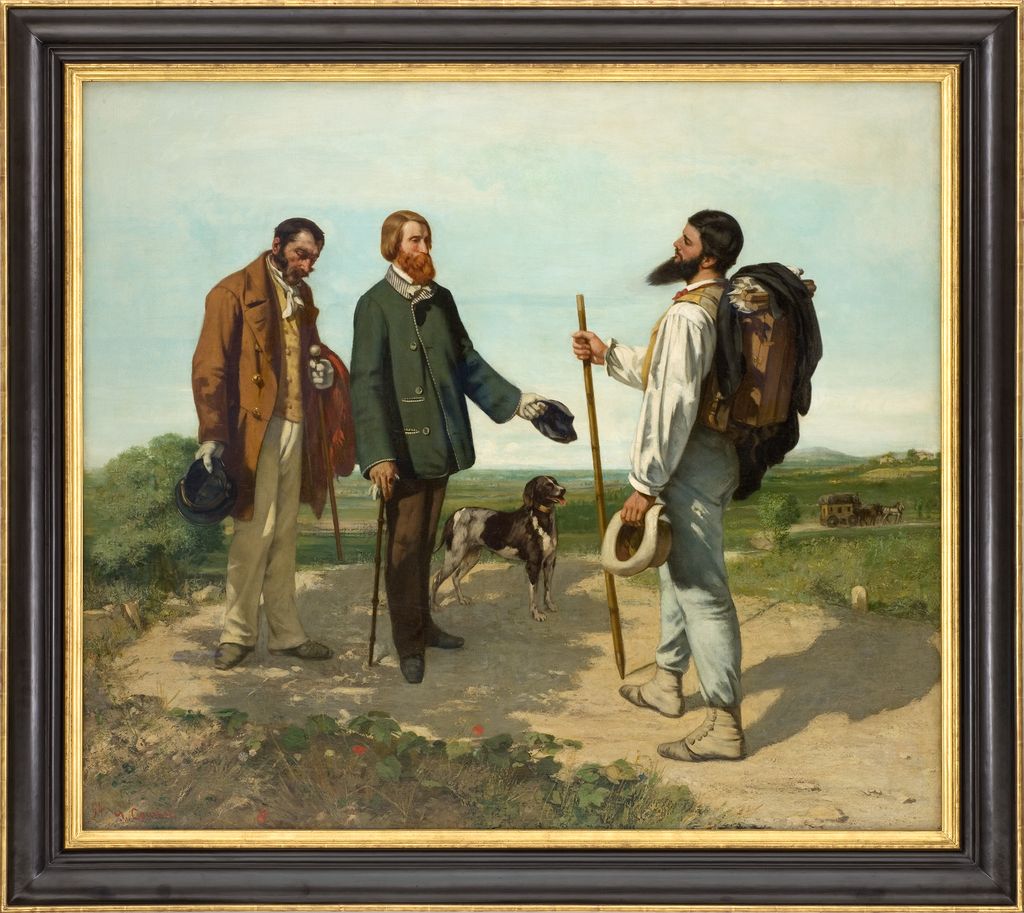
The Meeting, Musée Fabre 868.1.23. Image source. Public domain. Resized from the complete source image.
A comparison with Friedrich
The Musée Fabre has compared the painting with Caspar David Friedrich’s The Monk by the Sea, painted in 1808–10 and held at the Alte Nationalgalerie in Berlin. Both works give a solitary person a thin strip of land and put a much larger expanse of sea and sky in front of him. A viewer can take in the figure’s situation immediately, even before attending to the weather or the colour of the water. In both compositions, the coast also offers few visual cues about where the eye should stop. [2] [6]
The kinship is clearest in the proportions of the figure to the view. The difference comes out in the pose and the light. Friedrich’s monk stands within a dark, still expanse. The figure’s stillness encourages the eye to linger on the sky and the uncertain distance ahead. Courbet raises an arm into the light and sets the figure beside a warm strip of sand. The gesture gives the scene the feeling of a particular moment. The comparison helps explain how a view of an identifiable stretch of coast can also suggest something as difficult to measure as a person’s feeling for a place. [1] [2] [6]
Palavas in the catalogue and on canvas
The Fabre’s record identifies the picture with entry 66 at the Montpellier Salon of 1860, where it was listed as Les Bords de la mer. It entered the museum through Bruyas’s gift in 1868. In September of that year, he wrote to the mayor of Montpellier to offer his gallery to the city, explaining his belief that major works should pass from private collections into public view. The municipal council accepted the gift in October. What began as a commission from an individual patron thus became part of a public collection in the region it depicts. [1] [4]
The titles of Courbet’s coastal paintings can be deceptively close. Mer calme à Palavas, catalogued by the Musée d’Orsay under MNR 880 and held at the Musée Paul Valéry in Sète, is a separate oil on canvas dated 1857. At 74 × 92 cm, it is roughly twice the height and width of the Fabre painting. A small sailboat is among the details in the later view. A reader looking for the lone figure raising his hat should look for the Fabre’s 1854 canvas. There is also a Seashore at Palavas of about 1854 at the Musée d’art moderne André Malraux in Le Havre. There, four sails break the horizon, and the surf spreads in a much wider area of worked paint between the sea and the beach. [1] [7] [8]
The Metropolitan Museum of Art’s The Calm Sea takes us to a different coast. Courbet painted it at Étretat in Normandy in 1869. Two boats sit on the exposed shore at low tide, and the sky takes up most of the canvas. In that picture the boats give a measure of the sea’s withdrawal and tell us something about the people who use the shore even though they are absent. The man at Palavas supplies a different kind of measure. His silhouette makes the distance to the horizon seem greater, and his lifted hat gives that distance an emotional force. The water is calm enough for the gesture to hold the eye against it. [1] [9]
Courbet artworks directory
Browse the paintings covered in this guide. Dates identify the specific versions discussed.
Discussion
Look again at the images and ideas explored in The Seaside at Palavas by Gustave Courbet. These editorial prompts invite your observations.
Reader Insights
What does the figure’s size tell you about the sweep of the coast?
How does the raised hat affect your reading of the scene?
What changes when you compare this painting with the separate Orsay view of Palavas?
Join the Conversation
Share a detail, comparison or question about The Seaside at Palavas by Gustave Courbet below.
References
- Musée Fabre, Le Bord de mer à Palavas, collection record 868.1.24. View source.
- Musée Fabre, Le Bord de mer à Palavas, Enfants ambassadeurs object commentary. View source.
- Musée Fabre, Le bord de mer à Palavas, educational dossier. View source.
- Musée Fabre, La « Solution » d’Alfred Bruyas. Includes Bruyas’s letter to the mayor of Montpellier, 14 September 1868. View source.
- Musée Fabre, La Rencontre ou Bonjour Monsieur Courbet, object commentary. View source.
- Staatliche Museen zu Berlin, Alte Nationalgalerie, Caspar David Friedrich Project: Monk by the Sea and The Abbey in the Oakwood. View source.
- Musée d’Orsay, Mer calme à Palavas, collection record MNR 880. View source.
- Musée d’art moderne André Malraux, The Seashore at Palavas, object commentary. View source.
- Metropolitan Museum of Art, The Calm Sea, collection record 29.100.566. View source.


