



 by Tom Gurney
Tom Gurney BSc (Hons) is an art history expert with over 20 years experience
Published on June 19, 2020 / Updated on October 14, 2023
Email: tomgurney1@gmail.com / Phone: +44 7429 011000
Young Ladies of the Village by Gustave Courbet: Introduction
At the foot of a rocky slope, a young woman pauses to offer alms to a barefoot cowherd. The two bend their heads towards their outstretched hands. Behind the woman, one companion stands under a parasol and another turns to watch. It is a small exchange in a painting more than two and a half metres wide. Gustave Courbet painted Young Ladies of the Village in 1851–52, using his sisters Zélie, Juliette and Zoé as models for the three women. The oil on canvas measures 194.9 × 261 cm and belongs to the Metropolitan Museum of Art in New York, where it entered the collection in 1940 as a gift from Harry Payne Bingham. [1]
At the Paris Salon of 1852, the dresses, the dog and the surprisingly small cows all became matters for debate. The landscape was part of the quarrel too. Look first at how Courbet has laid out the valley, and it becomes easier to see why a picture of four people quietly meeting on a patch of grass could have provoked such sharply different responses. [1]
At a Glance
- Date1851–52
- MediumOil on canvas
- CollectionThe Metropolitan Museum of Art, 40.175
Contents
- Four figures in a valley near Ornans
- What the Salon critics saw
- What it meant to call them young ladies
- Annotated details
Four figures in a valley near Ornans
The woman nearest the girl wears a pale pink dress and carries a wicker basket in the crook of her arm. The rim of her bonnet casts a shadow over her face as she looks down. Her free hand makes a short diagonal towards the girl's, low against the grass. The girl has a bundle strapped to her back, a head covering drawn close to her face and a red apron that stops well above her bare feet. The two inclined heads make the figures momentarily alike. Everything below them, from the line of the shoulders to the shoes and feet, tells a different story about their reasons for being outdoors. [1]
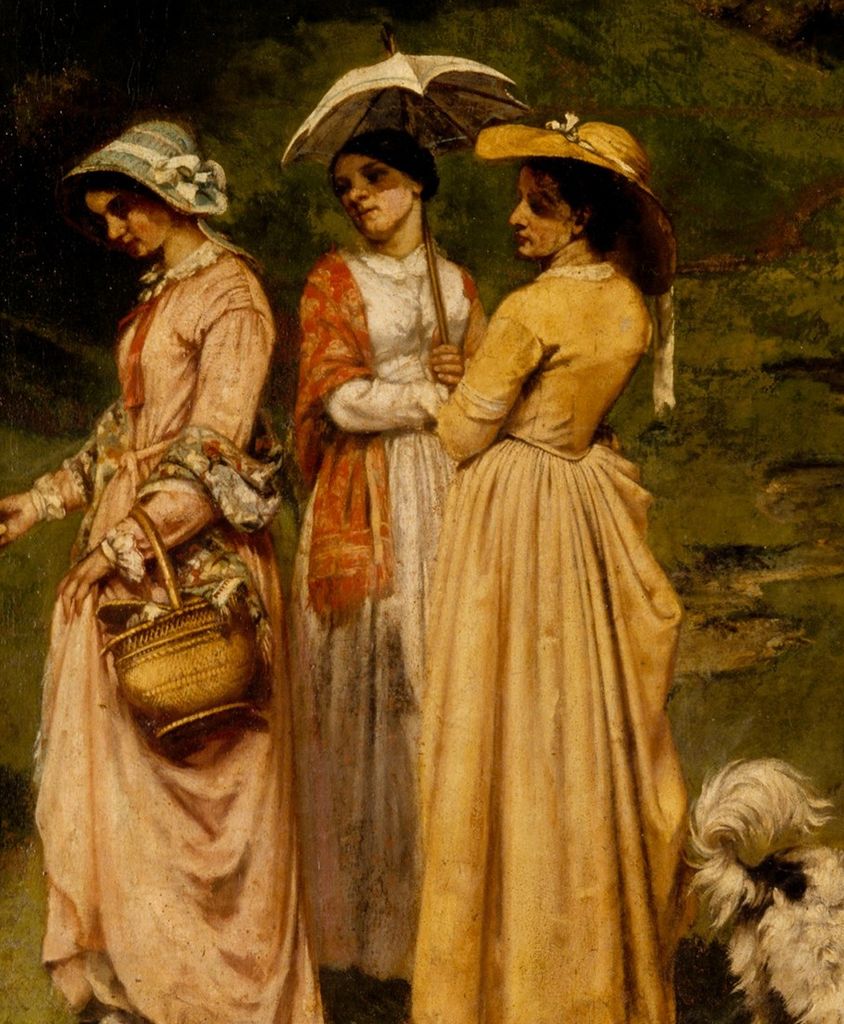
The other women are close enough to touch the giver's sleeve. One faces partly outwards, her light bodice and the red fabric at her shoulder framed by the darker underside of the parasol. The woman in yellow shows most of her back, but turns her head far enough for us to see her profile beneath the hat brim. This succession of angles gives the group a rhythm. The two onlookers keep their arms close to their bodies while the giver reaches out. Courbet lets the gesture disturb the otherwise upright cluster, drawing the eye sideways to the smaller figure. [1]
The setting is the Communal, a small valley near Courbet's native Ornans in eastern France. The limestone cliffs familiar from the surrounding Jura appear here as a broken ledge beneath a grassy skyline. On the left the ground drops abruptly into shadow. Farther right, the exposed rock catches the light, and a dark shrub marks the foot of the pale wall. The sky runs across the top in a comparatively open band. Below it, the slopes dip towards the centre, where the eye can follow a narrow break in the grass uphill behind the women. Seen from below, the slopes enclose the figures even as the shallow dip in the skyline draws the eye towards open country. [1] [2]
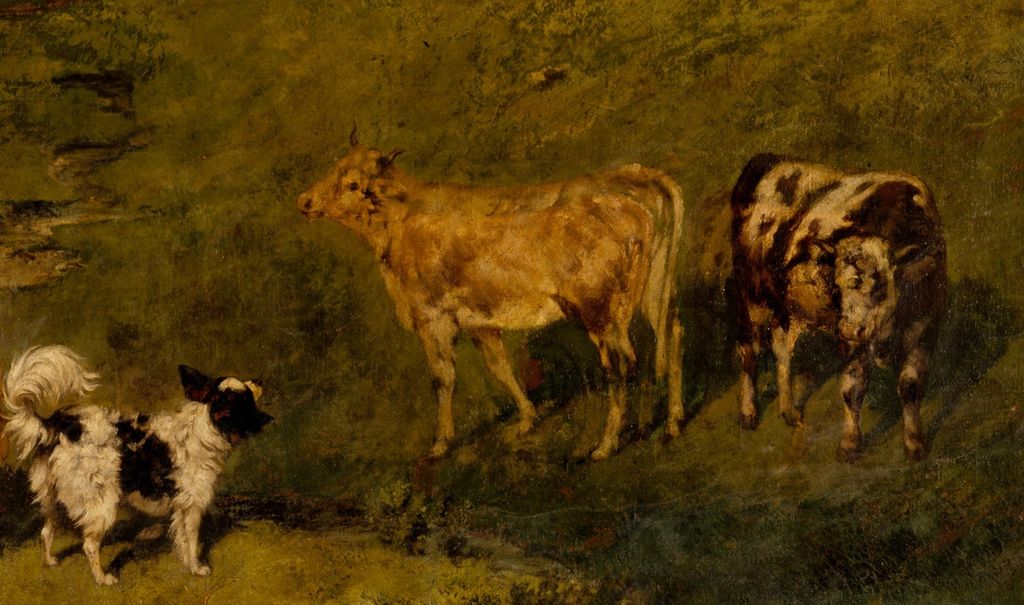
The dark face of the ledge helps the parasol and hats stand out. Below, the uneven ground works against that clarity. Grass, stone and low plants interrupt the intervals between feet, paws and hooves. The viewer can see the country open up behind the group but has fewer cues for judging the shorter distances across the meadow. That difficulty becomes most apparent on the right, where a small black-and-white dog stands near the yellow skirt. Its raised head and curled tail make a sharp silhouette. Beyond it are two cattle, one seen from the side and the other turned away. The space between dog and cows appears modest beside the difference in their apparent size. [1]
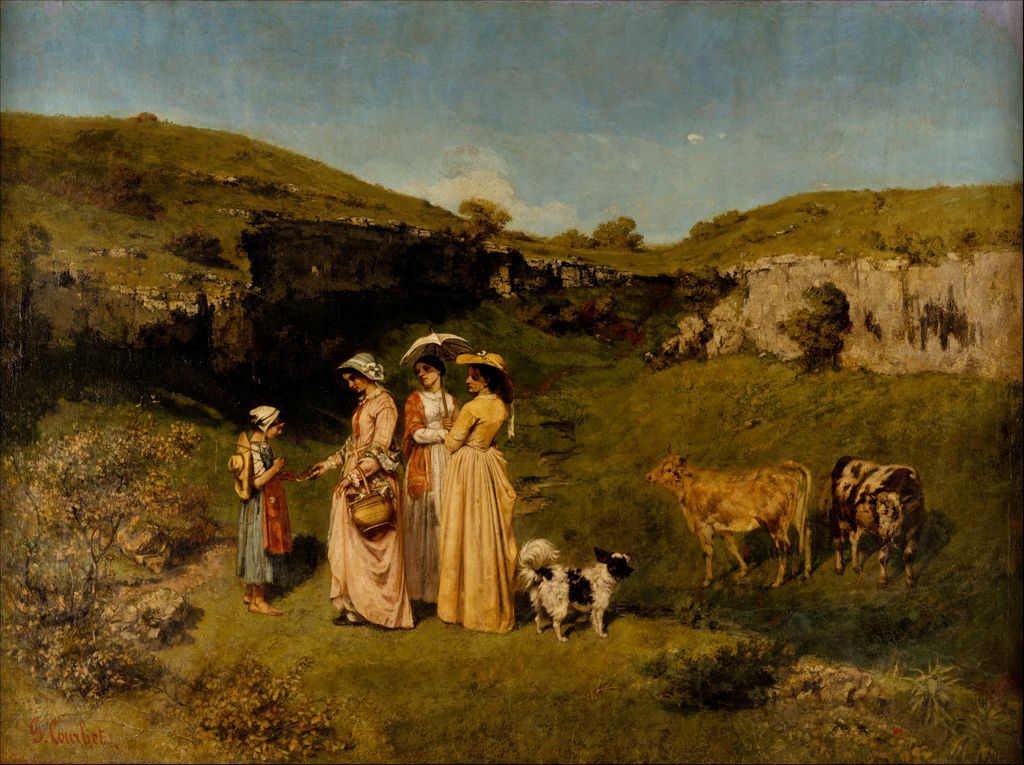
Young Ladies of the Village, Met 40.175. Image source. CC0 / Public domain. Resized from the complete source image.
What the Salon critics saw
In a January 1852 letter to Champfleury reproduced by the Institut Courbet, the painter said he had done something graceful and put his judges on unfamiliar ground. [3] At the Salon of 1850–51, A Burial at Ornans and The Stone Breakers had given a village funeral and roadside labour the dimensions associated with ambitious public painting. On the new canvas, the event that commanded so much wall space was a pause in a walk. [2] At the Palais-Royal in 1852 the work appeared as number 292 in the painting section of the Salon catalogue, which gives the short title Les demoiselles de village and names the comte de Morny as its owner. [4]
Gustave Planche, writing in the Revue des Deux Mondes, could credit the figures in the earlier Burial with a vitality he admired despite his objections to their looks. In the Village painting he attacked the women's faces and the harshness of the colours. His larger charge was that Courbet could observe and paint individual things but had failed to make them cohere as a picture. Planche granted that the foreground terrain was well handled, then used the cows to explain where, in his view, the arrangement broke down. Their size suggested distance while the ground under their feet seemed to place them much closer. He likened their proportions to wooden toy cows. [5]
That complaint makes sense if we follow the rising ground from the women's feet towards the cattle. The patch under the animals appears above the dog on the canvas, which suggests a step back. The cow in profile, however, is readily legible, with a lit flank and a dark line under the belly. There is little overlap to tell us just how much ground separates one group from the next. The animal can seem quite near and too small at the same time. Planche took the difficulty as a failure of perspective. It also helps explain why the cattle attract so much attention in a scene whose main action lies well to the left of them. [1] [5]
Claude Vignon, reviewing the same Salon, heard the familiar jokes about the size of the cows and wondered whether their oddity was a device for catching the eye. The critic admired the landscape, apart from some branches that could have stood out more clearly, and found the young women convincing in their dress and bearing. Vignon had long regarded Courbet as a painter with a future in landscape. Where Planche saw well-observed patches that failed to add up, Vignon found much of the painting persuasive and took issue with particular details. The two readings leave room for both the sure sense of a place and the uncertainty about exactly where its animals stand. [6] [5]
The picture also changed places during the exhibition. In one of Gustave Le Gray's photographs of the Salon, it is centred on the north wall of the Grand Salon, in the middle tier of paintings. In another plate from the same album, the Musée d'Orsay identifies it in the first-floor gallery. The Salon rules provided for changes to the hanging. Orsay suggests that unfavourable reviews may have prompted this particular move, a possibility the photographs leave open. The view of the main room places Courbet's broad horizontal canvas among paintings stacked in tiers, with two much smaller landscapes by Théodore Rousseau below it. It brings a piece of recognisable Franche-Comté terrain onto the same wall as subjects such as Charles Lefebvre's Satan Struck Down, which Orsay identifies in the upper tier. [7]
What it meant to call them young ladies
The difference between the girl and the sisters is clear in the scene. She is there to mind cattle. They have the freedom to walk together, dressed for an outing. The title points to a second distinction, one harder for some Paris critics to accept. As the Met's Kathryn Calley Galitz explains, demoiselles carried the social implications of the English “young ladies.” Putting the word beside de village gave a title associated with gentility to women from a rural community. The attacks on the women's appearance and dress reveal how much some reviewers expected a picture to sort its figures according to conventions of class and beauty. [2] [1]
Courbet makes those distinctions visible through small contrasts. The parasol opens above three women whose skirts sweep the ground. The girl has her arms free to receive something and carries her bundle behind her. The cut and fall of the clothing give the women different silhouettes even where their bodies overlap. Yet the distance between the girl and the giver is the width of their reach, and their faces are lowered at much the same angle. The painting lets the physical nearness of the two coexist with the difference in what each is doing there. This gives the act of charity a particular character. One young person can interrupt a walk to give something to another whose work continues when the group moves on. [1]
The colour does some of the work of joining figures that dress and occupation set apart. The red at the central woman's shoulder echoes the brighter red of the girl's apron across the space between them. The yellow skirt and the tawny hide of the nearer cow catch the light against the grass. From a distance these patches are easy to pick out. As you move in, the skirt separates into folds and seams, and the light on the cow breaks into variations along the ribs and shoulder. The surfaces that drew complaints about harmony also give the eye paths to follow through the meadow. [1]
Courbet returned to the word demoiselles for Young Ladies beside the Seine (Summer), shown at the Salon of 1857 and now in the Petit Palais in Paris. That later canvas presents two women reclining on a riverbank, their contemporary clothes and ease outdoors subjects of criticism in their own right. In the earlier picture, the women are upright, the landscape is a valley near Ornans, and the action is a moment of giving. The shared title makes it worth looking at how much social information Courbet could put into the fall of a dress, the way a body occupies a patch of ground, or the space between one person and another. [8] [1]
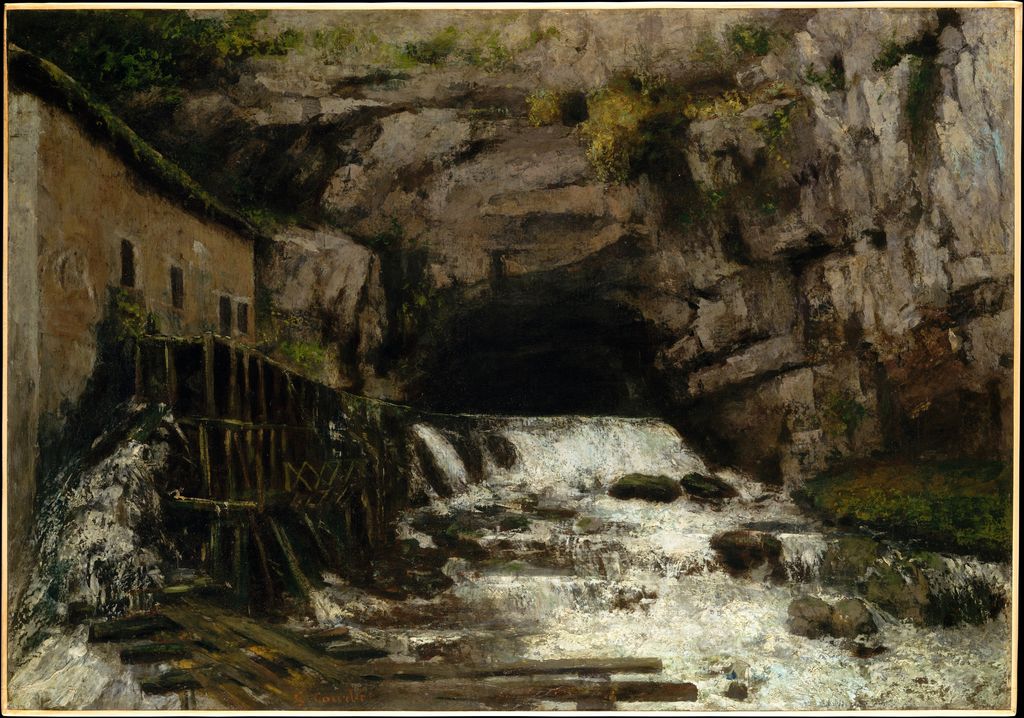
The Source of the Loue, Met 29.100.122. Image source. CC0 / Public domain. Resized from the complete source image.
Annotated Details from Young Ladies of the Village
Use the numbered details to follow the encounter, the animals and the terrain.
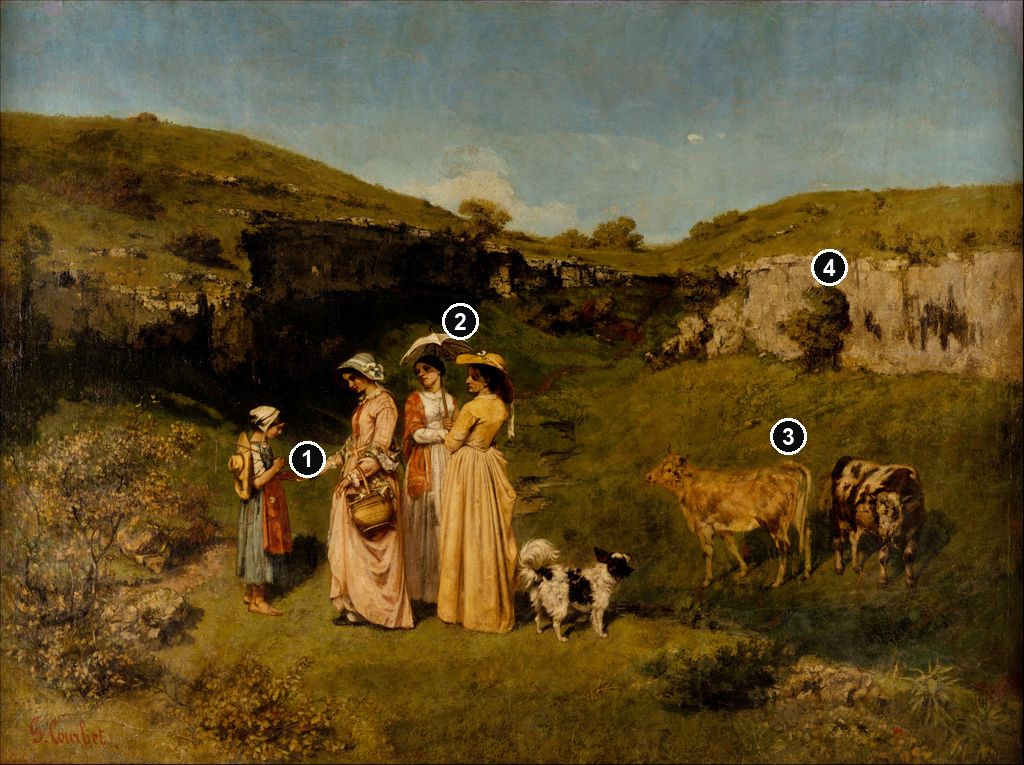
Details from YOUNG LADIES OF THE VILLAGE
Compare each crop with the full composition.
The exchange at the path
The girl stands at the left edge of the group. The small gap between her hand and the extended hand of one of the sisters gives the exchange room to register.
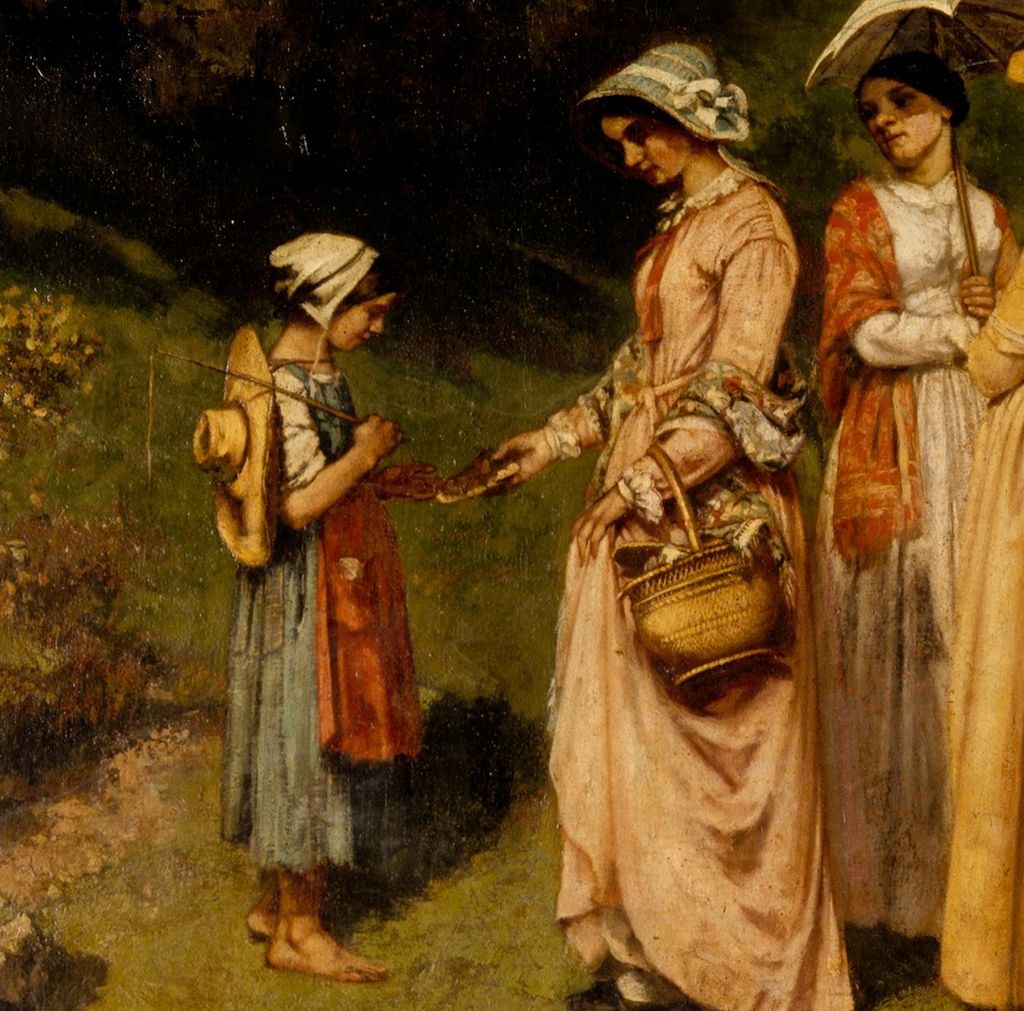
Clothes and parasol
Hats, a parasol and the folds of the dresses make the group legible against the shaded ground. The light cloth also marks the separation between the women’s silhouettes.
Cattle on the slope
The cattle look small beside the figures, yet the rising ground leaves their distance hard to judge. The dog in the foreground offers another point of comparison.
The limestone valley
The pale face of the cliff catches the light above the green slope. Across the picture, darker rock helps frame the figures.
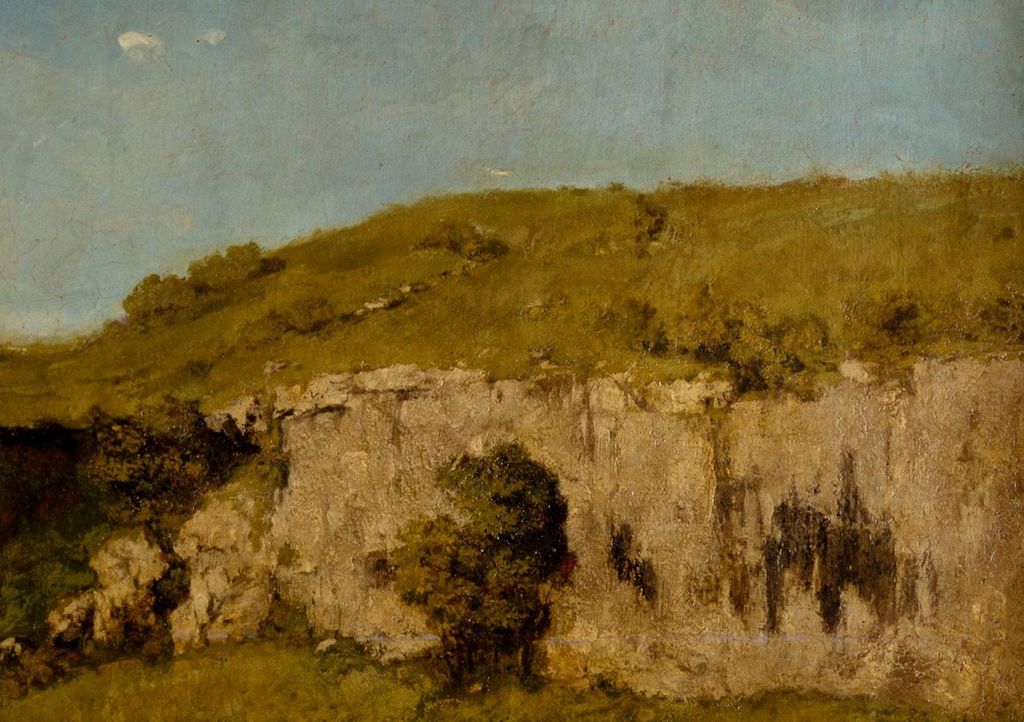
Image courtesy of The Metropolitan Museum of Art. The details are cropped from the museum image. Collection record · CC0
Courbet artworks directory
Browse the paintings covered in this guide. Dates identify the specific versions discussed.
Discussion
Look again at the images and ideas explored in Young Ladies of the Village by Gustave Courbet. These editorial prompts invite your observations.
Reader Insights
Where do the cattle seem to stand in relation to the figures?
How do the women’s clothes affect your reading of the encounter?
What did Planche and Vignon notice about the same details?
Join the Conversation
Share a detail, comparison or question about Young Ladies of the Village by Gustave Courbet below.
References
- The Metropolitan Museum of Art, Young Ladies of the Village, collection record and audio transcript, accession 40.175. View source.
- Kathryn Calley Galitz, “Gustave Courbet (1819–1877),” Heilbrunn Timeline of Art History, The Metropolitan Museum of Art, 2009. View source.
- Benjamin Foudral and Carine Joly, curators, Acheter Courbet, Ferme Courbet exhibition catalogue, 2022–23. View source.
- Musée d'Orsay, Base Salons, 1852 Salon catalogue entry for Les demoiselles de village, no. 292. View source.
- Gustave Planche, “La Peinture et la sculpture au salon de 1852,” Revue des Deux Mondes, new series, vol. 14, 1852, pp. 667–693. View source.
- Claude Vignon, Salon de 1852, Paris, Dentu, 1852, digitised edition. View source.
- Musée d'Orsay, Gustave Le Gray, Salon de 1852, Grand Salon mur nord, 1852, photographic print PHO 1984 104 2. View source.
- Petit Palais, Les Demoiselles des bords de la Seine (été), collection record and interpretation, PPP377. View source.


