



 by Tom Gurney
Tom Gurney BSc (Hons) is an art history expert with over 20 years experience
Published on June 19, 2020 / Updated on October 14, 2023
Email: tomgurney1@gmail.com / Phone: +44 7429 011000
The Cellist: Introduction
Gustave Courbet sits with a cello slanting across his body. The instrument’s scroll rises at the left, the strings pass beneath a pale hand, and the bow enters from the right. His head tilts away from the instrument. Beneath a furrowed brow, his eyes are so deep in shadow that it is hard to tell where he is looking. The two hands give the figure something to do while the face suggests that his attention is elsewhere. [1]
Nationalmuseum in Stockholm dates The Cellist (Self-portrait), or Le Violoncelliste, to 1847. It is an oil painting on canvas, 117 × 89 cm, and entered the museum in 1936 as a gift from the Friends of Nationalmuseum. Its inventory number is NM 3105. Courbet showed the picture at the Paris Salon in 1848, a year after the date the museum gives for its making. [1]
At a Glance
- Date1847
- MediumOil on canvas
- CollectionNationalmuseum, NM 3105
Contents
- The bow, the hands and the light
- What Paris saw in 1848
- A painter taking the part of a musician
- The other canvas and the drawing
- Two kinds of performance
The bow, the hands and the light
The scroll of the cello sits near the left edge at the height of Courbet’s upper arm. From there the neck and fingerboard drop across the dark coat towards the lower right, where the rounded body of the instrument fills much of the corner. The cello leans far enough over that its neck cuts across the chest in the manner of a sash. The bow comes down across the strings on a different diagonal. Its pale line is easy to follow even where the lower part of the instrument disappears into shadow. Together the two angles give a seated figure a sense of movement. [1]
Courbet makes each hand legible in a different way. Near the middle, the knuckles and wrist catch the light, and the fingers curve down over the strings. The cuff at the wrist is among the palest passages in the picture. At the right edge, part of the other hand is cut off, leaving the bow to carry the gesture back into the canvas. The picture gives us the essential points of contact between the player and the instrument. Its emphasis falls on the weight of the arms and the placement of the hands, with little to specify the music or the moment in which it is being played. [1]
The face is the brightest passage above the instrument. Light picks out the forehead, the bridge of the nose and one cheek, then breaks into smaller touches around the lips. The fall into shadow across the eye sockets is abrupt, while the edges of the hair and beard merge more gradually with the surroundings. A narrow arc of white collar separates the head from the coat. Compare the small area of light on the face with the expanse of brown around it. The wall gives almost nothing away about the room. As the figure turns towards that emptiness, the lack of a clear object for his gaze helps give the pose the dreamy quality Nationalmuseum describes. [1]
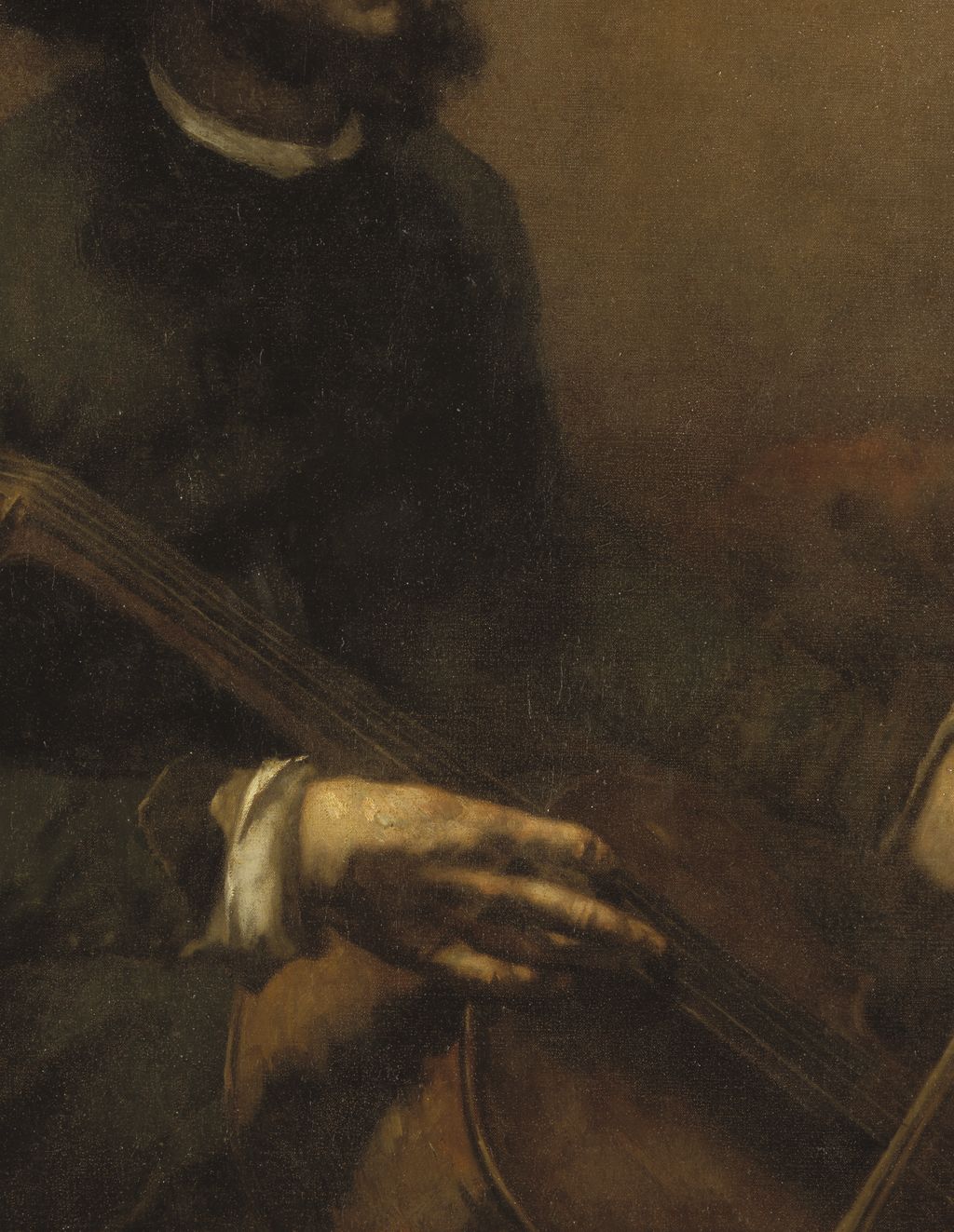
Detail of The Cellist, Nationalmuseum NM 3105. Shown here, bow and hands. Nationalmuseum, Stockholm. Image source. Public domain. Cropped and resized from the source image.
What Paris saw in 1848
According to Robert Fernier’s catalogue raisonné, the jury refused the painting at the Salon of 1847. The Second Republic dispensed with the admission jury the following year. The 1848 catalogue lists Courbet’s painting as Violoncelliste, no. 1015, among the works exhibited at the Louvre. The entry gives his address on the rue de la Harpe. For someone encountering the picture through the catalogue, the first thing to know about the man was his role as a musician. The modern title adds the information that the painter and sitter are the same person. [2] [3] [4] [1]
Nationalmuseum records that critics at the 1848 Salon compared Courbet’s use of light and dark with Rembrandt’s self-portraits. One contemporary response survives in a transcription by the biographer Georges Riat. Writing in Le National on 15 June 1848, Prosper Haussard singled out the painting’s touch and chiaroscuro, recalling both Caravaggio and Rembrandt. The comparison makes sense at the level of individual passages. Look at how little of the coat Courbet needs to define before the pale wrist seems to come forward, or at how the bright plane of the forehead turns down into near-black around the eyes. What the critic could recognise was a way of modelling a figure and giving it presence through selective light. [1] [5]
Courbet brought the picture back before the public. Fernier records a Brussels showing in 1851 under the title Le Bassiste, followed by Courbet’s independent exhibition in Paris in 1855. The 1855 catalogue gave the work an earlier date, 1845, although Fernier and Nationalmuseum date the painting to 1847. The distinction matters because a date printed in a later exhibition catalogue tells us how a work was presented on that occasion. The Stockholm record gives the date by which the canvas is identified today. [2] [1]
A painter taking the part of a musician
Four years before the cellist appeared at the Louvre, Courbet had made his Salon debut with Self-Portrait with a Black Dog. There the hat, dog and open sky make a recognisable situation out of a figure sitting outdoors. The low viewpoint lets him look down towards us. In Stockholm the scenery falls away, the figure turns from us, and the cello gives his hands their task. In The Wounded Man, the red mark on the shirt and the sword beside the resting figure give the body another story. The Metropolitan Museum of Art and Museum Folkwang have both presented these early self-portraits as experiments in the roles Courbet could assume. A change of gaze, setting and object could alter the impression made by the same face. [6] [7] [8]
There is evidence of Courbet’s interest in music apart from the portrait. Art historian James H. Rubin points to letters in which Courbet discusses entering a competition for a popular song in 1848 and reports in 1849 that his friend Alphonse Promayet and other musicians from Ornans had set four of his ballads to music. The letters document an interest in making songs. They leave his training and ability on the cello unestablished. In the Stockholm picture, the bow and the instrument are enough to establish the role, and Courbet gives the most emphatic light to the face and hands that play it. [9] [1]
In After Dinner at Ornans, shown at the 1849 Salon, Courbet gave the instrument to Promayet. The violinist sits to the right while the men around the table remain caught up in different things. Courbet’s father dozes and Marlet lights his pipe. As the eye passes from the white tablecloth to the less brightly lit musician, it becomes clear how much the scene turns on a person who is neither centrally placed nor the most strongly lit. In the self-portrait, we have to infer the effect of the music from one face. At Ornans, the same suggestion of sound extends into the room and helps account for the stillness of several people. [6] [10]
The other canvas and the drawing
The Portland Art Museum owns a separate 1847 oil painting titled The Violoncellist (43.2.1). The figure, hands and instrument occupy much the same positions, but Portland’s painting includes a conspicuous open score at the right. In Stockholm, the corresponding area is mostly brown, with no comparable pages to meet the sitter’s gaze. The difference affects the way we read his tilted head. In Portland the score gives his attention a plausible destination. In Stockholm the turn of the head is more elusive, and that makes the expression carry more weight. [1] [11]
A smaller drawing in pencil and ink on card also records the composition. Christie’s identifies it as a possible ricordo, a record made after the painting, citing its finished appearance, the ruled border and measurements inscribed around the edges. On the canvas, the contrast between the straight bow and the swelling body of the cello supplies the same sense of balance that the drawn lines can convey on their own. In paint, Courbet adds a second way to follow the action. The glow of the face draws us in first, and the lit knuckles and white cuff then lead us back down to the strings. [1] [12]
Two kinds of performance
In The Cellist, each hand leads the viewer to a different part of the same act. The hand at the instrument’s neck establishes height and pressure. The other is separated from it by the angle of the bow. Follow the bow from the hand towards the strings and there is a crossing point that gives the body’s gestures a purpose. Then look back at the face. Its attention makes more sense after the viewer has reconstructed what is happening below it. The picture can show concentration through the space between the hands even though it can supply no actual sound. [1]
In After Dinner at Ornans Courbet changes the location of that attention. The violinist has company, and the seated figures suggest several ways to listen. Their place around the table lets the viewer read a performance through the people receiving it. In the Stockholm painting, there is no equivalent ring of listeners. The face, the bow and the instrument have to make the performance legible from inside the musician’s own field of attention. The difference makes the two paintings useful to compare even before asking how well Courbet himself could play. [1] [10]
The near-contemporary Self-Portrait with a Black Dog gives its sitter a different set of objects. The stick and the dog suggest travel or company beyond the instant of the portrait. The cello has the opposite effect. The moving arm and the seated body belong to an action taking place in that moment. An artist could use costume and objects to signal a social identity, but he could also use them to describe what a person’s attention was doing from one second to the next. [1] [13]
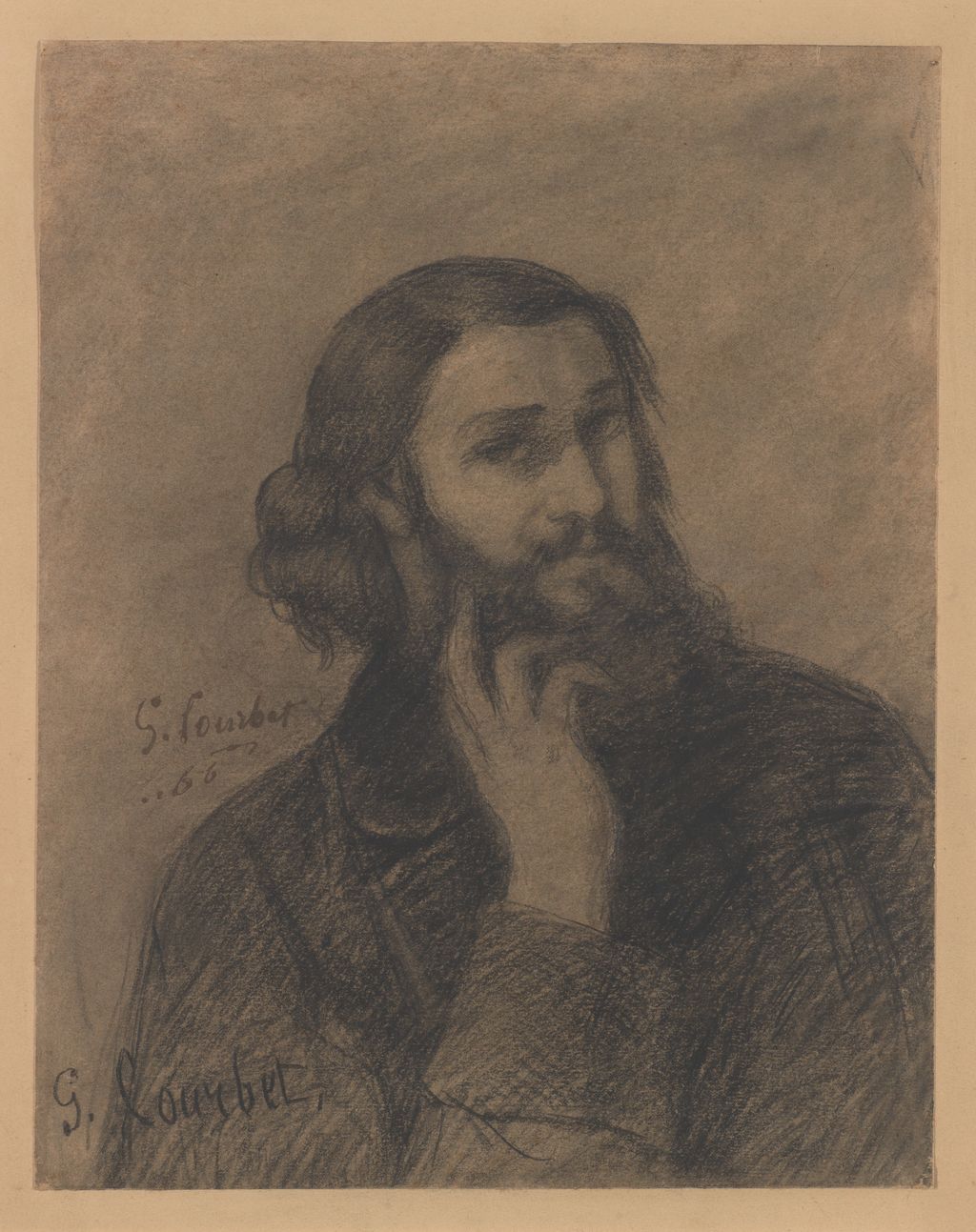
Gustave Courbet, Self-Portrait, about 1866. The Metropolitan Museum of Art. Image source. CC0 / Public domain. Resized from the complete source image.
Courbet artworks directory
Browse the paintings covered in this guide. Dates identify the specific versions discussed.
Discussion
Look again at the images and ideas explored in The Cellist. These editorial prompts invite your observations.
Reader Insights
What tells you that the sitter is in the act of playing?
Where do the sharpest contrasts of light fall?
How does the addition of a score alter the scene in the Portland painting?
Join the Conversation
Share a detail, comparison or question about The Cellist below.
References
- Nationalmuseum, The Cellist (Self-portrait), Stockholm, NM 3105, collection entry and illustration. View source.
- Robert Fernier, La Vie et l’œuvre de Gustave Courbet. Catalogue raisonné, vol. I, 1977, p. 46, no. 74. View source.
- Bibliothèque nationale de France, Le Salon officiel et ses héritiers, chronology of the Salon. View source.
- Musée d’Orsay, Base Salons, transcription of the 1848 Paris Salon catalogue, Violoncelliste, no. 1015. View source.
- Georges Riat, Gustave Courbet, peintre, 1906, pp. 47–48, transcribing Prosper Haussard’s review in Le National, 15 June 1848. View source.
- The Metropolitan Museum of Art, Gustave Courbet, 2008 retrospective, “Self-Reflections” and “Ornans: The Emergence of Realism”. View source.
- Museum Folkwang, Ich, Gustave Courbet. Maler und Rebell, exhibition wall texts, “Selbstbildnisse”, 2026, p. 2. View source.
- Musée d’Orsay, L’Homme blessé, RF 338, collection entry. View source.
- James H. Rubin, “Courbet, Wagner and the Total Work of Art,” in Charlotte de Mille, ed., Music and Modernism, c. 1849–1950, 2011, pp. 110–11 and notes 14–15. View source.
- GrandPalaisRmn, Panorama de l’art, L’Après-dîner à Ornans, illustrated analysis of the Lille painting. View source.
- Portland Art Museum, European Art, collection documentation, Violoncellist, 43.2.1. View source.
- Christie’s, Le violoncelliste, autoportrait de l’artiste, lot 5879199, illustrated record for the pencil-and-ink drawing. View source.
- Paris Musées and Petit Palais, Autoportrait dit Courbet au chien noir, collection record. View source.


