



 by Tom Gurney
Tom Gurney BSc (Hons) is an art history expert with over 20 years experience
Published on June 19, 2020 / Updated on October 14, 2023
Email: tomgurney1@gmail.com / Phone: +44 7429 011000
The Monk by the Sea: Introduction
The Monk by the Sea is one of Caspar David Friedrich's most radical paintings. A small black-robed figure stands on a bare shore before a dark, unsettled sea and a vast sky. There is almost nothing else to hold onto: no framing trees, no architecture, no warm foreground path, no narrative event that explains what has brought the man to this place. Friedrich reduces landscape to a few immense zones of earth, water and air, then places a single human figure at their edge.
The painting was made between 1808 and 1810 and belongs to the Staatliche Museen zu Berlin, Nationalgalerie, inventory number NG 9/85. [1] It was shown in Berlin in 1810 with its pendant, The Abbey in the Oakwood, and bought by King Friedrich Wilhelm III of Prussia. [1] That early public display and royal acquisition helped establish Friedrich's reputation, but the painting did not become famous because it was easily understood. It became famous because viewers found it difficult, disturbing and unusually open.
Friedrich's own description, preserved through later citation, begins with a stark sequence: shore, sea and air. [1] That is almost the whole composition. The simplicity is not emptiness for its own sake. It is a form of pressure. The beach offers no shelter. The sea has no clear boundary. The sky expands far beyond the monk's scale. The figure is visible, but vulnerable; central to the image, yet barely able to affect the world before him.
The painting has often been discussed through the responses of Heinrich von Kleist, Clemens Brentano and Achim von Arnim. Those responses matter, but they are reception history rather than Friedrich's final explanation. The most careful way to approach The Monk by the Sea is to begin with the painting's visual facts: a stripped shoreline, a dark sea, an immeasurable sky, a small figure, anxious birds, and a composition that breaks many of the expectations earlier viewers brought to landscape painting.
At a Glance
- ArtistCaspar David Friedrich
- TitleThe Monk by the Sea
- Date1808-1810
- Mediumoil on canvas
- Dimensions110 cm high × 171.5 cm wide[5]
- CollectionStaatliche Museen zu Berlin, Nationalgalerie, inventory number NG 9/85. [1]
- Related workshown with The Abbey in the Oakwood, 1809/10, Nationalgalerie, inv. NG 8/85. [1] [2]
- Key contextBerlin Academy exhibition of 1810, early reception by Kleist, Brentano and Arnim, and later conservation of the Berlin pendant works. [1] [3]
Contents
- Object Facts
- Annotated Details
- A Painting Reduced to Shore, Sea and Sky
- Horizon, Boundary and No Foothold
- The Monk, the Birds and Human Scale
- What Friedrich Changed
- Conservation and the Fragile Surface
- The 1810 Berlin Exhibition
- Kleist, Brentano, Arnim and Early Reception
- The Pendant with Abbey in the Oakwood
- Three Studio Encounters Before the Berlin Exhibition
- What a Ship Would Have Done to the Picture
- Paint Thickness and the Distance Between Two Colours
- From Royal Acquisition to the 1906 Exhibition
- Where the Viewer Stands
Object Facts
The Monk by the Sea is an oil painting on canvas made over roughly two years, from 1808 to 1810.[1] The Nationalgalerie in Berlin records the painting as 110 cm high by 171.5 cm wide.[5] The work is now one of the central images of German Romanticism, but its authority depends on how little it seems to contain.
The canvas is wider than it is high. The eye moves across bands: the strip of shore, the dark water, the clouded sky and the pale upper atmosphere. Friedrich does not offer a conventional foreground that welcomes the viewer into space. The beach is barren. The sea is a band of darkness. The horizon is unsettled rather than crisply secure.
The figure is usually called a monk because he wears a dark robe and is placed in a scene charged with spiritual uncertainty. Friedrich's own description speaks of a man in black clothing walking along the beach, deep in thought, while gulls move around him. [1] The title has fixed the figure as a monk in later reception, but the painting's effect does not depend on knowing his order, biography or destination. He is a human presence reduced almost to a sign.
The work was not conceived in isolation. It was presented with The Abbey in the Oakwood, a painting of a ruined Gothic church, winter trees and a funeral procession. [1] [2] The two works differ in imagery but are closely connected in scale, mood and exhibition history. The Monk by the Sea faces the empty edge of the world; The Abbey in the Oakwood places death and sacred memory within a ruined architectural setting. Together they form one of Friedrich's most important paired meditations on nature, faith and mortality.
The Staatliche Museen zu Berlin conservation project identifies the two paintings as perhaps the most famous pair of German Romantic paintings in the Nationalgalerie's care. [3] That paired status is essential. The Monk by the Sea should not be reduced to a lonely seascape detached from its original relationship with The Abbey in the Oakwood. Friedrich and his early audience encountered the two works together.
Annotated Details from The Monk by the Sea
This annotated close reading follows five restrained visual pressures in Friedrich's seascape: the small dark figure, the narrow shore, the dark sea band, the low sea-and-sky boundary, and the broad unsettled sky. The notes keep the painting's sparseness intact instead of turning it into a simple image of sadness.
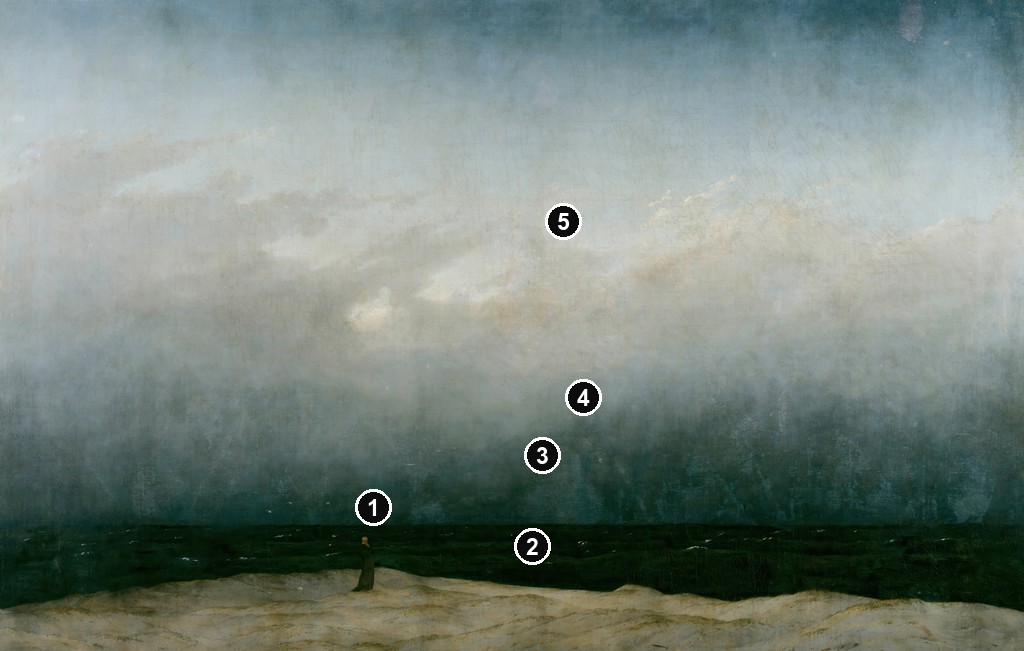
Details from THE MONK BY THE SEA
These details use the high-resolution Monk by the Sea image while preserving the Berlin Public Domain Mark wording, the pendant relationship with The Abbey in the Oakwood, the early reception context and the page's conservation cautions.
Small dark figure
The small dark figure gives the vast scene a human scale. The traditional title calls him a monk, while Friedrich's own description is more cautious: a man in black on the beach.
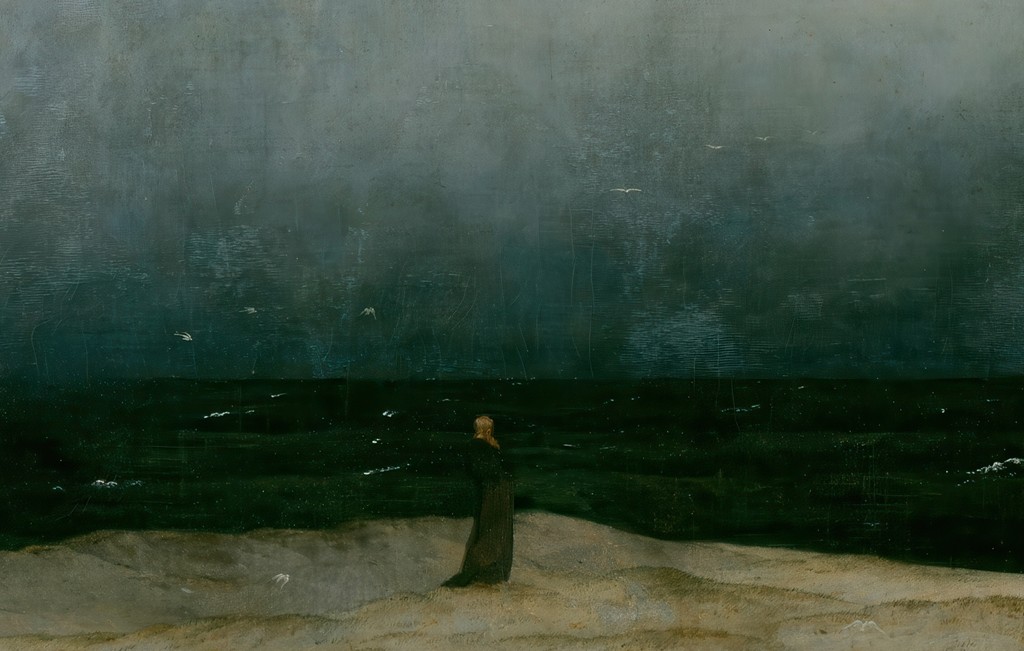
Narrow shore
The pale shore is barely enough ground for the figure. It works as a threshold between land and sea rather than as a secure foreground path.
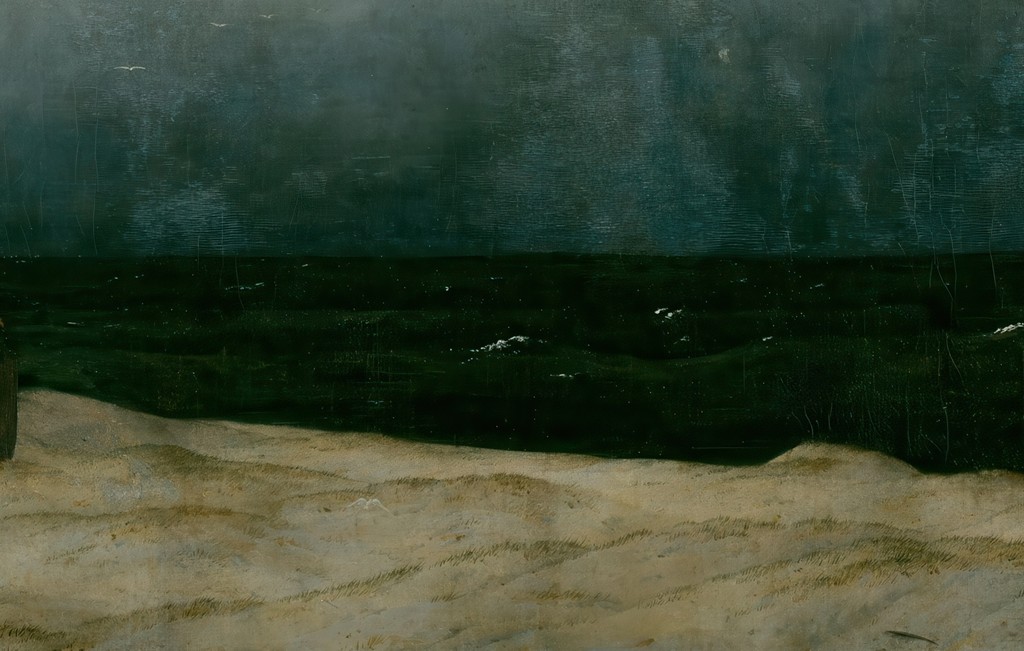
Dark sea band
The dark sea forms a heavy horizontal band, stopping the eye before the scene can become a comfortable coastal view.
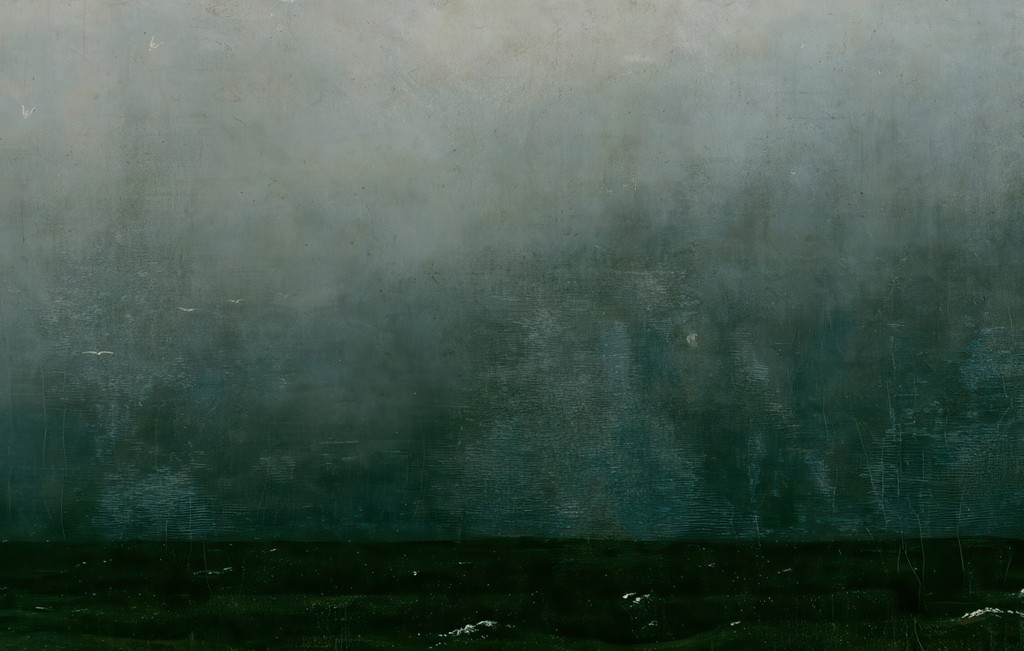
Low sea and sky boundary
The boundary between sea and air stays subdued. The painting offers no clear destination, opening or narrative horizon.

Broad unsettled sky
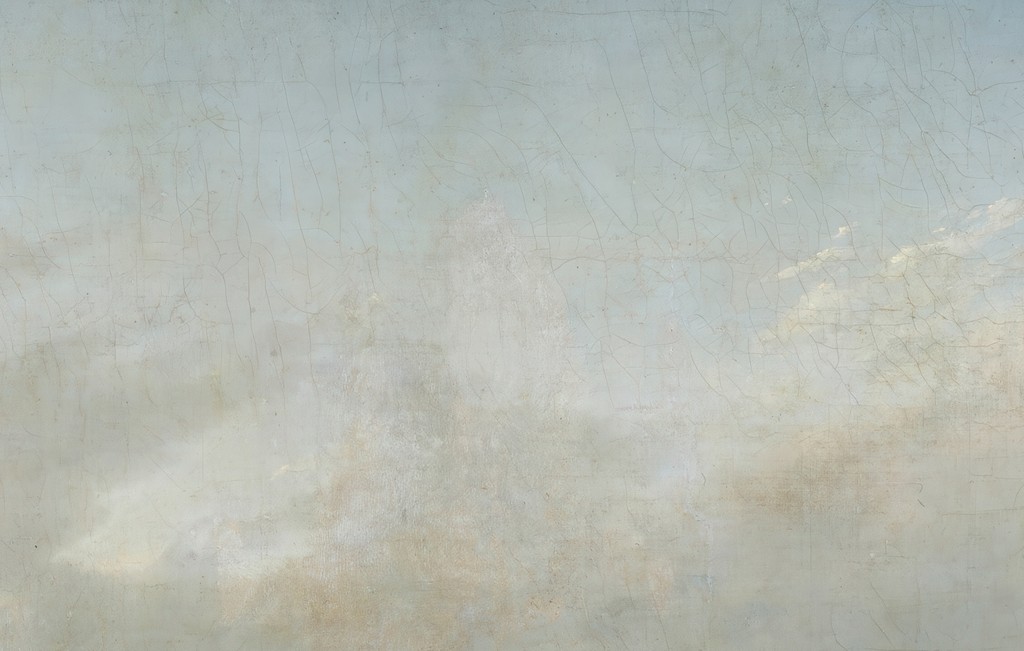
The sky occupies most of the picture and creates scale through restraint. Its tonal changes invite close looking without turning every surface shift into a conservation claim.
A Painting Reduced to Shore, Sea and Sky
The shock of The Monk by the Sea begins with reduction. Many landscape paintings lead the eye through a sequence of inviting details: trees, paths, figures, buildings, boats or rays of light. Friedrich strips most of that away. The composition is built from three elemental zones: land, sea and sky. [1] They are not decorative divisions. They are the painting's structure and subject.
The shore is narrow and almost empty. It gives the monk a place to stand, but it does not give him security. There is no path leading back, no shelter nearby, no visible community. The beach is a threshold between human land and the restless water. It is enough ground for a body, but not enough to feel stable.
The sea is darker and more uncertain. It does not glitter, sparkle or open into a picturesque maritime scene. It is a flat, heavy band that seems to resist penetration. Friedrich's own description refers to the unsettled sea before moving into the air above it. [1] That sequence matters because the painting's space does not unfold as a scenic view. It confronts the figure and the viewer with layers that are difficult to enter.
The sky is the largest field in the painting. It dominates the monk not through spectacle but through scale. The clouds are not theatrical storm clouds arranged around a dramatic event. They form a broad, changing mass that makes the human figure appear extremely small. Near the top, the atmosphere lightens, and this pale zone prevents the painting from becoming simply dark. It opens upward, but not in a way that resolves the scene.
This austerity was one reason the painting seemed so bold. Friedrich moved away from the expected pleasures of landscape composition and toward an image that looks almost abstract in its large bands of tone. The cdfriedrich.de object text notes that Friedrich worked on the painting for two years, making changes and overpainting until the composition reached its unusual degree of abstraction. [1] The simplicity was achieved, not accidental.
The lack of conventional markers also shifts the viewer's attention inward. With few objects to catalogue, we become aware of relation: figure to beach, beach to sea, sea to sky, body to infinity. The painting does not ask us to admire a beautiful coast. It asks us to inhabit a confrontation between human thought and an ungraspable world.
Horizon, Boundary and No Foothold
One of the painting's most unsettling features is the weakness of its boundaries. In many coastal landscapes, the horizon gives the viewer orientation. It tells us where water ends and sky begins, and it offers a steady line against which ships, cliffs, clouds and figures can be measured. Friedrich makes that kind of certainty difficult. The sea and sky meet in a zone of tonal instability rather than in a clear, reassuring edge.
This instability changes the painting's sense of space. The viewer can identify the basic elements, but cannot easily settle into them. The beach is visible, but too narrow to function as a safe foreground. The sea is present, but its dark breadth feels less like a navigable surface than a barrier. The sky opens above, but it does not resolve into a radiant sign or dramatic revelation. The whole image seems to deny the normal pleasures of orientation.
The cdfriedrich.de object text describes the monk as facing a sea without boundary or foothold. [1] That phrase is useful because it identifies the painting's psychological geography. The problem is not simply that the man is alone. It is that the world before him offers no stable point where thought can rest. The viewer experiences something similar. We look for a place to enter the scene, but the painting gives us a shore that stops, water that darkens and air that expands beyond measure.
Friedrich's composition also resists the picturesque. There is no boat to carry the eye outward, no distant town to anchor the horizon, no sunset path across the water, no human group to create anecdote. The few visible birds do not open space; they intensify unease. Instead of inviting movement into depth, the painting holds the viewer at the threshold.
This threshold effect is central to the work's seriousness. The Monk by the Sea is not only about a figure before nature. It is about the failure of ordinary visual habits before nature. The monk looks, but the world remains beyond him. The viewer looks, but the painting refuses to become a comfortable view. Friedrich turns landscape into an encounter with limit.
The Monk, the Birds and Human Scale
The monk is small, but he is not insignificant. He gives the painting its human scale. Without him, the image might become an elemental study of shore, water and cloud. With him, the same space becomes existential. The viewer measures the world through a solitary body.
Friedrich places the figure low and slightly off the central axis, on the barren shore. He does not dominate the picture as the figure does in Wanderer above the Sea of Fog. He is closer to the tiny human presences in other Friedrich paintings, yet here there is no surrounding architecture or narrative to help explain him. His smallness is exposed.
The dark robe makes the monk visible against the pale shore, but it also makes him seem absorbed by the larger darkness of the sea. He is both distinct and nearly swallowed. This is part of the painting's emotional force. Friedrich does not erase human presence; he makes it fragile.
The birds around the figure are among the few signs of life. Friedrich's description mentions gulls circling anxiously around the man, as if warning him against the stormy water. [1] The birds therefore intensify the boundary between land and sea. They animate the emptiness without making it hospitable. Their motion suggests alarm rather than comfort.
The figure's inwardness is equally important. He is described as deep in thought. [1] Yet Friedrich does not show his face clearly enough to provide a psychological portrait. The viewer cannot know exactly what he thinks. His thoughtfulness becomes a visible posture before a world that remains beyond explanation.
This is where the painting differs from generic melancholy. The monk is not simply sad because he stands alone by the sea. The painting's feeling arises from the relation between a thinking person and an environment that cannot be mastered. The sea and sky do not mirror a private mood in a simple way. They confront the figure with scale, uncertainty and limit.
The monk's apparent movement also matters. Friedrich's description says he walks along the shore, but the painting suspends him in a still moment. [1] He seems both mobile and fixed. He belongs to the shoreline as someone passing through it, yet the image holds him as if thought has stopped him at the edge of the world.
What Friedrich Changed
The Monk by the Sea did not reach its final form immediately. Friedrich worked on the painting for about two years, and the cdfriedrich.de object text emphasizes that several changes and overpaintings led to the final abstraction of the composition. [1] This technical history matters because it shows that the painting's severity was deliberate.
The final painting can appear so simple that viewers may mistake it for a first idea. In fact, reduction often requires more decisions than elaboration. Friedrich had to decide what to remove, what to keep, how much space to give the sky, how small to make the figure, how dark the sea should become and how little narrative support the scene could bear.
Infrared examination revealed three sailing ships in the underdrawing. Friedrich drew details of their hulls and rigging, then left the ships out when he painted the sea. The surface also shows changes elsewhere in the composition. The hidden ships record an early design decision, while the empty water belongs to the picture Friedrich made visible.[3][6]
This process also helps explain why the painting seemed new. Earlier landscape conventions often encouraged variety, recession, balance and scenic interest. Friedrich narrowed the image until it became almost a philosophical problem in visual form. How little can a painting show while still making the viewer feel the presence of an immeasurable world?
The answer lies in the relation among the remaining elements. A small figure alone would not be enough. A dark sea alone would not be enough. A vast sky alone would not be enough. Friedrich's achievement is the severe proportion among them. The human figure is small, but not lost; the sea is dark, but not total; the sky is vast, but not theatrically dramatic. The painting's extremity depends on restraint.
Conservation and the Fragile Surface
The modern appearance of The Monk by the Sea is inseparable from conservation history. The Staatliche Museen zu Berlin conservation project studied and restored The Monk by the Sea and The Abbey in the Oakwood between 2013 and 2016, with both works returning to display in 2016. [3]
The project explains that Friedrich used a very fine primed canvas for both paintings and applied paint in one or two very thin layers. [3] That technique helped create the delicate visual effect of the paintings, but it also made them vulnerable. Thin paint and fragile surfaces can suffer from handling, aging, varnish changes and earlier restoration work.
By around 1900, the condition of the paintings had already deteriorated considerably, according to the Berlin conservation account. [3] From 1906 onward they underwent intensive restoration campaigns of varying quality. The conservation project records substantial loss of original material, discolored retouching, overpainting and darkened varnish layers that altered how the works appeared. [3]
This history is not merely technical background. It affects interpretation. A painting like The Monk by the Sea depends on subtle transitions between dark water, clouded sky and pale air. If varnish yellows, retouching darkens or paint losses interrupt the surface, the delicate relation among those zones can change. Conservation research therefore helps modern viewers understand not only how the painting was made, but how its visual language has been preserved, damaged and recovered.
The 2013-2016 project aimed to secure remaining original material, estimate the paintings' original state as closely as possible and restore legibility. [3] That wording is important. Conservation does not return a painting to an imaginary untouched condition. It works with evidence, limits and material survival. In the case of Friedrich's Berlin pair, technical research clarified how the works were constructed and why earlier damage had affected their appearance so strongly.
For The Monk by the Sea, this material history reinforces the painting's vulnerability. The image already shows a tiny human presence exposed before immense natural forces. The object itself has also proved fragile: thin paint, altered surface, damaged substance, restoration history. The painting's modern power depends partly on the care taken to let its spare visual structure remain legible.
The 1810 Berlin Exhibition
The Monk by the Sea entered public life through the Berlin Academy exhibition of 1810, where it was shown with The Abbey in the Oakwood. [1] The cdfriedrich.de object page notes that the works were presented there at the urging of Friedrich Schleiermacher, bought by King Friedrich Wilhelm III, and followed by Friedrich's appointment as a member of the Berlin Academy of the Arts. [1]

This was a major moment in Friedrich's career. The painting's radical reduction did not prevent institutional recognition. On the contrary, the work's display and royal purchase helped elevate Friedrich's position. Yet that recognition did not make the painting easy. Its public success was tied to debate, surprise and interpretation.
The exhibition context also clarifies the painting's relation to Berlin. Friedrich was based in Dresden, but the Berlin audience and Prussian royal acquisition gave the work a public status beyond his immediate circle. [1] The painting became part of a larger conversation about what landscape painting could do.
That conversation was not only about subject matter. It was about artistic hierarchy and expectation. Could a nearly empty seascape carry the seriousness traditionally associated with history painting, religious painting or literary narrative? Could land, sea and sky become sufficient material for spiritual and philosophical reflection? Friedrich's painting answered by refusing conventional narrative and forcing viewers to confront the power of reduction.
The royal purchase also complicates modern assumptions about the painting as purely private or inward. The Monk by the Sea feels intensely solitary, but it was public from early in its history. It was exhibited, discussed, bought and written about. Its loneliness was never merely private melancholy; it was a public artistic problem.
Kleist, Brentano, Arnim and Early Reception
The early reception of The Monk by the Sea is unusually important. Heinrich von Kleist's 1810 article in the Berliner Abendblätter is one of the most famous responses to Friedrich's art. [1] Yet the history behind that article is complicated and requires careful attribution.
According to cdfriedrich.de, Kleist had asked Clemens Brentano and Achim von Arnim for a review of the painting, and his printed article was based on that material. [1] Brentano's remarks and Kleist's final text both became important documents in the painting's reception. The point is not simply that "Kleist explained the painting." Rather, the painting produced a cluster of responses among major literary figures, and those responses helped define its early public meaning.
Kleist saw his own thoughts and feelings reflected in the painting, while Brentano's contribution addressed longing and the human relation to infinity. [1] Kleist's text is especially remembered for an intense metaphor of exposed seeing, often summarized through the image of eyelids cut away. [1] That metaphor is powerful because it responds to a central experience in the painting: being forced to look into a space that offers no comforting boundary.
But reception should not replace the painting. Kleist, Brentano and Arnim were not neutral guides whose words exhaust Friedrich's meaning. They were early viewers and writers responding to a work that unsettled them. Their importance lies in showing how quickly the painting generated language about infinity, loneliness, apocalypse and the limits of comprehension. [1]
This distinction matters because The Monk by the Sea can easily be trapped inside its famous reception. If the page begins and ends with Kleist, the painting becomes an illustration of literary feeling. Friedrich's work is stronger than that. The painted structure came first: shore, sea, sky, monk, birds, vastness. The literary responses tell us how early viewers struggled with that structure.
The reception also shows how new the painting seemed. The cdfriedrich.de account describes Friedrich's approach to landscape as unusually modern for its time. [1] Modernity here does not mean contemporary fashion. It means a willingness to make landscape carry unresolved thought, to reduce pictorial content, and to place the viewer before a scene that seems to resist narrative explanation.
The Pendant with Abbey in the Oakwood
The Monk by the Sea was shown with The Abbey in the Oakwood, and the two works should be understood together. [1] [2] [3] The Abbey painting, also in the Berlin Nationalgalerie, is dated 1809/10, measures 171 by 110.4 cm and carries inventory number NG 8/85. [2] Its imagery is different: a ruined Gothic church, winter trees and a funeral procession. Yet its scale, mood and exhibition history bind it to the Monk.

The pendant relationship creates a movement between open nature and ruin. In The Monk by the Sea, the figure stands before sea and sky, without architecture or visible shelter. In The Abbey in the Oakwood, human death is framed by a ruined sacred building and leafless trees. One painting confronts the infinite edge of nature; the other places mortality within the remains of religious architecture.
The pairing also keeps The Monk by the Sea from becoming a purely secular image of loneliness. Friedrich did not need to paint a cross or church into the seascape for the work to carry spiritual pressure. Seen beside The Abbey in the Oakwood, the monk's confrontation with sea and sky becomes part of a broader meditation on faith, death and the possibility of meaning after visible supports have failed.
At the same time, the pendant relationship should not flatten the two paintings into one message. The Abbey in the Oakwood has procession, ruin and a more legible funerary subject. The Monk by the Sea has almost none of that. Its spiritual uncertainty is more exposed because it has fewer symbols. The two paintings intensify each other through difference.
The Berlin conservation project reinforces this paired reading by treating the works together: their materials, condition, restoration and public display histories are linked. [3] Both use delicate materials and thin paint layers; both suffered from aging and earlier interventions; both were restored and returned to public display after extensive study. [3] Their relationship is therefore not only iconographic and historical, but material.
For a modern viewer, the pairing offers a useful discipline. It prevents the Monk from becoming a poster of solitary sadness and prevents the Abbey from becoming merely a Gothic ruin scene. Together they show Friedrich working at the boundary between landscape and spiritual thought. One work strips the world down to elemental openness; the other stages human passage through the broken remains of sacred architecture.
Why the Painting Still Feels Modern
The Monk by the Sea still feels modern because it refuses to comfort the viewer with abundance. Its emptiness is structured, not vague. Large areas of the canvas seem to contain little, yet they hold the viewer in a state of concentration. The painting asks how much can be removed before a landscape stops being scenery and becomes a test of perception.
This is one reason the painting speaks strongly to later audiences. Many modern images depend on reduction: large fields, isolated figures, simplified horizons, minimal narrative. Friedrich reached that intensity within an early nineteenth-century Romantic context. The painting's modernity lies in its disciplined refusal of pictorial reassurance.
The Met's recent exhibition framing places Friedrich at the centre of a renewed international conversation about landscape, inwardness and the emotional life of nature. [4] The Monk by the Sea is central to that conversation because it does not simply represent nature as beautiful. It shows nature as something before which human thought becomes exposed.
The painting also resists quick symbolic closure. The monk may suggest prayer, contemplation, doubt or spiritual searching. The sea may suggest infinity, danger, death or the unknowable. The sky may suggest transcendence or emptiness. But none of these meanings becomes final on its own. Friedrich's composition keeps the symbols open by making them visual relations rather than fixed emblems.
This openness is why the painting should not be reduced to generic Romantic melancholy. It is not merely a sad monk by a dark sea. It is a rigorous painting about human scale, spiritual uncertainty, modern looking and the inability of thought to exhaust what lies beyond it. The work gives melancholy a structure, but it also gives it resistance.
The painting's continuing force also depends on its refusal of spectacle. Many sublime landscapes overwhelm the viewer with cliffs, storms, waterfalls, ruins or dramatic light. Friedrich's seascape overwhelms by withholding. Its vastness is quiet. Its drama is nearly motionless. Its most frightening quality may be that the world does not explain itself.
Three Studio Encounters Before the Berlin Exhibition
The earliest descriptions let us follow the seascape while it still belonged to a studio rather than to an exhibition. They were made by different people at different moments, and the finished surface cannot independently confirm every feature they report. Their value lies partly in the differences between them. A visitor in Dresden might have encountered a painting with details that a visitor to Berlin never saw. Even where the material state had stayed the same, the witnesses brought different ideas about what the sea ought to look like.[7]
Christian August Semler's early printed account in 1809 notices the prevailing grey and the absence of the bright flashes of white a painter might use to enliven breaking water. That remark makes sense as a professional observation. White flecks can mark individual crests, separate approaching waves and distribute incident across a dark sea. In Friedrich's finished picture the dark water holds together across the canvas. The birds and the small variations in the water register at a different level of attention. A visitor could plausibly remember a sea with little bright articulation and still be describing a substantial pictorial decision.[7]
A letter written by Helene von Kügelgen on 22 June 1809 supplies another kind of evidence. She mentions the man, the shore and the absence of ships, and expresses a wish for more movement. This was the response of somebody looking at a picture in progress. Her desire for movement identifies one of the things the seascape made unusually hard to locate. The clouds vary, birds can fly and a person could walk the length of a shore. Each belongs to a different timescale, and the painting gives us very little indication of where any of them is going. A sail travelling across the dark band would have supplied a direction and a comparatively easy way to gauge speed.[7]
The detail about the absent ships is especially valuable beside the infrared evidence. The letter records an impression made by the picture as it stood in the studio. The infrared image reveals preparatory work through layers that an ordinary visitor would see together as an opaque surface. The two sources can therefore describe a canvas with quite different contents. An apparent contradiction disappears once one asks what was visible to whom, by which means, and at which stage. There is no secure calendar for each stroke of the underdrawing.[3][7]
Karl Friedrich Frommann's report of a September 1810 studio visit mentions celestial details that have led to a different puzzle. Helmut Börsch-Supan proposed that Frommann saw an intermediate form of the seascape with a moon and a morning star. The identification is a scholarly reconstruction, and the particular configuration he suggests cannot simply be transferred to the present painting. The record does establish the importance of considering a late studio visit separately from the published exhibition response. A description made just before dispatch need not fix the last state of a canvas an artist was still working on.[7]
The possibility of a specified celestial hour directs attention to how the finished picture handles time. A low moon or a conspicuous star would give a spectator an identifiable thing to look for and a reason to consider the light at a particular moment. The pale region in the upper sky of the present painting is spread over an area, without a concentrated disc or bright point. It is possible to consider the accumulation of light and cloud there without settling the hour. The passage can seem as if it were opening, while the darker belt above the water remains in place. Much of the picture's quiet activity depends on such separate motions.
These accounts also resist the idea of an audience coming around to a single judgment. An early writer can single out how grey works as paint. A correspondent can find a scene insufficiently animated. A literary response from the academy exhibition can turn an absence of familiar pictorial supports into its very subject. The different genres matter. A private letter can make an immediate complaint and move on, while a newspaper piece has to find a language in which to communicate the encounter to somebody who may have yet to see the work. Two people can be precise about different experiences of the same object.[1][7]
What a Ship Would Have Done to the Picture
The detailed ship outlines found during examination make it possible to ask a precise counterfactual of the composition. A hull would mark the water as a surface on which a vessel could travel, and a mast would draw the eye upward through the dark belt. Rigging would provide a scale of fine marks relative to the monk and birds. A group of vessels could make a loose sequence across the water even if the sea remained largely dark. Those possibilities help explain how far the change extends beyond the disappearance of three motifs.[3][6]

The ship in this comparison is an instrument of looking. A viewer commonly judges the distance of one vessel relative to another by apparent size and by position near the horizon. Once the vessels disappear, the sea loses a set of measurable intervals. Its upper edge becomes a powerful lateral division, but the distance from the monk's position to that edge remains difficult to imagine. One can recognize that the water extends far beyond the shore without being able to work out how far a particular mark is from the beach. The painting encourages an estimate and removes much of what could make it reliable.
The relative heights of figures and masts would also matter. The monk rises only a little above his ground, and his silhouette has a point of contact with it. A mast could rise through several surrounding bands or put a hard vertical accent well away from him. The painting would acquire an additional upright feature that could balance him or draw the eye from his location. In the finished composition a viewer searching the lower half for another standing form is unlikely to find a comparable support. The position of the monk carries unusual weight because his upright has so few counterparts.
This distinction can be tested by looking from the monk outward along the beach, then starting a second time from a far edge of the canvas. From the figure, the bank reads as somewhere a person could stand, with the water immediately beyond. From the side, the same bank becomes a strip whose changes of height matter in their own right. It has no obvious destination at either edge. The monk stabilizes the local reading while remaining unable to organize the whole panorama around himself. Each look assigns the figure a slightly different authority.
Friedrich's later On Board a Sailing Ship offers a productive comparison because it gives the viewer part of a vessel as an immediate bodily location. Even without knowing what city lies ahead, a spectator can tell which way the boat is pointed and where the people on deck stand in relation to its equipment. The deck and rigging set up lines that converge and overlap. In the Monk, what is close to the viewer has very little of that directional information. The comparison is between two ways of placing a spectator in relation to water. The visible vessel in the later picture puts the sea to work as a route. The dark expanse of the earlier picture leaves the direction of any crossing undecided.
There are, of course, other lives that could belong to this shore. A ship could suggest trade, fishing, passage between ports or a rescue from bad weather. The picture has no painted evidence for choosing any of those stories. The visible beach and the reported identification of the figure as a man in a dark garment bring a human situation into view, while the omissions leave its practical outcome open. Reading the infrared record helps clarify how a painting with detailed preparatory marks came to offer so few grounds for an event narrative.[1][3]
Paint Thickness and the Distance Between Two Colours
The 2016 exhibition about the conservation work treated the canvas as an object with a history, alongside its history as a famous image. Conservators had to take seriously the difference between a change made by Friedrich and one introduced by deterioration or earlier treatment. The same visual symptom, an area appearing darker or less distinct than its neighbours, can have several causes. The technical problem is to determine which material is present and how it relates to surrounding passages before deciding what can be done to it. A dark field is central to the composition, so general brightness would be a poor measure of success.[3][8]
This is particularly important in the upper portion, where transitions take place over areas much larger than the monk. A small patch that registers as a sharp boundary can pull attention towards a local event in the paint. Such an event may be very different from the broad drift of tone across the sky. Preserving a transition as a transition is distinct from preserving a clear outline. It entails looking at what happens on either side of a change in colour and at the distance over which it occurs. In this painting those distances make up much of the visible weather.
The bottom of the image places another demand on the surface. The pale shore needs enough contrast against the sea to read across the width. It also has small changes of colour and unevenness that give the bank substance at close quarters. A reproduction adjusted to make the monk easy to pick out may make the shore appear more uniformly light than it does on the wall. A dark reproduction can bury variations in the water. Two photographic versions can give opposing impressions while preserving the positions of all the major forms. Much of what is at stake concerns relationships that are less readily measured by tracing contours.[3][5]
At around 1.7 metres wide, the painting is large enough to support successive distances of looking. Close up, a viewer may see a shift from one patch of paint to another without immediately seeing its place in the spread of sky. From farther away, the whole band of air is readily apparent, while the details that mark it out as painted atmosphere can become harder to see. The monk operates on both levels. At a distance he draws attention by interrupting the lower bands. Up close a viewer can try to resolve the form of his head and clothing. The change of distance is part of the encounter with an object whose small figure and broad tonal fields ask for different kinds of scrutiny.[5]
The work with the Abbey establishes a further point of comparison. Its trees and architectural openings distribute a number of important slender forms across the picture. Small local disruptions can therefore interfere with the reading of a branch, a figure or the contour of the opening. The seascape requires comparable sensitivity for another reason. Changes across large relatively open areas are themselves significant. Similar thinly painted supports present related conservation problems, while each composition gives the surviving paint a different visual task.[3][8]
This way of looking clarifies the limits of an appealing claim about restoration: that it lets us see just what the 1810 audience saw. That audience was seeing a recent painting under the conditions of a particular exhibition. Today's viewers see original paint that survives, with its own material history, under present exhibition conditions. The conservation account identifies both substantial losses and earlier interventions. Its achievement lies in a more legible relation among what survives, under conditions the institution can document and study. There is no way to repeat the first exhibition as an experiment with identical light, walls and spectators.[3][8]
From Royal Acquisition to the 1906 Exhibition
The original catalogue placed the pair under the general description Two Landscapes in Oil. A reader of that description would have known the medium and category before meeting the scene or its companion. Nothing in the wording gives one composition precedence. The painted facts then become unusually important. A horizontal dark strip and a solitary upright in one picture can be encountered in relation to the high openings and tree forms of the other. What happens first depends partly on where an individual spectator begins.[9]
The royal acquisition gave the two pictures a continuing relationship after the exhibition. Birgit Verwiebe's account traces the part played by the future Friedrich Wilhelm IV in advocating their purchase and follows the pair through subsequent royal display. They could be seen in the public royal gallery at Bellevue Palace from 1844 to 1865, where another Friedrich landscape, Morning in the Riesengebirge, provided a further comparison. An encounter there had the potential to change which aspects of the pair a viewer noticed. A spectator who had just seen a mountain view organized around a conspicuous summit and a cross could see how little similar guidance the low seascape offered.[9]
The later arrangement illustrates a larger issue in Friedrich's reception. A painting may carry its original companion into a gallery and acquire new neighbours in the same room. The pair remains meaningful, while the room makes other relations visible. In the Abbey, architecture defines a site through openings and walls. In Morning in the Riesengebirge, terrain gives figures a route and a height. The seascape offers an open edge with a much less determinate direction. Looking across such works turns the question of faith into a question about how bodies occupy specific places in the painted world.
The 1906 German Centenary Exhibition in Berlin placed Friedrich in a different historical argument. There were 36 paintings by him in two apse rooms and 57 drawings displayed in the Neues Museum, according to Verwiebe's account. An installation photograph shows the seascape amid other works including The Sea of Ice. Paintings hanging in two rows offered spectators several distinct compositions at once. The photograph helps establish what could be compared in that setting, although it cannot tell us how long any visitor stayed before the seascape or whether their most immediate comparison was with the Abbey.[9]
The ice painting makes a particularly revealing neighbour. Angular forms create a series of visible obstacles and lead the eye upward through a pile. In the Monk, a spectator looking for similarly pronounced landmarks repeatedly returns to wide horizontal divisions. Both scenes make the size of a person or vessel feel difficult to match against the surrounding environment. The degree of articulation is very different. The combination permits a viewer to see that Friedrich had more than one way of making landscape feel physically unmanageable.
The drawings in the neighbouring museum also mattered to an account of his practice. A public encountering dozens of works on paper could see that the well-known oils were only part of an extensive body of looking and making. It is possible to appreciate the simplification of the sea more fully when one knows that Friedrich was perfectly capable of making detailed studies and had reasons for restricting what an oil should show. In the case of this particular canvas, the subsequent technical evidence gives that observation a material basis that the 1906 public could not have seen.[3][9]
Where the Viewer Stands
A detail easy to miss in a small image is the difference between the place the figure occupies and the place assigned to the viewer. The figure has a narrow patch of pale land beneath his feet. The viewer is close enough for that patch to extend across the entire lower edge, yet Friedrich gives very few clues to the surface that would continue behind it. If the beach curved into a path coming towards us, it could locate our approach. If a large rock or plant broke the foreground, it could identify our proximity to an object. The visible band supplies a line of contact with the water but very little ground on which to imagine arriving.

Try tracing that contact laterally before following the monk's orientation. The edge changes subtly across the frame. You can continue looking sideways after the figure has ceased to dominate. Follow his attention instead and the eye moves out through the water and up into the sky, towards broad zones without a fixed point of arrival. The two ways of looking create different kinds of duration. One follows a line that can be traversed to either edge. The other meets an expanse whose limits can be recognized only where the frame cuts it off.
That distinction gives the contemporary reactions a tangible basis. From the shore a person can judge position in relation to land even while remaining unsure about distant conditions. In this picture the horizontal certainty of the coast and the uncertain depth of the air and sea coexist within a single look. The unease develops as those forms of knowledge come apart. Friedrich supplies enough for us to find the figure, follow the shore and recognize the sea. Each act leaves much of the picture still to be explored. This is the experience the canvas can renew even for a viewer who already knows its title and the most celebrated lines written about it.
Related Friedrich Works
The Abbey in the Oakwood is the essential companion. It was shown with The Monk by the Sea in 1810 and remains linked to it through the Berlin collection and conservation history. [1] [2] [3] The two paintings should be read as a pair, but not collapsed into the same subject.
The Cross in the Mountains (Tetschen Altar) offers an earlier example of Friedrich turning landscape toward religious meaning. Unlike The Monk by the Sea, it includes a clear devotional object: the cross. Comparing the two shows how Friedrich could make landscape spiritual both with and without explicit religious imagery.
Wanderer above the Sea of Fog places a larger figure before a mountain view. The Wanderer appears more commanding than the monk, but both paintings organize landscape through a solitary beholder facing a world that exceeds him.
The Sea of Ice pushes Friedrich's interest in nature's extremity toward catastrophe. It nearly hides the human story beneath broken ice. The Monk by the Sea is quieter, but both works make human scale feel precarious.
Chalk Cliffs on Rügen gives a brighter and more social version of looking at nature. Its figures lean, stand and peer over a coastal edge. The comparison shows how varied Friedrich's seascapes could be, from luminous cliff and blue water to the severe emptiness of the Monk.
The biography and paintings pages give broader context for Friedrich's career, exhibition history and repeated use of solitary figures, coasts, ruins and thresholds.
Frequently Asked Questions
Discussion
Reader insights are welcome, especially source-grounded observations about the work, its context and its visual structure.
Reader Insights
Which boundary feels least stable: shore, sea, horizon or sky?
How much should Kleist, Brentano and Arnim shape a modern reading?
How does the painting change when seen beside The Abbey in the Oakwood?
Reader insights are welcome, especially close-looking observations about the painting's shore, sea, sky, monk, birds, conservation history and relation to The Abbey in the Oakwood.
Does the empty space in The Monk by the Sea feel consoling, frightening or deliberately unresolved? The answer may depend on whether you see the monk as protected by contemplation, exposed to infinity or suspended between both conditions.
Join the Conversation
Share a source-aware observation or question about this page.
References
- Monk by the Sea, cdfriedrich.de, Caspar David Friedrich anniversary Chronicle Source
- Abbey in the Oakwood, cdfriedrich.de, Caspar David Friedrich anniversary Chronicle Source
- Caspar David Friedrich Project: Monk by the Sea and The Abbey in the Oakwood: technical analysis, conservation, restoration, Staatliche Museen zu Berlin Source
- Caspar David Friedrich: The Soul of Nature, Metropolitan Museum of Art exhibition page Source
- Staatliche Museen zu Berlin, Mönch am Meer. Institutional source
- Staatliche Museen zu Berlin, 2024 exhibition room texts. Institutional source
- Helmut Börsch-Supan, Caspar David Friedrich's Landscapes with Self-Portraits, The Burlington Magazine, 1972, pp. 623–626.
- Staatliche Museen zu Berlin, The Monk Has Returned, conservation exhibition, 2016.
- Birgit Verwiebe, Caspar David Friedrich in the Nationalgalerie, exhibition catalogue essay, 2024, pp. 14–19.


