



 by Tom Gurney
Tom Gurney BSc (Hons) is an art history expert with over 20 years experience
Published on June 19, 2020 / Updated on October 14, 2023
Email: tomgurney1@gmail.com / Phone: +44 7429 011000
Femme nue couchée by Gustave Courbet: Introduction
A blue band holds up one white stocking. The other has slipped into folds below the knee. Above the woman, a red curtain has been drawn back far enough to show trees and sky through a window. Gustave Courbet painted Femme nue couchée (Reclining Nude) in 1862, signing and dating it at the lower right. Christie’s illustrated sale catalogue records the oil on canvas at 74.9 × 97.1 cm. In Robert Fernier’s catalogue of Courbet’s work, it is number 335. The stockings, shoes, window and raised elbow make this particular canvas recognisable across the different titles it has carried. [1] [2]
At a Glance
- Date1862
- MediumOil on canvas
- CatalogueFernier 335
Contents
- The woman and the window
- Courbet in Saintonge
- Titian, Goya and Courbet’s reclining figures
- From Saintes to Budapest
- Wartime loss and the 2005 return
- The light from outside
The woman and the window
The figure stretches from the blue shoe at lower left to the bent elbow at upper right. Her body faces us, but her face turns into profile, with the eyelids lowered. One arm folds under her hair. The lower leg extends almost straight while the other bends, raising a knee near the centre of the picture. The knee interrupts the long slope of the body and makes the loose stocking easier to pick out. Its folds are small and close together compared with the broad turns of the fabric above her. [1] [2]
The light catches the torso and the front of the nearer leg in a continuous passage. Courbet lets that light fade along the side of the body into the warm colours of the upholstery. Behind the shoulder, the much cooler white fabric breaks into irregular edges. It shows between the body and the window and again where the hair spreads out near the right edge. The stocking gives white a third appearance. The fabric follows the contour of the extended shin, then comes to an abrupt end at the narrow blue band. That short stripe has enough colour to answer the shoe at the opposite end of the leg. [1]
The space above the figure is nearly all curtain. A heavy fold dips towards the centre and lifts back up above her head. Beneath it, the window bars divide the small view of foliage and pale sky into straight-edged compartments. The trees are close enough in tone to the dark inside of the room that the window seems at first like a lighter patch behind the bed. As the bars come into focus, the patch gives the room a depth that the tilted figure and close drapery would otherwise keep out of sight. It also gives the turned face a direction. Her head is angled towards the opening even as her lowered eyes make the pose read as rest. [1]
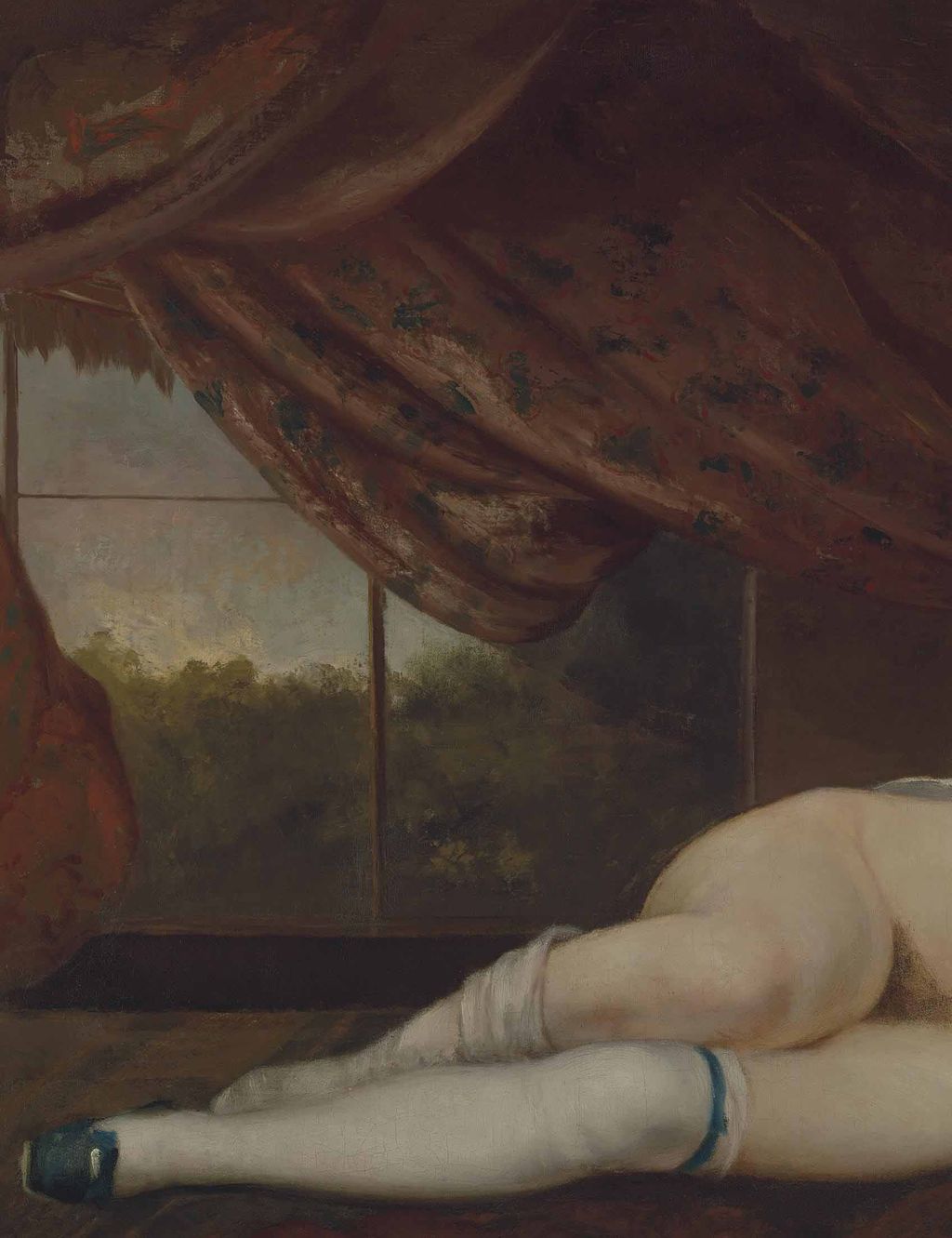
Detail of Femme nue couchée, 1862, formerly Hatvany. Shown here, window, curtain and bedding. Image source. Public domain. Cropped and resized from the source image.
Courbet in Saintonge
The signed date falls in Courbet’s stay around Saintes in western France. The Institut Gustave Courbet’s account of its 2019 exhibition describes how a short visit in the spring of 1862 turned into a stay of about a year. Étienne Baudry, a friend and patron, received him at the Château de Rochemont. Courbet used the period to paint a range of subjects. The Institut also places the anticlerical Return from the Conference in Saintonge and locates work on that canvas in a different building, the home of the director of the town’s stud farm. The region supplied him with several places to work and more than one kind of audience. [3]
Both Fernier and Christie’s list Baudry as the reclining nude’s first recorded owner. The identification of the place and person depicted is less secure. Fernier reports Roger Bonniot’s proposal that the work was painted at Rochemont and that a young woman from Saintes named Françoise posed for it. Christie’s essay tentatively names Léontine Renaude. Baudry’s ownership and his documented hospitality give the painting a setting in Courbet’s working life. The two suggestions about the sitter leave her identity open, and the visible window and trees provide little basis for assigning the room to a particular building. [1] [2] [3]
Titian, Goya and Courbet’s reclining figures
The arrangement belongs to a tradition that long predates Courbet. Titian’s Venus of Urbino of 1538 places a reclining woman on white bedding in an interior. The figures behind her and the light through the window extend the space well beyond the bed. The Uffizi connects the roses, dog and activity around the clothing chest to marriage. Courbet keeps the textile, the bed and the opening beyond them, but makes the far space much harder to see. In his picture the stockings are already on the body, and the room is empty of attendants. The comparison brings out how much of the earlier painting’s social world is visible inside its frame and how little information Courbet gives us about the moment he depicts. [1] [4]
Laurence des Cars, in the retrospective catalogue discussion cited by Christie’s, situates the picture within the Renaissance tradition and brings Goya’s The Naked Maja into the comparison. In Goya the bent elbows spread on either side of the head and the woman looks directly out. Courbet places the head higher in the frame and turns the face towards the window. In both paintings, the raised arms leave the torso open to view. The gaze changes the effect of the pose. Goya’s figure seems alert to the spectator’s presence. Courbet lets the viewer look for a response and gives us a face seen sideways, partly shaded by the hair. [1] [5]
Courbet himself varied the arrangement. In the Met’s Woman with a Parrot, accepted at the Salon of 1866, the reclining woman lifts a hand and the bird balances on her fingers. Her hair spills towards the front edge of the canvas. The bird directs the viewer’s attention above the body and makes the raised arm part of an action. Four years earlier, Courbet folded the raised arm back into the head and kept the largest forms close together. With the 1862 picture there is time to notice how the bed covering buckles beneath the hip and how its folds continue towards the signature. [1] [6]
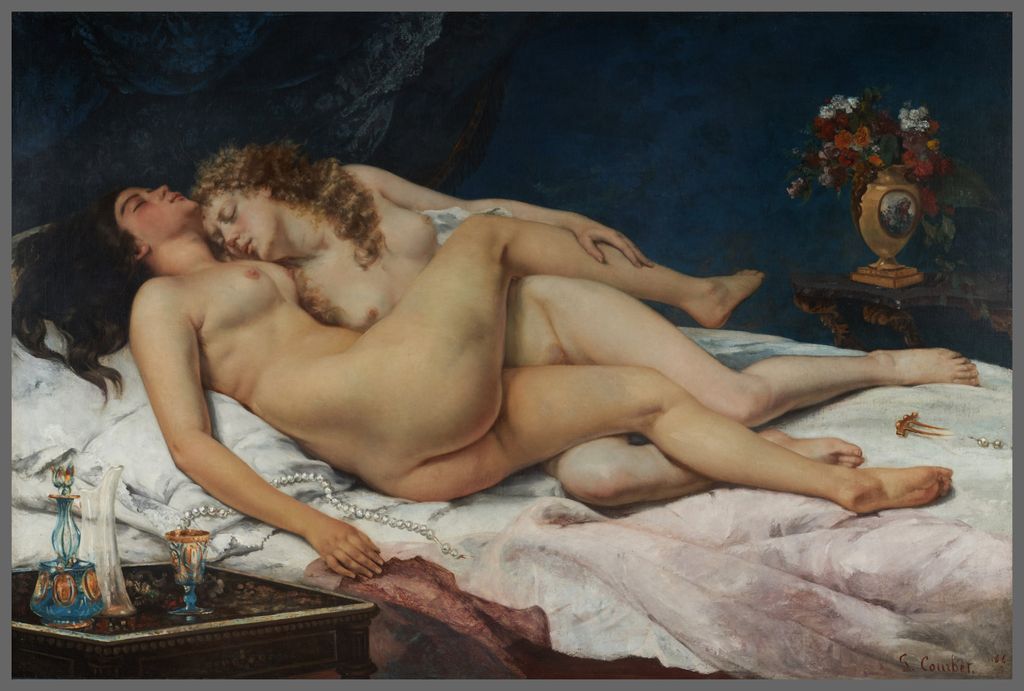
Le Sommeil, Petit Palais PPP3130. Image source. CC0 / Public domain. Resized from the complete source image.
From Saintes to Budapest
In 1878 the Galerie Durand-Ruel exhibited the work under the title Le sommeil (Sleep). Christie’s records it at the 1899 sale of Maurice Lippmann’s collection in Paris as lot 8. Fernier gives the title at that sale as Lassitude. By 1913 it was in the collection of Marczell von Nemes, following ownership by the Prince de Wagram and Baron Mór Lipót Herzog. Christie’s records Bruno Cassirer of Berlin as acquiring it at the Nemes sale in Paris in June 1913 and lists the Hungarian collector Baron Ferenc Hatvany as its owner by 1927. The purchase date for Hatvany is less firmly established than his ownership. The Petit Palais catalogue of 1929 names him as the lender of the work, exhibited as Femme endormie (Sleeping Woman). [1] [2] [7]
Those titles describe different things in the same scene. Femme nue couchée tells us how the woman is placed. Femme endormie and Le sommeil name a state suggested by her stillness. Lassitude adds a feeling that the painting leaves for the viewer to read. The names are useful clues in exhibition records, but the 1862 date and Hatvany’s name help distinguish this entry even within the 1929 catalogue, which lists another Femme endormie dated 1853. Christie’s also records a showing in Amsterdam in 1938 and lists the painting in a Budapest exhibition early in 1940. [1] [2] [7]
The 1878 title Le sommeil also names a different painting by Courbet. The Petit Palais’s Sleep, painted in 1866 for Khalil-Bey, shows two women entwined on a bed and is almost twice as wide as the 1862 canvas. The visible room is different as well. The string of pearls and a comb on the bedding in the later work draw attention to the space the two figures occupy together. In the earlier picture the garments still on the body tell us more about its solitary occupant than any object placed beside her. [1] [8]
Wartime loss and the 2005 return
During the war, Hatvany, a Hungarian Jewish collector, put works into bank vaults in Budapest for safekeeping. Christie’s lists a confiscation by the National Socialists in 1944 in the formal provenance. Its accompanying essay describes a more complicated sequence. It distinguishes the looting of Hatvany’s house during the German occupation from the removal of pictures from bank vaults during the Soviet capture of the city. Fernier’s entry, written while the painting was still missing, records the disappearance in connection with the 1944 German occupation and notes that responsibility for the loss of the collection was disputed. The records agree that the painting disappeared from Hatvany’s collection in wartime. They give different accounts of who removed it. [1] [2]
Christie’s dates the picture’s resurfacing to 2000, in the hands of a Slovak art dealer. The Commission for Art Recovery helped negotiate its return. The law firm Herrick’s register of resolved art claims independently records the 2005 restitution to Hatvany’s heirs, through a reward and without litigation. The record names the picture and identifies the dealer as the party to whom the heirs’ claim was addressed. The painting returned to public view at the Grand Palais in Paris in 2007, as part of the 2007–08 Courbet retrospective. The catalogue identified it as Reclining Nude, no. 173. Christie’s records a private acquisition shortly after the return to the heirs, and its published results for the New York sale of 9 November 2015 list the work as sold to an anonymous buyer. [1] [9] [10]
Two other paintings help clarify which recovery this was. Hatvany also owned Courbet’s 1866 The Origin of the World, a much more tightly cropped composition. The Musée d’Orsay traces that work through Jacques Lacan’s collection and records its entry into the museum in 1995. Another Hatvany Courbet, Bathers in the Forest (Baigneuses dans la forêt), is a small vertical canvas showing two figures among trees. Sotheby’s records a separate restitution to the family in 2021 and cites Fernier no. 331. The painting returned in 2005 was the horizontal canvas of the single reclining woman, her stocking slipping against the dark of the room. [1] [9] [11] [12]
The light from outside
The window complicates the apparent ease of the reclining figure. Courbet gives the opening hard edges and keeps the clouds beyond it quiet. Below and in front of it, the body and sheets make a series of irregular curves. Follow the darker contour where the red cloth meets the pale bedding. It becomes difficult to tell whether the brightest passage belongs to the figure or to the fabric that supports her. The scene depends on ordinary things in a room, such as a bed, a curtain and a view to the outside, to direct a sustained look at its central subject. [1]
The same period in Saintonge produced work in which the outdoors was the subject. The Met tentatively locates its A Brook in a Clearing at Fontcouverte and connects it with Courbet’s sketching alongside Louis-Augustin Auguin in 1862. It also records a second, now unlocated Fontcouverte view exhibited as a collaboration. The two canvases discussed here serve different purposes. The stream picture makes the viewer move into a small landscape through vegetation and reflected light. The reclining figure is close to the viewer, and the outdoor light remains at a distance behind glass. The regional evidence is a reason to compare how Courbet apportioned space and light across subjects from the same working period. [1] [13]
The title Femme nue couchée describes a subject that several painters, and Courbet himself, could return to. For this painting the window, red curtain and folded bedding are useful first points of recognition. They are more specific than a translation such as Reclining Nude. Identification becomes especially important when one follows the work from exhibition lists to documents about the Hatvany collection and later sale. Matching the description, size, date and reproduction together helps keep this work distinct from pictures that may share part of its title. [1] [7] [10]
Courbet artworks directory
Browse the paintings covered in this guide. Dates identify the specific versions discussed.
Discussion
Look again at the images and ideas explored in Femme nue couchée by Gustave Courbet. These editorial prompts invite your observations.
Reader Insights
How do the stockings and shoes affect the way you read the pose?
Which details identify this canvas among Courbet’s reclining figures?
What do the provenance sources each establish about the painting’s return?
Join the Conversation
Share a detail, comparison or question about Femme nue couchée by Gustave Courbet below.
References
- Christie’s, Gustave Courbet, Femme nue couchée, 2015 illustrated sale catalogue, lot 5946116. Includes the inscription, measurements, ownership and exhibition history, and a lot essay citing Laurence des Cars’s retrospective catalogue entry. View source.
- Robert Fernier, La vie et l’œuvre de Gustave Courbet, vol. I, p. 194, no. 335, Femme nue couchée. Digitised by the Wildenstein Plattner Institute. View source.
- Institut Gustave Courbet, Gustave Courbet, une histoire intime, 2019 exhibition catalogue and summary. View source.
- Uffizi Galleries, Titian, Venus of Urbino, collection record. View source.
- Fundación Amigos del Museo del Prado, Francisco de Goya, The Naked Maja. View source.
- Metropolitan Museum of Art, Gustave Courbet, Woman with a Parrot, collection record 29.100.57. View source.
- Petit Palais, Exposition Gustave Courbet, 1929, pp. 24 and 26, nos. 38 and 49. View source.
- Metropolitan Museum of Art, 2008 Gustave Courbet retrospective gallery, Sleep. View source.
- Herrick, Feinstein LLP, Resolved Stolen Art Claims, p. 33, Slovakia, 2005. View source.
- Christie’s, The Artist’s Muse, New York, 9 November 2015, sale results, lot 10A. View source.
- Musée d’Orsay, Gustave Courbet, L’Origine du monde, collection and provenance record. View source.
- Sotheby’s, Gustave Courbet, Baigneuses dans la forêt, 2021 illustrated sale catalogue. View source.
- The Metropolitan Museum of Art, A Brook in a Clearing, collection record and evidence for Courbet’s Saintonge work with Auguin. View source.


