



 by Tom Gurney
Tom Gurney BSc (Hons) is an art history expert with over 20 years experience
Published on June 19, 2020 / Updated on October 14, 2023
Email: tomgurney1@gmail.com / Phone: +44 7429 011000
The Stone Breakers by Gustave Courbet: Introduction
A young worker carries a basket of broken stone. Beside him, an older man kneels with his hammer raised. The youth has turned away, and the older man’s hat shades his face. In the colour plate published in the Dresden gallery’s album, you can see their clothes and tools far more clearly than their expressions. Courbet began the painting in 1849 and gave the two road workers a canvas more than two and a half metres across. The original, which Dresden acquired in 1904, was lost during the Second World War. The plate preserves the arrangement of the figures and something of the contrast between the lit ground and the hillside. At the Paris Salon of 1850–51, these two men took up a stretch of wall a printed page can scarcely suggest. [1] [2] [3] [4] [5]
At a Glance
- Date1849
- MediumOil on canvas
- StatusDresden original lost in 1945
Contents
- A basket and a hammer
- What Courbet told the Weys
- The road workers at the Salon
- From Frankfurt to Dresden
- What survives
- Courbet and Millet on the rhythm of work
- When the stone breaker became a caricature of Courbet
A basket and a hammer
Start with the basket on the left. The youth grips it in both hands and holds it close, his upper body bent towards the load. He is still upright, but his posture registers the weight he carries. The older worker’s body is gathered much lower to the ground. One knee bears his weight while his arms lift the hammer. Courbet has set the two workers close enough to see their movements together and left room around each for the action to read. One gathers and moves what the other breaks. The fragments between them are both the product of the hammer blow and the next load for the basket. [1]
The hill behind them fills nearly the whole upper part of the picture, leaving a small opening of sky on the right. You can follow the line of the slope to the edge without finding an inviting view into the distance. That steep backdrop also lets the figures register strongly. A patch of shirt or the bend of an elbow stands out where it meets the darker bank. Look down again and the ground separates into larger stones, broken fragments and the finer material spread underfoot. The image gives you several stages of the job at once, though it catches the workers between one action and the next. [1]
At the right edge, a pot and a piece of cloth sit on the ground. They are small beside the figures, but their distance from the raised hammer matters. Courbet found room for what the workers had brought along as well as for what they were doing. The pot suggests a meal taken where the work is, and perhaps the short pause it would bring. The painting makes no such pause for the men themselves. The youth’s hands stay occupied, while the brim of the kneeling man’s hat directs attention back towards the stones. [1]
Both bodies are easy to read even though neither face is fully available. This is part of what makes the picture different from a pair of portraits. The youth’s turn tells us how he balances the basket. The older man’s profile gives us just enough to register the angle of his head. To work out the relation between them, we have to look at their occupations, their apparent ages and the condition of their clothes. Courbet supplied a way of putting those things together in a letter written while the painting was new. [1] [5]
What Courbet told the Weys
In a letter dated 26 November 1849, Courbet told Francis and Marie Wey that he had set out in a carriage towards the château of Saint-Denis to paint a landscape. Near Maizières he stopped to watch two men breaking stones by the road. He described the encounter as an unusually complete image of poverty and said he asked the men to come to his studio the next morning. His account places the idea beside the road and the making of the picture in the studio. The hillside and the two bodies belong to a composition that grew out of that encounter. [5]
Courbet described the older worker as seventy. He lingered over the man’s patched trousers, cracked clogs and worn socks, then turned to the younger man’s torn shirt, single suspender and shoes full of holes. These were the details Courbet thought worth setting down for friends who had yet to see the canvas. He also supplied a reading of the difference in age. For people of the workers’ class, he suggested, the young man showed where a life of work began and the older one where it ended. One figure therefore makes the other harder to look at. You can see what the boy is carrying now and what decades of such work might ask of him. [5]
The letter also gives the painting an early audience. Courbet reported that visitors to his studio in Ornans preferred The Stone Breakers to After Dinner at Ornans, the picture for which he had received a medal at the previous Salon. He compared the new picture’s size to that earlier canvas. The two paintings were roughly comparable in width, as the editor Petra ten-Doesschate Chu points out, although the roadside picture was appreciably lower. The dinner scene had put acquaintances and family life on a broad canvas. The new format gave two standing and kneeling workers much of that width, with the open ground between them doing work that furniture and company did in the interior. [2] [5] [6]
The road workers at the Salon
The official Salon catalogue lists the painting as no. 663, Les casseurs de pierre (Doubs). The last word locates the scene in the department around Ornans. It gives the Paris viewer a place to associate with the two figures, much as the other large works in Courbet’s submission named Ornans or Flagey. A Burial at Ornans, The Peasants of Flagey Returning from the Fair and The Stone Breakers shared an exhibition and an insistence on the scale of regional life. Each made a different use of it. The burial spreads its participants across a procession, the fair picture sends its group along a road, and the stone breakers occupy a stretch of roadside they have to work on. [4] [6]
Large paintings had traditionally carried the prestige of history painting, a category that embraced subjects from antiquity, religion and national history. Courbet used an expanse of canvas comparable to such ambitious work for a scene whose principal event was a hammer blow. The question his choice raised was how long someone might stand in front of a painting of this task, and what it meant to accord the people who performed it so much attention. In an exhibition where scale helped announce a picture’s importance, the work had already made a claim before anyone read its title. [3] [6]
The reactions differed. As the historian Paul B. Crapo records, the critic Louis Enault associated Courbet’s work with democratic and social painting in his review of the 1851 Salon. The comparison he reached for was Proudhon. Proudhon himself had reservations. In a notebook entry of 11 April 1851, he credited Courbet’s Salon paintings with vigour but judged them large-scale genre scenes that offered ugliness in its natural state. Enault heard a political argument in the choice of subject. Proudhon wanted more from the way Courbet painted it. [7]
In Du principe de l’art et de sa destination sociale, published in 1865, Proudhon went much further in defending The Stone Breakers. He read it as an irony of industrial civilisation. A society ingenious enough to invent machines for complicated tasks still left its poorest people to perform some of the most punishing labour. Even a machine that could break the stones would, in his account, leave open the question of how the displaced workers were to live. Courbet’s letter had paired two ages of working life. Proudhon made the scene the starting point for a broader argument about who bears the cost of progress. [5] [8]
From Frankfurt to Dresden
Within two years of the Paris Salon, people were arguing about the picture in Frankfurt. The dealer Georg Ludwig Kohlbacher included it in an exhibition at the Casino building on the Roßmarkt in November 1852. The Frankfurter Intelligenz-Blatt reported that Courbet’s political pictures kept attracting attention and found the manner of painting itself strikingly democratic. Several years later, Arthur Schopenhauer recalled his distaste for what he took to be the socialist provocation of The Stone Breakers and A Burial at Ornans, even as he singled out Courbet’s self-portrait with a pipe for praise. The same painter could impress him with a portrait and disturb him by giving road workers the prominence of a large painting. [9]
When the École des Beaux-Arts staged a retrospective in Paris in 1882, Eugène Chéron photographed the hanging. In plate 17 of his album, The Stone Breakers occupies the centre of a group of pictures. The surrounding works help convey its width, something a photograph of the painting alone tends to hide. In the exhibition catalogue, the critic Jules-Antoine Castagnary looked back to the aftermath of the 1848 Revolution and argued that the rural workers on the Salon walls had unsettled viewers already anxious about working people’s place in politics. His essay shows how a supporter of Courbet remembered the controversy three decades later. The photograph shows what the organisers made of the canvas in 1882, when they gave it a conspicuous place in an exhibition devoted to the artist. [10] [11]
Dresden bought the painting at the Binant sale in Paris in 1904. Its 1920 catalogue identifies it as Die Steinklopfer, no. 2522, and gives its dimensions as 159 by 259 centimetres. The acquisition belonged to a wider effort to collect significant recent French painting. The catalogue places the purchase alongside works by Thomas Couture and Pierre Puvis de Chavannes. By then the roadside scene that had caused such argument in Frankfurt was a work a German gallery wanted to represent nineteenth-century French art. [2]
The original was lost in 1945. The historian Anne Kuhlmann-Smirnov places it among works moved from wartime storage at Schloss Milkel and reports that it burned during the Dresden air raids. The Frankfurter Personenlexikon gives the destruction as highly probable. The account of the fire comes from a later reconstruction of what happened to the dispersed Dresden collections. [3] [9] [12]
What survives
The surviving images record different aspects of the lost painting. Chéron’s photograph shows the canvas as one object on an exhibition wall. The Dresden album’s plate fills its frame with the painted scene. The text that accompanies the plate describes colours as well as composition, including the older worker’s dull blue socks, which Courbet also mentioned in his letter. That agreement helps with one particular detail. The colour plate is still printed ink on paper. The exact tones and texture of the painted surface are harder to recover than the positions of the men or the distribution of the light and dark areas. [1] [5] [10]
The Musée Gustave Courbet in Ornans holds a lithograph after the painting by Émile Vernier, dated about 1860. Here the image had already left the canvas and entered circulation as a print during Courbet’s lifetime. The words below it give the Salon year as 1849, while the original exhibition catalogue records the work in the Salon that opened in December 1850. A later postcard preserved at the DDR Museum in Berlin names the Dresden collection alongside the image. That wording carries the association with Dresden into another generation of reproductions. For the whereabouts of the original, the museum catalogue and the record of its wartime loss carry greater weight than a line printed beneath a picture. [2] [3] [4] [13] [14]
A separate Dresden collection entry is indexed as a painted copy after Courbet by L. Schünzel, with inventory number 89/30. It belongs to a different category again. A painter working from another picture can render weight and volume with paint where the lithographer uses marks on stone, but each makes decisions about what to carry over. The smaller oil in the Oskar Reinhart Collection in Winterthur has yet another status. The collection attributes it to Courbet and dates it to about 1849. It puts the workers on opposite sides from the Dresden composition. The similarity of the subject makes the contrast worth seeing. Where the Dresden picture opens out around the two bodies, the Winterthur painting draws them together in a more compact field. [1] [15] [16]
A reproduction can make the lost painting fit the palm of a hand. The Dresden catalogue gives a better sense of how much wall those working bodies once claimed, and Chéron’s photograph shows what that looked like in company with other pictures. Even at a fraction of its former size, the composition holds the instant between lifting and striking. The basket is already full, and the hammer is still in the air. [1] [2] [10]
Courbet and Millet on the rhythm of work
Jean-François Millet’s The Gleaners, exhibited at the Salon of 1857, gives another account of what repetitive labour does to the posture of the body. The Musée d’Orsay identifies the three women as gleaners gathering ears left behind after the harvest. It reads their positions as successive stages of a movement, from bending to picking up and straightening. In the Dresden reproduction of Courbet’s painting the distinction is between two people doing different parts of the same job. One raises the hammer and the other carries the result. The work can continue because the two movements complement each other. The raised hammer by itself would tell us less about that division of effort. [1] [17]
The surroundings set the terms of the comparison. In Millet’s canvas there is a harvest going on beyond the three women. The great stacks and the activity around them place the small quantities the women gather in relation to the abundance of the field. Orsay suggests that the mounted figure in the distance may be an overseer. The hill in Courbet’s picture leaves little room for an equivalent view. The road workers occupy almost all the space available for a human figure, while whoever commissioned or supervised their work stays outside the frame. That absence makes it harder to turn their effort into an orderly picture of an entire enterprise. The viewer sees the ground the men have to work on, the materials it offers and the tools they brought. [1] [17]
Dimensions sharpen the distinction. Millet makes the three workers monumental against the distance on a canvas 110 centimetres wide. Courbet’s was 259 centimetres wide according to the Dresden catalogue. The two pictures thus ask for different kinds of viewing even though both direct attention down towards the ground. The shape of a bent back may look similar in a pair of small reproductions. The amount of wall a worker’s body claimed at each Salon was quite different. [2] [17]
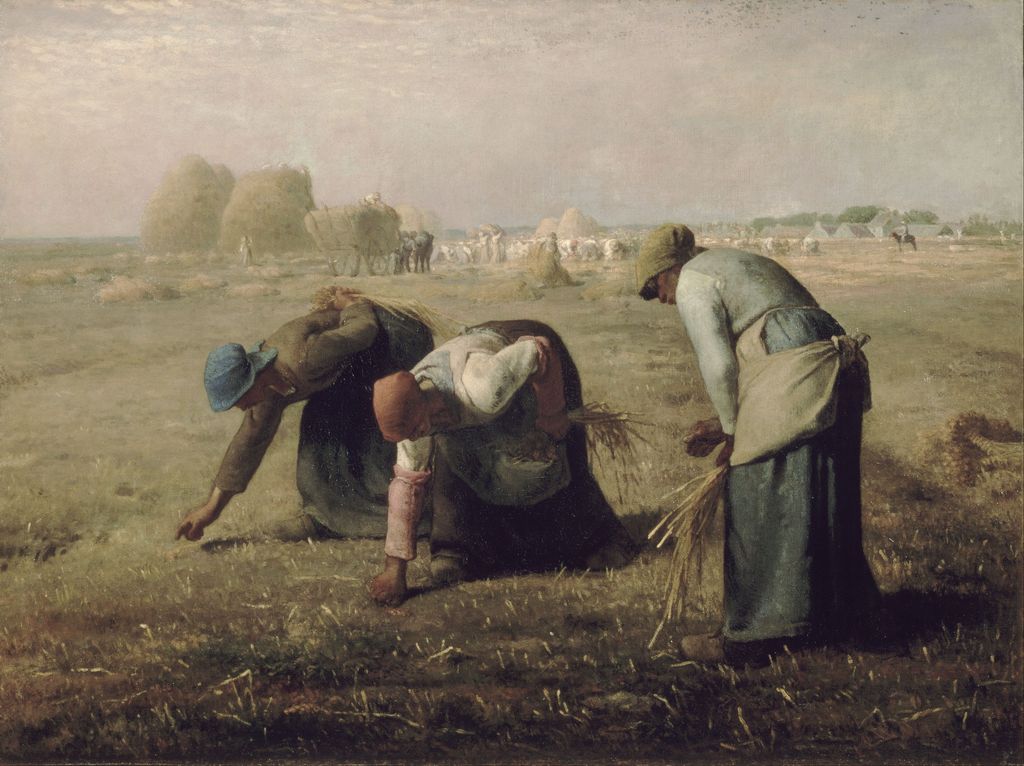
Jean-François Millet, The Gleaners, 1857. Musée d’Orsay. Image source. Public domain. Resized from the complete source image.
When the stone breaker became a caricature of Courbet
The act of breaking stone acquired a second life during the Paris Commune. In 1871 Léonce Schérer depicted Courbet as a worker with a hammer while the Vendôme Column fell in the distance. The caption turned his painting into a prediction of his supposed role in the destruction. The joke required a reader to recognise the reference to the roadside picture and accept, at least for the moment, the substitution of the painter for the labourer. The print belongs to the campaign of caricature that made Courbet’s connection with the column a readily recognisable political image. [18] [19]
That reuse changes where the action leads. In the Dresden painting the blow is part of a task that will have to be repeated. In the caricature the work in the foreground points to a famous event happening behind the painter. There is now an identifiable person to blame or ridicule, and the caption supplies the causal story. The print tells us how a public image of Courbet could be made from one of his best-known subjects. The Commune’s deliberations and the subsequent legal proceedings supply a separate account of what the artist did. [1] [18] [19]
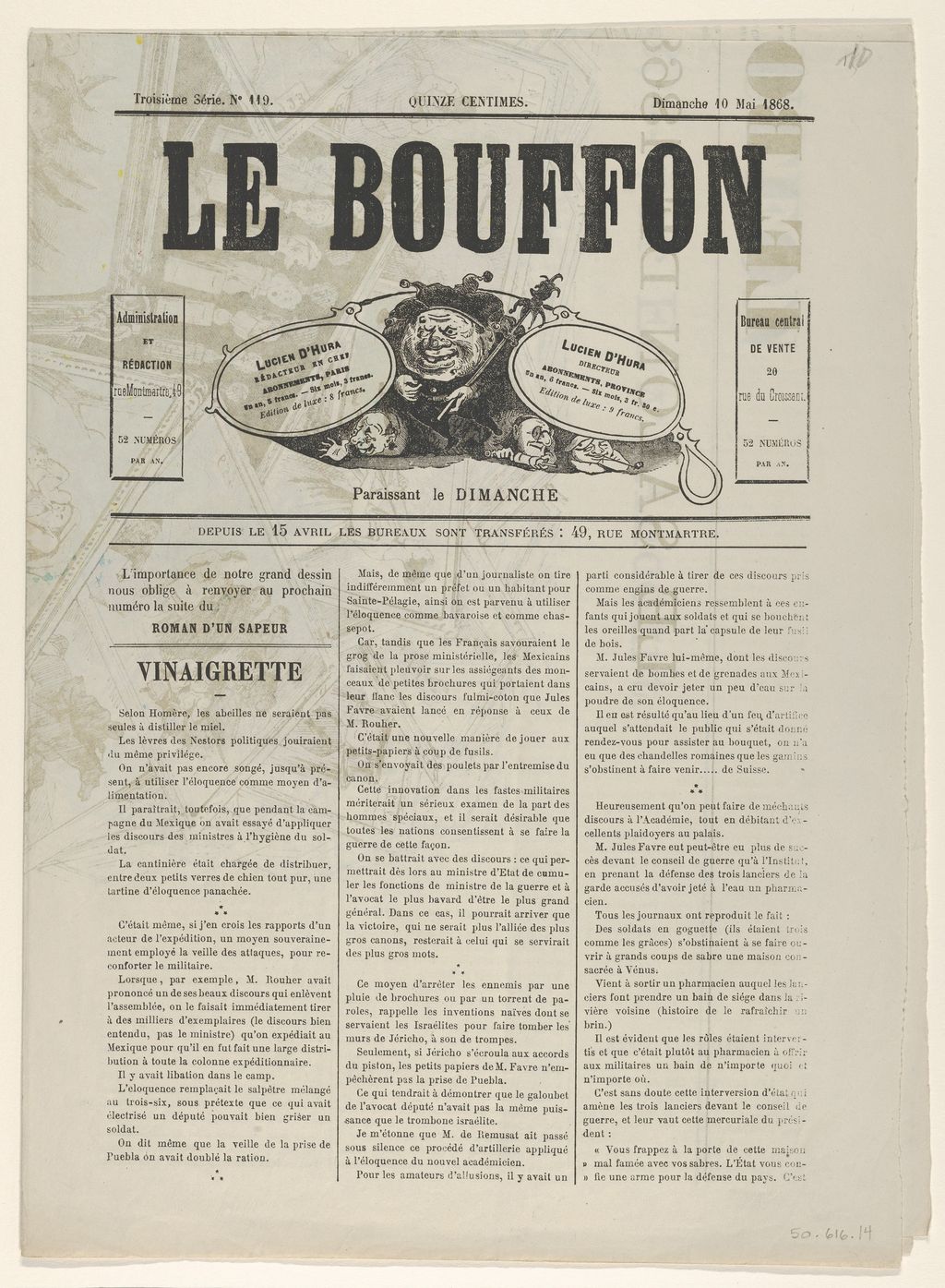
Le Bouffon, illustrated Salon satire, 10 May 1868. Paris Musées. Image source. CC0 / Public domain. Resized from the complete source image.
Courbet artworks directory
Browse the paintings covered in this guide. Dates identify the specific versions discussed.
Discussion
Look again at the images and ideas explored in The Stone Breakers by Gustave Courbet. These editorial prompts invite your observations.
Reader Insights
What does Courbet show about work through the two men’s different postures?
How do the basket and hammer help organise the scene?
Which details can a historical photograph establish about the lost painting?
Join the Conversation
Share a detail, comparison or question about The Stone Breakers by Gustave Courbet below.
References
- Gemäldegalerie Dresden, Album der Dresdner Galerie. Gemälde des XIX. Jahrhunderts und der Gegenwart, Leipzig, E. A. Seemann, 1920, plate 3 and accompanying essay on Die Steinklopfer. View source.
- Staatliche Gemäldegalerie zu Dresden, Katalog der Staatlichen Gemäldegalerie zu Dresden, 1920, no. 2522. View source.
- The Metropolitan Museum of Art, Gustave Courbet, 2008 retrospective overview. View source.
- Salon of 1850–51, Les casseurs de pierre (Doubs), no. 663 in the printed catalogue, transcribed by the Musée d’Orsay’s Base Salons. View source.
- Gustave Courbet, letter to Francis and Marie Wey, 26 November 1849, no. 49-8 in Petra ten-Doesschate Chu, ed. and trans., Letters of Gustave Courbet, University of Chicago Press, 1992, pp. 87–90. View edition. View source.
- The Metropolitan Museum of Art, Gustave Courbet, 2008 retrospective gallery, entry for The Peasants of Flagey Returning from the Fair. View source.
- Paul B. Crapo, Disjuncture on the Left: Proudhon, Courbet and the Antwerp Congress of 1861, Art History, vol. 14, no. 1, March 1991, pp. 67–91, especially pp. 67 and 77–78. View source.
- Pierre-Joseph Proudhon, Du principe de l’art et de sa destination sociale, Garnier Frères, 1865, chapter XV. View source.
- Sabine Hock, Courbet, Gustave, Frankfurter Personenlexikon, with extracts from the Frankfurt press and Schopenhauer’s correspondence. View source.
- Eugène Chéron, installation photograph with The Stone Breakers, plate 17, Album de l’exposition des oeuvres de Gustave Courbet à l’École des Beaux-Arts, 1882, Bibliothèque de l’INHA. View photograph record. View source.
- Jules-Antoine Castagnary, Exposition des œuvres de Gustave Courbet à l’École des beaux-arts, 1882, introduction. View source.
- Anne Kuhlmann-Smirnov, Jenseits des organisierten Abtransports, in Britta Kaiser-Schuster, ed., Kulturelles Gedächtnis. Kriegsverluste deutscher Museen, Böhlau, 2021, pp. 137–139 and fig. 6. View source.
- Musée Gustave Courbet, Émile Vernier after Gustave Courbet, Les casseurs de pierre, inv. 1976.1.90, Joconde record. View source.
- DDR Museum, Postkarte “Gustave Courbet – Die Steinklopfer”, inv. 1020577. View source.
- Staatliche Kunstsammlungen Dresden, online collection entry 189729, indexed as L. Schünzel, Die Steinklopfer (Kopie nach Gustave Courbet), inv. 89/30. View collection entry and indexed metadata. View source 1. View source 2.
- Oskar Reinhart Collection “Am Römerholz”, Gustave Courbet, The Stonebreakers, c. 1849, inv. 1923.15, Winterthur, institutional exhibition materials and image. View source.
- Musée d’Orsay, Jean-François Millet, Des glaneuses, object and exhibition record, RF 592. View source.
- Musée Courbet, Courbet en son territoire, reproduction and caption for Schérer’s print from Souvenirs de la Commune. View source.
- Christine Pétitet, Courbet vandale et anti-vandale, Université de Bourgogne, analysis of the 1871 caricature and the column controversy. View source.


