



 by Tom Gurney
Tom Gurney BSc (Hons) is an art history expert with over 20 years experience
Published on June 19, 2020 / Updated on October 14, 2023
Email: tomgurney1@gmail.com / Phone: +44 7429 011000
Self-Portrait with a Black Dog: Introduction
Gustave Courbet sits under a rock ledge with a black spaniel beside him. His body turns towards the valley and his face turns back towards us. The broad hat shades his eyes, but his gaze is direct. A walking stick leans against the rock at the left and a pipe rests in his hand. The man looks as though he has stopped for a moment on a walk. Seen from below, with his hat and shoulders rising against the light, he also looks quite sure that we will stop for him. [1]
The Petit Palais in Paris catalogues Self-Portrait with a Black Dog as Autoportrait dit Courbet au chien noir, an oil painting on canvas measuring 46.5 × 55.5 cm, made between 1842 and 1844. Courbet’s sister Juliette gave the painting to the museum in 1909. It is recorded as PPP731. [1] [2]
At a Glance
- Date1842–44
- MediumOil on canvas
- CollectionPetit Palais, PPP731
Contents
- Looking up at Courbet
- The view from the rock ledge
- The date on the canvas and the date at the Salon
- Other roles, the same sitter
- Annotated details
- The place of the picture in the Petit Palais collection
Looking up at Courbet
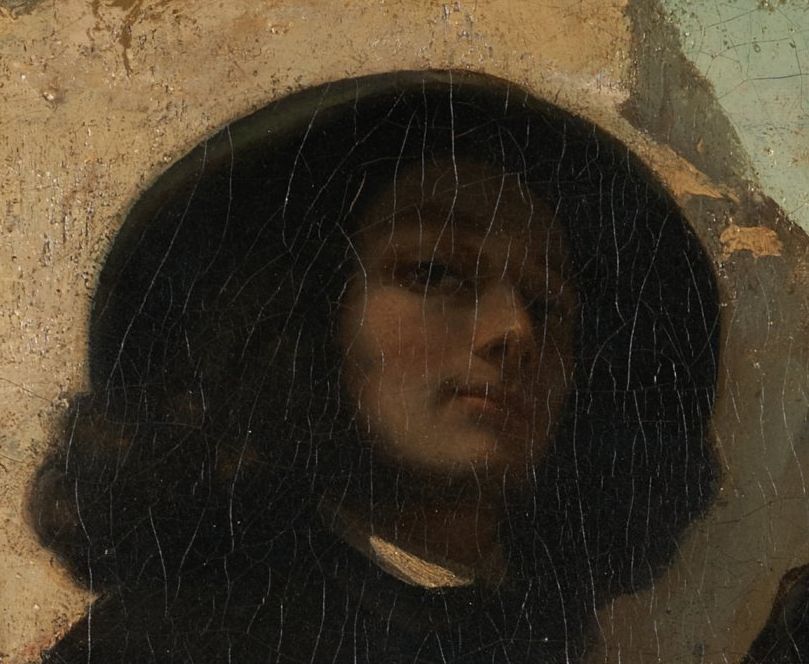
Follow the line of the grey trousers from the lower right towards the middle of the picture. The raised knee brings the sitter close and gives the hand holding the pipe somewhere to rest. Higher up, the bright rim of a white collar picks out the underside of the face. Courbet tilts his head just enough for us to see his chin and the underside of the hat. That angle gives the portrait its peculiar social distance. We are near enough to see the pipe and the cuff, yet his eyes meet ours from above. [1]
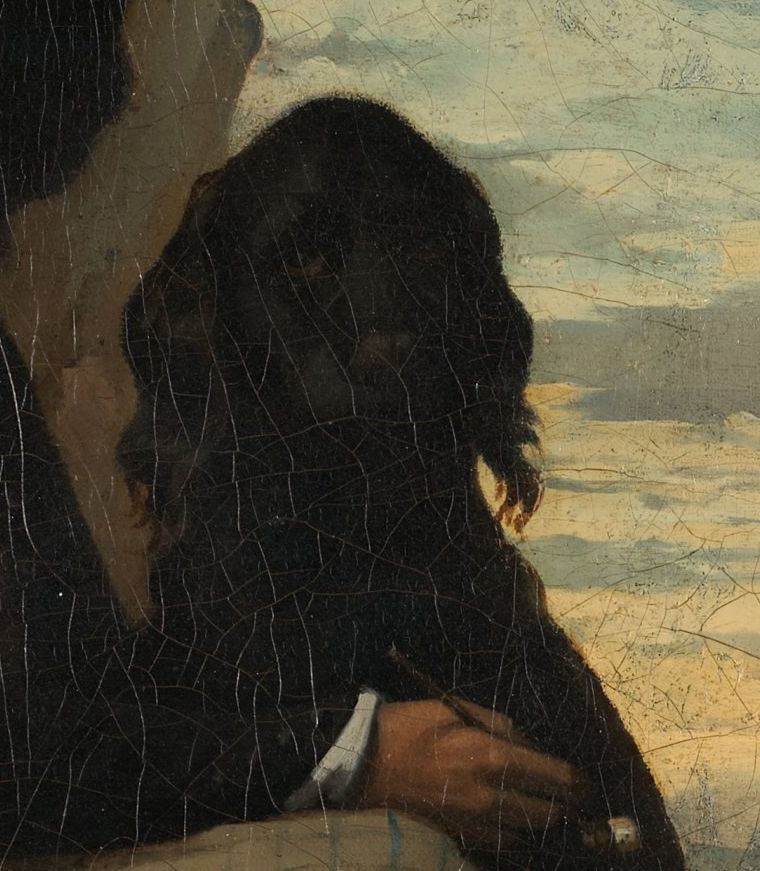
The dog occupies much of the space a second person might take in a double portrait. Its head rises almost to Courbet’s shoulder, and its body follows the outward slope of his leg. Part of the animal’s outline is lost against the painter’s dark clothes. Against the bright opening at the right, its head and hanging ears come into focus. The Musée Courbet draws attention to the resemblance between the spaniel’s wavy ears and the painter’s hair. The likeness has some visual wit, especially once you notice how differently the two heads are lit. The spaniel’s face stays deep in shadow while a narrow patch of light under the hat keeps drawing us back to Courbet’s expression. [1] [3]
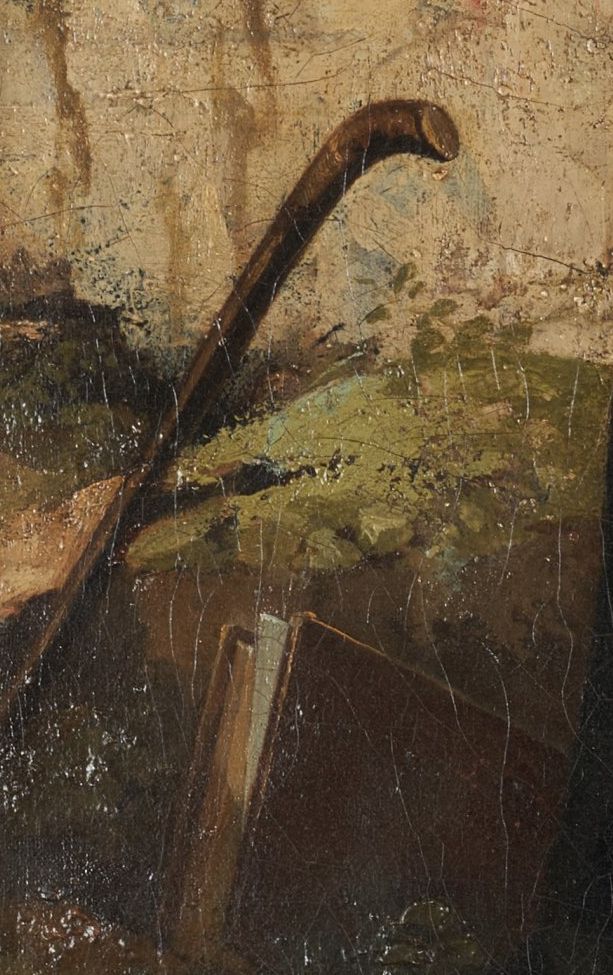
The pipe is small enough to miss. The light on the cuff and hand gives it away, and the space around the fingers makes it look lightly held. At the left, the curved handle of the walking stick stands out against the rock. Below it, the pale edge of a rectangular object catches the light. The Petit Palais identifies it as a book or sketchbook. A book would suit someone taking a pause outdoors, while a sketchbook would give the outing a painter’s purpose. Either reading starts from how casually Courbet places it, set down behind his back where a visitor would see it only after taking in the face. [1]
The Musée Courbet reads the stick and hat as signs of a walker in the countryside, and the clothes and pipe as elements of a Parisian bohemian or dandy persona. Look at how little Courbet has to do to bring those associations together. The dark coat pools on the ground, but the clean edge of the cuff survives in the middle of the shadows. The coat has fallen into the folds you would expect when someone sits on the ground. The crisp cuff and collar still look deliberate, tiny points of white in a painting largely built from earth colours and black. [1] [3]
The view from the rock ledge
The rock at the left seems close enough to touch. Its broken patches of ochre and grey meet the broad curve of Courbet’s hat, and the ledge continues over part of the blue sky. The valley opens only on the right, beyond the figures. Thin streaks of pale yellow run through the cloud, with muted greens and browns far below. The change from the upright wall of rock to these narrow bands gives the scene its depth. It also explains the force of the foreground silhouette. Courbet and the dog stay in the shadow while the brightest part of the sky draws the eye past them. [1]
The Petit Palais places the landscape in the vicinity of Ornans, Courbet’s home town in Franche-Comté. The Musée Courbet relates the cliff to the valley of the Loue, and the Metropolitan Museum sees the limestone around Ornans as a terrain Courbet identified himself with early in his career. The painting leaves much of the distance indistinct. The place comes through most strongly in the shape and weight of the rock immediately above him. By making the ledge almost a roof, Courbet gives his body a sheltered place within the view. A sitter could have posed against a painted prospect that opened evenly behind him. Here the irregular edge of the rock determines how much of the world the portrait lets us see. [1] [3] [4]
The Petit Palais points to early use of the palette knife in the luminous sky. Across the opening, several pale strokes lie in flattened patches against the blue. Near the sitter, colour breaks into smaller, rougher changes along the rock. The two passages catch light differently and help the eye judge their distance from us. The sky belongs to the same small canvas as the face, but its streaks of colour let the air feel wide. [1]
The date on the canvas and the date at the Salon
At the lower left, Courbet’s name and the year 1842 appear in blue. The Petit Palais questions whether the date is contemporary with the painting and suggests Courbet may have added it later. The museum’s range of 1842–44 allows for that uncertainty. The 1844 Salon gives us a separate date, the year the painting appeared in public. The Metropolitan Museum identifies it as Courbet’s first painting accepted by the Salon. Robert Fernier’s catalogue raisonné records its exhibition there as entry 414. [1] [4] [5]
The Paris audience thus met Courbet through a portrait of his own making. A visitor drawn close by the modest size of the canvas would find a sitter who still seemed to look down from his ledge. The walking stick and the objects on the rock offer clues about the scene, but none explains what has interrupted the walk or why the man has turned. His eyes put the visitor in the position of someone arriving. The encounter is brief enough to feel accidental and composed enough to serve as an introduction. [1] [4]
A related painting in Pontarlier shows how much of this effect belongs to the particular setting. The French national collection record dates that smaller portrait to 1842 and compares its costume, lighting, hand and pose with those of the Petit Palais canvas. The dog in the Pontarlier painting stands behind Courbet against a dark ground. In Paris, the spaniel has clear sky at its side and takes up much more of our attention. The two works share a man and a dog, while the opening onto the valley gives the pair a different presence in the larger picture. [1] [6]
Other roles, the same sitter
The Met puts the painting within a series of painted and drawn self-portraits from 1842 to 1855. In The Cellist, exhibited at the 1848 Salon, Courbet gives both hands to an instrument and its bow. The upright cello carries much of the action. In The Wounded Man, a tree shelters a reclining figure, with a sword and a bloodstain to suggest a story. The walker with the spaniel has a different task for his hands and a different relationship to the ground. He can sit easily and meet our gaze, while the cello player seems occupied and the wounded figure has closed his eyes. The differences are choices about what the figure is doing and how much access a viewer gets to him. [4] [7] [8]
When the Petit Palais held a Courbet retrospective in 1929, the catalogue listed the picture in its portraits section as Portrait de l’Artiste, adding that it was known as Courbet au chien noir. It recorded the date on the canvas, 1842. The two titles together are a reminder of how the picture works. Courbet is recognisable as the artist, yet the animal gives this particular portrait a name that sets it apart from the others. [9]
The name Courbet au chien noir also appears on a later lithograph in the Petit Palais by Alexandre Toupey, who worked from Courbet’s painting. The museum dates the print to 1900–25 and records it separately as PPG2964. Toupey reproduced the 1842 inscription within the printed image and signed the sheet himself. That small detail shows how easily a date can travel with an image. The dog travels with it too, its dark silhouette against the opening in the rock as distinctive as the young painter’s broad hat. [1] [10]
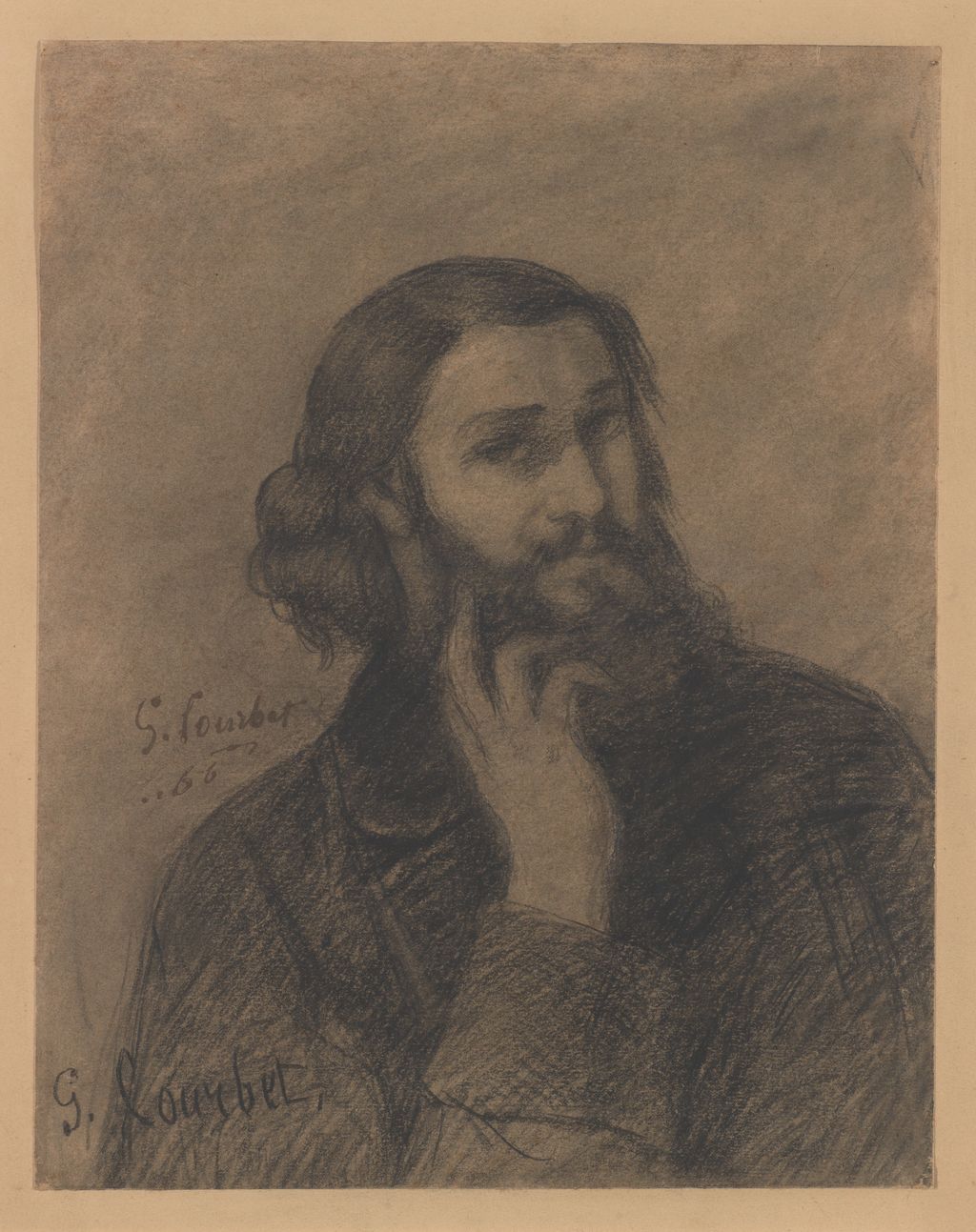
Gustave Courbet, Self-Portrait, about 1866. The Metropolitan Museum of Art. Image source. CC0 / Public domain. Resized from the complete source image.
The place of the picture in the Petit Palais collection
The painting’s place in a public collection belongs to a much later episode than its appearance at the Salon. The Petit Palais tells the story of how Juliette Courbet and other donors built up its holdings of her brother’s work. Juliette became an heir to paintings Courbet still owned at his death. She later gave works to the museum, including Young Ladies beside the Seine in 1906 and a further group in 1909. This history helps explain why a visitor can compare an early image of the painter with portraits and much larger scenes from the years in which his work was widely exhibited. [11]
The collection also gave specialists a group of works to examine together. The C2RMF dates a joint investigation of Courbet’s early self-portraits to 1972–73 and includes the black-dog painting among examples in which changes could alter the appearance or meaning of the subject. It groups the portrait with works as different as The Wounded Man and the Lyon painting of lovers. That is a history of the discovery of revisions, alongside the history of the finished picture. A visitor can notice the way the dark outline of the coat meets the dog, while a technical examination can ask when particular boundaries in the painting took shape. [12]
The contrast with The Desperate Man is clearest when the pictures are approached as two acts of self-presentation. In the black-dog portrait the stick and the ledge provide a way to imagine arriving at the place and leaving again. The dog gives the gaze another nearby object. In the closely cropped portrait the hands take up the space another figure or object might have occupied. The two works make different demands on a viewer, even if their early dates bring them close together in an account of Courbet’s career. [13]
Annotated Details from Self-Portrait with a Black Dog
Look at the face, the dog and the two groups of objects on the left.
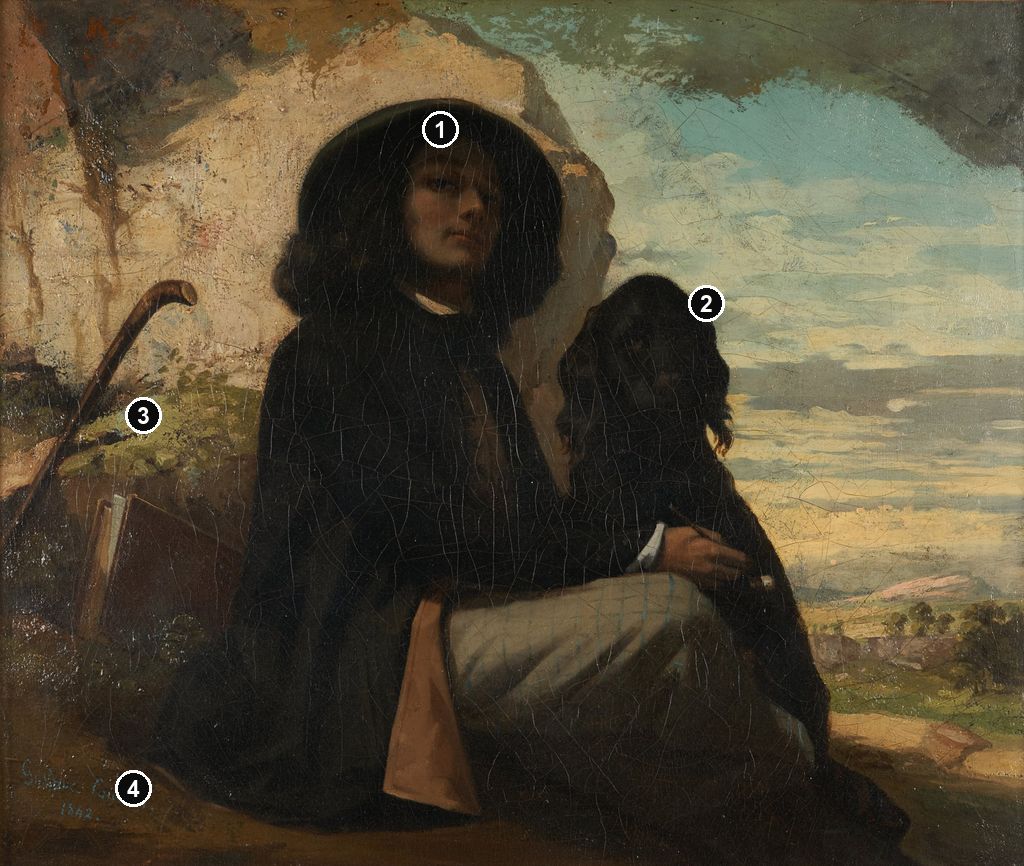
Details from SELF-PORTRAIT WITH A BLACK DOG
Compare the details with their position in the full painting.
The sitter’s gaze
The brim frames the face and leaves the eyes in shade. The low viewpoint makes the head stand out against the pale rock.
The dog and the hand
The dog’s dark head is legible against the sky. Follow its outline down towards the pale cuff and the hand that holds the pipe.
Walking stick and book
A curved stick leans beside a book or sketchbook. The objects help place the figure outdoors and suggest an outing.
The blue inscription
Blue lettering is visible near the lower left. The Petit Palais questions the inscribed date of 1842 and dates the painting between 1842 and 1844.
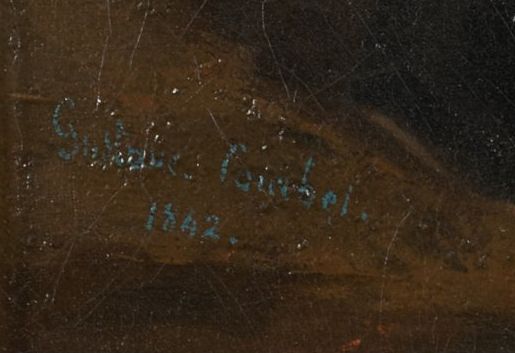
Image courtesy of Paris Musées / Petit Palais. The details are cropped from the museum image. Collection record · CC0
Courbet artworks directory
Browse the paintings covered in this guide. Dates identify the specific versions discussed.
Discussion
Look again at the images and ideas explored in Self-Portrait with a Black Dog. These editorial prompts invite your observations.
Reader Insights
How does the low viewpoint affect your sense of the sitter?
What do the dog and walking gear tell you about the role Courbet is presenting?
What evidence can establish when a signature and date were added?
Join the Conversation
Share a detail, comparison or question about Self-Portrait with a Black Dog below.
References
- Paris Musées, Petit Palais, Autoportrait dit Courbet au chien noir, object record and reproduction, inventory PPP731. View source.
- Petit Palais, Les donateurs de Courbet, Bibliothèque Dutuit, account of Juliette Courbet’s gifts. View source.
- Musée départemental Gustave Courbet, Devenir Courbet, teaching dossier, p. 6. View source.
- The Metropolitan Museum of Art, Gustave Courbet, 2008 retrospective, sections on self-portraits and landscape. View source.
- Robert Fernier, La vie et l’œuvre de Gustave Courbet. Catalogue raisonné, vol. 1, 1977, entry 27, digitised by the Wildenstein Plattner Institute. View source.
- French Ministry of Culture, Joconde, Pontarlier self-portrait with a dog, object record M0340000028. View source.
- Nationalmuseum, Stockholm, The Cellist (Self-portrait), object record NM 3105. View source.
- Musée d’Orsay, L’Homme blessé, object record RF 338. View source.
- Petit Palais, Exposition Gustave Courbet, May–June 1929, p. 17, no. 3. View source.
- Paris Musées, Petit Palais, Alexandre Toupey, Courbet au chien noir d’après lui-même, object record PPG2964. View source.
- Petit Palais, Les donateurs de Courbet, account of the gifts and the Courbet holdings. View source.
- Bruno Mottin, C2RMF, Gustave Courbet étudié et restauré au C2RMF, investigation of the self-portraits. View source.
- Musée d’Orsay, Le Désespéré, object record. View source.


