



 by Tom Gurney
Tom Gurney BSc (Hons) is an art history expert with over 20 years experience
Published on June 19, 2020 / Updated on October 14, 2023
Email: tomgurney1@gmail.com / Phone: +44 7429 011000
Gustave Courbet Prints and Reproductions: Introduction
The name Courbet appears just below an etched portrait of the writer Champfleury. Two words and another name tell you how to read it. The inscription credits Félix Bracquemond d’après Courbet, meaning that Bracquemond made the etching after a design by Courbet. Across the margin, a shorter inscription names the printer. The little portrait reached readers through several hands, each responsible for a different part of the finished image. Those few words under the picture are a good starting point for understanding what a print associated with Courbet actually is. [1]
Prints brought Courbet’s work within reach of people who could never stand before some of his canvases. The Musée Courbet’s exhibition on his engravers traced that circulation through illustrated books, periodicals and albums. It also drew attention to designs he supplied for books by friends. The museum considers it unlikely that Courbet practised etching himself. His involvement in a particular print might begin with a drawing made for publication or with a painting that someone else adapted years later. [2]
At a Glance
- Historical examplesEtchings, lithographs and wood engravings
- AttributionCheck the designer, printmaker, printer and publisher
Contents
- Pictures designed for books
- Bracquemond’s portrait of Champfleury
- Timothy Cole’s The Musician
- Courbet in the satirical press
- Reading the margin and choosing a reproduction
Pictures designed for books
One of the earliest examples is Mon rosier (My Rose Bush), a lithograph for Max Buchon’s Essais poétiques, published in 1839. The Musée Courbet holds a copy measuring 18.4 × 12 cm and identifies it as one of the vignettes for the collection. Courbet supplied images conceived for the poems. A small printed picture could give a reader a setting or a figure to hold in mind before reading the verse. Its scale belongs to the book and to the distance at which someone holds an open page. Lithography, which transfers a drawing from a prepared flat surface, gave publishers a way to carry that sort of work into multiple copies. [3] [4]
Almost thirty years later, Étienne Baudry’s Le Camp des bourgeois gave Courbet another reason to design for print. The title page of the 1868 Dentu edition credits Baudry with the text and Courbet with the illustrations. The Musée Courbet preserves Le vieux bourgeois (The Old Bourgeois), a small graphite drawing dated 1867, and identifies it as part of the group of designs for the book. The drawing and the printed volume supply different pieces of evidence. A reader of the book meets the images in a sequence framed by Baudry’s writing. A drawing from the project preserves Courbet’s work on paper before the image had to be made repeatable. The frontispiece, headed Lacédémone, shows a man in a dark jacket raising his eyes as he brings his hands together. The printed initials G. C. sit on his coat at lower right. At lower left is E. B. followed by sc., the abbreviation for the engraver’s role. The title page tells you who supplied the illustrations. The frontispiece shows how the book divided the credit for this particular image. [3] [4] [5] [6]
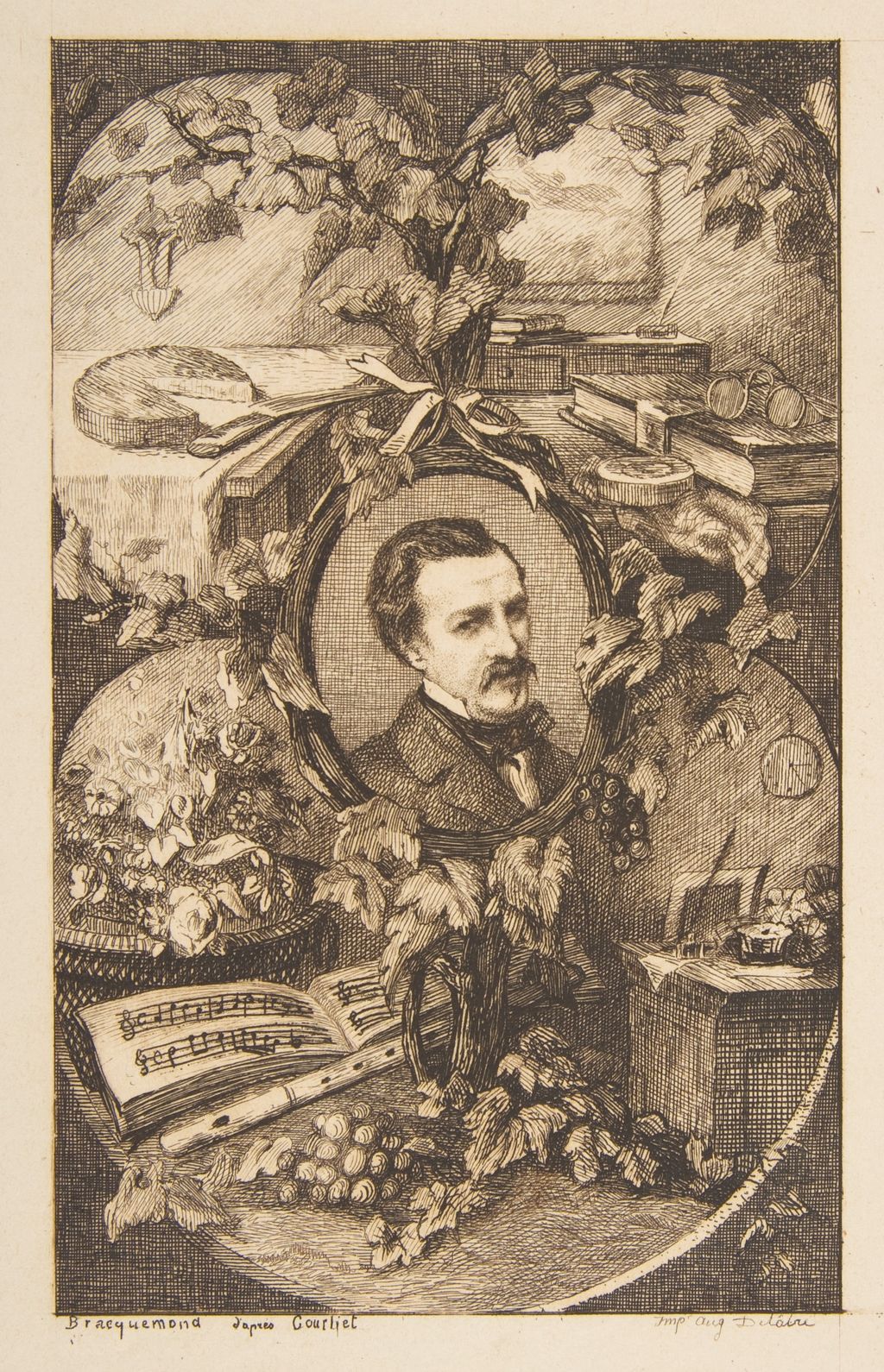
Félix Bracquemond after Gustave Courbet, portrait of Champfleury, frontispiece. The Metropolitan Museum of Art. Image source. CC0 / Public domain. Resized from the complete source image.
Bracquemond’s portrait of Champfleury
The Metropolitan Museum of Art’s impression of the frontispiece to Les Amis de la Nature is dated 1859. The image sets Champfleury’s head and shoulders in an oval surrounded by vine leaves, grapes and objects. An open book of music lies at lower left, and stacked books and spectacles appear above the portrait at right. The oval’s firm contour and the hatching around it keep the face legible amid the small, densely worked details. Bracquemond gets different effects from the same ink. Crossed lines deepen the corners, while the forehead and cheek stay comparatively open to the light of the paper. The sheet measures just 19.7 × 14.3 cm. At that size the objects invite a close look of the kind a reader can give a book held in the hand. [1]
The Met names Bracquemond as the printmaker, Courbet as the source of the design, Champfleury as the sitter, Auguste Delâtre as the printer and Auguste Poulet-Malassis as the publisher. The Musée Carnavalet records a separate impression, G.10726bis, with the same division between Bracquemond, Courbet and Delâtre. The Met calls its sheet, 22.1.27, the fourth state of four. A state describes a stage in the development of the printing plate. Several sheets can be pulled from the plate at the same stage, each an individual impression. An alteration such as additional lettering or a reworked passage can distinguish successive states. The fourth state can therefore include multiple impressions, each with the same changes to the design. [1] [4] [7]
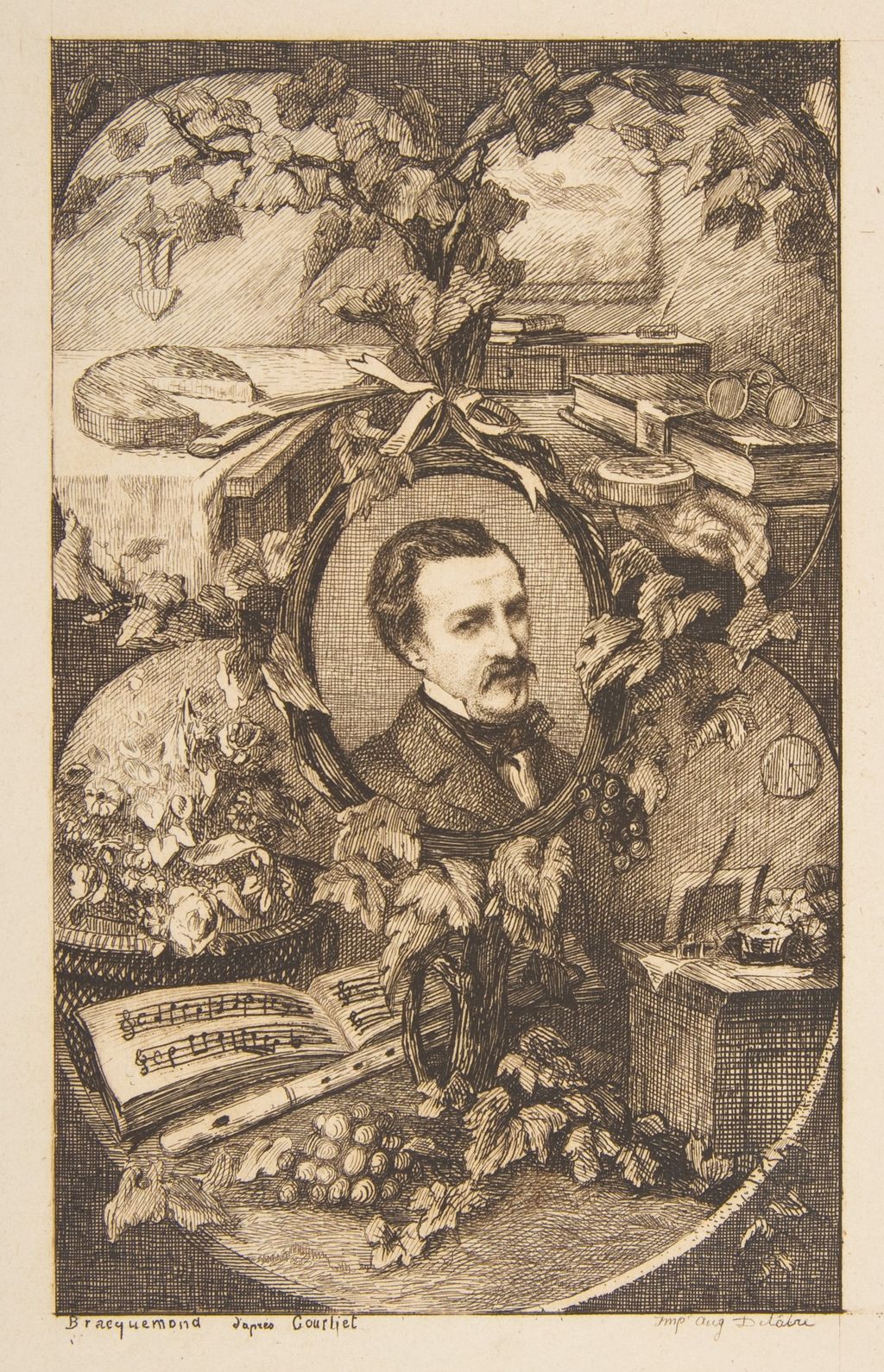
Frontispiece for Les Amis de la Nature, etched by Félix Bracquemond after Gustave Courbet The Metropolitan Museum of Art. Image source. CC0 / Public domain.
Timothy Cole’s The Musician
The February 1884 issue of The Century printed a full-page engraving titled The Musician. Its caption credits Timothy Cole and identifies the source painting as a Courbet then in Erwin Davis’s possession. Cole’s work dates from seven years after Courbet’s death. The Met catalogues its impression, 66.582.12, as a wood engraving with an image just 17 × 13.4 cm. The museum gives separate measurements for the larger sheet. That distinction matters when a copy has been cut close to the image, or when a digital photograph shows only what was printed. [1] [8] [9]
The magazine illustration makes the source composition recognisable. The cellist’s face emerges from a dark background. His eyes turn towards an open score on the right, a light rectangle tilted into the picture. The same score appears in the Portland Art Museum’s Violoncellist of 1847, 43.2.1. It distinguishes that composition from the related Cellist (Self-portrait) in Stockholm, where the area beyond the face remains dark. The period caption establishes whose painting Cole worked from at the time, and the published image identifies the version with the open music. [9] [10] [11] [12]
Wood engraving makes light by cutting away parts of the block so that the paper shows through. In Cole’s print, fine marks lighten the cellist’s face, sleeve and hands. The cuff catches the eye before the thin lines of the instrument lead it into shadow. The pages of the score register even at this small scale, helping the viewer follow the musician’s gaze. Cole had to decide which differences of colour and brightness in the oil painting to carry into black ink and where a few lines could do the work of a brushstroke. The engraving could then travel with an article about Courbet and reach readers far from the painting’s owner. [4] [9]
Courbet in the satirical press
The 10 May 1868 issue of Le Bouffon carried a Salon feature. On the masthead, the grinning jester sits between two ovals of subscription information. Above him, next to the date and issue number, is the price of fifteen centimes. The Met catalogues the item, 50.616.14, as a hand-coloured lithograph and credits Edward Ancourt as printer. Courbet appears among the painters whose work the Salon feature references, alongside Camille Corot, Édouard Manet and others. The newspaper’s format gives those names a different purpose from the credit on a single reproduction. It brings different artists together as material for one issue’s commentary on the exhibition. [13]
The satirical press could also make a joke of the artist himself. André Gill’s Caricature of Gustave Courbet, a colour lithograph from Le Salon Pour Rire in the same year, is catalogued at the Met as 64.693(1). Here Gill is the artist and Courbet is the sitter. The Institut Gustave Courbet describes how caricaturists made a recognisable public character out of the painter’s beard, pipe and provincial manners. The prints record something about his reputation even where the original occasion for a joke has become obscure. A catalogue search for his name can turn up both a print based on his work and a print in which he is the subject. [4] [14]
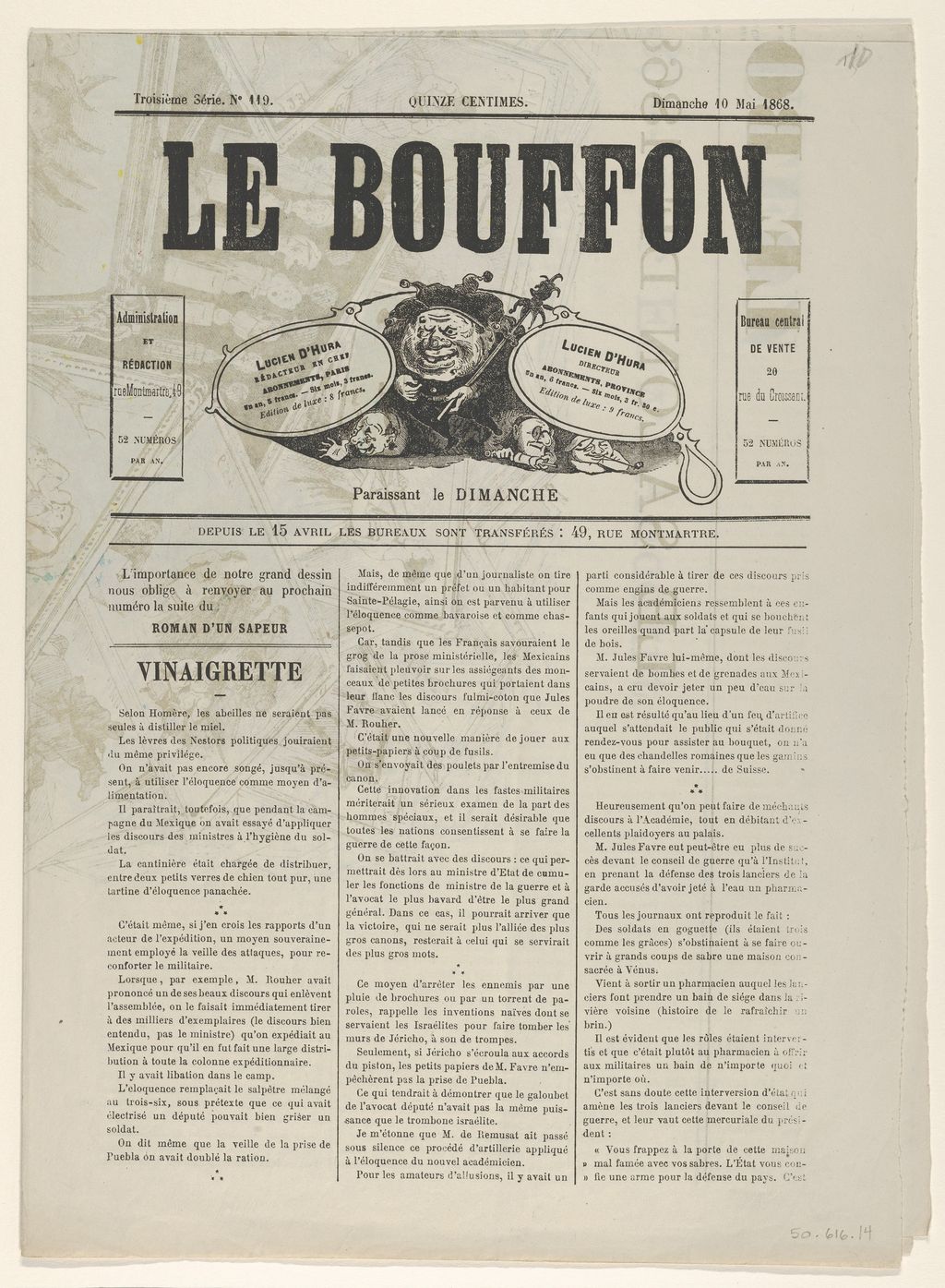
Le Bouffon, illustrated Salon satire, 10 May 1868. Paris Musées. Image source. CC0 / Public domain. Resized from the complete source image.
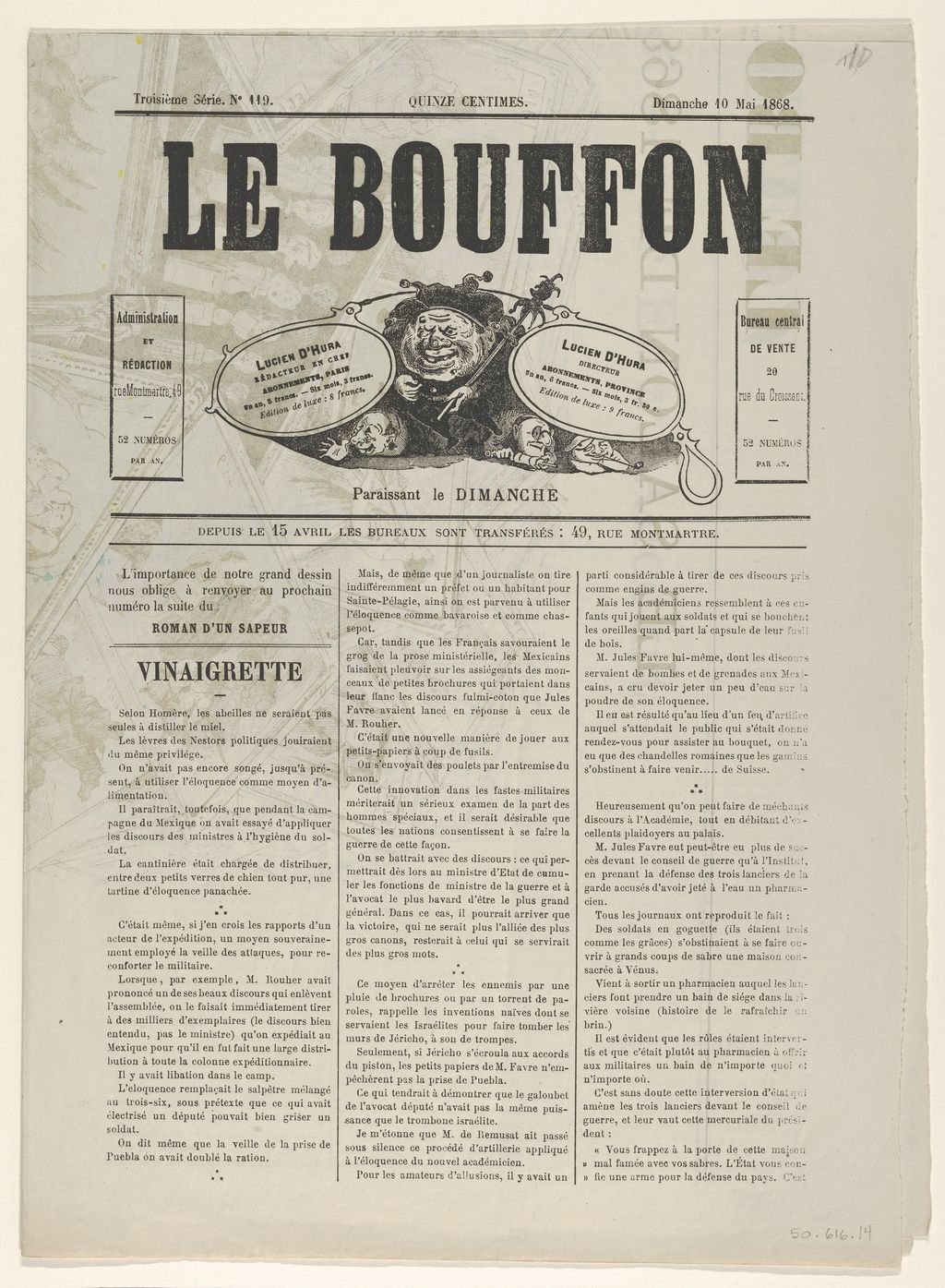
The front page of Le Bouffon, 10 May 1868 The Metropolitan Museum of Art. Image source. CC0 / Public domain.
Reading the margin and choosing a reproduction
A margin can help distinguish the people involved. Pinx. is short for pinxit, meaning that the named artist painted the source. Del. identifies a draughtsman, and sc. or sculpt. usually identifies the engraver. A publisher’s name or address may point to a particular issue. The wording and placement vary, so read the full inscription alongside the catalogue entry. In Bracquemond’s etching, the name Courbet forms part of the printed credit. A photograph or facsimile of that etching can reproduce the same lettering down to the last stroke. The inscription identifies a role in making the image. The date and method of production of the sheet are separate questions. [1] [4]
For a wall print of one of Courbet’s paintings, the useful starting details are the version of the painting, the size of the printed image and the amount of cropping. A modern colour reproduction can preserve the distribution of colour across a whole canvas, and an enlargement can make a small detail easier to see. If the subject has several painted versions, look for the collection name or a detail like the score beside the cellist. Even a clearly printed title may describe more than one composition.
For a historical impression, the printmaker, printing process and publication carry more weight. Compare the lettering, image measurements and, where documented, the state with a museum or library record. A date under an image may belong to the original painting, to the first publication of a print or to the printing of the particular sheet. A later reproduction of Cole’s engraving can preserve the magazine caption and lettering. The 1884 page gives those details their setting, right down to the blank space around the cellist and the line naming the owner of the canvas. [8] [9]
Courbet artworks directory
Browse the paintings covered in this guide. Dates identify the specific versions discussed.
Discussion
Look again at the images and ideas explored in Gustave Courbet Prints and Reproductions. These editorial prompts invite your observations.
Reader Insights
What information can the lettering beneath a print provide?
How do a historical print and a modern reproduction serve different readers?
Which details can identify two impressions of the same print?
Join the Conversation
Share a detail, comparison or question about Gustave Courbet Prints and Reproductions below.
References
- Metropolitan Museum of Art, Félix Bracquemond after Gustave Courbet, Frontispiece for Champfleury’s “Les Amis de la Nature”, 1859, 22.1.27. View source.
- Musée Courbet, Les graveurs de Courbet, exhibition overview. View source.
- Musée Courbet, Courbet dessinateur, la face cachée d’un talent, exhibition teaching dossier, entries for Mon rosier and Le vieux bourgeois. View source.
- Institut Gustave Courbet, Les graveurs de Courbet, sections on caricature and print techniques. View source.
- Bibliothèque nationale de France, Étienne Baudry, Le Camp des bourgeois, Paris, E. Dentu, 1868, FRBNF31775583. View source.
- Étienne Baudry, Le Camp des bourgeois, Paris, E. Dentu, 1868, digitised first edition, frontispiece and title page. View source.
- Musée Carnavalet, Paris Musées, Félix Bracquemond after Gustave Courbet, Frontispice pour Œuvres Nouvelles de Champfleury (IFF 124), 1859, G.10726bis. View source.
- Metropolitan Museum of Art, Timothy Cole after Gustave Courbet, The Musician, 1884, 66.582.12. View source.
- The Century Magazine, “Gustave Courbet, Artist and Communist,” vol. 27, no. 4, February 1884, The Musician, plate between pp. 488 and 490. View source.
- Portland Art Museum, European Art, collection documentation identifying Gustave Courbet’s Violoncellist, 1847, 43.2.1. View source.
- Portland Art Museum, collection photograph of The Violoncellist, 43.2.1. View source.
- Nationalmuseum, Gustave Courbet, The Cellist (Self-portrait), 1847, NM 3105. View source.
- Metropolitan Museum of Art, Le Bouffon – Le Salon de 1868, 10 May 1868, 50.616.14. View source.
- Metropolitan Museum of Art, André Gill, Caricature of Gustave Courbet, from “Le Salon Pour Rire”, 1868, 64.693(1). View source.


