



 by Tom Gurney
Tom Gurney BSc (Hons) is an art history expert with over 20 years experience
Published on June 19, 2020 / Updated on October 14, 2023
Email: tomgurney1@gmail.com / Phone: +44 7429 011000
After Dinner at Ornans: Introduction
A man in a pale coat has turned his chair towards a violinist. Seen from behind, he holds a pipe to his mouth while a dog sleeps at his feet. The violinist sits in shadow at the far right, where the light catches his face and the hands working the bow and strings. Around them, the table still carries the remains of a meal. Gustave Courbet painted this lull in After Dinner at Ornans, an oil on canvas measuring 195 × 257 centimetres, now in the Palais des Beaux-Arts de Lille (P 522). At more than two and a half metres wide, the canvas gives a quiet gathering the physical presence of a public ceremony. [1]
At a Glance
- Date1849
- MediumOil on canvas
- CollectionPalais des Beaux-Arts de Lille, P 522
Contents
- Who is at the table?
- How Courbet paints the sound of a violin
- A room big enough for the Salon
- What the X-rays and cleaning revealed
- Hearing the player through the people in the room
- From the table to the roadside
Who is at the table?
The catalogue of the Paris Salon that opened at the Palais des Tuileries on 15 June 1849 listed the painting as Une après-dînée à Ornans. Courbet described the occasion as a November visit to his friend Cuenot. Marlet had come back from hunting, and they had asked Promayet to play the violin for Courbet’s father. The note gives the picture the character of a recollection and tells us how Courbet wanted his audience to understand the scene. It leaves open how closely the finished canvas follows the arrangement of people and furniture on that particular visit. [1] [2]
The painting is generally dated to 1848–49. The French title refers to the time after the midday meal, which helps explain why the room can feel like an autumn afternoon even though the fireplace and dark clothes give it the closeness of an evening interior. The usual identifications put Courbet’s father, Régis, on the left, holding a glass with his head bowed. Urbain Cuenot, the host in Courbet’s account, sits farther back, supporting his head with his hand. Adolphe Marlet is the man seen from behind with the pipe, and Alphonse Promayet plays the violin. Their names give the small differences in posture the specificity of portraits. Régis’s bent head suggests drowsiness, while Cuenot’s face is turned towards the playing. [3]
The man whose face we see least is the one who brings us closest to the group. Marlet’s chair back rises squarely in front of us. His coat sweeps across its top, and his raised arm carries our attention towards the instrument. You can follow that movement without getting a clear view of his expression. The dog below him curls into the gap between the chairs. Its position makes the crowded lower half of the painting feel like space someone actually uses. Together the chair and dog make it easy to imagine how someone would have to move to get to the table.
How Courbet paints the sound of a violin
Promayet occupies a comparatively narrow strip near the edge of the canvas. The broken highlights on his forehead, fingers and instrument bring his playing into focus in stages. Courbet gives the instrument enough sheen to distinguish wood from the dark sleeve behind it. The fingers gathered on the neck and the raised bowing hand show the musician at work. A glance at the scene catches the broad patch of Marlet’s coat first, but lingering in front of it brings the eye round to Promayet. The strongest light and the source of the action are in different places.
The listeners supply much of the music’s effect. Cuenot’s elbow stays planted on the table and his head settles into his hand. Marlet has turned towards the violinist while keeping his own small occupation. Régis sits with his crossed legs and lowered face, his attention harder to read. Courbet allows the men to share a room without giving them a single response. Each seems to have been sitting there long enough to find his own way of being comfortable. The time of the painting feels closer to the length of a tune than the instant of a dramatic entrance.
Look down from Cuenot’s face and the tablecloth picks up the light again. Its long fold at the near corner marks where the tabletop ends and shadow takes over. The food left on the table, the glasses and the mark identified as spilled wine make the cloth look used. The bright surface also gives the picture a measure of depth. Cuenot’s dark figure rises behind it, while the upright back of Marlet’s chair interrupts it in the foreground. Above the company, a broad expanse of wall and the dim outline of the fireplace leave room for the eye to adjust. As those details emerge, the enclosure feels larger than the patch of light around the table. [3]
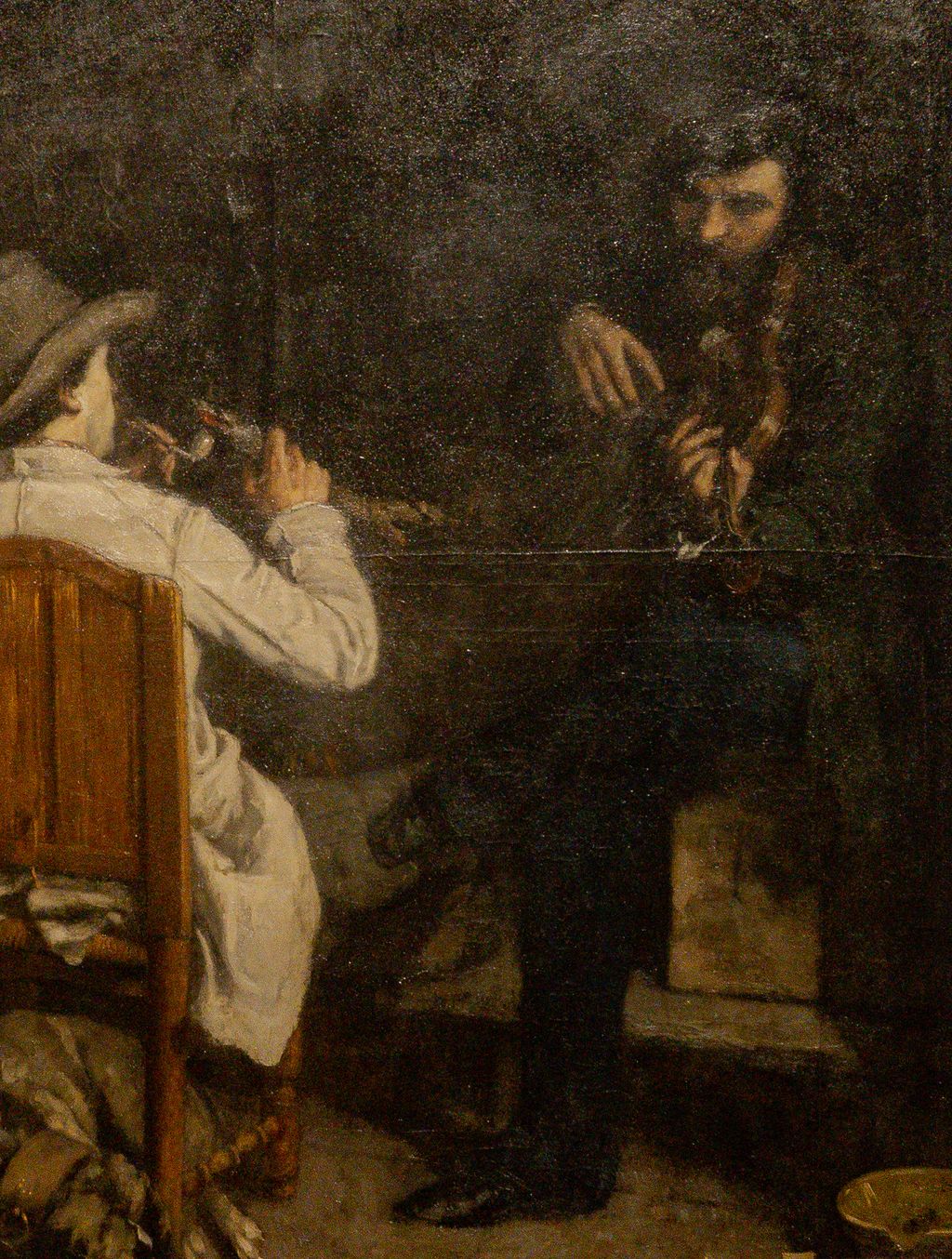
Detail of Gustave Courbet, After Dinner at Ornans. Palais des Beaux-Arts de Lille. Historical source reproduction, before the recent restoration. Shown here, violinist and listeners in the source reproduction. Image source. Public domain. Cropped and resized from the source image.
A room big enough for the Salon
Painters had long set musicians and drinkers around tables. The Louvre’s Peasant Meal of 1642, attributed to Louis Le Nain with possible participation by his brother Antoine, offers a particularly close comparison. At 122 centimetres across, it is less than half the width of Courbet’s canvas. It also brings a group, a white cloth and a musician into a subdued interior. In the earlier painting, the seated figures who look out meet the spectator across the table. At Ornans, the company’s attention stays within the room. The comparison shows how differently two painters can place a viewer in relation to an ordinary meal. The Louvre traces the Le Nain painting’s first public exhibition to 1860. The resemblance tells us how Courbet worked with the possibilities of an older type of painting, while the history of this particular canvas leaves the question of direct influence open. [4]
At the Salon, the scale of the Lille picture was itself a point of argument. Large canvases were associated with history painting, which traditionally drew on subjects such as scripture, mythology or consequential public events. Reviewing the Salon in the Revue des Deux Mondes, F. de Lagenevais acknowledged the painter’s accuracy and complained that a kitchen interior lost its charm when given the dimensions of life. He preferred the way a small Flemish picture distanced and softened such a scene and contrasted Courbet’s canvas with Ernest Meissonier’s small painting of a smoker. His review pinpoints a consequence of Courbet’s choice. The viewer has to reckon with the bulk of a man in an overcoat and the space taken up by his chair before taking in the anecdote. [5]
The Salon awarded Courbet a second-class medal, and the French state bought the painting and deposited it with the museum in Lille. The medal brought exemption from submitting work to the Salon jury in subsequent years. That practical advantage mattered when Courbet returned to the everyday life of the region on a still larger scale. In A Burial at Ornans, shown at the Salon of 1850–51, a crowd stretches across the open air, its attention loosely gathered around a grave. Here four men and a dog occupy the space bounded by the table and the hearth. The two paintings ask different things of the viewer’s attention, even as both give the activities of Ornans the scale of history painting. [6] [7]
What the X-rays and cleaning revealed
The canvas began as seven pieces of cloth that Courbet sewed together. X-rays taken by the Centre de recherche et de restauration des musées de France (C2RMF) reveal revisions beneath the surface. The seated man identified as Régis underwent the most extensive changes. Courbet also moved the dog, changed the position of Promayet’s arm and reworked the fireplace. These are revisions to the elements that make the scene feel unforced. The placement of the dog and the lift of the bowing arm emerged through decisions made on the canvas. [8]
The picture’s darkening was already a concern in 1878, when the critic Paul Mantz described a grainy surface like sand scattered over wet paint. The C2RMF identifies the texture as an irreversible alteration associated with litharge, a lead compound. A separate problem arose around the end of the First World War. The painting came back from Brussels around 1919 with a tear, probably sustained in transport. Léon Govaert and Gaston Chauffrey treated the paint and repaired the canvas in 1920. Under ultraviolet light, a second varnish suggested another intervention between 1920 and 1972, for which the C2RMF found no documentation. The painting reached the Laboratoire des musées de France in 1973 and returned for study and treatment in 2023–24. [8]
The recent team used nanogels to control cleaning on the potentially sensitive paint surface. They found extensive later repainting and tinted coatings, which probably helped mask wear and soften the appearance of the grain. Removing them made the violinist’s midnight-blue trousers legible where they had previously appeared black. It also brought out the grey and orange tones of the wall and gave the white cloth a clearer edge against the rest of the room. The team limited new retouching. The team also reinforced the seams and the edges where the canvas is held under tension. It fitted a new stretcher, the structure carrying the canvas behind the picture, for finer adjustment of tension and cushioned the original canvas with padding. [8] [9]
The trousers are a good place to start when looking at the restored painting. Their blue gives the seated violinist more weight below the table line, where his figure can otherwise merge with the dark of the room. Once the eye finds the leg, the small bright marks around the bow and fingers belong to a body seated on the same floor as Marlet and the dog. Much of the painting’s quiet depends on those relations in the shadows. The light on the table sets the company before us at once, and the time it takes for the rest of the room to come into view lets the playing go on.
Hearing the player through the people in the room
Courbet had already made a picture of a musician in The Cellist, the self-portrait now in Stockholm. The bow and the instrument occupy the foreground there, where the viewer can relate the action of both hands to the turn of the player’s face. The vertical canvas keeps the attention of the figure and the attention of the viewer close together. In the Lille picture, the musician has to compete with the pale cloth and the near chair for our first look. The listener facing him from the foreground gives the eye a route through those distractions. The violin becomes easier to find once we see where the man in the chair has turned. [1] [10]
The presence of several listeners also gives the painting more ways to represent time. One man holds himself ready to see the player, another supports his head and the dog sleeps under the chair. Look at the distances between the heads. The violinist is at the end of a succession of intervals, some marked by a figure or chair and others by shadow. There is no equivalent interval between a performer and an audience in the Stockholm picture. Here the effect of the music spreads across a room people have inhabited for longer than it takes to play a phrase. [1] [3] [10]
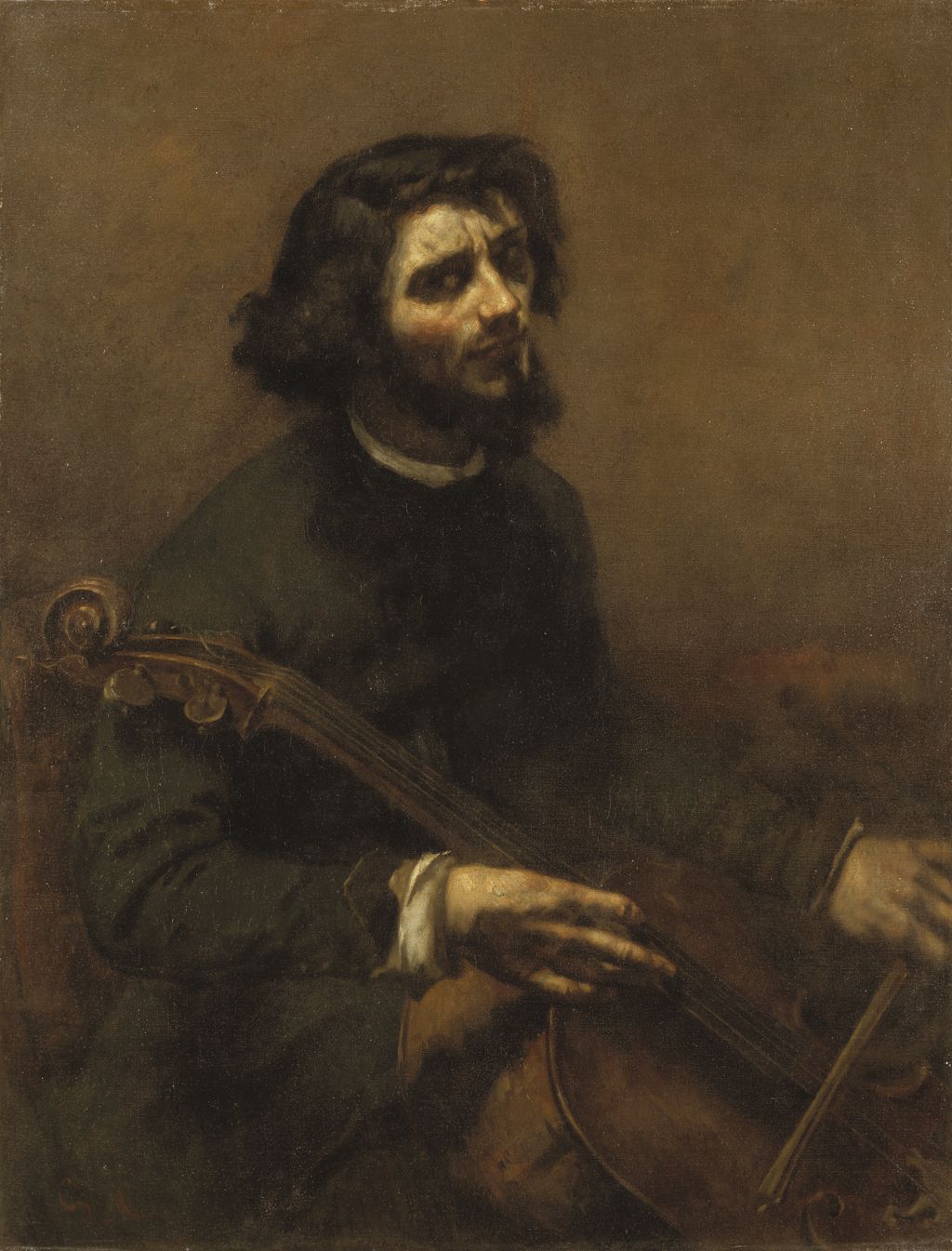
The Cellist, Nationalmuseum NM 3105. Nationalmuseum, Stockholm. Image source. Public domain. Resized from the complete source image.
From the table to the roadside
In November 1849, writing to Francis and Marie Wey about The Stone Breakers, Courbet used After Dinner at Ornans to convey the size of the new painting and relayed a comparison his studio visitors made between them. The Lille canvas could serve as a measure because it was already a work for which he was known. Its medal and acquisition gave the private-looking room a public history that a correspondent could place. The comparison also shows how quickly Courbet moved from giving this width to a group at ease to giving it to two people who could scarcely stop. [6] [11]
The pot at the edge of the Dresden picture makes that difference visible. A meal is the occasion for the Lille gathering, and its remnants remain at the centre of the painting long after eating has finished. The roadside pot sits away from the main action. It allows a viewer to imagine the workers pausing, while every prominent gesture belongs to a task still going on. Similar widths leave room for radically different proportions of work and rest. The family and friends gathered indoors had occupations of their own, yet Courbet chose to paint a point in the day when the room could be given over to listening. [1] [11] [12]
Courbet artworks directory
Browse the paintings covered in this guide. Dates identify the specific versions discussed.
Discussion
Look again at the images and ideas explored in After Dinner at Ornans. These editorial prompts invite your observations.
Reader Insights
How does Courbet direct your attention to the violinist?
What does the white cloth contribute to the dim interior?
Why might a near life-size scene of an ordinary room have surprised a Salon audience?
Join the Conversation
Share a detail, comparison or question about After Dinner at Ornans below.
References
- Palais des Beaux-Arts de Lille, Un après-dîner à Ornans, collection record P 522 View source.
- Musée d’Orsay, Base Salons, Une après-dînée à Ornans, 1849 Salon catalogue entry View source.
- Françoise Besson, L’Après-dîner à Ornans, GrandPalaisRmn, Panorama de l’art, 2013 View source.
- Musée du Louvre, Repas de paysans, collection record MI 1088 View source.
- F. de Lagenevais, “Le Salon de 1849,” Revue des Deux Mondes, 1849, pp. 559–593 View source.
- Palais des Beaux-Arts de Lille, L’Après-dîner à Ornans, painting dossier View source.
- Musée d’Orsay, Un enterrement à Ornans, collection record View source.
- Centre de recherche et de restauration des musées de France, Restauration : L’Après-dînée à Ornans de Gustave Courbet View source.
- Centre de recherche et de restauration des musées de France, Rapport d’activités 2024, pp. 36–37 View source.
- Nationalmuseum, Stockholm, The Cellist (Self-portrait), object record and reproduction, NM 3105. View source.
- Gustave Courbet, letter to Francis and Marie Wey, 26 November 1849, no. 49-8 in Petra ten-Doesschate Chu, ed., Letters of Gustave Courbet, pp. 87–90. View source.
- Gemäldegalerie Dresden, Album der Dresdner Galerie, 1920, plate 3, Die Steinklopfer. View source.


