



 by Tom Gurney
Tom Gurney BSc (Hons) is an art history expert with over 20 years experience
Published on June 19, 2020 / Updated on October 14, 2023
Email: tomgurney1@gmail.com / Phone: +44 7429 011000
Paintings: Introduction
In A Burial at Ornans, Gustave Courbet makes a funeral nearly seven metres wide. At the source of the Loue, he brings the dark mouth of a cave so close that it takes up much of the picture. In The Calm Sea, a great expanse of sky reduces two fishing boats to small marks on the shore. All three are oils on canvas. Each asks for a different kind of attention. The funeral makes you scan a line of faces. The cave draws your eye into shadow and then out along the moving water. On the coast the eye can travel almost the whole width of the painting along the horizon. [1] [2] [3]
Courbet is best known for painting ordinary people on the scale of historical heroes. That change in scale was one part of his Realism. He also used the size of a figure within a painting, the distance between bodies and the texture of paint to direct attention. These choices help explain how a painter associated with rural labour could also make a fashionable portrait, a private double nude and a lavish bouquet. [4]
At a Glance
- ArtistGustave Courbet
- Main mediumOil on canvas
Contents
- Self-portraits and encounters
- Village gatherings and the scale of the Salon
- Figure painting in public and in private
- Inland landscapes, from the Loue to Lake Geneva
- Calm and storm on the coast
- Animals in shelter, pursuit and distress
- Flowers and still life
- What conservation can add to a paintings catalogue
Self-portraits and encounters
In the Petit Palais’s Self-Portrait with a Black Dog, shown at the 1844 Salon, Courbet turns to look out from a rocky seat. The black spaniel settles beside him in the foreground. There is room for the figure to settle into his surroundings and for the eye to continue past him into the landscape. In The Desperate Man, the face comes right up to the picture plane. The hands grip the hair, the elbows press out toward the edges and the wide eyes meet ours. Set the two portraits side by side and the change in distance does as much as the expressions to set their emotional temperature. [4] [5] [6]
The Wounded Man adds another kind of change. The closed eyes, white shirt and patch of blood make the figure look as though he has collapsed against the tree. Technical examination reported by the Centre de recherche et de restauration des musées de France found two earlier compositions beneath the visible paint. One showed Courbet with a woman. He kept his own figure when he reworked the scene and turned a shared pose into a solitary one. It is the most literal instance of a change of role among these self-portraits. [7]
The distance between people matters just as much in The Meeting. Courbet approaches the collector Alfred Bruyas and his companion on a road near Montpellier. The painter carries his equipment on his back and holds his hat away from his body. The space between the men gives each greeting room to register. Courbet sets his travelling figure against the open country and gives him as much presence as the man who collected his work. Bruyas’s collection took in both this carefully staged encounter and the much smaller Seaside at Palavas. Together they show the range a single relationship with a patron could sustain. [8]
Portraits could also offer a view of someone absorbed in a private gesture. In Jo, the Beautiful Irishwoman, Joanna Hiffernan holds a mirror and lifts her hair. The mirror turns her attention inward while the hair spreads across the foreground, where we can follow its colour and movement. Four related paintings are known. The Nationalmuseum in Stockholm holds the signed 1866 version, while the Met, the Nelson-Atkins Museum of Art and a private collection hold the other three. The Stockholm museum has described its canvas as the original, and the Nelson-Atkins catalogue favours the Met version as the first. Compare the pictures by collection and date so the disagreement stays attached to the right objects. [9] [10]
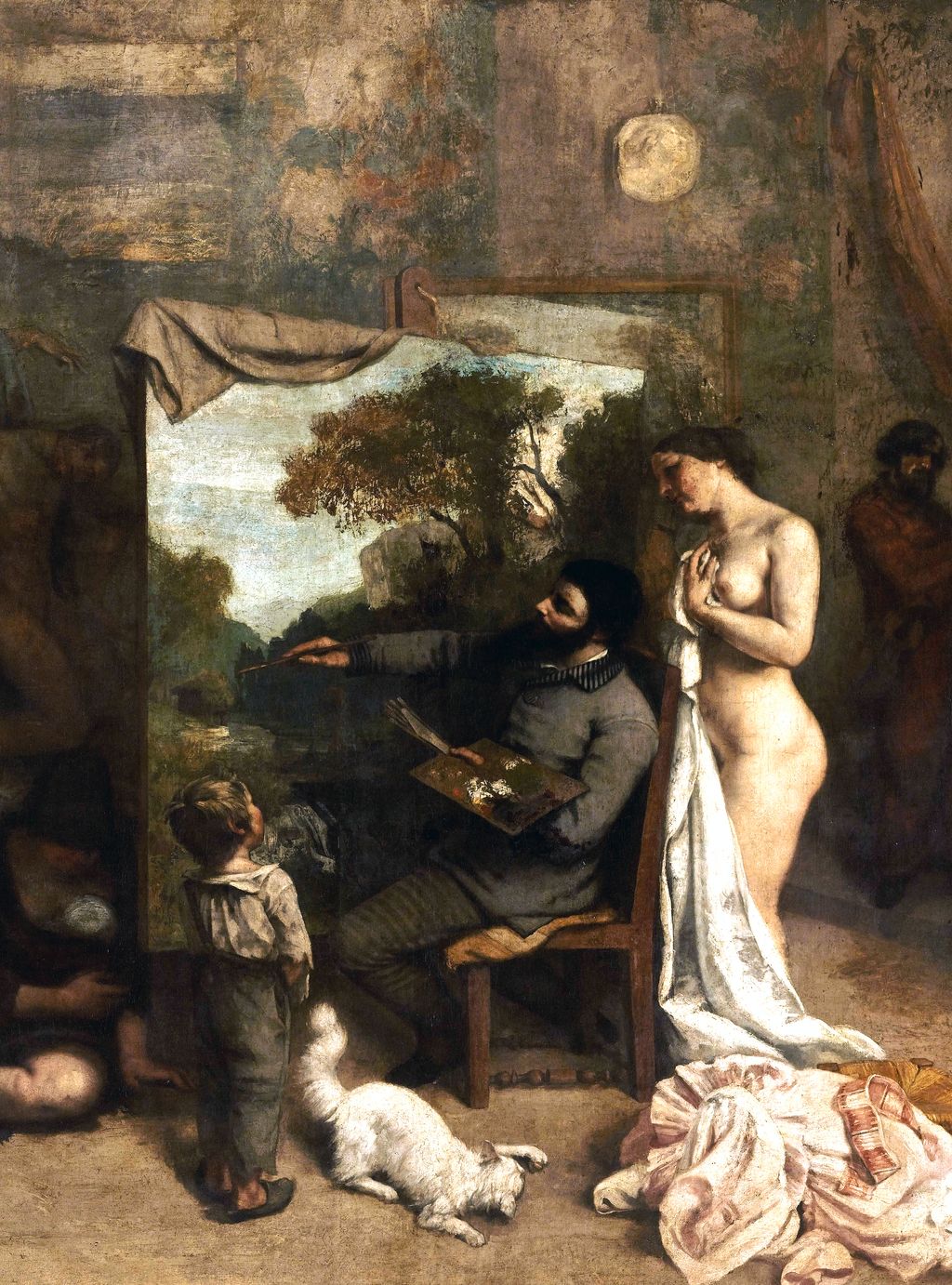
Detail of The Painter’s Studio, Musée d’Orsay RF 2257. Shown here, painter, model and easel. Image source. Public domain. Cropped and resized from the source image.
Village gatherings and the scale of the Salon
At After Dinner at Ornans, a small group remains around a table as one of the men plays the violin. The table collects the figures around it and the music supplies a reason for the others to sit still. The painting won a medal at the 1849 Salon. For the 1850–51 Salon Courbet expanded that attention to familiar activities into a much larger public setting. In A Burial at Ornans, the mourners stretch sideways across a canvas 6.68 metres wide. Low cliffs carry the eye along the row of heads. The cross rises above them, and the open grave at the front interrupts the sweep of the group. You can take in the gathering from across a room, then move nearer to see how individual faces turn towards or away from the rite. [1] [11]
Courbet’s long title called the funeral a history painting. The claim becomes clearer at the scale of the canvas. In the hierarchy familiar to the Salon audience, figures of this size typically belonged to biblical, mythological or other grand narratives. Courbet gives that physical presence to people attending a burial in his home town. The Stone Breakers, shown at the same Salon, focused on two men doing road work. The Dresden painting is lost. [12] Surviving reproductions let us compare how the men stoop or kneel, with their faces largely withheld, but the original paint surface and colour are beyond inspection. The funeral and the road work show two different uses of scale. One makes room for the variety of a community, and the other concentrates attention on the demands of a task. [1] [4]
Two other rural pictures direct the eye through the work itself. The Peasants of Flagey Returning from the Fair distributes riders and livestock along a route, so that the activity extends beyond any single person. The Wheat Sifters brings the action indoors and close. The red dress of the kneeling figure gives the composition a centre, while the circle of the sieve and the spread of her arms make the action readable even at a distance. In the fair painting we follow people and animals through a place. In the wheat painting we can compare the postures and tools that divide a job among three figures. [13] [14]
In the Met’s Young Ladies of the Village, Courbet sets the distance between people through a small exchange. Three women stand together and one reaches towards a young cowherd. Their clothes and the interval between them mark a difference in station that the offered gift briefly crosses. Courbet used his sisters for the three women, and the valley is near Ornans. Here landscape gives a social gesture room to register, just as the road does in The Meeting. [15]
In The Painter’s Studio, Courbet makes a broad gathering serve a different purpose. He places himself at the centre, painting a landscape while a child and a nude model stand nearby. Figures on either side extend the scene beyond the act at the easel. Courbet described the work as a real allegory, a title that suits the curious company assembled around a recognisable act of work. He showed the painting in his independent Pavilion of Realism in 1855. Seen alongside the funeral, the studio helps explain how Courbet could turn the breadth of a public picture from a collective portrait of a town to a statement about his own work. [4] [16]
Figure painting in public and in private
Woman with a Parrot appeared at the Salon of 1866. The figure reclines across the canvas, with her arm lifted towards the bird. Follow the gesture back down to the bed and you find a face tilted up and hair winding across the sheets. The Salon audience knew the reclining nude as an established format. Some critics took exception to precisely the details that animate this one, including the pose and the loose hair. The Met holds both Courbet’s canvas and a separate painting by Édouard Manet with the same title. Courbet’s reclining figure and lifted arm make a quick point of identification. [17]
The Petit Palais’s The Sleepers is also from 1866 and roughly two metres wide. The two women turn into one another in a bed that fills much of the picture. Folded drapery and objects near the edge of the bed frame the figures, whose bent arms and overlapping bodies make a shared shape. The diplomat Khalil-Bey commissioned the painting for his private collection. Its size is comparable to the Salon canvas, though the arrangement and the conditions of viewing are quite different. The parrot draws a gesture up and out into the room. In The Sleepers, the gestures fold back towards the centre. [17] [18]
Courbet brings the viewer closer still in The Origin of the World. The crop excludes the face and much of the limbs, leaving the body and surrounding fabric to fill a far smaller canvas. The three paintings are useful to compare because their viewing distance, pose and framing change so markedly within the same year. The separate guide to Courbet’s nudes follows those choices across the works shown at the Salon and those made or circulated in private. [17] [18] [19]
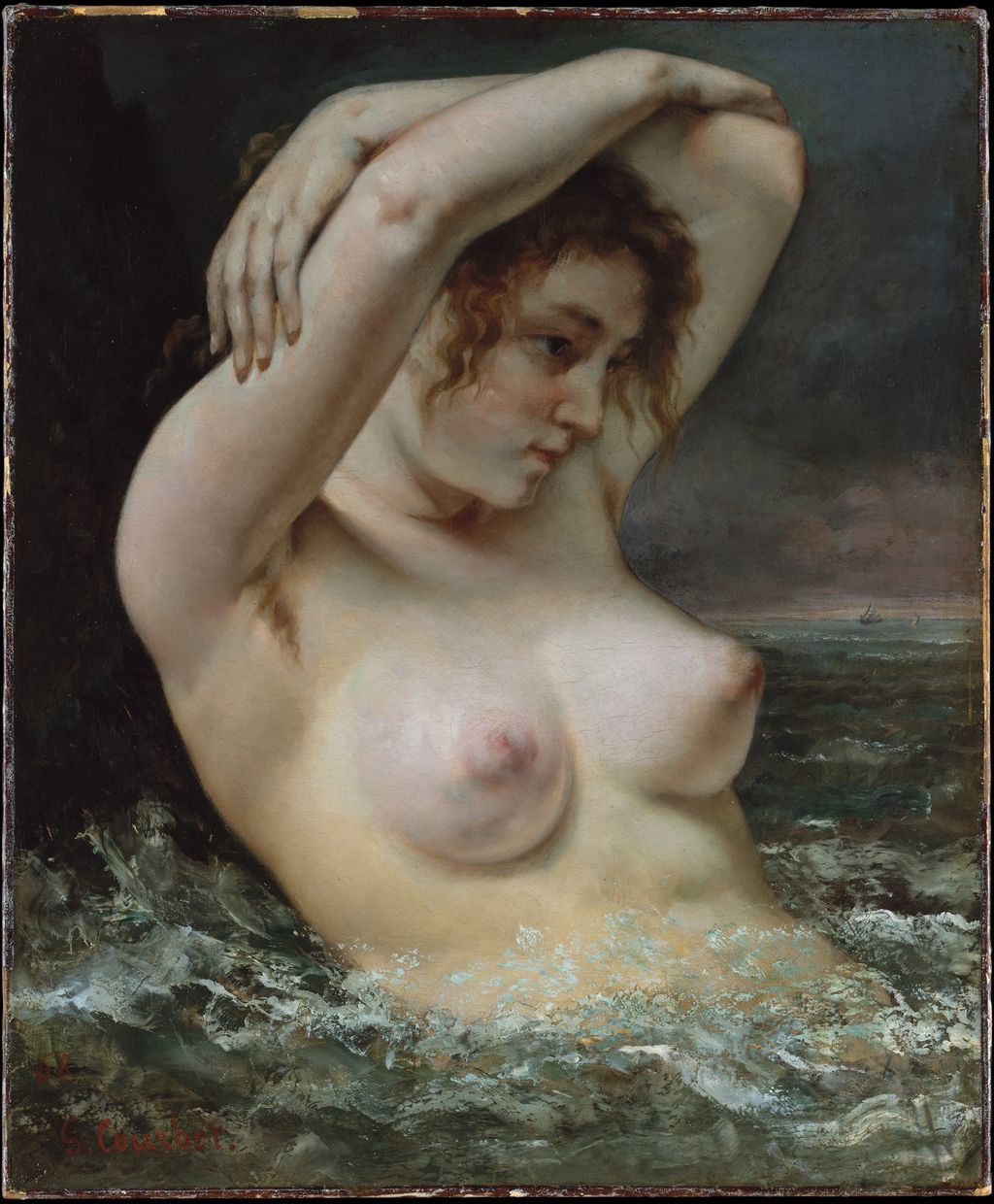
The Woman in the Waves by Gustave Courbet, The Metropolitan Museum of Art Image source. CC0 / Public domain.
Inland landscapes, from the Loue to Lake Geneva
At The Source of the Loue, the cliff face runs into the top of the Met’s 1864 canvas. The dark opening dominates the view, and low in the picture pale water works its way out from beneath the rock. Buildings at the left give a sense of scale and mark the presence of waterworks beside the spring. Look at the short, broken lights on the water beside the broader patches of colour on the rock. The Met points to Courbet’s use of the palette knife in both places. It gives the rock a rough surface, while the smaller interruptions of light help the water appear to move over the uneven ground. The difference in scale and spacing is a good place to start looking at Courbet’s technique. [2]
Courbet told his dealer Luquet in 1864 that he had painted four landscapes at the source. The Met describes its canvas as probably one of those four. Another Loue picture may give more or less room to the opening, the water or the structures alongside it, so it helps to start with the museum and title when comparing views. The Met landscape is numbered 29.100.122. In The Oak of Flagey, also dated 1864, the subject fills the canvas in a different way. The trunk rises from open ground and sends out branches that carry the mass of foliage outwards. The cave draws the eye towards an opening, while the tree invites it to follow the limbs back to a single point of support. Both paintings give a feature of Franche-Comté the concentrated attention of a portrait. [2] [20]
In the 1874 Château de Chillon, the castle sits amid horizontal stretches of shore and water. Its walls and towers make a distinct profile, repeated in a softer reflection. Farther back, snowy peaks mark the depth of the view. The Musée Courbet connects this composition with a photograph marketed by Maison Braun. Courbet painted the castle repeatedly during his Swiss exile. This particular picture, D1976.1.3, is a deposit from the town of Ornans at the Musée Courbet. It offers a clear comparison with the Loue. In one landscape the rock face crowds the viewer’s field of vision, while in the other, water opens a long interval between the viewer and the land. [21] [22]
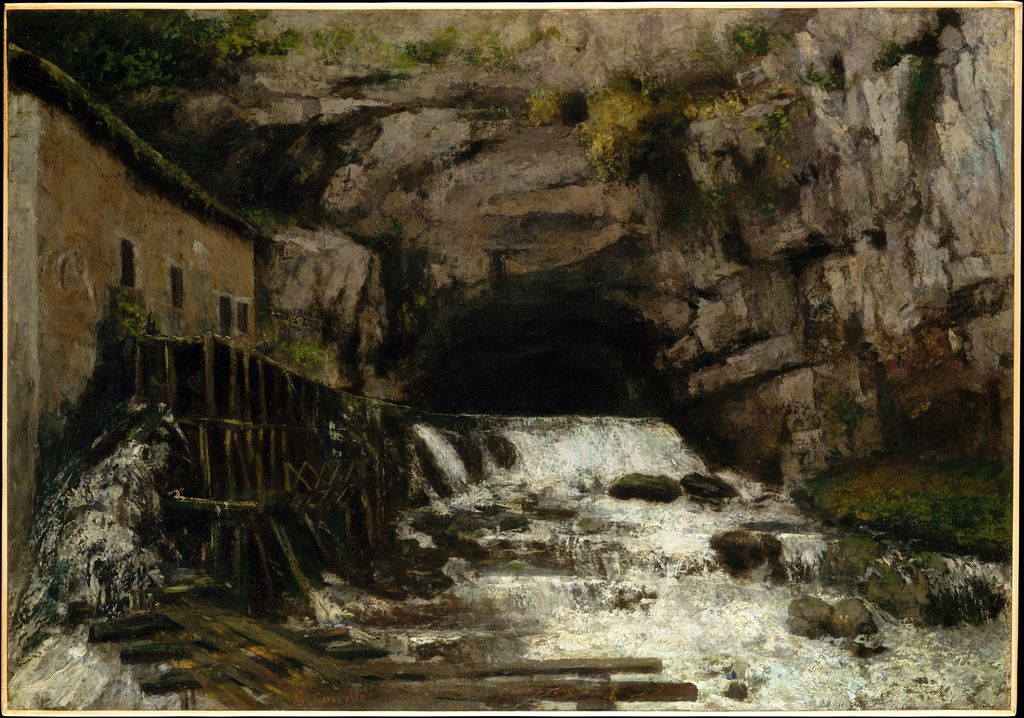
The Source of the Loue by Gustave Courbet, The Metropolitan Museum of Art Image source. CC0 / Public domain.
Calm and storm on the coast
A small figure lifts his hat towards the sea in The Seaside at Palavas, painted in 1854 and given to the Musée Fabre by Bruyas. The figure’s upright stance breaks up the wide, low divisions of beach, water and sky. On a canvas only about 46 centimetres wide, he makes the emptiness around him seem immense. The Musée d’Orsay’s Mer calme à Palavas is a separate, larger canvas dated 1857. Its record gives the identifier MNR 880 and states that it was recovered after the Second World War and entrusted to the French national museums. The place name connects two pictures with different compositions and histories. [23] [24]
In the Met’s 1869 Calm Sea, two small boats rest at low tide on the Normandy coast. The thin stretch of water beyond them and the high sky make their stillness especially apparent. The National Gallery of Art in Washington has another Courbet titled Calm Sea, dated 1866. The dates and collections distinguish the paintings more reliably than the English title. For a contrast with the Met canvas, compare The Wave, the Musée d’Orsay’s La Mer orageuse. A dark green swell rises across the middle, pressing between a strip of shore and a low sky. Where the beach in The Calm Sea gives the eye a long horizontal rest, the crest in The Wave breaks into irregular touches of white. [3] [25] [26]
The 1870 Salon paired La Mer orageuse with Cliffs at Étretat after the Storm. In the cliff picture the arch and headland give the eye something solid to follow out towards the water. The foreground stones break up the shore, while pale faces of chalk catch the returning light. Orsay describes the use of thick paint applied with a knife in the storm canvas. A comparison makes clear what matters about those marks. The broken white across the wave follows a form that is about to collapse, while the marks across the cliff painting convey stable surfaces of very different sizes, from pebbles to an entire headland. The Salon cliff canvas, MNR 561, is in the custody of the Musée d’Orsay as a recovered work. Courbet also used the cliffs as a setting in the Met’s Marine: The Waterspout, a separate canvas dated 1870. [26] [27] [28]
Courbet could also change the setting around a breaking wave. The Musée des Beaux-Arts de Lyon’s La Vague (B 295) crops tightly to the water, while Waves in Tokyo (P.1959-0062) sets the surf against large foreground rocks. The Lyon museum identifies brushwork as well as passages made with a knife. At Orsay the two boats on the shore make a third arrangement, offering a familiar measure of size against the swelling sea. [26] [29] [30]
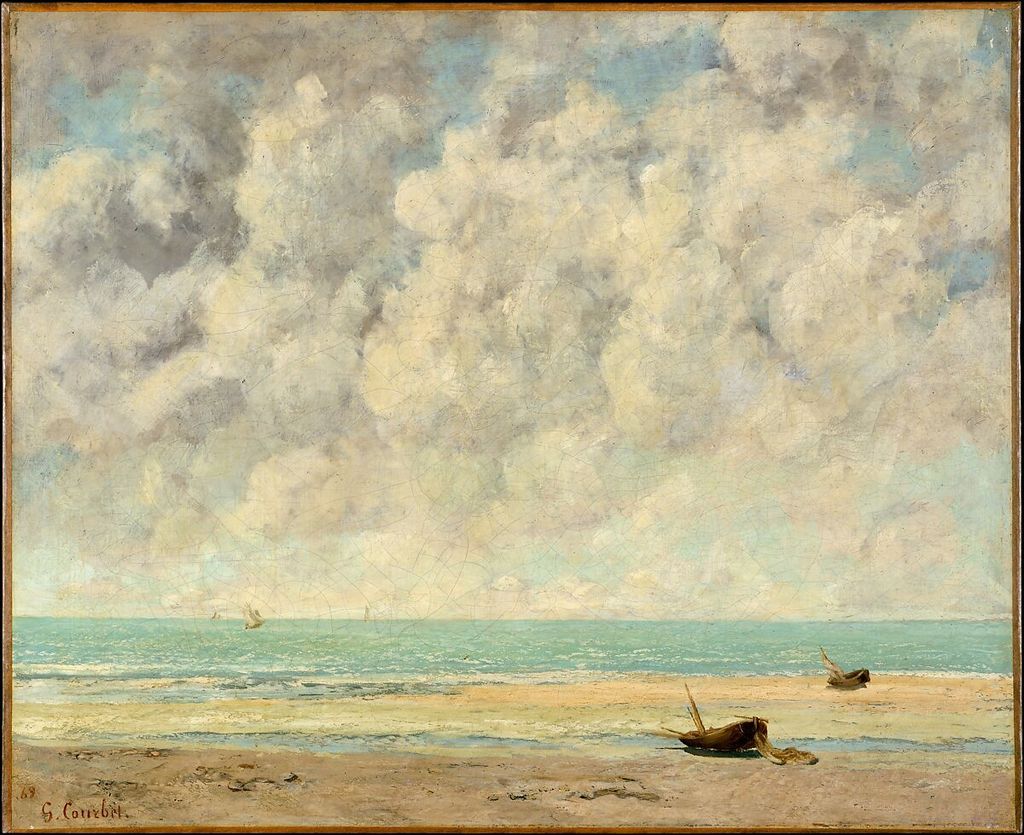
The Calm Sea, Met 29.100.566, 1869. Image source. CC0 / Public domain. Resized from the complete source image.
Animals in shelter, pursuit and distress
In Roe Deer at the Stream of Plaisir-Fontaine, small changes of tone bring the animals out of the sheltering landscape. The dark terrain and the water help locate them before individual bodies become clear. In The Death of the Stag, the snow makes the movement of the dogs and the outline of the stag easier to pick out at once. At over five metres wide, the hunt has a physical scale comparable to the large figure pictures. The canvas is in Besançon on deposit from the Musée d’Orsay. The deer paintings give the viewer two distinct relationships to an animal in a landscape. In one, our eyes have to adjust to where the deer are standing. In the other, the chase drives our attention straight to a cornered body. [31] [32]
Fox Caught in a Trap makes that concentration more intimate. In the Tokyo canvas of 1860, the animal twists against the trap, and the low viewpoint keeps the fox close to the ground and to the viewer. The National Museum of Western Art identifies it as P.1959-0061. The Musée Courbet in Ornans holds a separate fox painting. [20] The Tokyo work is a useful third point of comparison in Courbet’s hunting and animal paintings. Shelter, pursuit and entrapment each give the body a different range of possible movement, and that range shapes how much of the surrounding landscape the viewer needs to see. [31] [32] [33]
Flowers and still life
The Getty’s Bouquet of Flowers in a Vase gathers pale lilies, roses and other blooms over a vessel that takes up relatively little of the tall canvas. Some flowers project clearly against the dark background, while others crowd into the mass. The Getty notes that Courbet combined plants that flower at different times. The resulting abundance has something in common with Dutch flower pictures, although the broad brushwork and passages of thick paint give the Getty bouquet a different surface from the finely worked Dutch examples. The picture belongs to a group Courbet developed in western France in 1862, where Étienne Baudry’s gardens and greenhouses gave him access to a wide range of plants. The Getty also records Courbet’s satisfaction with the money the flower paintings brought in. [34]
The Trout offers a very different still life. In the Orsay canvas the line runs taut from the fish’s mouth and the body lies across a stony bank. The hooked mouth and the curve of the body keep a sense of recent motion in the picture. Look between the trout and the bouquet for the different ways Courbet brings the surfaces forward. The silver of the fish is concentrated along one body, while the lights on the flowers are scattered across petals at different depths. The Musée d’Orsay relates the hooked fish to Courbet’s imprisonment after the Commune and identifies a closely related painting in the Kunsthaus Zürich. The inscription belongs to the history of the individual canvas, and the political reading remains an interpretation. [34] [35]
For a first look through Courbet’s paintings, try the funeral beside The Death of the Stag to see how he moves a viewer’s attention across a very wide canvas. Set The Source of the Loue beside The Wave and follow the paint where water meets stone or air. When two entries carry the same or similar titles, start with the collection, date and inventory number. Robert Fernier’s catalogue raisonné supplies another point of comparison across collections, while museum records can establish which painting is in front of you and distinguish ownership from custody or a loan. [1] [2] [26] [32] [36]
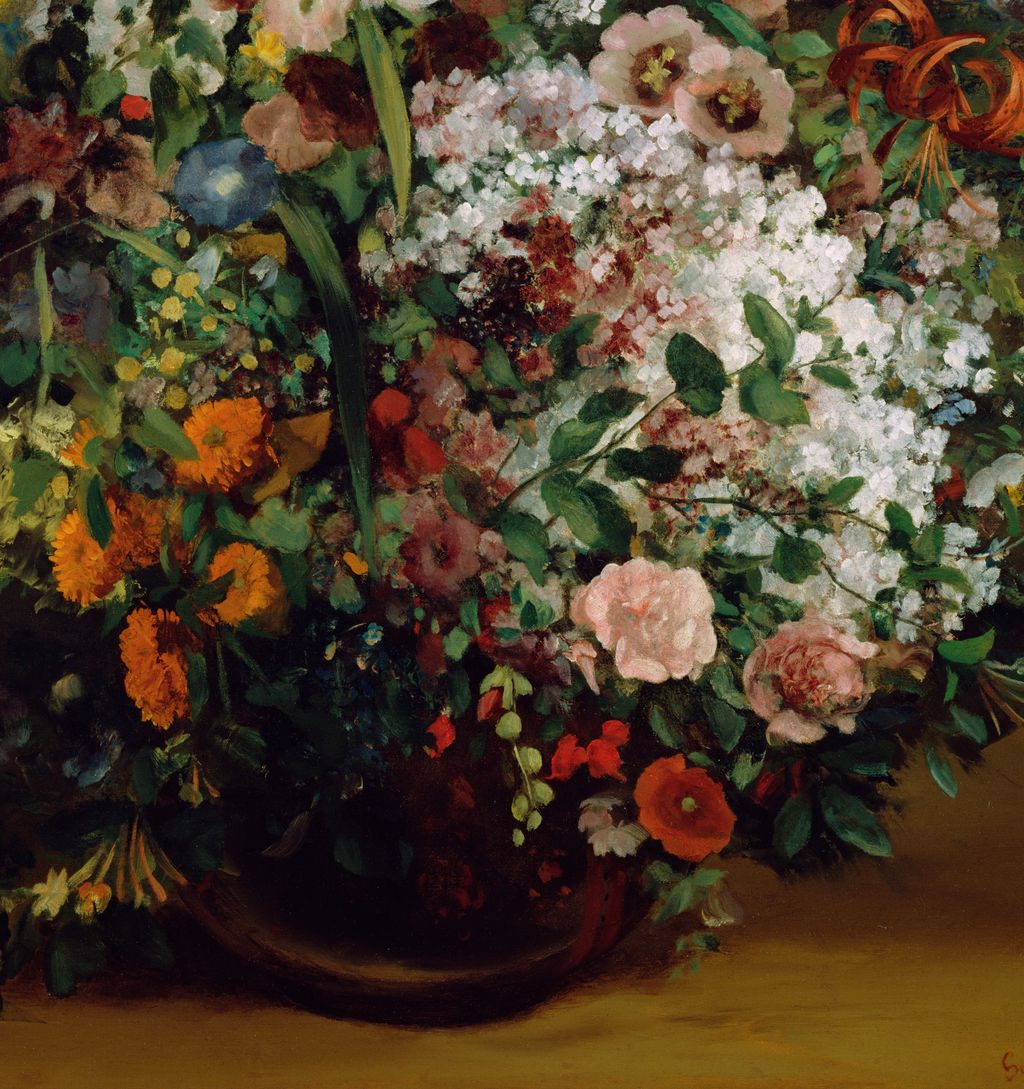
Detail of Bouquet of Flowers in a Vase, Getty 85.PA.168. Shown here, flower heads and vase. Image source. Public domain. Cropped and resized from the source image.
What conservation can add to a paintings catalogue
A finished canvas tells us which version of the scene Courbet chose to leave visible. It can also contain parts of another subject. At the C2RMF, investigations of The Wounded Man and Roe Deer at the Stream of Plaisir-Fontaine have brought different kinds of reuse to light. In one case, a self-portrait developed across several layers. In the other, an animal landscape lies above traces identified as an earlier subject, the Source of Hippocrene. A catalogue still needs a clear entry for the painting that hangs on the wall. A technical record can explain why its material history begins before the subject in that entry. [37]
There is an equally important lesson in how images are interpreted. The C2RMF recounts that an early partial radiograph of the Peasants of Flagey led to the supposition that the surviving painting was a later repetition. Its current account describes a canvas cut and subsequently enlarged. A join is evidence of a change to the support. By itself it cannot establish when the different parts were painted, what occasion prompted a change or which appearance corresponds to an exhibition title. The original documents and the evidence of the object have to be read together. [37]
The investigation of A Burial at Ornans offers another example of what looking can gain from a technical record. Before the recent restoration, the centre recorded the work under different lighting conditions and used infrared imaging, radiography and X-ray fluorescence. These methods address different questions, from surface condition to what can be detected below the paint. The Musée d’Orsay’s account of the finished restoration makes the photographs before and after treatment available for comparison. A reproduction made earlier still documents the painting, but its colours and the legibility of its dark areas belong to a particular point in the object’s history. [38] [39]
The same care helps when comparing variants. Look for details that the collection record can pin down, such as dimensions, the outline of a rock formation, the direction of a wave or the shape of a hand. Then distinguish a separately painted version from an altered state of the same canvas. Courbet did both kinds of work. The difference matters if a person is trying to locate an original, follow a loan or understand the choice he made while painting. [37]
Browse Courbet’s paintings


 Gustave Courbet.jpg)


 Gustave Courbet.jpg)
Courbet artworks directory
Browse the paintings covered in this guide. Dates identify the specific versions discussed.
Discussion
Look again at the images and ideas explored in Paintings. These editorial prompts invite your observations.
Reader Insights
Which painting would you pair with a Courbet seascape to show the range of his work?
How does your reading change when you see different versions of the same composition?
What does the paint surface tell you about the difference between rock and water?
Join the Conversation
Share a detail, comparison or question about Paintings below.
References
- Musée d’Orsay, Un enterrement à Ornans, RF 325. View source.
- The Metropolitan Museum of Art, The Source of the Loue, 29.100.122, including the museum’s audio commentary. View source.
- The Metropolitan Museum of Art, The Calm Sea, 29.100.566. View source.
- The Metropolitan Museum of Art, Gustave Courbet, 2008 retrospective overview. View source.
- Paris Musées, Autoportrait dit Courbet au chien noir. View source.
- Musée d’Orsay, Autoportrait de l’artiste dit aussi Désespoir, ou encore « Le Désespéré ». View source.
- Centre de recherche et de restauration des musées de France, Gustave Courbet étudié et restauré au C2RMF. View source.
- Musée Fabre, Bonjour, Monsieur Courbet ! Chefs-d’œuvre de la collection Bruyas du musée Fabre. View source.
- Nationalmuseum, Jo, the Beautiful Irish Girl, NM 2543. View source.
- The Nelson-Atkins Museum of Art, Jo, the Irish Woman, scholarly catalogue entry for 32-30. View source.
- Palais des Beaux-Arts de Lille, L’Après-dînée à Ornans, object dossier. View source.
- The Metropolitan Museum of Art, Gustave Courbet, illustrated retrospective checklist, entry for The Peasants of Flagey Returning from the Fair. View source.
- Musée d’Orsay, Les Paysans de Flagey. View source.
- Musée d’arts de Nantes, teaching dossier including Les Cribleuses de blé. View source.
- The Metropolitan Museum of Art, Young Ladies of the Village. View source.
- Musée d’Orsay, L’Atelier du peintre. View source.
- The Metropolitan Museum of Art, Woman with a Parrot, 29.100.57. View source.
- Petit Palais, Le Sommeil, PPP3130. View source.
- Musée d’Orsay, L’Origine du monde. View source.
- Musée Courbet, collection overview, including Le Chêne de Flagey. View source.
- Musée Courbet, La nature comme tableau, no. 2 of Les Carnets du Musée Gustave Courbet. View source.
- Musée Courbet, Qui est Gustave Courbet ?, caption and credit for Le Château de Chillon. View source.
- Musée Fabre, Le Bord de mer à Palavas, 868.1.24. View source.
- Musée d’Orsay, Mer calme à Palavas, MNR 880. View source.
- National Gallery of Art, The Calm Sea, 1985.64.10. View source.
- Musée d’Orsay, La Mer orageuse. View source.
- The Metropolitan Museum of Art, Marine: The Waterspout, 29.160.35. View source.
- Musée d’Orsay, La Falaise d’Étretat après l’orage, MNR 561. View source.
- Musée des Beaux-Arts de Lyon, La Vague, B 295. View source.
- National Museum of Western Art, Waves, P.1959-0062. View source.
- Musée d’Orsay, Remise de chevreuils au ruisseau de Plaisir-Fontaine, RF 583. View source.
- Musée des Beaux-Arts et d’Archéologie de Besançon, L’Hallali du cerf, D.882.2.1. View source.
- National Museum of Western Art, Fox Caught in a Trap, P.1959-0061. View source.
- J. Paul Getty Museum, Bouquet of Flowers in a Vase, 85.PA.168. View source.
- Musée d’Orsay, La Truite. View source.
- Robert Fernier, La vie et l’œuvre de Gustave Courbet. Catalogue raisonné, 2 vols., La Bibliothèque des Arts, 1977–78. View source.
- Bruno Mottin, C2RMF, Gustave Courbet étudié et restauré au C2RMF, history of examination and case studies. View source.
- C2RMF and Musée d’Orsay, Restauration d’Un enterrement à Ornans, pre-treatment examination and scientific imaging. View source.
- Musée d’Orsay, Completion of a Remarkable Restoration, conservation account and comparative images. View source.