



 by Tom Gurney
Tom Gurney BSc (Hons) is an art history expert with over 20 years experience
Published on June 19, 2020 / Updated on October 14, 2023
Email: tomgurney1@gmail.com / Phone: +44 7429 011000
Gustave Courbet Quotes and Letters: Introduction
In December 1849 Gustave Courbet wrote to Francis and Marie Wey about a fish from the Loue, a walk in the dark and a favour he wanted from them in Paris. Among these things he put a sentence about how he was making one of his largest paintings. Six years later, a visitor to his independent exhibition in Paris could pick up a printed statement explaining what he wanted to do as a painter. The two documents offer different views of the same career. One lets us into the arrangements that made a painting possible. The other asks a paying public to judge the paintings together. The short English excerpts below are translations from the cited French texts. [1] [2] [3]
At a Glance
- Primary sourcesLetters, printed statements and exhibition catalogues
- ContextsArt, exhibitions, teaching and public life
Contents
- Painting a crowd in Ornans
- What Courbet meant by Realism in 1855
- A note to Alfred Bruyas after the exhibition
- A painter’s studio and the limits of teaching
- The Commune in a letter home
- Letters about rooms, work and the things Courbet could lose
- What a finding aid can tell us about a letter
Painting a crowd in Ornans
At this moment I am composing my painting on the canvas. [1]
Courbet wrote this from Ornans to Francis and Marie Wey on 12 December 1849, while he was working on A Burial at Ornans. His account of the fish winds its way to a request that his friends collect his medal from Charles Blanc and send it on. Then he reports that the parish priest has supplied funeral clothing and that both the priest and the vicar have agreed to sit. The letter moves so easily between the arrangements for a parcel and the arrangements for a painting that we can see how much of Courbet’s work depended on getting people and things into the right place. [1]
The phrase “on the canvas” puts the emphasis on where he was making decisions about the composition. A drawing and a canvas offer very different spaces in which to decide how much room a figure needs. In a picture on the scale of the Burial, each additional person changes the distances between faces and the rhythm of the line of mourners. Courbet could be speaking very precisely about what he was doing that December, while earlier work on the subject could still take place on paper. The surviving charcoal study in Besançon offers a separate view of how he arranged the procession. [1] [4]
Everyone would like to be in the burial. [5]
The Louvre dates the signed letter that contains this remark to February or March 1850 and places it in Ornans. Courbet was writing to the critic Champfleury about local hunting, carnival and the pictures he was making, including The Stone Breakers. He joked that he would make enemies if he failed to satisfy everyone who wanted to appear in the funeral. In Petra ten-Doesschate Chu’s edition, the ensuing list includes the mayor, Courbet’s father and the gravedigger. He also tells Champfleury that two members of the parish took offence when they heard he meant to leave them out. The letter lets us hear the competing claims of people who expected to recognise their town in a painting. Its comic account of the sitters also gives a friend in the Paris art world a memorable story about how the picture came together. [5] [6]
What Courbet meant by Realism in 1855
The title of Realist was imposed on me. [2]
That is how the preface to Courbet’s independent exhibition catalogue begins. The printed text addresses the visitors to his 1855 show, and its first sentence compares the label to the name given to the Romantics of 1830. In the same year, works by Courbet also appeared in the official fine arts exhibition of the Exposition universelle. The two exhibitions gave him different ways of reaching the public. In his own pavilion, the name Realism and the catalogue preface were part of the setting in which visitors encountered paintings he had brought together himself, including The Painter’s Studio. [2] [3] [6] [7]
The opening turns an apparent contradiction into a reason to look at the paintings. Courbet gives the exhibition a name the public already knows, then questions how much a name can explain. Chu raises the possibility that Champfleury helped draft the preface in consultation with Courbet. It went to visitors under Courbet’s name. The preface goes on to describe studying old and modern art and drawing on that tradition to develop an independent sense of his own practice. Its final aim is to render the customs, ideas and appearance of his own time as he sees them. That last qualification leaves considerable room for the painter. The faces in the Burial come from a particular town, but the spacing, scale and distribution of attention belong to the composition. The preface gives a reader a way to connect the particularity of the sitters with the choices that make the assembled figures a painting. [2] [5] [6]
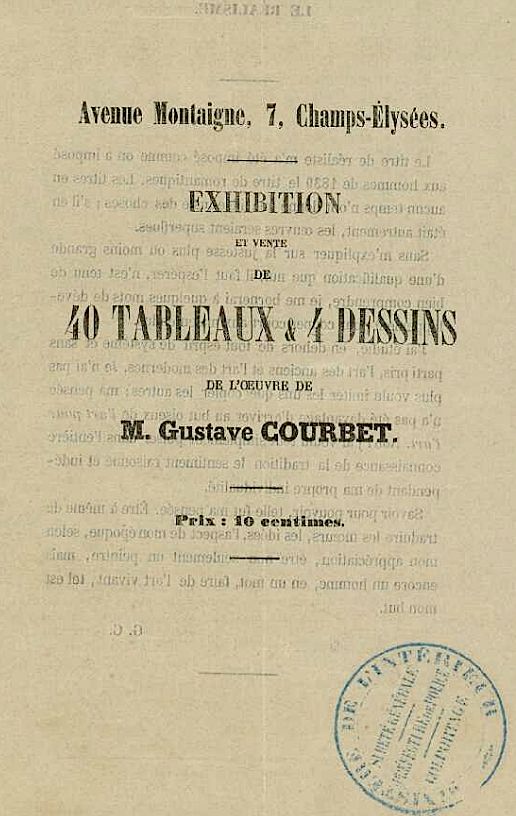
Cover of the catalogue for Courbet’s independent exhibition, 1855. Image source. Public domain. Resized from the complete source image.
A note to Alfred Bruyas after the exhibition
Please deduct the shipping cost from what you owe me. [8]
On 9 December 1855, Courbet wrote from Paris to the collector Alfred Bruyas about the return of works Bruyas had lent. The Institut Gustave Courbet’s exhibition catalogue on buying Courbet reproduces the passage about shipping, and Chu’s edition puts it in a letter that also asks Bruyas to send money if he can and declares that the exhibition had given the artist great importance. In the public preface, Courbet could ask visitors to think about the relationship between tradition and individuality. With the lender he could take up who was going to pay to get the pictures home. [6] [8]
That practical exchange adds something to the celebrated image of painter and patron greeting one another in The Meeting. The Musée Fabre places Bruyas’s support for Courbet within a wider project of collecting contemporary art. The crate that Courbet describes contained The Bathers, The Spinner and two self-portraits. Chu’s notes place The Bathers in the private exhibition and the other three works in the official exhibition. The lender’s pictures had helped Courbet show different parts of his work to the public, and now both exhibitions came down to the same practical problem of getting the paintings back. The warmth of the letter and the precision about costs show how those two forms of exchange could run alongside one another. [6] [8] [9]
A painter’s studio and the limits of teaching
Every artist must be his own master. [10]
The letter to the young artists of Paris is dated 25 December 1861. It appeared four days later in Le Courrier du dimanche, on page 4 of the 29 December issue. Its opening explains that a group of artists wanted a common painting studio where they could continue their training and had invited Courbet to direct it. The surviving manuscript matters because it distinguishes the signed position from the hand that put the argument into words. The Institut Gustave Courbet reports a visible difference between the writing and the signature. It gives the usual attribution of the drafting to the critic Jules-Antoine Castagnary, with Courbet as signatory. [10] [11]
The passage makes sense as a response to an invitation. What would directing the studio entitle Courbet to ask of the people who worked there? The letter proposes explaining how he had tried to become a painter and treating the other artists as collaborators. It also gives a reason for working together, appealing to productive collaboration in Renaissance workshops. That historical example allows for learning in company while leaving each artist free to decide how to apply what they learn. The distinction is sharper than the isolated sentence suggests. It concerns the point at which a painter’s account of his own method becomes a demand that others paint like him. [10] [11]
The letter also argues that painting works with visible and tangible things. It gives imagination a part in discovering how fully something can be expressed, and it challenges the authority of artists who claim to paint an age they never lived in. Read alongside the 1855 preface, the argument makes room for studying the art of the past while putting the artist’s own experience at the centre of what gets painted. That is a more specific claim than the familiar shorthand of Realism as faithful copying. A person looking at the Burial can follow the placement of a hand, a face or a gap between bodies and see what the painter’s imagination contributes to the visible scene. [2] [10] [11]
The Commune in a letter home
I’m beginning to feel as if my head were a baked apple. [12]
Courbet wrote this to his parents from Charenton on 30 April 1871. In the preceding lines he lists his responsibilities, among them the presidency of the Federation of Artists and membership of the Commune, and says he sits and presides for twelve hours a day. The baked apple is a domestic image for the strain of a public role. The joke gives his family a picture of how the days feel even as the list of offices tells them how far he has entered public affairs. The letter records how Courbet chose to describe his position to the people at home during the Commune. [6] [12]
His surviving correspondence about the Vendôme Column had a different purpose. The BnF’s inventory identifies a letter from the Conciergerie to Pierre Frédéric Dorian in summer 1871 in which Courbet disputed responsibility for the toppling and offered to pay for the column to be raised again by selling paintings. The inventory also lists the Commune’s decree ordering demolition, papers from the military proceedings and a later seizure notice. The letter is an argument made from prison, while the decree and court papers record decisions and proceedings. Reading those documents separately preserves the difference between Courbet’s defence and the actions he was called to answer for. [13] [14]
Chu’s critical edition brings these kinds of writing into chronological order, with notes on the people and paintings the letters mention. It makes it possible to follow a recurring subject such as independence across very different exchanges. In the pavilion it meant having a place to show the pictures and address their viewers. In the studio letter it meant leaving artists room to develop their own expression. In the letter to Bruyas, even an exhibition under Courbet’s own name still left a shipping bill to settle. [2] [6] [8] [10]
Letters about rooms, work and the things Courbet could lose
On 30 October 1849 Courbet wrote from Ornans to Francis and Marie Wey about changes to his first workspace there. His father had already had the room adapted. Courbet complained that the window was too small and badly placed and had a much larger one fitted. He described the dark colours he chose for the walls and the blue at the top of the room. Read beside the painting he was making in Ornans at this stage, the letter supplies a rare account of how he thought about the actual conditions of work. It also has the character of an account written to friends, full of details that make the room imaginable to people who were elsewhere. [15]
A very different letter about a workspace went to Castagnary on 3 April 1876. Courbet was in exile and feared the loss of the later studio at Ornans during the proceedings against him. He made a practical case about how expensive and difficult it would be to replace. The two letters bracket changes that a statement about Realism alone could not explain. In the first, the artist had found a way to modify a family property to suit his needs. In the second, retaining a building he had spent years making his own had become a condition he raised while arguing about his future. The museum’s history supplies the dated extracts, while the biography traces what happened to the two workplaces. [15]
What a finding aid can tell us about a letter
The Besançon archive’s description of the papers gathered by Charles Clerc lists a fragment about a postponed sitting, a short message to Alfred Bruyas about arriving from Ornans in 1861, a letter about Proudhon’s death in 1865 and a later letter to Bruyas on Courbet’s role in the Commune. The list also identifies a letter from his father Régis to Bruyas in June 1871 defending his son. The presence of both writers in one collection matters. It is possible to follow the question through the family and the patron’s correspondence as well as through Courbet’s own account. [16]
The inventory gives dates, recipients and subjects, but the description of a letter should be kept distinct from its wording. A fragment about the number of canvases painted may be worth pursuing for a particular exhibition, while its presence in the inventory supplies neither a total nor a full statement by the artist. The same care applies to the papers around the Commune. A letter from the artist, a defence by his father and a government record each establish a different kind of evidence. [13] [16]
Courbet artworks directory
Browse the paintings covered in this guide. Dates identify the specific versions discussed.
Discussion
Look again at the images and ideas explored in Gustave Courbet Quotes and Letters. These editorial prompts invite your observations.
Reader Insights
What changes when a remark moves from a private letter into a public catalogue?
How does Courbet describe the freedom he wants for artists?
Which details matter when checking a widely repeated quotation?
Join the Conversation
Share a detail, comparison or question about Gustave Courbet Quotes and Letters below.
References
- Gustave Courbet, letter to Francis and Marie Wey, Ornans, 12 December 1849, in Lettres choisies – Courbet en privé, Éditions du Sékoya and Institut Gustave Courbet, reproduced by Fondation La Poste, summer 2019. View source.
- Gustave Courbet, preface to Exhibition et vente de 38 tableaux et 4 dessins de l’œuvre de M. Gustave Courbet, Paris, Morris, 1855, French transcription in the Musée Fabre dossier Le réalisme. View source.
- Bibliothèque nationale de France, Exhibition et vente de 38 tableaux et 4 dessins de l’œuvre de M. Gustave Courbet, record FRBNF30279450, with link to the digitised copy NUMM-315160. View source.
- Musée des Beaux-Arts et d’Archéologie de Besançon, Étude pour Un enterrement à Ornans, charcoal on bluish paper, inventory D.3980. View source.
- Musée du Louvre, signed autograph letter from Gustave Courbet to Champfleury, Ornans, dated February–March 1850, Chu letter 50-1, inventory A 240, recto, catalogue excerpt from Véronique de Chillaz, 1997, p. 69. View source.
- Gustave Courbet, Letters of Gustave Courbet, edited and translated by Petra ten-Doesschate Chu, University of Chicago Press, 1992, letters to Champfleury, Alfred Bruyas and Courbet’s parents, and chronology for 1855. See letter 50-1, the Bruyas letter on p. 147, and the letter from Charenton beginning on p. 416. View source.
- Commission impériale de l’Exposition universelle, Explication des ouvrages de peinture, sculpture, gravure, lithographie et architecture des artistes vivants, étrangers et français, exposés au Palais des beaux-arts, Paris, 1855, p. 287. View source.
- Institut Gustave Courbet, Acheter Courbet, exhibition catalogue, excerpt from the letter to Alfred Bruyas of 9 December 1855. View source.
- Musée Fabre, La « Solution » d’Alfred Bruyas, on Bruyas’s collecting project and Courbet’s relationship with the collector. View source.
- Institut Gustave Courbet, Le manuscrit de la lettre de Courbet aux jeunes artistes de Paris présenté pour la première fois, 20 May 2016, manuscript account and partial transcription of the letter dated 25 December 1861. View source.
- Gustave Courbet, letter to the young artists of Paris, signed 25 December 1861, published in Le Courrier du dimanche, 29 December 1861, p. 4, reproduced in Florilettres, no. 205. View source.
- Gustave Courbet, letter to his parents, Charenton, 30 April 1871, transcription published by Les Amies et Amis de la Commune de Paris 1871. View source.
- Bibliothèque nationale de France, Dossier sur le renversement de la colonne de la place Vendôme, 1871–1874, fol. 124, inventory including Courbet’s letter to Dorian from the Conciergerie, summer 1871. View source.
- Musée d’Orsay, Courbet et la Commune, exhibition account, 14 March–11 June 2000. View source.
- Musée Courbet, Histoire de l’atelier, extracts from letters to Francis and Marie Wey and Jules-Antoine Castagnary. View source.
- Bibliothèque municipale de Besançon, Mémoire vive, MS Z 540, Gustave Courbet. Lettres et documents divers rassemblés par Charles Clerc, inventory, folios 1–32. View source.


