



 by Tom Gurney
Tom Gurney BSc (Hons) is an art history expert with over 20 years experience
Published on June 19, 2020 / Updated on October 14, 2023
Email: tomgurney1@gmail.com / Phone: +44 7429 011000
The Painter’s Studio: Introduction
A pale sky opens in the middle of a crowded, dim room. Below it, foliage and rock catch the light, and for a moment the eye can go straight through to the distance. Then the edge of the canvas asserts itself. The sky belongs to a landscape that Gustave Courbet is painting within The Painter’s Studio. Around him are people who earn a living, watch, read, collect art and write about it. The three figures closest to that opening are the painter himself, a standing nude and a small boy in rumpled clothes. The boy has his back to us. We follow his gaze into the landscape before we have had much chance to decide what kind of gathering this is. [1]
Courbet painted this oil on canvas in 1854–55 and signed and dated it 1855. At 361 × 598 cm without its frame, it covers more than twenty square metres. The Musée d’Orsay in Paris holds it under inventory number RF 2257, and it is number 165 in Robert Fernier’s catalogue. Its longer title, The Painter’s Studio, a Real Allegory Summing Up a Seven-Year Phase of My Artistic Life, gives that enormous gathering an autobiographical purpose. The seven years are compressed into the time it takes an artist to sit back and see how a picture is coming along. [1] [2]
At a Glance
- Date1854–55
- MediumOil on canvas
- CollectionMusée d’Orsay, RF 2257
Contents
- A painter at work
- The people on the right
- The people and objects on the left
- What Courbet meant by a real allegory
- The exhibition of 1855
- From exhibition canvas to museum painting
- What the restoration brought into view
A painter at work
Begin at Courbet’s extended hand and follow the length of his brush. His body leans back on the seat and the arm reaches forward, leaving an interval between his face and the point where he is working. That small distance lets us imagine him assessing the picture as a whole. It also gives his body a striking outline. His dark hair and beard read against the light of the easel picture, and his other hand holds a palette close to his lap. For all the room given to him, he offers the public a profile. The person best positioned to show us what Courbet looks like is occupied with what he sees. [1]
In The Meeting, Courbet stands on an open road with the equipment of a travelling painter. His bearing matters because of how he and his patron greet one another. Indoors, with his implements in use, he commands attention through the concentration of figures and light around an ordinary working movement. The hand with the brush needs very little room. Courbet gives it nearly six metres. [1] [3]
The woman stands directly behind him holding a length of white fabric. The cloth gathers below her torso, broadening the light patch that starts at her shoulder. She could have stepped out of a painting session, and there is enough of the studio around her to make her presence intelligible in those terms. Look at the direction of the working arm, though, and the subject that would explain her presence slips away. Courbet is making a landscape of the Franche-Comté. His model can be seen as a person employed in the studio, as someone looking at the work, or, given the title, as a figure with a wider significance. Orsay reads her as a muse and connects her nudity with the convention of representing Truth unclothed. The drapery under her hand also trails into a pile of ordinary fabric that could be picked up and put away. Courbet gives the symbolic reading the weight of a body and the practical furniture of a working room. [1] [4]
The child stands just below the painter’s extended arm, with his weight pitched forward towards the canvas. His body is turned into the space of the picture, so the attention we read in him comes from his stance and the tilt of his head. At his feet a white cat approaches the fallen fabric. There is a useful change in scale here. The model, boy and animal draw the eye from the tall strip of illuminated flesh to the ground in three steps. Their proximity helps the centre feel inhabited, even while the bright landscape seems to suspend the rules of the room. [1]
The landscape itself is an arresting choice. With a nude and a crowd available to him, Courbet shows himself painting trees, pale rock and a bank of rising ground. The local scenery belongs to the artistic life named in the title just as surely as the portraits do. The painter’s fingers are engaged with a remembered or worked-out view, and the child looks as though he recognises a world he can enter. The picture gives looking a physical direction. From the dim gallery of people, we move towards the bright opening and, a moment later, back to the artist whose hand makes it possible. [1] [4]
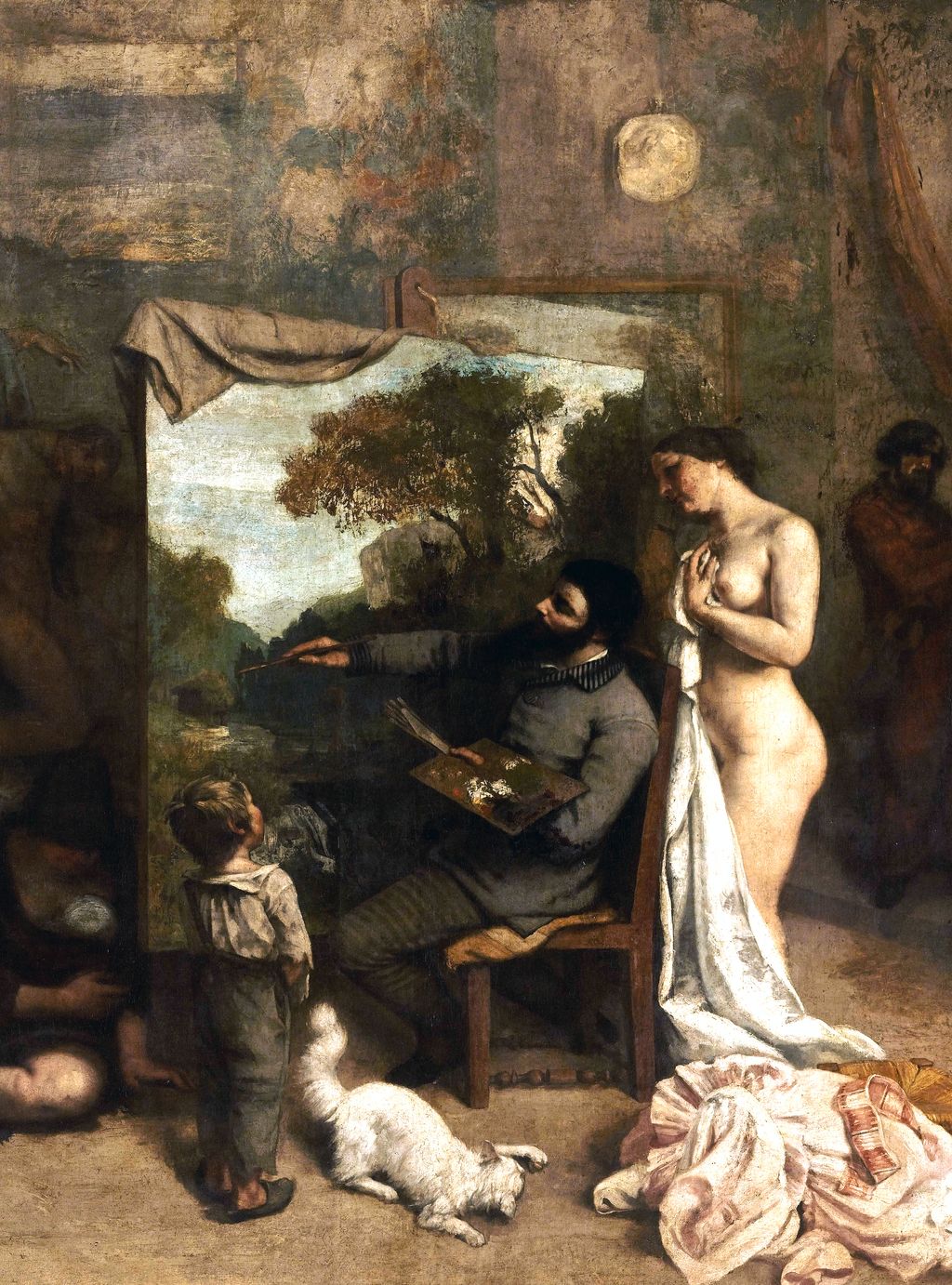
Detail of The Painter’s Studio, Musée d’Orsay RF 2257. Shown here, painter, model and easel. Image source. Public domain. Cropped and resized from the source image.
The people on the right
The figures on the viewer’s right occupy the studio in the easy, uneven way that visitors might fill a room. Some stand, others sit or turn towards a neighbour. At the outer edge, Charles Baudelaire has opened a book. His reading gives that end of the canvas a private focus, and the pale pages catch enough light to make his downward attention legible from across the picture. He is present as a writer through an action. We can grasp something about his place in this gathering before we recognise his face. [1] [2]
Champfleury, the pen name of the novelist and critic Jules-François-Félix Husson, sits on a stool closer to the painter. Orsay also holds Courbet’s small portrait of him, an oil on paper mounted on canvas that bears the date 1855. The museum thinks it was probably painted in 1854 as a study for the group picture. At the Pavilion of Realism it was shown separately from the large canvas, where the critic’s posture and place in the company help tell us what sort of man Courbet thought he was. Champfleury himself took a darker view. In a private letter cited by Orsay, he compared his appearance in the large painting to that of a Jesuit superior and called the portrait monstrous. His response makes it possible to distinguish the well-supported identity of the figure from the question of whether its sitter found it a good likeness. [5]
Orsay points to the bearded profile of the collector Alfred Bruyas and, behind him, the more frontal head of the political thinker Pierre-Joseph Proudhon. It also lists the writer Max Buchon, the musician Alphonse Promayet and Urbain Cuenot among those represented. The Met identifies Courbet’s separate portrait of Promayet, in which he holds his violin, as the model for the likeness in the larger work. The evidence for these portraits is stronger than the evidence for a complete labelling of every head. Even the presence of a recognisable likeness tells us only part of what a figure is doing in the composition. Bruyas belongs here because collecting is one of the activities that makes a painter’s career possible. Proudhon and Champfleury point to the public life of paintings in argument and print. Baudelaire, bent over a book, makes literary work visible through the quiet act of reading. [1] [2] [4] [5] [6]
The supporting circle contains different kinds of relationships. Bruyas could purchase work and give Courbet the opportunity to paint in Montpellier. Champfleury could defend the work in public and wince at what Courbet had made of him in private. Those are different degrees of proximity and very different ways of taking a stake in a painting. We can see a corresponding variety in how people are allowed to occupy the canvas. Follow the front of the group from Champfleury’s stool to the richly patterned shawl of the visitor standing closer to the edge. Orsay reads her and the man beside her as art lovers. Low down near them, Champfleury noticed a second child occupied with prints. The two children have very different roles. The boy at the easel is intent on the making of a picture. The other is already handling pictures that can circulate outside a studio. [1] [4] [5] [7]
A faint shape near Baudelaire complicates that arrangement. The Musée d’Orsay identifies the covered figure as Jeanne Duval, Baudelaire’s companion. She was painted in and subsequently painted over, and part of her form has become visible through the paint above. The visible trace is easy to miss beside the solid figure and the book. It belongs to a different stage of work from the one the poet occupies, and its emergence has made two stages visible at once. The presence of the earlier figure and the reasons for its removal are separate historical questions. [4] [8]
The people and objects on the left
The viewer’s left gathers different ages and social stations into less clearly defined space. A woman with a child sits low among the figures. A dog, a seated man and the diagonal of a gun laid on the floor spread the group out towards us, while heads and hats interrupt the darkness behind them. Set against the groomed visitors on the right, these figures have the variety of people one might encounter in the street, on the road or at work. Yet the transitions between them are abrupt. A change of costume or bearing can seem as consequential as a change of distance. [1] [4]
Courbet described this side to Champfleury through the conditions and occupations it brings into view. He included wealth and poverty, people who exploit others and people who are exploited, and those who make a living from death. The museum’s account of the group gives examples of his social types, including a priest, a hunter and a republican associated with 1793. These descriptions make a broad historical and social reading possible. They also make the left side more awkward than a tidy opposition between the poor and the cultivated. Wealth belongs on that side too, and the letter puts the two ends of several social relations in the same space. [1] [4]
Look down near the easel at the skull and the newspaper beneath it. A studio might contain a skull as an object to study. In this company, and in a painting in which Courbet invokes the livelihoods that depend on death, it has more than one use. Orsay’s restoration dossier connects the dark-clad figure Courbet described as an undertaker with a possible likeness from the Bertin family, who directed the Journal des débats. The case rests on the newspaper and a pose that recalls Ingres’s portrait of Louis-François Bertin. The dossier leaves open which of the two sons might have provided the likeness. The newspaper can sharpen the possibility of a joke about hostile criticism without settling who is supposed to be sitting above it. [4]
The seated figure near the dog is another example of the distance between an observed detail and a proposed identity. In her study for the 1977 Courbet exhibition, Hélène Toussaint read the figure as a poacher with the likeness of Napoleon III. That interpretation gives the hunting imagery a political force, since an emperor recast as a poacher has a very different status from one portrayed in official dress. The hat, coat, gun and dog can also do their work at the level of social type. Courbet’s broad categories and Toussaint’s identification offer different kinds of evidence, and it is possible to see why the interpretation has attracted attention without treating the face as a securely documented imperial portrait. [1] [4]
Behind the landscape is a narrow, drooping shape that the Orsay dossier identifies as a mannequin. The shape is partially hidden and easy to take for a living person on a first pass. Once recognised as a studio prop, it provides an uneasy counterpart to the woman on the other side. She stands close behind Courbet, her body brightly lit and her attention apparently engaged. The mannequin hangs among the darker, more compressed shapes. A guitar, dagger and hat lie among the objects in the foreground. The museum reads the costume pieces and the studio figure as a comment on the props and conventions of academic art. Their low position matters in that reading. The objects with which a painter might dress up a staged scene have been dropped into a corner of this one. [1] [4]
What Courbet meant by a real allegory
Courbet told Champfleury that the world was coming to his studio to be painted. He called the people on the right his actionnaires, a word that can mean shareholders, and went on to describe them as friends, fellow workers and people interested in art. The expression makes a social circle sound like an enterprise. It accommodates the collector who pays for paintings, the friend who poses, and the critic who helps shape how a painting is understood. The other half of the room contains the range of people and conditions he sets before himself as a painter. In the middle he gives us the occupation on which this imagined arrangement depends. [1] [4]
The subtitle invites a reader to understand how particular people and things can stand for relationships and experiences larger than themselves. On the right, a collector is both a person Courbet knew and someone who occupies a recognisable position in the life of art. On the left, a figure can be a type and still look as if Courbet has caught an individual in a moment of distraction. In the centre the woman has the bodily presence of a model whose weight settles into a particular stance, even as the prominence Courbet gives her invites a symbolic reading. The elements have the specificity of ordinary life. Their arrangement is an argument about what belongs in the painter’s world. [1] [4]
Champfleury saw the tension in the title as soon as the picture was shown. In an open letter to George Sand published in 1855, he welcomed the range of the exhibition but found the words real and allegory hard to reconcile. He also asked what the nude was doing beside a landscape and whether well-to-do parents would bring their child into a studio where a model was undressed. His enthusiasm was strongest when he came to the little country boy, whose face we scarcely need to see to know how completely he is looking. The defence is valuable because it comes from a friend of the painter who still registered the strangeness of the encounter. [7]
The canvas gains another dimension beside A Burial at Ornans. The funeral supplies a common action around which Courbet can organise the clergy, bearers and mourners. The studio shares the human scale and crowded breadth of that picture, but the people have far less obvious reason to assemble in this precise combination. The studio makes the act of painting its centre of gravity, with enough space around the easel for the activity to be legible. That is a particularly public use of the scale of history painting, which Courbet had already applied to the rites of a small town. Now he gives that scale to the everyday work of making art and to the people on whom it depends. [1] [4]
The seven years in the title matter because this is a painting about how a career takes shape in the company of other people. One small discovery makes that especially tangible. On the dim back wall, to the left, Orsay’s conservators identified a sketchy representation of The Peasants of Flagey Returning from the Fair, one of the paintings Courbet had mentioned when describing his plans to Champfleury. A work made earlier in his career has a second life here as part of the studio furnishing. It is given a different kind of presence from the landscape in progress. One picture is nearly lost in the room that holds it, while the other opens a bright space in the middle of the gathering. [4]
The exhibition of 1855
Courbet intended the painting for the Exposition Universelle in Paris. The jury accepted eleven of his works, according to Orsay’s restoration dossier. The Musée Fabre records the appearance of The Meeting at the official exhibition. The jury rejected the Studio, as it did A Burial at Ornans. The two large compositions were among the works Courbet showed in his own Pavilion of Realism on avenue Montaigne, close to the official fine arts exhibition. The French national inventory records The Painter’s Studio as catalogue number one in the pavilion. Its place there made an ambitious depiction of artistic work the opening declaration of a public exhibition arranged by the artist himself. [1] [2] [3] [4] [9]
The pamphlet accompanying the pavilion put Courbet’s position in words. The Bibliothèque nationale de France preserves a catalogue dated 1855, and the Met’s retrospective quotes the preface generally known as the Realist Manifesto. Courbet wanted to give an account of the habits, ideas and appearance of his time as he himself understood them. The qualification matters in front of the Studio. His public ambition was to paint the present, and his claim to independence concerned the terms on which he would choose, combine and interpret it. The people in this enormous interior are a selection arranged from his particular place in the world. [9] [10]
The pavilion offered a second context for the Studio. A visitor who had seen The Meeting at the official exhibition could recognise both Courbet and Bruyas as players in another account of the painter’s career. At the independent show, A Burial at Ornans made it possible to compare the distribution of figures across two great widths of canvas. Champfleury’s open letter describes a broader assortment of portraits, domestic subjects, animals and landscapes. The different genres practised across the exhibition turn up inside the Studio as well. Courbet could give the public something like an overview of his work on the walls and then show, within a single picture, how that work issued from one place. [3] [4] [7] [9]
Eugène Delacroix visited on 3 August 1855. In his journal he recorded the reduced admission price of ten sous and said that he had the exhibition to himself for nearly an hour. The rejected painting held him. He called it a masterpiece and singled out passages in the nude and the shawled woman in the foreground. He also found the gathering crowded and took issue with an ambiguity at its centre. The landscape on the easel looked, he wrote, as though there were a real sky in the middle of the picture. For one of Courbet’s first attentive viewers, the very thing that drew the eye across the room gave him a reason to question the construction of the scene. [11]
Delacroix’s entry gives the visual effect a secure date. The sky already looked as if it might belong to the larger painting when the Studio was new. The remark also puts his praise on a more interesting footing than simple approval of a colleague whom the jury had turned down. He responded to flesh, fabric and air in individual passages and thought about where those passages asked him to stand in relation to the whole. Champfleury, for his part, found himself imagining the boy’s recognition of trees and rocks. The two men followed the same view in different directions. One saw the ambiguity of a picture almost passing for an opening. The other saw the way a child in the room might discover familiar terrain on a piece of canvas. [7] [11]
From exhibition canvas to museum painting
After the pavilion closed, the painting returned to Courbet’s studio, where Orsay’s restoration dossier says it was kept rolled. The museum’s exhibition record lists later showings in Lyon in 1864 and Vienna in 1873. Courbet’s sister Juliette inherited the canvas after his death in 1877. It went through the Courbet sale at the Hôtel Drouot on 9 December 1881 to the dealer and collector Haro. It failed to sell at a Haro sale in 1892 and passed to Victor Desfossés at another in April 1897. His widow bought it back at his posthumous sale in 1899. [1] [2] [4]
In the Desfossés household the great picture served as a backdrop in an amateur theatre on the rue Galilée in Paris. Its use there makes unexpected sense in physical terms. At nearly six metres across it could occupy the width of a stage, and it offers an interior already full of people. In 1919 it passed to the Galerie Barbazanges. The Louvre acquired it for the national collections in 1920 with help from a public subscription and the Société des Amis du Louvre. The museum records the purchase as a collective undertaking, decades after Courbet had given his supporting circle the name of shareholders. The painting was assigned to the Musée d’Orsay in 1986. [1] [2] [4]
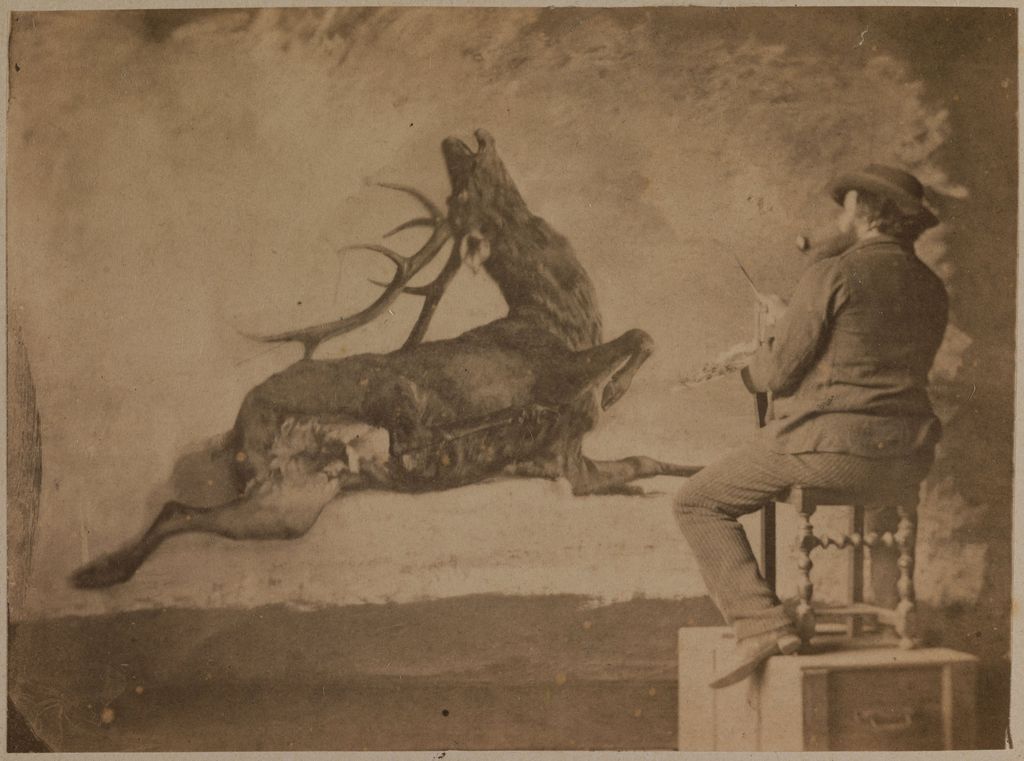
Étienne Carjat, Courbet painting The Death of the Stag, 1867. Paris Musées. Image source. CC0 / Public domain. Resized from the complete source image.
What the restoration brought into view
A canvas this large has a material history that can be read independently of its ownership. To examine it, the Centre de recherche et de restauration des musées de France, or C2RMF, digitised and assembled a radiograph made up of 165 plates. The radiograph and new photographs taken under different kinds of light helped distinguish underlying strokes and changes in composition from vulnerable areas of paint. The images also show that the enormous support was built up from joined sections. What presents itself in the gallery as a single continuous field was extended as the painting developed. The size of the finished work is itself part of the history of its making. [4] [12]
Individual changes call for different means of examination. The Orsay dossier illustrates the addition of the seated hunter with an X-ray detail. It uses infrared reflectography to illustrate a change in the figure with a small box on the left, whose earlier prominence was reduced. Infrared also helped document the covered figure beside Baudelaire. In the visible painting her shape has grown easier to discern with the ageing of the paint layers, a different process from the making of a scientific image. The conservators retained these transparencies as part of the painting’s material history. Their presence gives the eye a way to encounter an earlier choice while looking at the surface Courbet left. [4] [8] [12]
The C2RMF dates the research and treatment project to 2013–16. Work on the painting itself began in November 2014 and finished two years later. Visitors could see part of it through a glazed enclosure in the gallery. Work on the support took place in an adapted space in the museum’s reserves. The old lining, a fabric backing applied to help carry the weight of the original canvas, had weakened. Conservators removed the former lining materials and adhesives, added a new backing, and replaced the faulty stretcher. The surface work included securing unstable paint and reducing discoloured varnish. The new support addressed the physical condition of the canvas, while the reduction of varnish made it possible to see differences already present in the paint. [4] [12] [13] [14] [15]
Some of those differences are small enough to reward a slow look. Orsay points to the pipe with Baudelaire and to the faint Flagey painting on the back wall. In the architecture, a window and a curtain help establish the way the room recedes at an angle. The group can still strike us as a long row of figures, especially in a small reproduction. On the large canvas, the diagonal is easier to follow through gaps and overlaps. The dark wall begins to have depth, and the light opening at the centre can look all the more startling because the room around it has become more intelligible. [4] [13]
Delacroix’s journal remains a good companion to that last observation. Cleaning can help separate a wall from a recess and a pipe from a shadow. His account makes it possible to recognise how old the ambiguity at the easel is. Stand back far enough for the whole gathering to register, and the painter, his visitors and his double audience of model and boy occupy one immense interior. Then return to the point of the brush. The sky is still where a stretch of wall might have been, and the artist is still deciding what to do with it. [1] [11] [13]
Courbet artworks directory
Browse the paintings covered in this guide. Dates identify the specific versions discussed.
Discussion
Look again at the images and ideas explored in The Painter’s Studio. These editorial prompts invite your observations.
Reader Insights
What makes the bright landscape seem like an opening in the studio?
Which figure changes your understanding of the room most, and why?
What does Delacroix’s description of the painted landscape add to your reading of the scene?
Join the Conversation
Share a detail, comparison or question about The Painter’s Studio below.
References
- Musée d’Orsay, L’Atelier du peintre, RF 2257, collection record and image. View source.
- French Ministry of Culture, L’Atelier du peintre. Allégorie réelle, Joconde record 000PE000690. View source.
- Musée Fabre, La Rencontre ou Bonjour Monsieur Courbet, inv. 868.1.23, collection essay. View source.
- Musée d’Orsay and Centre de recherche et de restauration des musées de France, L’Atelier du peintre de Gustave Courbet restauré, dossier, 13 December 2016, especially pp. 6–7, 22–24 and 38–39. View source.
- Musée d’Orsay, Portrait de Champfleury, RF 696, collection record. View source.
- The Metropolitan Museum of Art, Gustave Courbet, Alphonse Promayet (1822–1872), collection record. View source.
- Champfleury, Du réalisme. Lettre à Madame Sand, 1855, transcription hosted by the University of Wuppertal. View source.
- Musée d’Orsay, La femme sans nom, l’histoire de Jeanne et Baudelaire, note on Régine Abadia’s documentary, 2021. View source.
- The Metropolitan Museum of Art, Gustave Courbet, retrospective exhibition, 2008, including the sections “The Pavilion of Realism” and “Landscape”. View source.
- Gustave Courbet, Exhibition et vente de 38 tableaux et 4 dessins de l’œuvre de M. Gustave Courbet, Paris, Morris, [1855], Bibliothèque nationale de France catalogue record. View source.
- Eugène Delacroix, Journal, entry for 3 August 1855, ed. Paul Flat and René Piot, Plon, 1893, vol. 3, pp. 63–65. View source.
- Centre de recherche et de restauration des musées de France, Rapport d’activité 2014–2015, pp. 122–23. View source.
- Musée d’Orsay and Musée de l’Orangerie, Rapport d’activité 2016, pp. 46–49. View source.
- Musée d’Orsay, Restauration de L’Atelier du peintre. View source.
- Centre de recherche et de restauration des musées de France, Restauration du tableau de Gustave Courbet, Un enterrement à Ornans, overview of the centre’s Courbet studies. View source.


