



 by Tom Gurney
Tom Gurney BSc (Hons) is an art history expert with over 20 years experience
Published on June 19, 2020 / Updated on October 14, 2023
Email: tomgurney1@gmail.com / Phone: +44 7429 011000
The Bathers by Gustave Courbet: Introduction
A woman steps onto a shallow bank, her back turned towards us. With one hand she gathers a white cloth at her hip. Her other hand rises, palm open, against the dark trees. A seated woman looks up at her and raises a hand of her own. The two gestures seem to belong to the same exchange, but they leave its meaning open. Gustave Courbet gave this encounter the scale of a public event. Painted in 1853 and exhibited at the Paris Salon that year, The Bathers (Les Baigneuses) is an oil on canvas measuring 227 × 193 cm. It belongs to the Musée Fabre in Montpellier, where it is catalogued as 868.1.19. [1]
At a Glance
- Date1853
- MediumOil on canvas
- CollectionMusée Fabre, 868.1.19
Contents
- The two women at the water’s edge
- Skin, cloth and stone
- The Salon of 1853
- Alfred Bruyas and the journey to Montpellier
- The pose and the model
- Courbet’s other bathers
The two women at the water’s edge
The standing woman fills the brightest part of the canvas. Her head tips down and turns towards the right as her raised arm extends in that direction. Her back, broad at the shoulder and creased at the waist, takes the light in warm, closely graded tones. Below it the cloth bunches into much sharper folds. It hangs low at the back and gathers high in her left hand, so that its diagonal cuts across the turn of her body. One foot is on the ochre bank and the other is near the dark edge of the pool. The placing of the feet lets you read both the effort of the step and the momentary hesitation in the upper body. [1]
The seated woman makes an equally complicated movement. Her knees and lower legs angle towards the water, while her arms extend towards the right-hand edge of the picture. She turns her face back over her shoulder towards the bather. A stocking bunches around one ankle, and the other foot is bare. Her white blouse, ample ochre skirt and the bundle of clothes beside her hold the eye near the ground. Across the gap between the two women, the open palms echo one another. Their positions, however, point in different directions. The standing figure reaches across the scene while the seated woman’s outer hand meets the branches at the right. The gestures could belong to a brief exchange of words or to the practical business of keeping balance on uneven ground. Courbet gives us enough to imagine either. [1]
The space between the women is small, yet the drop from the raised hand to the seated face is considerable. You can trace it through the dark green beyond them, then across the brighter strip of ground between their feet. The painting carries the eye from one person to the other without making the exchange into a clearly legible event. Even the title supplies only an activity. In a painting this size, where a spectator might expect a dramatic gesture to explain what is happening, the absence of a clear answer becomes conspicuous.
Skin, cloth and stone
At the left, angular rocks catch patches of grey and yellow light. The Musée Fabre describes their execution as work with a palette knife. The slabs have sharply broken edges and broad changes of tone. Across the pool, the standing figure’s back seems to turn by much smaller degrees, from pale light across the shoulder to soft shadows down the spine and at the waist. Her cloth introduces a third kind of surface. Light catches its ridges abruptly and sinks into narrow hollows where the fabric twists. These passages make different demands on the painter even where their colours are close. The rock needs a hard edge, the back a gradual turn and the linen a succession of quick breaks. [1] [2]
For all the force of that pale figure, much of the canvas belongs to the woods. The trees arch over both women, and a little patch of blue beyond the leaves suggests an opening well behind them. The pool in the foreground has scarcely any of the clarity of the distant sky. Its browns and greens carry on into the bank, with small stones and patches of light marking the transition. The pale shoulder, the sleeve and the stocking stand out because Courbet holds most of the surroundings in deeper tones. A reddish garment beside the rocks on the left balances the splash of red in the clothes on the right. They are small patches, but they let the eye travel from one bank of shadow to the other. [1]
Courbet’s subject belonged to a familiar tradition. François Boucher’s Diana Leaving Her Bath, shown at the Salon of 1742 and acquired by the Louvre in 1852, also places two women beside water and under trees. A crescent ornament, hunting equipment and game give the viewer a way to recognise Diana and understand the scene. Boucher’s goddess sits with her legs extended, her face and torso easy to see. Courbet presents the largest body from behind and leaves a stocking and a heap of contemporary clothes in view. Boucher’s canvas is 57 cm high. In the Salon, viewers were accustomed to seeing canvases as large as Courbet’s used for episodes from history, scripture or myth. Here that scale gives a pause at the edge of the water the presence of a consequential act. [1] [3]
The Salon of 1853
The Paris Salon catalogue lists Les Baigneuses at the Menus-Plaisirs in May 1853. Courbet also showed The Wrestlers and The Sleeping Spinner. In a letter to his parents dated 13 May, Courbet told them that his paintings had been received without objection and that he had heard they were well placed. He anticipated a stir and said The Bathers was already causing some alarm. He also reported that since his parents had seen the work he had added a cloth across the standing woman’s buttocks, and that the landscape was drawing praise. The letter preserves Courbet’s own sense of the early response as the exhibition approached. It also makes the white cloth a rare visible detail that the artist described changing himself. [2] [4]
The critic Théophile Gautier asked what Courbet meant by exhibiting this body. In his published review, he wondered whether the painter was proposing a standard of beauty or had simply copied the model before him. His language about the woman was cruel, but his argument ranged beyond her appearance. A cabbage is real, he wrote in effect, and so is a rose. A marble vase has as much claim to existence as an earthenware pot. Gautier was challenging what he took to be Courbet’s premise that a painter had to choose the coarse or ungainly to paint truthfully. He saw ability in the picture and thought Courbet had put it to the wrong use. [2]
Eugène Delacroix, writing privately in his journal in April 1853, responded as a painter as much as a judge of the subject. The force with which the central figure projected from the canvas impressed him, and he found the landscape vigorous. He was puzzled by the apparent exchange between the two women and questioned how the figures and setting belonged together. In his account, one could admire individual passages and still find the conception of the whole exasperating. The points of friction differed from Gautier’s. Where Gautier queried the choice of body as a subject for art, Delacroix tried to read an action from the arrangement of the figures and found that their gestures told him very little. [5]
The two responses help explain the unusual experience of standing before the picture. Its scale makes an open hand legible from across a room. At close range, it is possible to see the turn of the wrist and the spread of the fingers. The meaning of the hand remains elusive at either distance. The same painting that gives such tangible weight to wet ground, cloth and flesh leaves a basic question about human action suspended.
Alfred Bruyas and the journey to Montpellier
Alfred Bruyas, a collector from Montpellier, bought The Bathers in 1853 and acquired The Sleeping Spinner as well. The reception of the purchase is documented in a letter dated 21 September from Louis Tissié-Sarrus, who reminded Bruyas that he had advised him against buying The Bathers. He thought the photograph gave a poor impression and reported hearing adverse opinions from people he considered competent. He also relayed surprise that Courbet had managed to sell the canvas. The letter records what reached the collector in private. Its references to what other people said convey the pressure Bruyas faced without telling us how widely those views were held. [2] [6]
The purchase began a relationship that continued in Montpellier and its surroundings. Bruyas commissioned a portrait, invited Courbet south, and received him in 1854. The Meeting, in which Courbet depicts his encounter with Bruyas on a road, and The Seaside at Palavas both came out of that visit. The Bathers also continued to have an exhibition life of its own. It appeared in Courbet’s independent exhibition of 1855, held alongside the Paris Universal Exhibition, and again in the artist’s independent show of 1867. In September 1868 Bruyas wrote to the mayor of Montpellier to offer his gallery to the city. He argued that works of genius belonged to posterity and should pass from private hands into public view. The council accepted the donation in October. The two dates in the painting’s provenance mark different decisions, the collector’s purchase in 1853 and his gift in 1868. [1] [6] [7]
The pose and the model
A photograph by Julien Vallou de Villeneuve shows a model in a strikingly similar pose. The Met’s Courbet retrospective identified the model in the photograph as Henriette Bonnion and cited a nineteenth-century account that she posed for the painter. An older Musée Fabre catalogue names Joséphine in connection with the standing figure. The accounts leave the sitter’s identity open, and the Met notes that the order of the photograph and painting is uncertain. The comparison does show how a pose that can be held and studied becomes, in Courbet’s painting, part of an encounter. The raised hand acquires a partner, and the shift in weight becomes a step onto a bank. [2] [7] [8]
Courbet’s other bathers
Courbet returned to figures by the water. The Petit Palais in Paris holds Three Bathers, which it dates to 1865–69. Its group of three women and its much smaller format distinguish it from the 1853 Salon canvas. In The Source of 1862 at the Metropolitan Museum of Art, a single woman seen from behind puts her arms around a cascade. The Met suggests that Courbet may have been responding to Ingres’s idealised figure of a spring, where the water pours from a jar. Courbet’s woman braces herself against rock, making contact with the place as directly as the standing bather’s foot meets the shore. The 1853 painting depends on a second figure for its peculiar tension. The standing woman’s arm would be easy to read as a movement of balance were it the only one raised. The answering hand makes the scene feel like a conversation that stops as we arrive. [1] [9] [10]
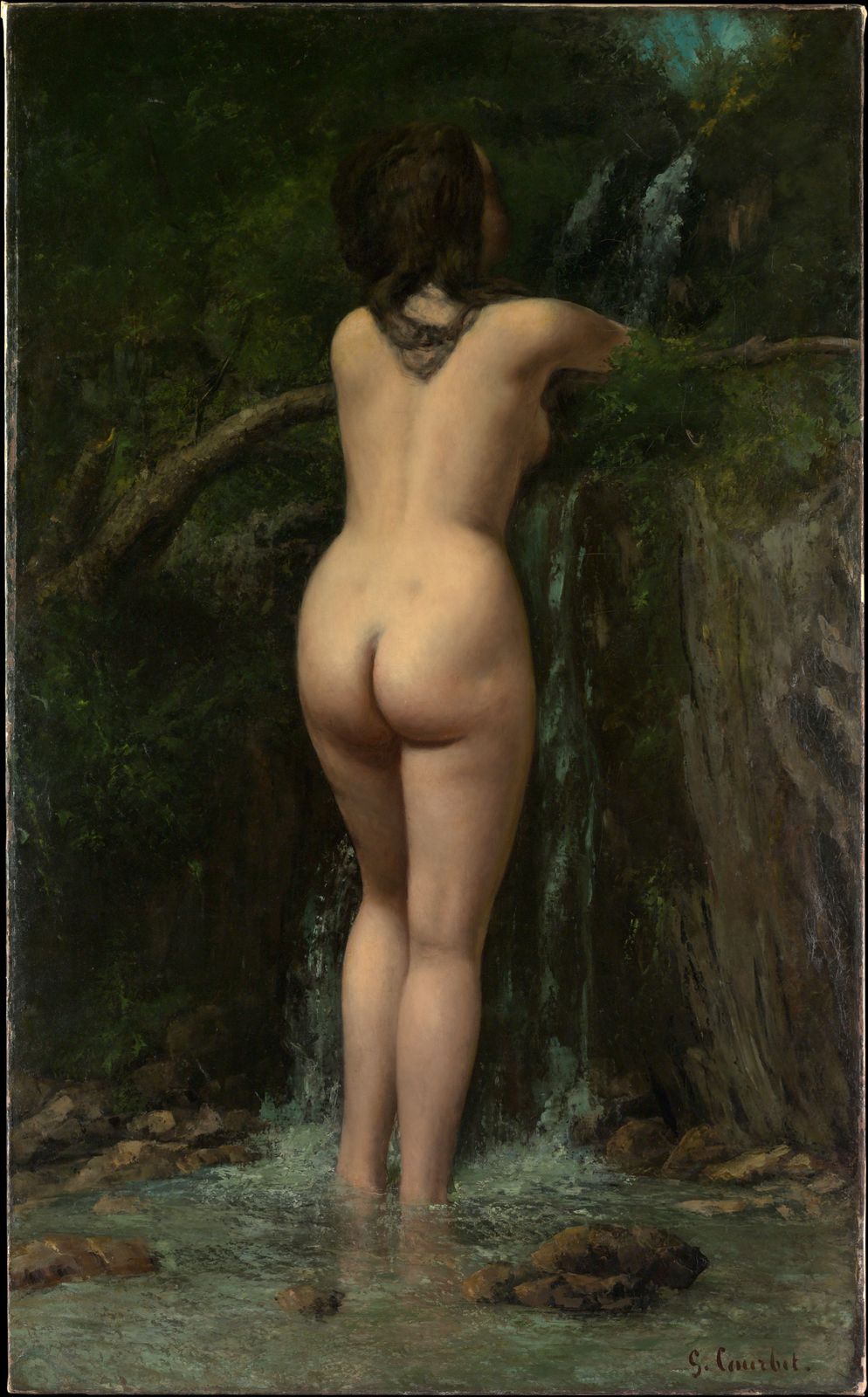
Gustave Courbet, The Source, 1862. The Metropolitan Museum of Art. Image source. CC0 / Public domain. Resized from the complete source image.
Courbet artworks directory
Browse the paintings covered in this guide. Dates identify the specific versions discussed.
Discussion
Look again at the images and ideas explored in The Bathers by Gustave Courbet. These editorial prompts invite your observations.
Reader Insights
Where does the raised hand lead your eye?
What does the difference in posture between the figures suggest to you?
How might the canvas’s size have affected the first Salon viewers?
Join the Conversation
Share a detail, comparison or question about The Bathers by Gustave Courbet below.
References
- Musée Fabre, Les Baigneuses, collection record 868.1.19. View source.
- Musée Fabre, Les Baigneuses, educational dossier. Includes extracts from Courbet’s letter to his parents of 13 May 1853, Théophile Gautier’s review of 1853 as reproduced in La Galerie Bruyas (1876), and Louis Tissié-Sarrus’s letter to Bruyas of 21 September 1853. View source.
- Musée du Louvre, François Boucher, Diane sortant du bain, collection record. View source.
- Musée d’Orsay, Base Salons, Les baigneuses, 1853 Salon catalogue entry. View source.
- Sébastien Allard and Côme Fabre, Delacroix, exhibition catalogue, 2018, pp. 203 and 260. Includes passages from Delacroix’s journal. View source.
- Musée Fabre, La « Solution » d’Alfred Bruyas. Includes Bruyas’s letter to the mayor of Montpellier, 14 September 1868. View source.
- André Joubin, Catalogue des peintures et sculptures exposées dans les galeries du Musée Fabre de la ville de Montpellier, 1926, entries for the portrait of Joséphine and Les Baigneuses. View source.
- Metropolitan Museum of Art, Gustave Courbet, 2008 retrospective checklist, The Bathers. View source.
- Paris Musées, Petit Palais, Trois baigneuses, collection record. View source.
- Metropolitan Museum of Art, The Source, collection record. View source.


