



 by Tom Gurney
Tom Gurney BSc (Hons) is an art history expert with over 20 years experience
Published on June 19, 2020 / Updated on October 14, 2023
Email: tomgurney1@gmail.com / Phone: +44 7429 011000
Biography: Introduction
Jean Désiré Gustave Courbet was born in Ornans on 10 June 1819 and died at La Tour-de-Peilz, on Lake Geneva, on 31 December 1877. Between those dates he turned the people and places of his home district into subjects for some of the most closely argued-over paintings in France. A Paris jury first accepted him in 1844. A medal in 1849 gave him an opening for the much larger pictures that followed. Twice, in 1855 and 1867, he mounted exhibitions of his own alongside the great international fairs in Paris. Then in 1871 he found himself defending his conduct before a military court. All the while, the places where he could paint and the people who would show his work mattered as much to his livelihood as the next decision in Paris. [1] [2]
At a Glance
- Born10 June 1819, Ornans
- Died31 December 1877, La Tour-de-Peilz
Gustave Courbet in context
Eugène Delacroix
1855 pavilion visit [2]James McNeill Whistler
Trouville, 1865 [2]Self-Portrait with a Black Dog
Salon of 1844 [4]A Burial at Ornans
1849–50 [5]The Painter’s Studio
1854–55 [6]The Source of the Loue
1864 [7]The Stormy Sea
Salon of 1870 [9]Contents
- Ornans and Besançon, 1819–1839
- Learning in Paris and getting into the Salon, 1839–1848
- A medal and a scandal, 1849–1852
- Alfred Bruyas and a pavilion of his own, 1853–1855
- Back at the Salon, and on the road, 1857–1866
- A second independent show and the last Salon success, 1867–1870
- War, museums and the Paris Commune, 1870–1871
- The military sentence and the civil case, 1871–1877
- Painting in Switzerland, 1873–1877
- What Courbet needed from a studio
Ornans and Besançon, 1819–1839
Courbet grew up in a family of prosperous landowners. His father, Régis Courbet, had a farm at Flagey, on the plateau above Ornans. His mother, Sylvie Oudot, came from an Ornans family with republican sympathies. The town sits in the Loue valley, and the farm gave the family a second foothold in the country above it. He kept returning to both places to work, long after he moved to Paris. [3] [10]
At around fourteen he began to study at the seminary in Ornans. Claude-Antoine Beau, one of his teachers, took his pupils outdoors to draw. In 1837 Courbet entered the Royal College at Besançon and took drawing lessons with the painter Charles-Antoine Flajoulot. The Franche-Comté he knew as a pupil is already recognisable in two small early works. One shows the bridge at Nahin, painted around 1837, and another the Loue near Ornans in 1838. The river and the built crossings along it gave a young painter nearby places to practise looking. The same valley would later supply the settings for paintings he sent to collectors, dealers and exhibitions. [3] [10]
The family gave him people to paint as well as places. His sisters appear in portraits and later in group pictures. Zélie, Juliette and Zoé would later appear together in a painting that turned a family walk into a scene of provincial life for the Salon. [2] [11]
Four stages of Gustave Courbet’s career
These periods group related developments; painting, travel and local work overlap across their boundaries.
Training and early portraits
Courbet copied older paintings in the Louvre, studied figures and secured his first Salon acceptance with the Black Dog self-portrait. [3]
Everyday figures on large canvases
After his 1849 medal, the public saw the Ornans paintings. The 1855 pavilion brought his work together under his own direction. [2]
Landscapes, figures and exhibition audiences
Courbet painted rivers, caves, portraits, seascapes and nudes, while continuing to show both publicly and independently. [2]
A working life on Lake Geneva
After the Commune, imprisonment and civil proceedings changed where Courbet could work. He continued painting during his years in Switzerland. [1]
Learning in Paris and getting into the Salon, 1839–1848
Courbet moved to Paris in 1839 and stayed with the family of his cousin Jules Oudot, a professor of law. His father wanted him to become a lawyer. Courbet chose painting and worked in private studios, among them those of the history painters Charles de Steuben and Nicolas Auguste Hesse. He also copied older paintings at the Louvre. One surviving copy, after Guercino’s Vision of Saint Jerome, belongs to the Musée Courbet. On the back of a self-portrait now in Besançon is a copy after Ingres. The two works suggest the breadth of the examples available to him in Paris, from a seventeenth-century painter’s religious scene to the work of an artist still alive. [3] [12]
He began sending work to the Salon in 1841. The jury turned down his early submissions before accepting the Self-Portrait with a Black Dog in 1844. Courbet placed himself on a rock with a dog and walking stick. He looks out from a position slightly above the viewer, with a view opening behind him. The pose makes an introduction of sorts. A visitor who had never heard of the painter could encounter him as both the maker and the subject of the picture. His other self-portraits from these years try out quite different roles, among them a musician and a wounded man. The series gives a better sense of his experiments with expression and pose than any one picture can give of his private state of mind. [2] [4]
In the mid-1840s Courbet began a relationship with Virginie Binet, who also modelled for him. Their son, Désiré Alfred Émile, was born in 1847. Binet moved to Dieppe with the child in 1852. Courbet had begun the self-portrait now called The Wounded Man during the years they were together. The Met links the changes he subsequently made to it with their separation. Beneath the figure we see today, imaging has revealed an earlier composition in which the painter rests beside a woman. [3] [13] [14]
Paris also put him among writers who could follow his work and argue about it. Champfleury, the writer and critic, became one of his early defenders. Courbet knew Charles Baudelaire and later painted him into The Painter’s Studio. In 1848 he contributed an illustration to Le Salut public, a short-lived paper associated with both men. The February Revolution brought down the July Monarchy and opened the Second Republic. It also changed the conditions of that year’s Salon, which was held without a jury. Courbet showed about ten paintings. For a painter who had repeatedly failed to get past the selectors, the chance to exhibit a group of pictures in one year mattered in its own right. [2] [12] [13]
A medal and a scandal, 1849–1852
The 1849 Salon brought a more durable change in his position. After Dinner at Ornans earned him a medal, and the French state bought the painting. It shows men listening while a companion plays the violin at the end of a meal. The people and the setting were familiar to Courbet. The scale, the weight of the dark room around the white cloth and the attention paid to the seated listeners gave the occasion the substance of a much more public event. The medal had an immediate practical consequence. He could send paintings to the next Salon without submitting them to the jury. [13] [15]
Courbet went back to Ornans and worked on a group of large paintings. He painted A Burial at Ornans in 1849–50 and showed it at the Salon of 1850–51, alongside The Stone Breakers and The Peasants of Flagey Returning from the Fair. It was the combination of subjects and scale that made the group so contentious. In A Burial, people from the town fill a canvas close to seven metres wide. In The Stone Breakers, two men spend their strength breaking and carrying stone at the roadside. Visitors accustomed to seeing sacred stories, battles or public figures at such dimensions now had to reckon with people whose names and occupations were known in the Loue valley. [2] [13] [5]
Critics could argue about the social meaning of the pictures because the Salon brought their subjects before so large an audience. But different pictures called for different judgments. Courbet’s family belonged to the landowning community he depicted, and the townspeople in A Burial occupy a different place in that community from the labourers in The Stone Breakers. At the 1852 Salon, Young Ladies of the Village put that difference in social position inside a single scene. Three women offer something to a young cowherd. The Met identifies them as Courbet’s sisters and records the hostile attention the picture attracted. The women’s clothes and the country setting became things critics could scrutinise together. By then Courbet had made encounters rooted in his own district the subject of a continuing argument about what public painting could represent. [2] [11] [5]
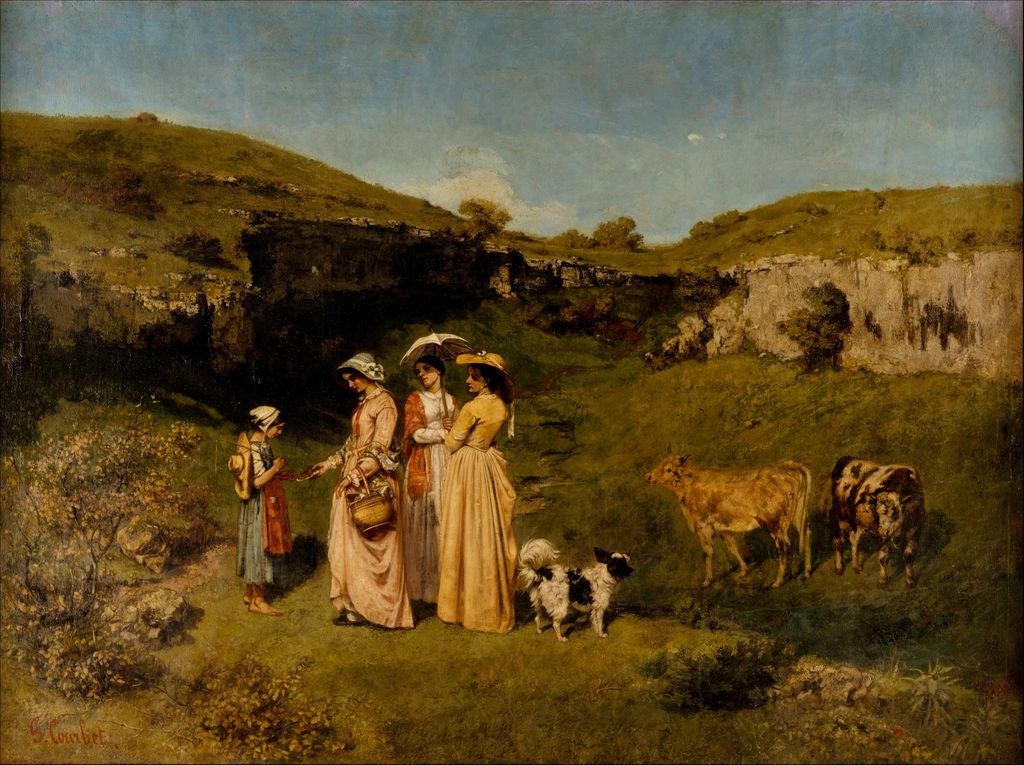
Young Ladies of the Village by Gustave Courbet, The Metropolitan Museum of Art Image source. CC0 / Public domain.
Alfred Bruyas and a pavilion of his own, 1853–1855
At the Salon of 1853, The Bathers gave Courbet a new set of critics and brought him a patron. The Montpellier collector Alfred Bruyas bought it and The Sleeping Spinner. He also commissioned a portrait from Courbet. Bruyas had spent time in Paris visiting studios, dealers and the Salon, and had already collected work by other living painters. His interest in Courbet took shape within a larger project of his own. The paintings he bought would eventually help form a public collection in Montpellier. [2] [16]
At Bruyas’s invitation Courbet went south in May 1854 and stayed in the Languedoc into September. The trip took him from the Loue valley to the Mediterranean coast. At Palavas he painted a figure by the sea, small against the water and sky. In The Meeting, he gave his relationship with Bruyas a setting outdoors, with the painter travelling on foot and the collector accompanied by a servant and a dog. Courbet had come south at the invitation of a man who bought his pictures, and now made that relationship a subject in its own right. [16]
The Exposition Universelle of 1855 gave Courbet access to an international audience in Paris. The official show included works by him. The Musée Fabre records Bruyas’s loan of The Meeting to that exhibition. The jury turned down The Painter’s Studio and A Burial at Ornans. Courbet paid to put up a separate Pavilion of Realism on the avenue Montaigne, near the exposition, with The Painter’s Studio as its principal statement. At the pavilion he could put the large paintings in a company of his own choosing. Bruyas’s Bathers went there. The loans remained a practical concern after the show. In a December letter to Bruyas, Courbet discussed the return of the paintings and the cost of shipping them. [2] [13] [16] [6] [17] [18]
Courbet’s catalogue preface took up the name Realism and explained what he wanted from painting. He presented it as work informed by earlier art and answerable to his own time, seen through his individual judgment. It was a claim to speak for his work at a moment when critics, juries and collectors were all doing so. The Painter’s Studio makes the circumstances of that claim visible. Courbet puts himself at work on a landscape at the centre of a large gathering. Bruyas, Champfleury and Baudelaire belong to the group on the right. The actual relationships that had brought Courbet to that point were part of the material with which he built the picture. [6] [17]
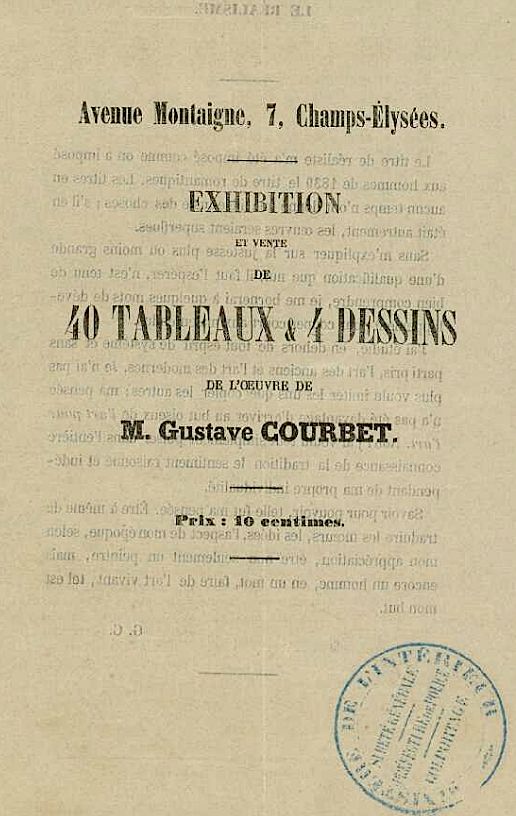
Cover of the catalogue for Courbet’s independent exhibition, 1855. Image source. Public domain. Resized from the complete source image.
Back at the Salon, and on the road, 1857–1866
Courbet returned to the official Salon in 1857 with six paintings. A hunt scene, The Quarry, and a portrait of the opera singer Louis Gueymard appeared alongside Young Ladies on the Banks of the Seine. That last work brought contemporary leisure close to the capital into his exhibition work. The group marks how far his subjects were ranging by then. A painter whose name was closely tied to Ornans could show a deer hunt, a performer and women resting by a river to the same public in the same year. [2] [13]
He travelled through Brussels to Frankfurt and spent part of 1858–59 in and around Frankfurt, hunting in the Taunus. The trips gave him first-hand experience of hunting in a landscape beyond the woods around Ornans. When he exhibited in Paris in 1861, his selection included hunting subjects, animals and landscapes, and he received another distinction. That year he also served on a committee selecting French contributions for the international exhibition in London, which showed two of his paintings in 1862. His reputation could now bring him into the machinery of an exhibition as well as into its galleries. [2] [13]
There was a brief experiment in teaching. In December 1861, at the request of students, Courbet opened a studio that lasted into the spring of 1862. The venture came more than twenty years after his own move to Paris, when he had learned through private studios and by copying paintings. In an open letter to the students dated 25 December, he put the emphasis on each painter’s powers of observation and on subjects accessible to the senses. He offered to explain how he had taught himself to work and left students to find their own way of painting. [13] [19]
In 1862 he visited his friend Étienne Baudry in the Saintonge, on the Atlantic side of France. Baudry’s gardens and greenhouses gave him a supply of subjects, and a visit intended to last a fortnight turned into an extended stay in the region. The Getty’s Bouquet of Flowers in a Vase is dated to that year. The museum connects it to the Dutch flower painting Courbet had encountered on a visit to the Netherlands in 1847. An earlier journey and a new acquaintance with the garden both had a part in opening up the genre for him. In 1864 he was again working extensively around Ornans. He took the Loue upstream as a subject in its own right and made several pictures of the spring as it issues from a cave. A letter to his dealer describes a group of views of the site. The Met’s Source of the Loue may belong to that group. In the same year he painted The Oak of Flagey, bringing a site near the family farm into a picture centred on a single tree. His trips gave him new subjects while familiar ground rewarded repeated visits. [10] [13] [20] [7]
In 1865 Courbet began a portrait of the philosopher Pierre-Joseph Proudhon after his death. Both men came from Franche-Comté and had known one another in Paris. The painting places Proudhon with his children in a scene set in 1853. Its date and subject make it a record of a friendship viewed in retrospect. That friendship belonged to a part of Courbet’s life that his landscapes and Salon nudes scarcely show, among writers who were arguing about the place of art in society. [12] [21]
At Trouville in 1865 he painted seascapes and portraits and worked alongside James McNeill Whistler. It was a resort where artists, holidaymakers and potential clients crossed paths. In Paris the following year the Salon accepted Woman with a Parrot. Other figure paintings had a private destination. The diplomat Khalil-Bey commissioned The Sleepers and was the first owner and probable commissioner of The Origin of the World. In one year Courbet could address a Salon audience and paint intimate works for a collector. Who would see a picture, and under what circumstances, could be decided well before the canvas left his studio. [2] [13] [8] [22]
A second independent show and the last Salon success, 1867–1870
In 1867 another Exposition Universelle came to Paris. Courbet again showed work in the official exhibition and mounted an independent display, this time near the Pont de l’Alma. His own show brought together more than a hundred works. He could now give whole groups of recent paintings room within a survey of his career. Among them were snow scenes with hunting subjects, some painted after heavy snow in the Ornans district during the winter of 1866–67. Seen beside earlier works, such pictures gave visitors a chance to follow what Courbet had made of years of returning to the same district under different conditions. [2] [13] [23]
Other audiences were beginning to see his work in comparable depth. The international exhibition in Munich devoted a room to him in 1869, and Ludwig II of Bavaria awarded him the knight’s cross of the Order of Saint Michael. That year he also worked at Étretat in Normandy. In the Met’s The Calm Sea, dated 1869, boats sit on the shore at low tide. At the Salon of 1870, The Wave and Cliffs at Étretat after the Storm showed what he could do with more turbulent weather and its aftermath. The pair was a public success. In the same year, Courbet turned down the French Legion of Honour in an open letter. His readiness to put paintings before a jury could coexist with a public refusal of the government’s decoration. [2] [13] [24] [9] [25]
War, museums and the Paris Commune, 1870–1871
The Franco-Prussian War and the fall of the Second Empire changed Courbet’s place in Parisian public life. In September 1870, after the proclamation of the Republic, he took the chair of the Commission des arts and helped protect the city’s collections during the war. That September he also urged the Government of National Defence to take down the Vendôme Column, a monument to Napoleon’s military victories. Months later, the Paris Commune inherited a capital divided from the national government after defeat, siege and the March insurrection. Courbet had meanwhile stood unsuccessfully in the legislative elections of February 1871. [13] [26]
On 12 April 1871 the Commune’s executive commission authorised him to restore the normal work of Paris museums, reopen their galleries to the public and re-establish the annual exhibition on the Champs-Élysées. The Commune’s decree for the demolition of the Vendôme Column was a separate decision made on 12 April. Courbet was elected to the Commune’s council four days later, on 16 April. His elected role included work on public instruction, and he presided over the Federation of Artists. [13] [26] [27] [28] [29]
The minutes of the council’s 27 April meeting record Courbet calling for the decree to be carried out. They also record that the executive commission had entrusted the work to engineers. The column fell on 16 May. Photographs and prints show the fallen monument and people gathered around it. Whether Courbet was at the demolition remains uncertain. After government troops suppressed the Commune at the end of May, his role in the affair became a question for a military court. [13] [26] [28] [30] [31]
The military sentence and the civil case, 1871–1877
Courbet was arrested on 7 June. In a letter to Pierre Frédéric Dorian that summer, preserved in the Vendôme archive, he denied responsibility for bringing the column down. The same archive records that he offered to raise money by selling pictures to help put it back up. The letter gives his position as a prisoner preparing to defend himself. The military court took a different view and in September convicted him of complicity, sentencing him to six months’ imprisonment and a fine of 500 francs. He spent part of his confinement at Sainte-Pélagie and was transferred in poor health to a clinic at Neuilly. [13] [26] [28]
Painting returned to his life during confinement and recovery. Still lifes gave him subjects he could work with in restricted circumstances, and some carry the name of Sainte-Pélagie. His pictures of trout from the period have also been read in light of the imprisonment. In the Orsay version, a fish hangs from a line with its mouth open. The museum dates that canvas to 1873 and identifies the related Zurich picture as a work of 1872 that bears the earlier date 1871. The link to captivity has informed readings of the subject, even though the paintings took shape after the events to which viewers relate them. After his release, the Salon rejected his submissions in 1872. Courbet spent months that year back in and around Ornans, painting views and returning to subjects such as snow and the sea. [2] [13] [26] [32]
The question of who would pay to rebuild the column remained open after the military sentence. In 1873 the National Assembly decided to have it rebuilt, and proceedings to recover the costs from Courbet followed. He left for Switzerland in July while the case was still in motion. A bailiff’s notice dated 16 April 1874, addressed to the dealer Paul Durand-Ruel, concerns the seizure of Courbet’s property towards the reconstruction. In June 1874 a civil judgment assigned liability to Courbet. It was upheld the following year, and in 1877 he was ordered to pay the full reconstruction costs. The stages matter because the financial pursuit accompanied him through exile for years after he had served his sentence. [13] [28] [33]
Painting in Switzerland, 1873–1877
Switzerland offered Courbet contacts he could draw on. He had visited before his exile and had exhibited in Geneva as early as 1861, with connections to the Bovy family and the painter Barthélemy Menn. After leaving France in July 1873 he spent time in the Valais and settled that autumn at La Tour-de-Peilz, near Vevey. The lakeside town put an expanse of water at his door again. This time he worked within reach of mountains rising directly beyond the shore, and with the Château de Chillon a little farther along the lake. [1] [13] [33]
He painted many views of Lake Geneva and returned repeatedly to the Château de Chillon. An 1874 canvas now in Ornans sets the building against mountain slopes and extends its reflection into the water. Chillon was already a subject of photographs and prints. The Musée Courbet connects the Ornans composition to a photograph, a specific example of the visual material Courbet could use alongside the place itself. In 1874 he also drew Marc-Louis Bovy, a portrait that attests to the family connection in a different medium. [1] [33] [34] [35]
In 1873 a selection of his paintings, including The Painter’s Studio, was shown at the Austrian Kunstverein in Vienna at the time of the international exhibition. Courbet also exhibited in Geneva and at travelling exhibitions in Bern, Aarau and Lausanne during his Swiss years. He painted portraits as well as landscapes and in 1875 modelled a bust of Liberty for La Tour-de-Peilz. Examples of the work also reached Martigny. His appeal for clemency in France failed in 1876. He continued to work as his health deteriorated and died at La Tour-de-Peilz on 31 December 1877. The bust at La Tour-de-Peilz remains a public work from his years in Switzerland. [1] [13] [33] [35]
His sister Juliette inherited his estate, including the last Ornans studio. She assembled paintings and other belongings there to preserve a record of his life and work. A Burial at Ornans entered the French national collection in 1881 as a gift from Juliette. In 1882 Juliette and Jules-Antoine Castagnary helped bring together a posthumous exhibition at the École des Beaux-Arts in Paris. Courbet himself was first buried in La Tour-de-Peilz. His remains returned to Ornans in 1919, a century after his birth. [10] [5] [36]
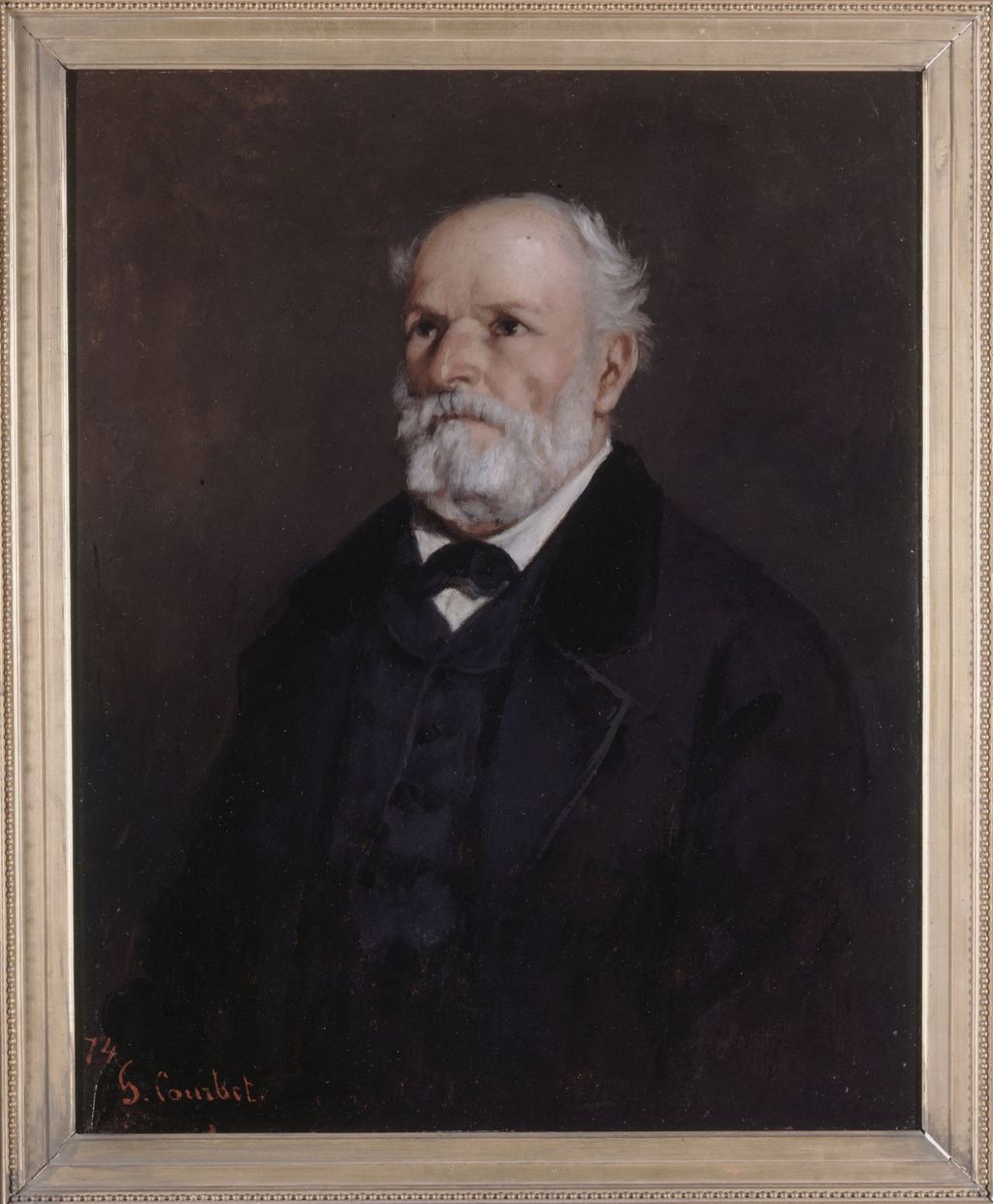
Gustave Courbet, Portrait of Régis Courbet, 1874. Petit Palais. Image source. CC0 / Public domain. Resized from the complete source image.
What Courbet needed from a studio
Courbet’s first room for painting in Ornans was an attic his father had adapted in the house of the artist’s maternal grandparents. That arrangement made it possible to work locally, but it gave a painter taking on canvases such as A Burial at Ornans little room to move back and inspect the whole picture. In October 1849 Courbet wrote to Francis and Marie Wey about changing the window. Its position and size had disappointed him and he had a much larger opening made. He also described the colours he chose for the room, including the blue overhead. The letter catches him treating the setting in which he worked as something he could alter, even in a building he had not chosen. [37]
His later plans began with a search for land in 1858. The parcels he acquired at the entrance to Ornans extended towards the Loue. Léon Isabey, the architect associated with his 1855 pavilion in Paris, produced a design for a country house and studio the following year. Courbet went a different way. He bought the former Bastide foundry in March 1860 for 5,000 francs and adapted the building. The finished workspace had a high ceiling and a large window facing north. Its size, its light and the space to keep materials close by made a different kind of work possible from the attic. The artist’s investment in Ornans took the form of an actual building he could use between trips. [37]
The Musée Courbet associates the building with the production of The Death of the Stag. A photograph by Étienne Carjat shows Courbet at work on the large canvas. A visitor to the studio might also have seen stuffed animals, furniture, arms and a study mannequin. These were objects that could be kept available to draw on and arrange, a useful reminder that some of the outdoor effects in the finished paintings were made within a room. The studio also had a social life. Friends, critics and collectors visited the property. It gave Courbet a place to receive people who had come to see him at work, in a town normally far from the exhibition calendar that shaped his reputation. [37]
Two painted views survive on the sides of the ceiling. They show the Scheldt and the Seine near Bougival, scenes from outside the region. Above them are swallows. Juliette later asked for a related sky-and-birds design in the extension she added to show his work. The distinction matters because the place visible today carries choices made by two people at different times. There is Courbet’s working room with its own painted decoration, and there is the place Juliette developed after his death for people who came to see what he had left. [37]
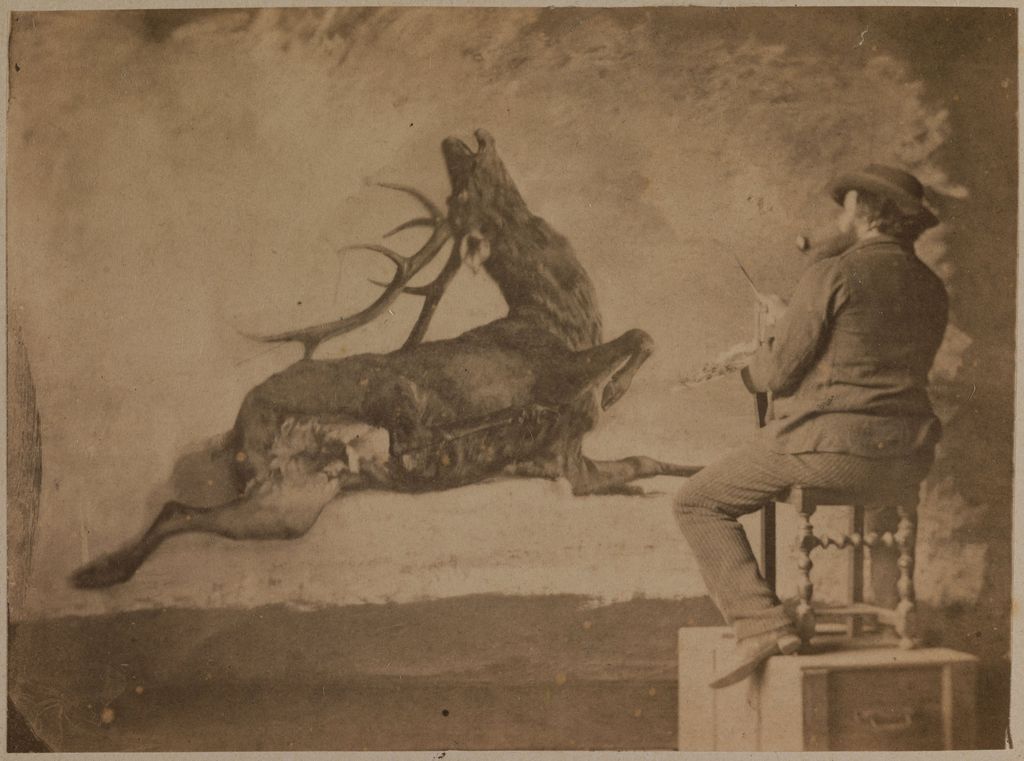
Étienne Carjat, Courbet painting The Death of the Stag, 1867. Paris Musées. Image source. CC0 / Public domain. Resized from the complete source image.
A career in more than one exhibition capital
The chronology of Courbet’s career can look different from Frankfurt or Munich. His stay in Frankfurt extended through the winter of 1858–59, and the Fondation Beyeler records his hunting in the Taunus. He was seeing another landscape and encountering another public in years when his large pictures were still provoking debate in Paris. A decade later he showed in the International Art Exhibition at Munich. The Beyeler records that the organisers reserved a room for him and that Ludwig II awarded him a decoration in the Order of Saint Michael. The Munich occasion belonged to a culture of international exhibitions that Courbet had already learned to navigate in Paris. [13]
At Munich he was also a viewer of other painters’ work. The Bayerische Staatsgemäldesammlungen records that Courbet singled out Wilhelm Leibl’s portrait of Mina Gedon in 1869, when the broader exhibition public gave it a more reserved reception. Leibl went to Paris later that year and showed the portrait at the Salon in 1870, where it drew favourable criticism. This is a documented encounter between painters at a specific exhibition. It gives a firmer starting point for discussing their relationship than a resemblance between two pictures by itself. It also shows that the French artist could use his position to direct attention towards someone whose work he was seeing for the first time in another city. [38]
A third case was Geneva. Pierre Chessex records that Courbet showed work there from 1861 and links those early opportunities with the Bovy family and the painter Barthélemy Menn. Switzerland therefore already belonged to his exhibition geography before the civil proceedings drove him across the border. Exile made the connection permanent in a way he had not planned. There is a difference between a place he had chosen to show pictures and a place where he later had to establish a household and earn a living. The earlier contacts help explain how the second phase could begin, even though the legal circumstances had changed profoundly. [1] [33]
The estate and the work of preserving it
Courbet’s letters show why the threatened loss of the Ornans building mattered to him even after he had found places to paint in Switzerland. In April 1876 he wrote to Castagnary about the cost and difficulty of making another studio if the proceedings left him without the one he had built. The issue was more than ownership of a house. The building represented years of decisions about where he would work, how he would light his canvases and where he could keep the things he drew on as a painter. The Swiss landscapes show that he could still work elsewhere, while the letter makes clear how much he thought would be lost. [33] [37]
After his death the paintings and the workplace followed different paths. The retrospective at the École des Beaux-Arts in 1882 presented works for a broad public. Juliette’s later enlargement of the studio put objects and pictures back into relation with the place her brother had chosen. The museum records a subsequent division of the property and the department’s purchase in 2008. Restoration of the surviving building and the painted decoration has made it possible to see part of that working environment again. The collection in Ornans thus has a history alongside the better-known passage of Courbet’s canvases to the national museums, from an artist’s own arrangements to an estate and eventually to a place people can study. [36] [37]
Courbet artworks directory
Browse the paintings covered in this guide. Dates identify the specific versions discussed.
Discussion
Look again at the images and ideas explored in Biography. These editorial prompts invite your observations.
Reader Insights
Which change in Courbet’s working circumstances most changed his painting?
What does the move to Lake Geneva add to the story told by his earlier landscapes?
How did showing paintings independently change who could decide what Courbet exhibited?
Join the Conversation
Share a detail, comparison or question about Biography below.
References
- Pierre Chessex, Gustave Courbet, Historical Dictionary of Switzerland. View source.
- The Metropolitan Museum of Art, Gustave Courbet, 2008 retrospective. View source.
- Musée Courbet, Tour Guide: Permanent Collections, rooms 1–2 and chronology. View source.
- Petit Palais, Autoportrait dit Courbet au chien noir, collection record. View source.
- Musée d’Orsay, Un enterrement à Ornans, collection record. View source.
- Musée d’Orsay, L’Atelier du peintre, collection record. View source.
- The Metropolitan Museum of Art, The Source of the Loue, collection record. View source.
- The Metropolitan Museum of Art, Woman with a Parrot, collection record. View source.
- Musée d’Orsay, La Mer orageuse, collection record. View source.
- Musée Courbet, Courbet en son territoire, Les Carnets du Musée Gustave Courbet no. 1. View source.
- The Metropolitan Museum of Art, Young Ladies of the Village, collection record. View source.
- Musée Courbet, Who is Gustave Courbet? View source.
- Fondation Beyeler, Gustave Courbet, biographical chronology. View source.
- The Metropolitan Museum of Art, Gustave Courbet, retrospective gallery notes, entry for The Wounded Man. View source.
- Palais des Beaux-Arts de Lille, L’Après-dînée à Ornans, collection dossier. View source.
- Musée Fabre, La « Solution » d’Alfred Bruyas, collection essay. View source.
- Gustave Courbet, 1855 exhibition catalogue, including the preface Le réalisme. BnF catalogue record. Preface transcribed by the Musée Fabre. View source 1. View source 2.
- Gustave Courbet, letter to Alfred Bruyas, 9 December 1855, discussed in the Institut Gustave Courbet exhibition catalogue Acheter Courbet. View source.
- Gustave Courbet, Lettre aux jeunes artistes de Paris, 25 December 1861. Institut Gustave Courbet manuscript presentation. View source.
- J. Paul Getty Museum, Bouquet of Flowers in a Vase, collection record. View source.
- Petit Palais, Pierre-Joseph Proudhon et ses enfants en 1853, collection record. View source.
- Musée d’Orsay, L’Origine du monde, collection record. View source.
- Gustave Courbet, Exposition des oeuvres de M. G. Courbet. Rond-point du pont de l’Alma (Champs-Elysées), Paris, 1867. BnF catalogue record. View source.
- The Metropolitan Museum of Art, The Calm Sea, collection record. View source.
- Musée d’Orsay, La Falaise d’Etretat après l’orage, collection record. View source.
- Musée d’Orsay, Courbet et la Commune, exhibition essay. View source.
- Commune de Paris, printed authorisation concerning museums and exhibitions, 12 April 1871, poster no. 128. Musée Carnavalet collection record and transcription. View source.
- Bibliothèque nationale de France, Catalogue collectif de France, Dossier sur le renversement de la colonne de la place Vendôme, 1871–1874, fol. 124, archive inventory. View source.
- Musée des Beaux-Arts de Caen, Muséales en Normandie, educational dossier on Courbet and the Commune’s decree. View source.
- Musée Carnavalet, La colonne Vendôme après sa chute le 16 mai 1871, collection record. View source.
- Joël Petitjean, Courbet et la Commune. Représentations photographiques, identification et mystification, excerpt from the minutes of the Commune’s 27 April session and discussion of photographs. View source.
- Musée d’Orsay, La Truite, collection record. View source.
- Musée d’art et d’histoire, Geneva, Gustave Courbet. Les années suisses, Musée Rath exhibition dossier, 2014–15. View source.
- Musée Courbet, La nature comme tableau, Les Carnets du Musée Gustave Courbet no. 2, study of Le Château de Chillon. View source.
- Musée Courbet, Courbet, dessinateur, bicentenary exhibition dossier, section on exile. View source.
- Institut Gustave Courbet, Biographie de Gustave Courbet. View source.
- Musée Courbet, Histoire de l’atelier, building history, transcribed letters and photograph. View source.
- Bayerische Staatsgemäldesammlungen, Wilhelm Leibl, Bildnis der Frau Gedon, collection record and exhibition history. View source.


