



 by Tom Gurney
Tom Gurney BSc (Hons) is an art history expert with over 20 years experience
Published on June 19, 2020 / Updated on October 14, 2023
Email: tomgurney1@gmail.com / Phone: +44 7429 011000
The Origin of the World: Introduction
Gustave Courbet brought the reclining nude so close to the edges of The Origin of the World that the body seems to continue into the room where the viewer stands. The head, arms and lower legs lie outside the composition. Pale bedding gathers around the torso, and a dark strip beneath it offers the only suggestion of a setting. The Musée d’Orsay dates the oil on canvas to 1866 and gives its dimensions as 46.3 by 55.4 centimetres. The painting is small enough to take in at close range. [1]
The frame acquired another purpose over the course of the painting’s life. In private collections, a curtain or a second picture could stand between the nude and its audience. In 1988, the Brooklyn Museum exhibited Courbet’s canvas to the public. It joined the Musée d’Orsay in 1995, after more than a century in which relatively few people could see the original. The move from a private room to a gallery changed the conditions under which the picture could be seen. [1]
At a Glance
- Date1866
- MediumOil on canvas
- CollectionMusée d’Orsay, RF 1995 10
Contents
- How Courbet frames the body
- Khalil-Bey and private patronage
- How the painting got its title
- Who might have posed for Courbet?
- From the dealer’s shop to the Lacans’ house
- Brooklyn, Ornans and the Musée d’Orsay
- What examination of the canvas edges established
- Another way to withhold a face
How Courbet frames the body
Follow the white fabric from the side of the torso up towards the breast at the top of the picture. Along that route, its folds change from soft shadows into sharper ridges of light. Against the fabric, the abdomen reads as a continuous plane with gradual shifts in colour. The deep brown of the background and the darker hair give the warm skin tones something to work against. Courbet directs attention to the vulva through the angle of the thighs and the contrast around it, then gives the eye a succession of textures to follow across the canvas. [1]
The proportions of the canvas contribute to the effect. It is wider than it is high, but only just. There is little space for the long line that conventionally leads the eye from a reclining figure’s head to her feet. The torso instead recedes towards the upper right, and the nearer thigh carries the composition towards the lower left. The perspective suggests a viewer close to the body, on the side towards which the knees would extend. As the edges cut across the figure, the eye has to supply the continuation of those forms. This makes the cropping feel deliberate even when the pose seems unarranged. Fernier’s catalogue records an unsigned canvas of substantially the same dimensions. The crop is a feature of the surviving picture. [1] [2]
There is scarcely enough information to tell where the scene takes place. The cloth suggests a place to lie down, and its folds register the weight and angle of the body, but there is no view into a room or out towards a landscape. There is no face to establish a character, return a look or register an attitude towards being seen. The body is close enough to suggest an intimate encounter, while the circumstances of that encounter are almost entirely withheld. The tension belongs to the painting’s arrangement and remains visible whoever the model may have been. [1]
Courbet’s Woman with a Parrot makes the differences unusually clear. Shown at the Salon in the same year, that much larger canvas also sets a reclining body against a dark ground and white cloth. The woman’s extended arm, the bird above it and the perch at the right establish a circuit for the eye. The face and loose hair give critics something to read as signs of character or manners. Some objected to the pose and dishevelled hair. The French state nevertheless briefly considered buying the painting. With The Origin of the World, Courbet removed the gestures and accessories through which a Salon audience could account for the nude’s presence and gave the anatomy the concentration of a much closer view. [3] [4]
The Musée d’Orsay calls attention to the amber range of colours and situates the painting in the tradition of the painted nude. That observation explains something the subject alone leaves out. A change in the temperature of a shadow can make flesh turn away from the light. A painted fold can establish how close the body lies to a surface. Those are familiar problems in European figure painting, brought into unusually close contact here with details that an idealised Salon nude might soften or cover. The force of the image comes in part from that continuity of craft. [1]
Khalil-Bey and private patronage
Khalil-Bey, the Ottoman diplomat and collector also known as Khalil Chérif Pacha, is the first owner in Orsay’s provenance. The Metropolitan Museum of Art describes The Origin of the World as a private commission, and Robert Fernier’s catalogue raisonné says it was painted for Khalil-Bey. That is the usual account of how the painting came into being. The ownership record establishes his connection to the canvas more firmly than it establishes the precise terms on which Courbet made it. The commission’s instructions, including who proposed the close framing, remain unknown. [1] [2] [4] [5]
Two other paintings give a sense of the collection in which it was seen. Khalil-Bey acquired Ingres’s The Turkish Bath, a circular composition of interlocking figures whose long, continuous contours encourage the eye to move from one body to another. The Louvre records the picture at his Paris sale in January 1868. He also commissioned Courbet’s Sleep, another 1866 canvas, now at the Petit Palais. Its two intertwined figures take up much of a large horizontal painting, with the bed, jewellery and surrounding furnishings still in view. The pictures suggest three very different ways of organising intimacy, from Ingres’s crowded circle to Courbet’s paired figures and then the single body isolated by the small Orsay canvas. [6] [7]
The collection also held work by Delacroix and Théodore Rousseau. The concentration on erotic pictures in accounts of Khalil-Bey reflects the unusual history of these particular objects. His broader purchases place the Courbet commission within the activity of a collector conversant with contemporary French painting. A wealthy private buyer gave Courbet room to vary the scale, pose and degree of exposure in his nudes. The Salon painting of the same year shows that this freedom coexisted with an active interest in what a juried public exhibition might accept. [3] [4] [5]
In an account published in 1878, the writer Maxime Du Camp described a small Courbet behind a green veil in Khalil-Bey’s dressing room. Fernier reproduces the passage in the catalogue raisonné, and Orsay includes the curtain in its account of the painting’s display. Du Camp’s list of missing body parts makes the framing sound like a painter’s absurd lapse, even as he acknowledges the quality of the painting. His sarcasm belongs to a retrospective and hostile account of Courbet in a book about the Paris Commune. It gives evidence about how the picture was described and shown, with little basis for reconstructing the habits of everyone who saw it. [2] [8]
A curtain in a private room made the moment of looking an event. Someone who knew where the canvas was could draw back the veil, and someone else could be admitted to see it. The arrangement allowed for discretion and for the theatre of a deliberate unveiling. In either case the owner could decide who saw the painting and when. A later encounter in a dealer’s shop shows that this controlled form of viewing outlasted Khalil-Bey’s ownership. [2] [8] [9]
How the painting got its title
Orsay catalogues the work as L’Origine du monde. That name has a history of its own. Art historian Frédérique Desbuissons finds early descriptions that refer to the body or the torso, and points to a 1935 lecture by Courbet scholar Charles Léger as an early documented use of the familiar name. The chronology of those written records leaves open when the phrase began to circulate and who devised it. [1] [10]
The title proposes a reading in its own right. The word ‘world’ takes a close view of one body and asks it to stand for something much larger. The reference to origins suggests birth and human generation, while the composition itself supplies no infant, narrative of maternity or scene of creation. The gap between the literal image and the scale of its name helps explain how the picture can be read as a work about desire, generation or the limits of the nude. Since the title’s authorship is uncertain, it is most useful as evidence of the painting’s reception. [1] [10]
Who might have posed for Courbet?
In 2018 the Bibliothèque nationale de France announced a proposal by the writer and editor Claude Schopp, who worked with Sylvie Aubenas, head of the library’s prints and photography department. While preparing an edition of Alexandre Dumas fils’s correspondence with George Sand, Schopp found a reference to a woman from the Paris Opéra. The editors identify her as Constance Quéniaux, a dancer linked to Khalil-Bey. The letter is dated 17 June 1871 in the published edition, about five years after the date assigned to the canvas. [11] [12] [13]
Dumas was writing angrily about Courbet in the aftermath of the Commune. He brought up a painting of Quéniaux’s intimate anatomy made for a Turkish patron and, in the same attack, referred to a picture of two women together. Read in light of Khalil-Bey’s collection, those two descriptions fit The Origin of the World and Sleep. The value of the letter is that its writer links a name, a patron and two unusual subjects. The inference still depends on matching his allusions to particular canvases. How Dumas learned of the paintings, and whether Quéniaux actually sat for Courbet, remain open questions. [7] [11] [12] [13]
The BnF also holds portraits of Quéniaux by Nadar and Disdéri. They connect the name in the letter with a person who had a career in the theatre and was photographed in her own right. They cannot provide a facial comparison with Courbet’s canvas, in which the face falls outside the frame. The photographs and the letter therefore answer different questions. The photographs document Quéniaux’s appearance and public identity. The letter supplies the circumstantial connection to the nude. [11] [13]
Joanna Hiffernan was an earlier suggestion. Her association with Courbet is well established through the portraits known as Jo, the Beautiful Irishwoman. The Metropolitan Museum of Art connects its version to Courbet’s time with James McNeill Whistler at Trouville in 1865. That evidence identifies Hiffernan in a different composition and explains why her name arose in discussion of Courbet’s work from the mid-1860s. For The Origin of the World, the Dumas letter gives Quéniaux a more specific connection. Her identification remains a hypothesis grounded in a period source. [11] [12] [13] [14]
From the dealer’s shop to the Lacans’ house
On 29 June 1889, Edmond de Goncourt recorded seeing the painting at the shop of the Paris dealer Antoine de La Narde. Goncourt came to see Japanese objects and encountered the Courbet in the course of his visit. Fernier’s catalogue reproduces his response, including a comparison of the painted flesh with Correggio’s. Where Du Camp made the unusual crop the basis of a joke, Goncourt found an occasion to reconsider Courbet’s skill in painting flesh. Their very different responses entered the history of the picture when few readers would have been in a position to make the comparison for themselves. [2] [9] [10]
At La Narde’s the picture was concealed behind a snowy scene. Fernier suggested that a painting known as The Château of Blonay might be that cover, based on the title, measurements and collecting history. He expressed doubt over the attribution of the landscape to Courbet. The evidence for the covering arrangement is stronger than the identification and authorship of its painted component. In the shop, a snowy landscape could look like a self-contained object until someone showed what lay behind it. [2] [9]
Orsay marks possible ownership by Émile Vial with a question mark. The record next lists the gallery Bernheim-Jeune from 1912 to 1913, a sale to Baron Herzog on 16 June 1913 and the collection of Baron Ferenc Hatvany. Fernier preserves a somewhat different account in which Hatvany obtained the nude and its frame from Bernheim-Jeune, while Herzog obtained the landscape cover. The two accounts make it especially important to distinguish the passage of Courbet’s canvas from the passage of the device that concealed it. [1] [2] [9]
The Musée d’Orsay records the canvas in Jacques Lacan’s collection from 1955. The Centre Pompidou-Metz describes its acquisition that year by Lacan and his wife Sylvia Bataille and the commissioning of a sliding wooden cover from the Surrealist painter André Masson, Sylvia’s brother-in-law. Masson gave the cover a landscape-like design with spare contours that echo the figure beneath. With the cover closed, the line could be read as terrain. As the panel moved aside, the correspondence between the line and the body became apparent. In the Lacans’ country house, the movement of the panel could make that resemblance part of a visitor’s encounter with the painting. [1] [8] [15]
The earlier covers offered two different surfaces, a snowy scene and a length of fabric. Masson produced a second image for this particular canvas, allowing it to suggest in outline what it concealed in paint. His panel belongs to the twentieth-century history of the object. It also shows how an owner and another artist could bring their own interpretation to the experience of seeing a work by Courbet. [2] [15]
Brooklyn, Ornans and the Musée d’Orsay
Courbet Reconsidered opened at the Brooklyn Museum on 4 November 1988 and ran until 16 January 1989. The museum archive documents the exhibition, organised by Sarah Faunce and Linda Nochlin, and the French national collections record identifies the painting as catalogue no. 66. Orsay describes Brooklyn as its first public exhibition. After generations of occasional private viewings, the picture could be studied in the company of other works by Courbet and discussed by an audience who had seen the object for themselves. [1] [8] [16] [17]
In 1991, Sylvia Bataille lent the canvas and the Masson cover to the Musée Courbet in Ornans for an exhibition on Masson, Les Yeux les plus secrets. Jean-Jacques Fernier, the curator who arranged the loan, recalled that the museum led visitors towards the work through a deliberately subdued space. The two objects had remained physically and conceptually connected in the Lacan household. The Ornans display allowed a public audience to consider that relationship and made the passage to the painting itself part of the visit. [1] [18]
In 1995 France accepted the work for its national museums through a dation en paiement, which allowed the heirs to settle inheritance taxes with the painting. Orsay’s record distinguishes the ministerial decision of 10 May from the order of 13 June and the assignment to the museum. The canvas entered Orsay without the Masson cover and received inventory number RF 1995 10. The accession provided a public collection and a regular setting for study after the temporary exhibitions in Brooklyn and Ornans. [1] [17] [18]
In 1996 the newly acquired painting appeared in Féminin-masculin. Le sexe de l’art at the Musée national d’art moderne in Paris. It was now available for exhibitions with different organising questions. The subject of that show was sex in art. A separate exhibition later the same year invited a closer look at the history of this particular picture. [1] [5] [17]
Laurence des Cars’s 1996–97 exhibition at Orsay set the canvas alongside The Turkish Bath, Sleep and Courbet’s painting of the source of the Loue. The first two works returned the nude to the context of Khalil-Bey’s collection and the third introduced a comparison with Courbet’s treatment of a landscape. A decade later, the retrospective that travelled from Paris to New York and Montpellier in 2007–08 placed it among the artist’s public and private nudes. These displays made different features available for comparison, from the conventions of the reclining figure to the relationship between figure and landscape. [1] [4] [5]
Subsequent exhibitions have taken up the question of who looks. In 2014 the Musée Courbet surrounded the picture with other representations of female genitalia and works made in response to it. In 2024 the Centre Pompidou-Metz exhibited the canvas in a show about Lacan’s engagement with art, returning attention to the collector and the experience of viewing. Orsay also records a different kind of encounter in 2011, when Facebook restricted circulation of the painting’s image under its rules. A photograph shared on a platform passes through a new system of access, even when the original is publicly exhibited. [1] [8] [15] [18]
At Orsay, the physical scale of the canvas remains an important part of seeing it. An enlarged reproduction can make the anatomy seem overwhelming by itself. The small original brings that directness into contact with the quiet transitions of tone across the belly, the folds of the cloth and the little depth between body and background. The history of curtains, panels and exhibition rooms explains why so many viewers arrived with a story about the picture. Standing before it gives them the chance to see how much of that story begins at the edges of the canvas. [1] [2]
What examination of the canvas edges established
The closeness of the framing has prompted a literal question about the object. Could the Orsay canvas have been cut from a larger picture that showed the sitter’s face? The Centre de recherche et de restauration des musées de France records what happened when a proposed fragment of a head was published. Researchers returned to the painting’s X-ray and a conservator removed the strips of paper that concealed the edges. The examination found that the unpainted margins survived. On that evidence the centre rejected the claim that the Orsay canvas had been cut from a painting from which the proposed head had been taken. [19]
The distinction is between an edge in the composition and an edge in the material. A painted form can continue in the viewer’s imagination beyond a rectangle that was chosen from the beginning. Evidence that the margins survive answers a claim about how the present object was made. It leaves the sitter’s identity and Courbet’s reasons for selecting the view open. It also gives the story of the covers a firmer starting point. The curtain and the Masson panel could change the order in which someone saw the painting, while the surviving canvas already determined where the body passed out of view. [1] [15] [19]
Courbet sometimes did alter the physical extent of a work. The same laboratory account describes the Peasants of Flagey as cut and subsequently enlarged. An earlier reading of a partial radiograph had led to the conclusion that the surviving painting was a later repetition. The two cases show why a join or an apparently abrupt image edge calls for its own examination. The existence of an altered canvas elsewhere in Courbet’s work cannot tell us whether the Orsay nude was one. [19]
Another way to withhold a face
In 1868 Courbet painted La Source, a much larger upright nude, also at the Musée d’Orsay. The figure turns away while reaching towards the water. The direction of her attention can be inferred from the pose and from the water, rock and vegetation around her. The title identifies a place and an action that the painting gives the viewer a chance to follow. The museum sets it against the convention in which a nude could stand as an allegory of a spring. Courbet brings the body into direct contact with a setting that has weight and texture. [20]
The Origin of the World makes very different use of the fact that we cannot read the face. With so little setting, there is scarcely an action for the eye to follow outside the body and the bedding. Compare also the window and curtain of Femme nue couchée. There the window supplies a light from outside and the architecture helps locate the bed within a room. The Orsay picture concentrates much of the change in light on the flesh and the folds nearest it. Taken together, the works show how differently Courbet could arrange a nude by varying the space he lets the eye enter. [1] [20] [21]
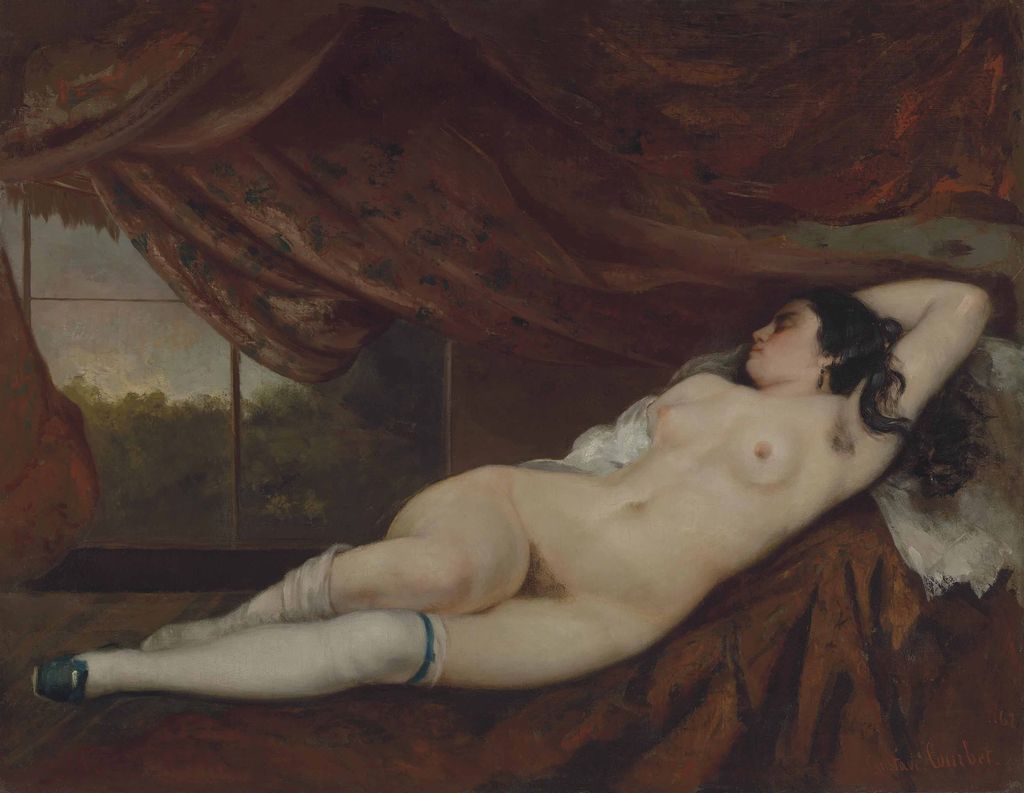
Femme nue couchée, 1862, formerly Hatvany. Image source. Public domain. Resized from the complete source image.
Courbet artworks directory
Browse the paintings covered in this guide. Dates identify the specific versions discussed.
Discussion
Look again at the images and ideas explored in The Origin of the World. These editorial prompts invite your observations.
Reader Insights
How does the close framing affect what you notice?
What changes when the work moves from a private viewing to a museum gallery?
How should a museum distinguish a plausible identification from a documented one?
Join the Conversation
Share a detail, comparison or question about The Origin of the World below.
References
- Musée d’Orsay, L’Origine du monde, object record RF 1995 10. View source.
- Robert Fernier, La Vie et l’œuvre de Gustave Courbet, vol. II, p. 6, no. 530, and adjacent entry for the proposed cover. View source.
- The Metropolitan Museum of Art, Woman with a Parrot, object record 29.100.57. View source.
- The Metropolitan Museum of Art, Gustave Courbet, 2008 retrospective. View source.
- Musée d’Orsay, L’Origine du monde. Autour d’un chef-d’œuvre de Courbet, 1996–97 exhibition. View source.
- Musée du Louvre, Jean-Auguste-Dominique Ingres, Le Bain turc, object record RF 1934. View source.
- Petit Palais, Le Sommeil, Paris Musées collection record. View source.
- Musée d’Orsay, ‘Tout le monde cache « L’Origine »’, Les mondes numériques d’Orsay. View source.
- Institut national d’histoire de l’art, research notice on Antoine de La Narde. View source.
- Frédérique Desbuissons, ‘Voir le mal en face’, Ligeia, nos. 19–20, 1996–97. View source.
- Bibliothèque nationale de France, 2018 announcement on the research identifying Constance Quéniaux. View source.
- Alexandre Dumas fils to George Sand, 17 June 1871, BnF, NAF 24812, fol. 294, letter 71-17 in Thierry Bodin and Claude Schopp, eds., Correspondance, Phébus, 2019. View source.
- Sylvie Aubenas on Constance Quéniaux and Claude Schopp’s discovery, Chroniques de la BnF, no. 84. View source.
- The Metropolitan Museum of Art, Jo, La Belle Irlandaise, object record 29.100.63. View source.
- Centre Pompidou-Metz, Lacan, l’exposition, exhibition guide, 2023–24. View source.
- Brooklyn Museum Archives, Courbet Reconsidered, exhibition press file, 1988. View source.
- Ministère de la Culture, Joconde notice M5060000044. View source.
- Institut Gustave Courbet, ‘L’Origine du monde de retour au Musée Courbet à Ornans’, including the 1991 curator’s account. View source.
- Bruno Mottin, C2RMF, Gustave Courbet étudié et restauré au C2RMF, re-examination of the canvas edges and account of the Flagey support. View source.
- Musée d’Orsay, La Source, object record, RF 2240. View source.
- Christie’s, Femme nue couchée, illustrated lot record for the 1862 canvas. View source.


