


 Gustave Courbet.jpg)
 by Tom Gurney
Tom Gurney BSc (Hons) is an art history expert with over 20 years experience
Published on June 19, 2020 / Updated on October 14, 2023
Email: tomgurney1@gmail.com / Phone: +44 7429 011000
Young Ladies beside the Seine (Summer): Introduction
A woman has settled so low on the riverbank that her cheek is almost level with the leaves. Her white skirts spread across the grass, and the hand that extends beyond her face seems too relaxed to be holding anything. A second woman props her head on her hand, a bouquet resting against her dress. The Seine shows blue through the trees, with a little boat at the bank. There is room in Gustave Courbet’s Young Ladies beside the Seine (Summer) for all the pleasures of an afternoon outdoors, yet the painting puts us so close to the women that looking begins to feel like an intrusion. [1]
Courbet began the picture in Ornans in 1856 and worked on it in the studio. The finished oil on canvas, dated 1857 by the Petit Palais, measures 174 by 206 centimetres. It is signed at lower left and entered the museum in 1906 as a gift from Étienne Baudry through Juliette Courbet, the painter’s sister. At the Paris Salon of 1857 it appeared under its French title, Les Demoiselles des bords de la Seine (été), at the Palais des Champs-Élysées. Across more than two metres of canvas, the women’s poses were legible from across a crowded room, even though the details of their clothing invited a much closer look. [1] [2] [3]
At a Glance
- Date1857
- MediumOil on canvas
- CollectionPetit Palais, PPP377
Contents
- A place in the shade
- Two ways of resting
- What the critics saw in 1857
- The painting after the Salon
- The Paris and London paintings
A place in the shade
The women have taken up a small piece of ground under a dense canopy. A trunk on the right gives the woman at the back something to lean against. Across the middle, branches hang low over the boat. Beyond the shade, the eye catches the open water and a low strip of the farther bank at the left edge. Courbet gives us just enough distance to recognise the river before bringing us back to the grass. The breadth of the canvas makes that bit of open water seem particularly small. Most of what we see belongs to the near bank and the patch of shade the women occupy. [1]
The boat is easy to overlook among the branches. Its shallow curves distinguish it from the loose pattern of leaves, and its closeness to the grass makes it feel like part of the outing. The flowers offer another trace of activity. Their bright heads lie together in a bunch against the upper woman’s dress, while scattered flecks of yellow in the grass belong to the bank itself. Courbet leaves the relation between these things open. The boat makes it easy to imagine the women arriving by water, and the flowers might have been gathered along the way. The painting begins where those possible actions end. [1]
The Petit Palais draws attention to the broad touches with which Courbet paints the light coming through the foliage. Look at the contrast between the scatter of light on the leaves and the long, cool folds in the foreground. The river has an openness and brightness that the bank lacks. Under the trees, patches of illumination find bits of cloth and bare skin, then break up again on the grass. The painting was composed indoors, yet those uneven changes of light make the shade feel like a particular refuge from summer heat. [1] [2]
Two ways of resting
The figure closest to us lies almost flat. Her head turns outward and both arms extend to the right, where a narrow gold bracelet catches the light. The Petit Palais identifies her visible garments as a corset and petticoat. The pale fabric gathers and flares, and a fringed shawl with a patterned border crosses the white expanse. Follow the pattern as the shawl folds over itself and the body underneath becomes harder to trace. At the far left, small stretches of stocking and dark shoes give the sprawling fabric a human length. At the right, the half-open eyes make it difficult to mistake repose for sleep. [1] [2]
Her companion reclines higher and keeps her head up with a gloved hand. Her elbow keeps the line from shoulder to head upright above the sweep of the skirts. A wide, light hat frames the face, turned towards the left. Below it, red and orange details in the dress emerge against the dark trunk and leaves. The bouquet sits between the two figures, close to the edge of the lower woman’s white clothing. A few of its flowers pick up the colour of the fabric, while yellow, blue and red lead the eye back into the darker costume. Courbet binds the two figures together through such small exchanges of colour while letting their attention go in different directions. [1]
At the Salon the clothes placed both women in the present. The hat, glove and bracelet could be read against what a visitor had worn to the exhibition or seen on the streets of Paris. The petticoat was equally familiar, though ordinarily hidden by a dress. Here the foreground woman appears to have made herself comfortable without much regard for the impression she would make. A painted goddess reclining in a landscape came with a recognisable role. Courbet’s woman wears contemporary underwear, and a viewer has to reckon with the circumstances in which an actual person would be seen like this. The Petit Palais reads her outward gaze as a reversal in which the person looking becomes aware of having entered a private moment. [2]
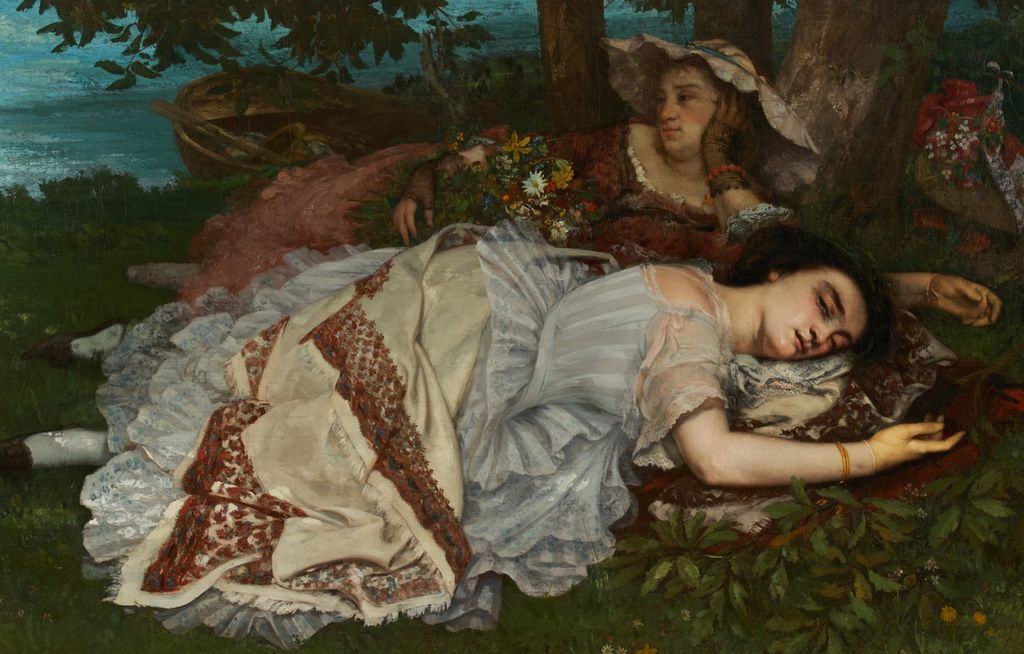
Detail of Young Ladies beside the Seine (Summer), Petit Palais PPP377. Shown here, the reclining figures and their clothing. Image source. CC0 / Public domain. Cropped and resized from the source image.
What the critics saw in 1857
Gustave Planche, writing in the Revue des Deux Mondes, approached the painting with Courbet’s Bathers of 1853 already in mind. He treated the new canvas as a challenge to those who had objected to the painter’s choice of subjects. He wondered how the foreground woman was even positioned and conceded skill in her execution while judging it badly spent. Planche had once entertained the idea that scandal was a route to recognition and that Courbet would change course when he had made his name. The Seine painting persuaded him that the artist meant to persist. His review makes visible the reputation that reached the Salon wall ahead of the picture. [4]
Maxime Du Camp also struggled to find the bodies within the clothes. He described the figures as a mass of fabrics from which heads and limbs emerged. Yet he singled out the lower woman’s arm and shawl as exceptionally deft passages. He even objected to the Seine being painted blue, which he thought implausible in the muddy environs of Paris and a deliberate choice to harmonise with the greens in front. The same folds that made the bodies hard for Du Camp to read let us see the weight of cloth left where it fell. The strip of blue sets off the crowded foreground and makes the depth of the shade apparent. [5]
Du Camp attached a degrading social story to the women and characterised the foreground woman’s eyes as impudent. Cham turned the same impulse to classify her into a joke in his caricature of the Salon. The caption calls his figure a society woman suddenly stricken with colic in the countryside and says that Courbet wanted to prove he could paint a respectable woman as readily as a common one. The cartoon supplies an embarrassing incident to account for the posture. It also shows how readily a viewer could convert the way a woman lay on the grass into a judgement of her standing. [5] [6]
The Petit Palais records that some interpreters have seen the women as Parisian prostitutes. It also notes a proposal that the pair evoke the sisters in George Sand’s novel Lélia. The models’ identities remain unknown. The two proposals answer different questions. One seeks a social reading of the scene, while the other seeks a literary association. The title supplies a season and a setting. Courbet leaves the character of the outing to details as open to interpretation as the boat, flowers and discarded layers of dress. [2]
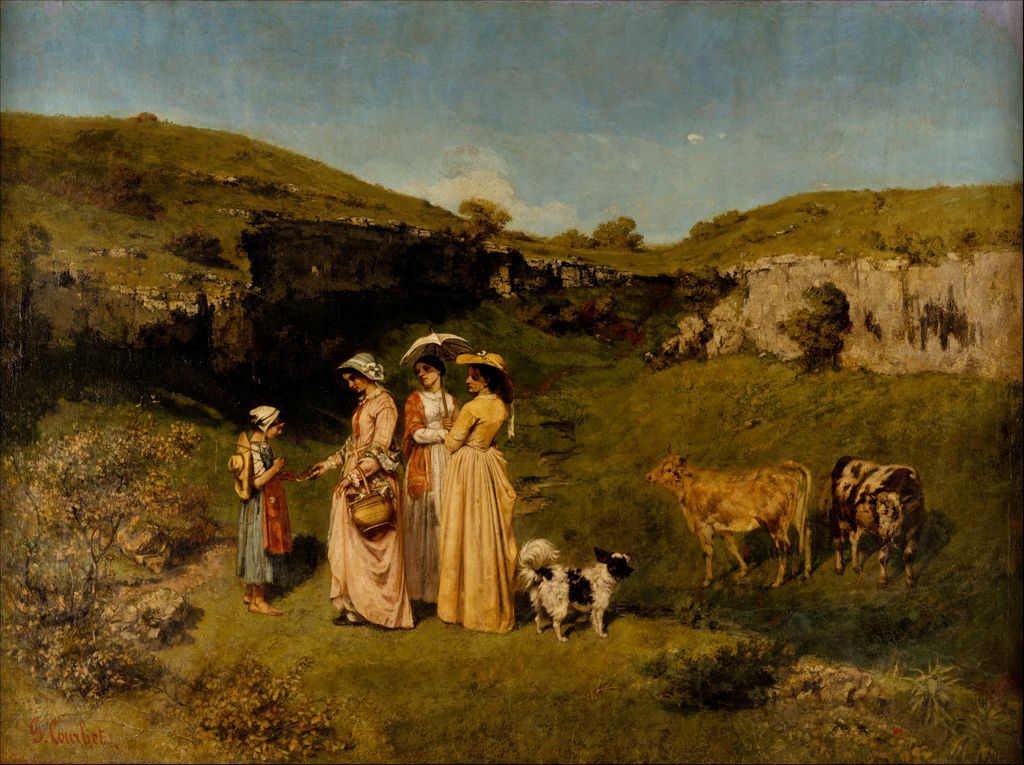
Young Ladies of the Village, Met 40.175. Image source. CC0 / Public domain. Resized from the complete source image.
The painting after the Salon
By 1910 Henry Lapauze could look back on the offence the picture had given to critics and celebrate the harmony of its colour. In his account of the Petit Palais collection, he pictured the women tired out by boating and flower gathering and perhaps lingering too long over a meal. He imagined the meadows towards Bougival and La Grenouillère, drawing on the reputation those resorts had acquired by the end of the Second Empire. The location and the meal belong to his reconstruction. Where Du Camp had treated the blue against the green as an affront to realism, Lapauze found the colour harmonious throughout and admired the sunlight dappling the dresses. [5] [7]
The Petit Palais compares Courbet’s treatment of figures in a landscape with Édouard Manet’s Le Déjeuner sur l’herbe, shown six years later at the Salon des Refusés after the official jury rejected it. Courbet’s two women occupy the shade without a group of companions. Manet sets a nude woman beside two dressed men and opens up the background to a bather. In both works the people and their clothes, or the clothes they have taken off, put a contemporary outing into a setting with a long history in painting. The distinction is especially clear in Courbet’s foreground, where a petticoat and a crumpled shawl can carry the charge that exposure carries in Manet. [2] [8]
The Paris and London paintings
A painting with almost the same English title is in the National Gallery, London. Young Ladies on the Banks of the Seine (Summer), inventory NG6355, is an oil on canvas measuring 96.5 by 130 centimetres. The Gallery catalogues it as possibly after Gustave Courbet and dates it tentatively to the 1870s. It acknowledges the existence of preparatory studies for the Salon canvas and considers whether London’s painting is a study or a later copy. Its current assessment doubts that the work is in Courbet’s hand. The London work once belonged to Juliette Courbet, the same sister who helped bring the larger painting into the Petit Palais. The large canvas that Salon critics saw in 1857 is PPP377 in Paris. [1] [9]
The Paris painting also has a near namesake in Courbet’s own work. In Young Ladies of the Village, shown at the Salon of 1852 and now in the Metropolitan Museum of Art, his three sisters walk in a valley near Ornans and one offers alms to a cowherd. In that picture an extended hand carries the action. On the Seine the hand nearest us has come to rest. Looking back from the blue water to that open hand, it is easy to see why viewers kept supplying stories for the picture and why those stories have never settled. Courbet painted the particulars of an outing with great care and gave the women the time and space to do very little. [1] [10]
Courbet artworks directory
Browse the paintings covered in this guide. Dates identify the specific versions discussed.
Discussion
Look again at the images and ideas explored in Young Ladies beside the Seine (Summer). These editorial prompts invite your observations.
Reader Insights
What differences do you see in the two women’s poses?
How much of the setting can you identify through the branches?
What can the clothes establish about the scene and what questions do they leave open?
Join the Conversation
Share a detail, comparison or question about Young Ladies beside the Seine (Summer) below.
References
- Paris Musées, Les Demoiselles des bords de la Seine (été), Petit Palais collection record and reproduction, PPP377. View source.
- Petit Palais, Les Demoiselles des bords de la Seine (été), collection interpretation and acquisition credit. View source.
- Musée d’Orsay, Base Salons, Les demoiselles des bords de la Seine (été), catalogue entry for the Salon of 1857. View source.
- Gustave Planche, Salon de 1857. La Peinture, Revue des Deux Mondes, 1857. View source.
- Maxime Du Camp, Le Salon de 1857. Peinture, sculpture, Paris, Librairie Nouvelle, 1857, pp. 101–105. View source.
- Cham, Femme du monde prise subitement de la colique à la campagne, Salon of 1857 caricature reproduced in Albums du Charivari. View source.
- Henry Lapauze, Le Palais des Beaux-Arts de la Ville de Paris, 1910, p. 76. View source.
- Musée d’Orsay, Édouard Manet, Le Déjeuner sur l’herbe, collection record. View source.
- National Gallery, Young Ladies on the Banks of the Seine (Summer), NG6355, collection entry and provenance. View source.
- The Metropolitan Museum of Art, Young Ladies of the Village, collection record, 40.175. View source.


