



 by Tom Gurney
Tom Gurney BSc (Hons) is an art history expert with over 20 years experience
Published on June 19, 2020 / Updated on October 14, 2023
Email: tomgurney1@gmail.com / Phone: +44 7429 011000
The Wounded Man by Gustave Courbet: Introduction
A man rests against a tree with his eyes closed and his shirt open at the throat. A sword leans beside him, its hilt just visible against the bark. The smallest detail changes how we read the scene. A red stain on the white shirt makes the man's stillness look less like sleep. Gustave Courbet used his own face for this figure in The Wounded Man (L’Homme blessé). The Musée d’Orsay in Paris dates the oil on canvas to 1844–54. It measures 81.5 × 97.5 cm and is catalogued as RF 338. The date range spans the making and remaking of the portrait. [1]
At a Glance
- Date1844–54
- MediumOil on canvas
- CollectionMusée d’Orsay, RF 338
Contents
- A sleeping pose and a wound
- What the X-rays revealed
- An artist in the role of a duellist
- From the independent exhibition to the Musée d’Orsay
- The later canvas in Vienna
- How the layers become evidence
A sleeping pose and a wound
Courbet places his head high in the picture and allows his body to slip diagonally towards the lower right. Warm light falls across the forehead, the closed lids and one cheek. It leaves much of the hair and beard in shadow. His head appears to have come to rest against the trunk, and the open collar falls away on either side of his neck. Farther down, a hand emerges from a pale cuff. Its loose fingers rest against the dark covering, with little suggestion of a grip. The hand and the closed eyes would make sense in a picture of someone drifting off to sleep. [1]
The setting helps sustain that impression. A heavy trunk occupies much of the left side, and leaves hang above the figure. A narrow opening on the right reveals sky and a distant line of trees. That glimpse makes the man seem to be lying in a sheltered spot within a larger landscape. Courbet lets the lower half of the picture darken almost to the point where the folds disappear. The eye returns to the collar, the face and the hand because those are the places where light makes their edges clear. The pale shirt spreads across the middle of the picture, so that the red mark near the heart is conspicuous even though it occupies very little space. [1]
The sword takes longer to pick out. The glint on the pommel and the curve of the guard distinguish it from the tree. Its diagonal runs up towards the shoulder while the torso slopes away in the other direction. Nothing in the man's expression supplies a precise account of what has just happened. The weapon and the stain suggest the aftermath of a duel, an interpretation that has some support in Courbet’s own language. In an exchange with the writer Pierre-Joseph Proudhon, cited by art historian Ségolène Le Men, Courbet referred to the figure as his dying duellist. The painted scene leaves the encounter offstage. It gives us one man, his sword and the signs of an injury, with enough of the posture of sleep to make us look again. [1] [2]
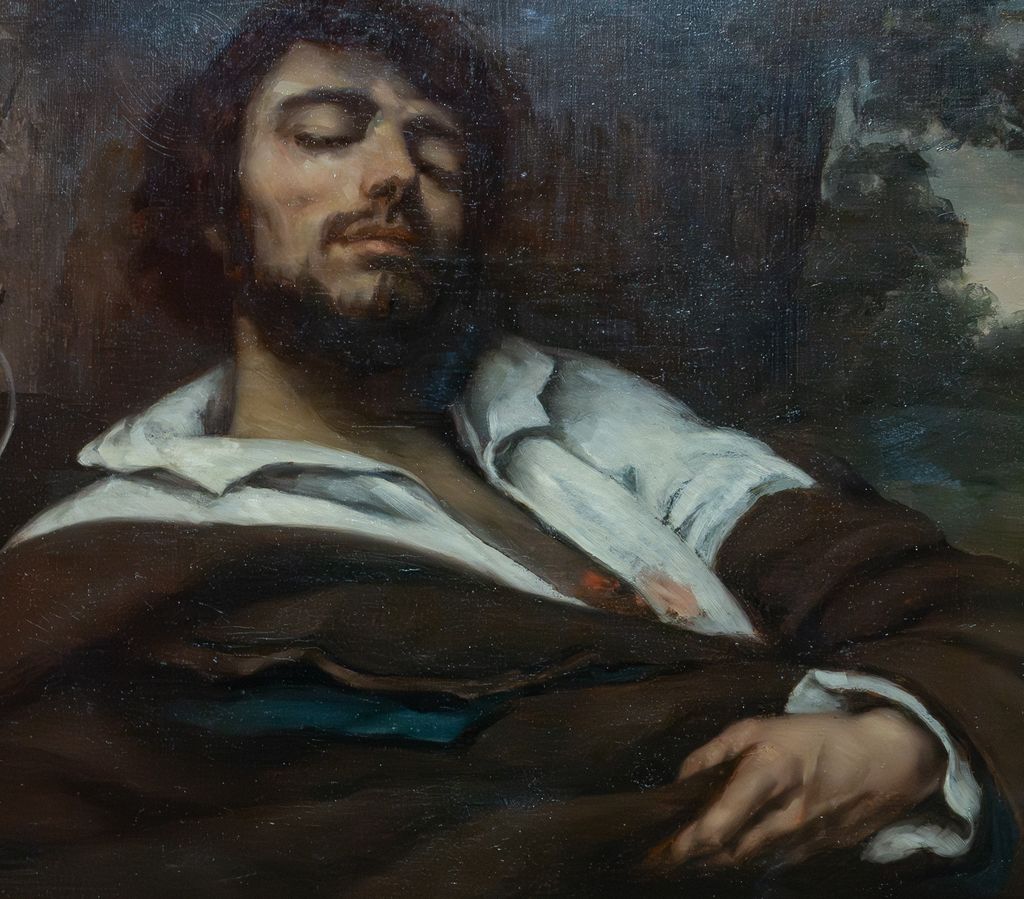
Detail of The Wounded Man, Musée d’Orsay RF 338. Shown here, head and upper body. Image source. CC0 / Public domain. Cropped and resized from the source image.
What the X-rays revealed
Laboratory examination reported in 1973 uncovered earlier figures beneath the paint. The oldest composition that researchers could distinguish was a portrait of a woman in profile. A subsequent scene showed two figures together beneath the tree, with a woman leaning against the reclining Courbet. The published radiograph made in 2012 shows traces of the companion that Courbet covered. Her presence changes the meaning of a familiar outline. In the composition with two people, the man's shoulder gives another person a place to rest. On the visible surface, that same reclining pose belongs to a man lying alone. [2] [3] [4]
A 2016 study led by Ina Reiche tested how the buried pictures were stacked. One method mapped where particular chemical elements occurred across selected areas of the surface, picking up signals from several layers at once. A second method probed selected spots at different depths. A map can show the shape of an earlier painted feature, but when the marks overlap, depth helps establish which one came first. The combined readings supported the sequence from the woman's portrait to the couple and then to the wounded Courbet. Eight or more paint layers could be distinguished in the study. The mercury signal, from the red pigment vermilion, helps trace the lips and nose of the woman in profile. Some of those traces overlap marks from the couple, so the team used depth measurements there to distinguish them. The researchers judged the first composition likely to have been left unfinished. [4] [5]
The drawing Country Siesta (Sieste champêtre), in the Musée des Beaux-Arts et d’Archéologie in Besançon, offers a more immediate comparison. Made with charcoal and pencil and softened by blending, the sheet shows a man and woman resting close together under a tree. The Met's 2008 retrospective compared it to the couple in the radiograph. On the sheet the two bodies are close enough to read as one arrangement of weight, with the companion tucked against the man's upper body. The resemblance helps us picture the effect of the lost scene without assuming that the drawing was made first or was meant as a plan for the canvas. [2] [6] [7]
Courbet retained the broad position of the reclining figure while revising his appearance and changing what surrounded him. The Met describes dark brown covering painted over the woman's body. The Musée d’Orsay draws attention to the sword where the companion had rested and to the blood-red mark added to the shirt. Those changes redirect the viewer's attention within a pose already in place. The body once had a companion to explain its repose. Now the mark on the shirt accounts for the silence that the face and hand suggest. [1] [2] [7]
An artist in the role of a duellist
The Musée d’Orsay interprets the changes as a response to a breakup. The Met connects them to Courbet’s separation from Virginie Binet in 1852, and the French museum conservation centre's account identifies the companion as Binet. Le Men treats the link between the revision and the breakup as a supposition. The Musée Courbet’s Devenir Courbet teaching dossier gives more weight to the possibility that the painter was dissatisfied with the earlier picture. The evidence of the layers establishes where and how much he changed. The sitter's identity and his reason for covering her remain matters of interpretation. [1] [2] [4] [7] [8]
Le Men also asks whether Courbet might have had Pyramus and Thisbe in mind. In the story, Pyramus mistakenly believes that Thisbe has died and mortally wounds himself. The encounter with a sword beneath a tree and the loss of a companion make the comparison possible. As a reading of the painting it gives the red mark an emotional as well as a physical meaning. The duel suggested by Courbet’s remark to Proudhon gives the same clues a different history. The artist could borrow the gravity of a tragic scene while leaving the viewer to decide what kind of loss had brought the figure to the ground. [2]
In 1854 Courbet wrote to his patron Alfred Bruyas that he had painted himself as his state of mind changed, likening the succession of portraits to writing his life. The self-portraits let him do this through poses and objects. In the Self-Portrait with a Black Dog, his first painting accepted at the Salon in 1844, he looks down towards us from a rocky seat. His walking stick and dog suggest someone who can get up and continue on his way. The Desperate Man brings the painter so close that his spread fingers and wide eyes are hard to look away from. The wounded figure closes his eyes to us and seems unaware of being watched. The costume and the sword give him a role to play, while his lowered lids let us study the face at our own pace. [1] [7] [9]
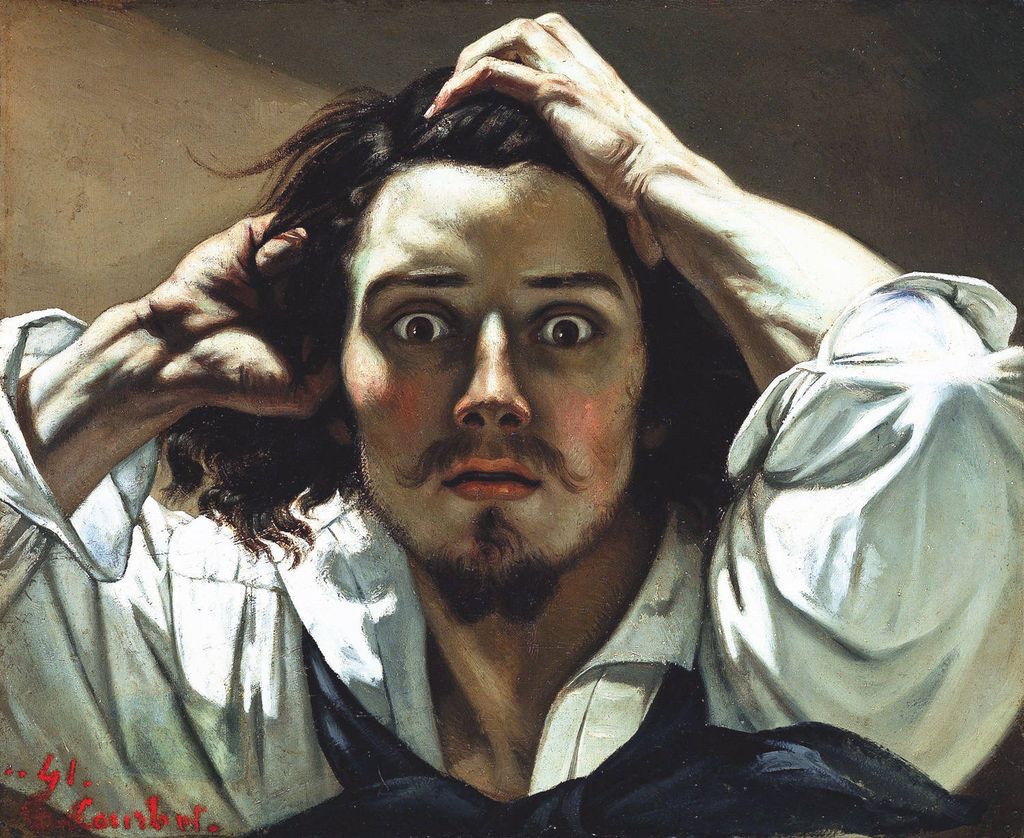
Gustave Courbet, The Desperate Man, about 1844–45. Qatar Museums, on loan to the Musée d’Orsay. Image source. Public domain. Resized from the complete source image.
From the independent exhibition to the Musée d’Orsay
The Musée d’Orsay records the painting as number 12 in Courbet's Pavilion of Realism in Paris in 1855, the independent show he set up during the Universal Exhibition. Visitors could see him in more than one guise. Alongside the reclining man was The Meeting, in which Courbet paints himself on his feet and equipped for a walk as he meets Bruyas. At the same show, The Painter’s Studio placed him at work at an easel in the middle of a crowded room. In each case we recognise the artist from his face, but it is the company he keeps, the objects near him and the place he occupies that tell us what part he has given himself. The wounded man was shown again at Courbet’s independent exhibition in 1867. [1] [2] [9]
Georges Riat, writing in 1906, noted that the catalogue of the 1867 exhibition dated the painting to 1844 in Paris. Riat also recorded that Jules-Antoine Castagnary argued for 1854 in the catalogue of the 1882 retrospective, on the grounds that the handling looked too assured for Courbet's early work. Riat proposed that Courbet had probably returned to an early composition around 1854. The current Orsay and French national catalogue records date the work to 1844–54 and record Courbet's signature at the lower left. That span accommodates the history of an early canvas and the later revision that made the subject recognisable under its present title. [1] [2] [10] [11]
The painting passed into the collection of Courbet’s sister Juliette after his death in 1877. The French state bought it as lot 6 at the studio sale at the Hôtel Drouot on 9 December 1881. It was assigned to the Louvre in 1882 and transferred to the Musée d’Orsay in 1986. That record follows the canvas that preserves all three compositions. A painting with nearly the same arrangement in another museum has its own history. [1] [11]
The later canvas in Vienna
The Belvedere in Vienna catalogues its A Wounded Man (Der Verwundete) as a reiteration of the Paris painting, dated about 1866. It is an oil on canvas measuring 79.5 × 99.5 cm, has the inventory number 2376 and entered the Belvedere in 1923. The similar titles reflect the subject shared by two canvases. The 1844–54 date, the studio-sale provenance and the imaging evidence for the buried companion belong to the Paris work. The Vienna picture shows that Courbet returned to the composition after he had arrived at the image of the man alone. By then that image could serve as the subject of a new painting in its own right. [1] [4] [12]
How the layers become evidence
The 2016 study combined a map of selected chemical elements across areas of the surface with measurements designed to help distinguish signals from different depths. These are complementary ways to ask where a material occurs. A broad map can disclose the shape of a buried passage. Measurements at selected points can help investigators decide whether a signal probably comes from paint below or from what remains visible on top. In a picture with more than one hidden composition, the question of depth matters. A map that showed every signal at once could make passages from different stages look as if they had been painted together. [4] [5]
One advantage of comparing the methods is that it lets the researchers keep changes on different scales in view. A revision may be the width of a stroke around the face, while the loss of a second figure changes the subject of the whole picture. The centre describes earlier radiographic work as part of a study of Courbet’s self-portraits, and treats the later elemental analysis as a fresh investigation of the same layered object. The studies can strengthen a reading of a hidden pose. The identification of a sitter and the reason an artist changed it still involve other records and interpretation. [4] [5]
Look at the present figure with that distinction in mind. The head inclines as if it needed support. The closed eyes are compatible with sleep, exhaustion or injury until the blood and sword give them a more specific setting. Because the artist kept something of the earlier man’s pose, we can still recognise that physical ease inside an image about injury. In The Desperate Man a visitor has the opposite experience. The awake eyes and hands announce distress straight away, while the painting supplies little evidence for its cause. In each canvas one visible clue is strong and another is deliberately scarce. [1] [4] [13]
Courbet artworks directory
Browse the paintings covered in this guide. Dates identify the specific versions discussed.
Discussion
Look again at the images and ideas explored in The Wounded Man by Gustave Courbet. These editorial prompts invite your observations.
Reader Insights
What can you infer about the man from his posture alone?
How do the sword and the stain change the scene?
What does the technical examination establish about the earlier composition?
Join the Conversation
Share a detail, comparison or question about The Wounded Man by Gustave Courbet below.
References
- Musée d’Orsay, L’Homme blessé, RF 338. View source.
- Ségolène Le Men, Problèmes de genèse d’un tableau de Courbet. L’homme blessé, pp. 47–64. View source.
- Gilles Bastian, Sous les « repentirs », La Lettre de l’Académie des beaux-arts, no. 80, p. 11. View source.
- Bruno Mottin, C2RMF, Gustave Courbet étudié et restauré au C2RMF : un travail au long cours. View source.
- Ina Reiche and colleagues, “New insights into the painting stratigraphy of L’Homme blessé by Gustave Courbet combining scanning macro-XRF and confocal micro-XRF,” Applied Physics A 122, article 947 (2016). View source.
- French Ministry of Culture, Joconde, Sieste champêtre, notice M0332004824. View source.
- Metropolitan Museum of Art, Gustave Courbet, 2008 exhibition gallery. View source.
- Musée départemental Gustave Courbet, Devenir Courbet, teaching dossier, p. 7. View source.
- Metropolitan Museum of Art, Gustave Courbet, 2008 exhibition overview. View source.
- Georges Riat, Gustave Courbet, peintre, 1906, pp. 36–37. View source.
- French Ministry of Culture, Joconde, L’Homme blessé, notice 000PE000700. View source.
- Belvedere, A Wounded Man (Der Verwundete), inventory 2376. View source.
- Musée d’Orsay, Le Désespéré, object record. View source.


