


 Sitting, Study Drawing Gustave Courbet.jpg)
 by Tom Gurney
Tom Gurney BSc (Hons) is an art history expert with over 20 years experience
Published on June 19, 2020 / Updated on October 14, 2023
Email: tomgurney1@gmail.com / Phone: +44 7429 011000
Gustave Courbet’s Drawings: Introduction
A hand fills the lower left of a small album page. Above it is a head in profile. Farther across, Gustave Courbet wears a broad hat and holds a pipe between his lips, while a handful of people occupy a patch of countryside below him. The hand is much larger than any of those people. Courbet can make the knuckles turn in space with graphite and then, a few centimetres away, suggest a gathering with marks small enough to take in at a glance. The page brings those two scales together without making them part of the same scene. [1]
At a Glance
- MediaChalk, charcoal, Conté crayon and other drawing media
- WorksStudies, self-portraits and drawings in letters
Contents
- A sketchbook page and its neighbour
- Three self-portraits on separate sheets
- Drawing the Loue
- A drawing for a painting
- Drawings and words on the same page
- When a drawing follows a painting
A sketchbook page and its neighbour
The Louvre’s Department of Prints and Drawings keeps this 14 × 21.7 cm leaf in an album from the Musée d’Orsay collection. The catalogue identifies the mixed studies as folio 23, drawn on the recto, or front, and gives a broad date of about 1840 to 1860. The darker strokes concentrate around the hat and the figure beneath it. In the profile at upper left, the eye and lips are clearer than the neckline. The places where the outlines fade into paper let us see how much Courbet could leave unstated while still giving the head a direction and tilt. [1]
The next leaf, folio 24, carries a graphite drawing catalogued as Seated Man Reading; Landscape with a Bridge. It shares the pipe drawing’s dimensions and album, but has its own inventory number. The catalogue describes portraits, landscapes, animals and architecture elsewhere in the volume, and records Courbet’s workshop stamp inside the front cover. The album makes a useful unit of comparison. A seated reader and a bridge can share a page much as a hand and a hillside can, while the catalogue’s broad dating of the preceding leaf leaves room for Courbet to have worked in it at different times. [1] [2]
Three self-portraits on separate sheets
Courbet’s Seated Young Man, Study, also called Self-Portrait at the Easel, is a separate charcoal drawing on paper, 45 × 34 cm. A broad sweep of charcoal runs across his chest and out to the right. The light catches the sleeve in angular patches, while the marks across the lap curve with the folds. The darkness of his hair frames features that would take up only a small part of the Louvre album leaf. Here there is room for the shoulders, clothing and pose to carry as much of the impression as the likeness itself. The Louvre dates the sheet to about 1847, citing Laurence des Cars’s comparison of the face with painted self-portraits, including The Cellist in Stockholm. The comparison helps place the drawing in Courbet’s career. It rests on the appearance of his face across different works and poses. [3]
The British Museum’s Self-Portrait of 1852 is larger still, at 57 × 45 cm. Courbet turns his head slightly and meets the viewer’s eye. The beard is densely worked and the upturned collar picks up the light beneath it. Across the lower part of the sheet, the edges of the clothing grow looser and the background remains visible between strokes. The contrast between the beard and collar gives the head a strong base, while the less heavily worked shoulders lead the eye back up to the face. The Art Fund records the drawing as charcoal, and the British Museum’s exhibition text gives the same medium and identifies the sheet as 1925,0711.1. The Art Fund explains the direction of the hair parting as a consequence of Courbet drawing himself in a mirror. The British Museum’s exhibition text discusses a proposed link with a painting in Copenhagen, then points to differences in hair and shirt and reads the drawing as more likely to be a work in its own right. [4] [5]
A much smaller Self-Portrait at the Metropolitan Museum of Art shows Courbet touching the side of his beard. The Met dates it to about 1866 and records the medium as Conté crayon. Within the 26.7 × 21 cm sheet, dense marks across the jacket give way to a pale hand. That hand takes up a narrow space between sleeve and face, but its light tone makes the gesture easy to follow. The background is worked into a midtone, so the forehead and hand can register through smaller differences of light than the collar and beard in the British Museum portrait. In the Louvre album the hand was a subject of study on its own. Here it changes how we read the sitter, whose turned head and raised fingers make the encounter feel more reflective. [1] [4] [6]
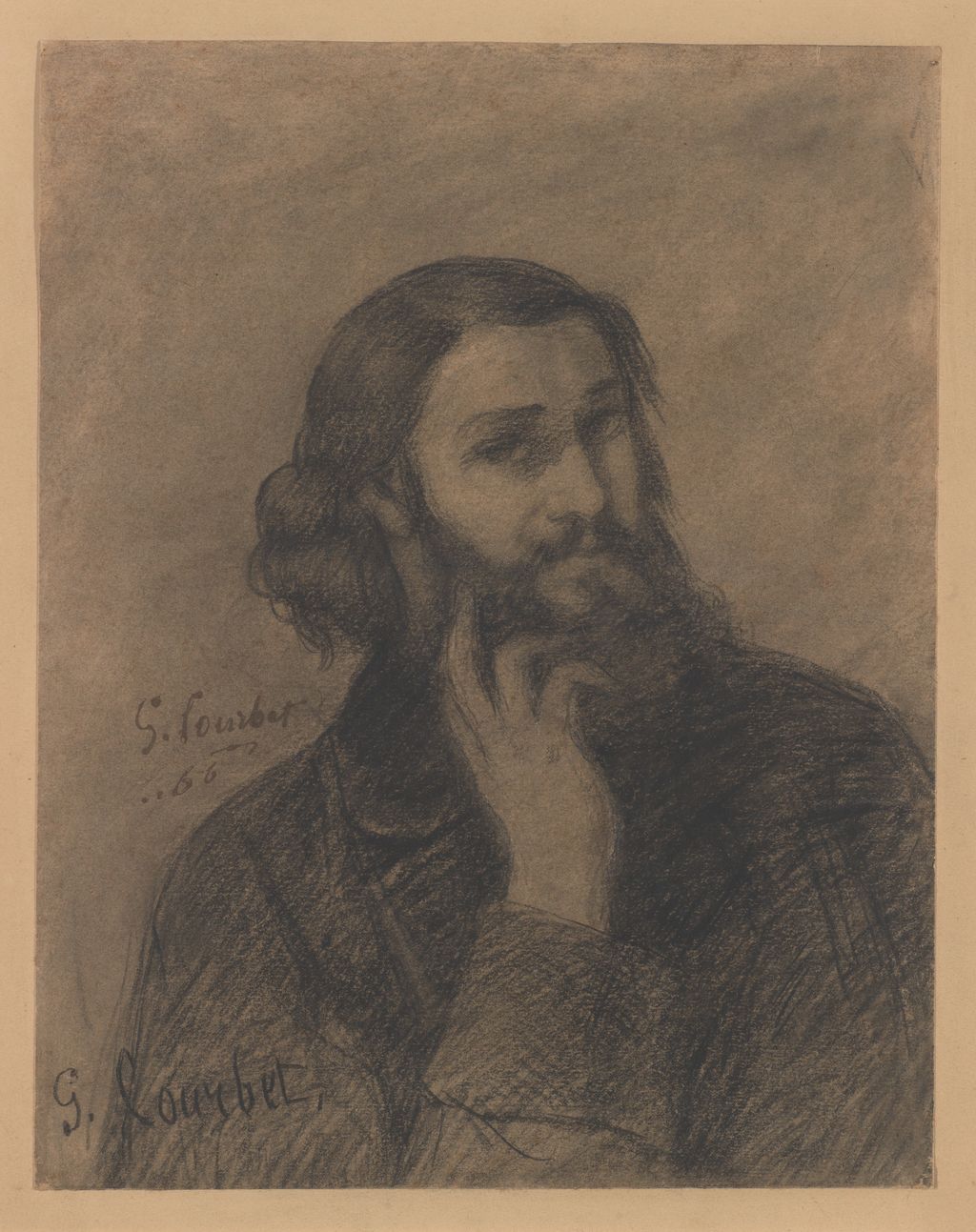
Gustave Courbet, Self-Portrait, about 1866. The Metropolitan Museum of Art. Image source. CC0 / Public domain. Resized from the complete source image.
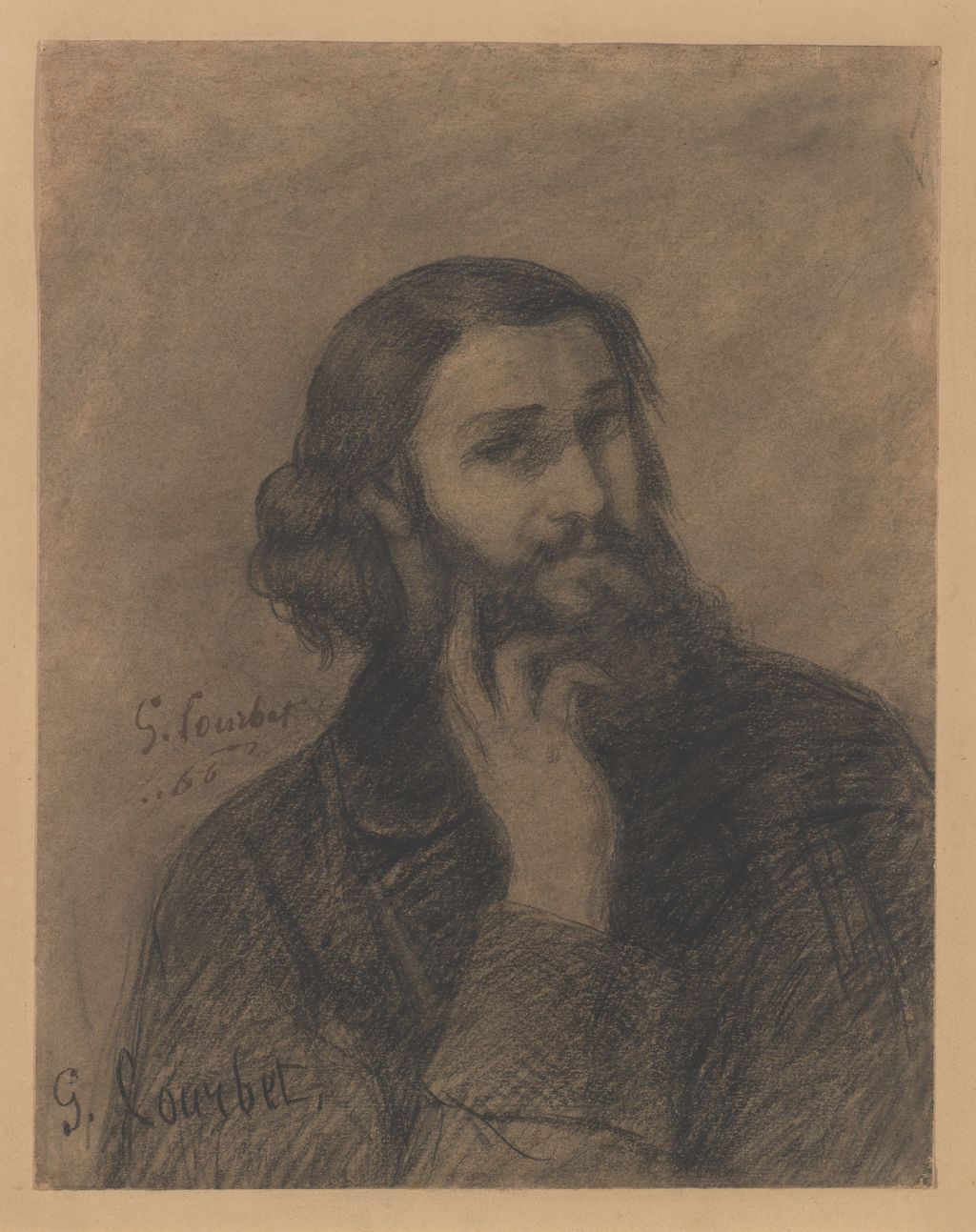
Self-Portrait, c. 1866, a Conté crayon drawing by Gustave Courbet The Metropolitan Museum of Art. Image source. CC0 / Public domain.
Drawing the Loue
The country sketches in the Louvre album share space with other subjects. Courbet gave a single landscape much more room in a drawing of the source of the Loue, now in the Museum of Fine Arts in Budapest. The Budapest catalogue dates the sheet to about 1864 and lists black and red chalk, pencil, watercolour and opaque white on brown paper. At roughly 39 × 60 cm, it has room to set the opening of the cave against the rock around it and the water below. The brown support already provides a middle tone. Courbet could work towards greater depth with dark material and towards the light with opaque white, so the paper itself could remain part of the landscape. [7]
The site also appears in Courbet’s paintings of the source of the Loue. The Musée Courbet discusses the subject as a series in both painting and drawing. That recurring motif allows comparison across media. In the Met’s 1864 oil painting, for example, the cave’s darkness and the textured rock and water depend in part on how Courbet varied his handling of paint with the palette knife. On the Budapest sheet the coloured support and the combination of dry and wet media offer a different way to establish those contrasts. The museum evidence places the drawing alongside a group of works on the same subject. It leaves the sequence of that sheet and the Met canvas open. [7] [8] [9]
A drawing for a painting
A long charcoal drawing in Besançon has a more firmly documented relationship to a particular canvas. The Musée des Beaux-Arts et d’Archéologie holds the preparatory study for A Burial at Ornans, inventory D.3980. It measures 37 × 95 cm and is drawn on bluish paper. Four men carry the coffin and a line of mourners fills the space around the burial. At this scale the charcoal lets the coats and hats register as a succession of dark shapes. The artist could see how an interval between figures or a change in the density of the group would affect the whole procession. [10]
The Centre de recherche et de restauration des musées de France distinguishes the Besançon sheet from the drawing Courbet made on the canvas itself. Its examination found that he set out figures over a brown preparation before working up the paint. The radiograph also shows that he moved the priest roughly 28 cm back from the grave during execution. On a canvas large enough for that shift to be measured in tens of centimetres, moving one person changes the space available to others and how we follow the procession towards the grave. The study records an early arrangement, while the painted object preserves evidence of choices made after Courbet had begun to work at full scale. [10] [11]
Drawings and words on the same page
In a signed four-page letter that the Louvre dates to February or March 1850, Courbet told the writer Champfleury about the burial picture and The Stone Breakers. He describes hunting and carnival in Ornans alongside his work and mentions the difficulty of accommodating people who wanted to be in the burial scene. The letter tells us something the charcoal study alone could scarcely show. In arranging a crowd, Courbet was also dealing with the expectations of people who might recognise themselves or their neighbours. [12]
A different letter, to his patron Alfred Bruyas, shows what happened when a drawing and a written description shared the page. In January 1854 Courbet imagined a large tent for an exhibition and sketched it over part of the handwriting. His description puts a column at the centre and pictures an entrance with staff and a place for sticks and umbrellas. The sketch gives the proposed structure a profile, while the writing supplies the movement of people through it. Patricia Mainardi, who reproduces the letter, notes that the pavilion Courbet ultimately built for his independent 1855 exhibition was rectangular. The two records preserve different stages, an idea Courbet was able to convey on paper and the structure visitors encountered in Paris. [13]
When a drawing follows a painting
The Musée Courbet identifies a charcoal-and-stump drawing of The Man with a Pipe in the Jean Bonna collection as a monochrome version made after the painting of that name now in the Musée Fabre. The order matters. The painted portrait already existed when Courbet restated it in charcoal, where the dark hat and shadow can run into one another and the softer passages are worked through gradations of tone. It is a third object alongside the Fabre canvas and the little graphite pipe portrait in the Louvre album. The familiar title and pipe can bring the three to mind, while the supports, scale and catalogue histories distinguish them. [1] [8]
Courbet also used drawing to help his work circulate. The Musée Courbet’s drawing exhibition describes designs he made on wood for engravers and ink drawings made for reproduction. A design records the artist’s marks, while an impression records how a design was transferred and printed. For the frontispiece to Champfleury’s Les Amis de la Nature, the Met identifies Félix Bracquemond as the maker of the etching and Courbet as the artist whose design it follows. The prints associated with Courbet can thus involve two distinct acts of making. A separate oil sketch, such as the small version of The Wheat Sifters catalogued by Christie’s, belongs with painting by medium even while its scale and brushwork warrant the term sketch. [8] [14] [15]
Courbet artworks directory
Browse the paintings covered in this guide. Dates identify the specific versions discussed.
Discussion
Look again at the images and ideas explored in Gustave Courbet’s Drawings. These editorial prompts invite your observations.
Reader Insights
What can a drawing reveal about an artist’s decisions?
Which effects distinguish the materials of the self-portraits?
What changes when a sketch appears in a letter?
Join the Conversation
Share a detail, comparison or question about Gustave Courbet’s Drawings below.
References
- Musée du Louvre, Études d’une main, de figures en buste et de figures dans la campagne, autoportrait à la pipe, album folio 23, RF 29234, 22. View source.
- Musée du Louvre, Homme assis, lisant ; paysage avec un pont, album folio 24, RF 29234, 24. View source.
- Musée du Louvre, Jeune homme assis, étude. Autoportrait, dit au chevalet, RF 52766, recto, with Fernier II, no. 18, and Laurence des Cars’s dating. View source.
- Art Fund, Self-portrait, British Museum acquisition entry. View source.
- Sarah Vowles, British Museum, French Portrait Drawings from Clouet to Courbet, exhibition text, no. 51, registration 1925,0711.1. View source.
- The Metropolitan Museum of Art, Self-Portrait, ca. 1866, 2010.232. View source.
- Museum of Fine Arts, Budapest, A Loue forrása (The Source of the Loue), inventory 1935-2682. View source.
- Musée Courbet, Courbet, dessinateur, exhibition dossier, 2019, pp. 4–8. View source.
- The Metropolitan Museum of Art, The Source of the Loue, 1864, 29.100.122. View source.
- French Ministry of Culture, Joconde, Un enterrement à Ornans, preparatory drawing in the Musée des Beaux-Arts et d’Archéologie de Besançon, D.3980. View source.
- Centre de recherche et de restauration des musées de France, Restauration du tableau de Gustave Courbet, Un enterrement à Ornans, technical and compositional examination. View source.
- Musée du Louvre, Février–mars 1850, Ornans, à Champfleury, manuscript Aut. 240. View source.
- Patricia Mainardi, “Courbet’s Exhibitionism,” facsimile and discussion of the letter to Alfred Bruyas, fig. 1. The French text is transcribed and dated January 1854 in Les pavillons Courbet, 1855, 1867, 1868. View source 1. View source 2.
- The Metropolitan Museum of Art, Félix Bracquemond after Gustave Courbet, Frontispiece for Champfleury’s “Les Amis de la Nature”. View source.
- Christie’s, Les cribleuses de blé, esquisse, lot 29, sale 19990, 2021. View source.


