



 by Tom Gurney
Tom Gurney BSc (Hons) is an art history expert with over 20 years experience
Published on June 19, 2020 / Updated on October 14, 2023
Email: tomgurney1@gmail.com / Phone: +44 7429 011000
The Calm Sea: Introduction
Two boats sit on the beach at Étretat. The nearer one rests beside a shallow run of water, with a length of ochre material trailing from its dark hull. The other stands farther back on a strip of sand, close enough to the sea for the edge of the surf to show behind it. Look beyond both boats and the English Channel seems surprisingly narrow. Gustave Courbet sets the horizon about a quarter of the way up the picture, leaving room for clouds that rise almost to the top of the canvas. [1]
The Calm Sea is an oil on canvas measuring 59.7 × 73 cm, painted during Courbet’s visit to the Normandy coast in August 1869, according to the Metropolitan Museum of Art. It entered the Met in 1929 through Louisine Havemeyer’s bequest and bears the accession number 29.100.566. The museum’s printed catalogue records a signature and date in the lower left corner, where the red-brown lettering sits close to the bottom edge of the beach. [1] [2]
At a Glance
- Date1869
- MediumOil on canvas
- CollectionThe Metropolitan Museum of Art, 29.100.566
Contents
- Reading the beach at low tide
- Why the sky takes up so much room
- Another Calm Sea in Washington
- Étretat and the Salon of 1870
Reading the beach at low tide
The two boats give the beach much of its depth. Both lie right of centre, and the smaller one is higher and farther to the right. Its dark hull and slanting spar look like a reduced echo of the near boat. Yet the two sit on different stretches of ground. The warm sand around the smaller boat opens out to the left, while a streak of blue-grey runs across the foreground at the level of the larger hull. That change in the colour of the sand between the two boats makes the distance easier to see than their difference in size alone. [1]
Follow the shoreline from the left and its layers become less regular. Pale touches of breaking water cluster there around darker patches, before the line thins and straightens behind the far boat. Closer to us, the shallow blue-grey streak has a wavering margin and a few darker flecks along it. It reads as water left on the beach after the tide has gone out. Courbet puts the broadest uninterrupted stretch of sand between these two edges. From a distance it looks almost like a single horizontal band. Up close it contains enough changes of colour and direction to suggest the uneven surface of the shore. [1]
The boats help us picture the water at another level. The nearer hull lies at an angle with its underside dark against the sand. The farther boat sits within a narrow margin between the sand and the surf. At a higher tide, that margin would shrink before the water reached the nearer boat. A few sails appear near the horizon, and even the most distinct is barely larger than a dab of light paint. The eye can follow the sequence from the dark hull in the foreground to the smaller boat and then across the Channel to those flecks of colour. [1]
Why the sky takes up so much room
The horizon is the steadiest edge in the painting. Above it the clouds swell and overlap, with grey hollows tucked between pale cream forms. Patches of blue show through near the top and again above the sea, where they look more washed out. The bulk of the clouds sits high enough to leave a narrow, light-filled interval over the horizon. That interval helps the pale cloud bank feel distant at its base, even where it seems to hang directly over the boats. [1]
A cloud and a boat each have a light and a dark side, but Courbet gives them different kinds of edges. The boats’ contours stay sharp enough to hold their shape against sand and water. In the sky a grey passage can belong to the underside of one cloud or disappear into the cloud beside it. The boundary of the open sea is firm at the horizon, while the water below it is broken into short strokes and flecks. The title describes a calm sea with a surface that still ripples, under a sky whose shifting masses occupy most of the view. [1]
Courbet had worked with this open arrangement on the Mediterranean fifteen years earlier. In the Musée Fabre’s The Seaside at Palavas, dated 1854, a small figure raises a hat towards the sea. The upright gesture breaks the bands of beach, water and sky and makes the person on the shore part of the subject. At Étretat, the two grounded boats are low shapes with little to interrupt the view above them. The similarly named Mer calme à Palavas, catalogued by the Musée d’Orsay and kept at the Musée Paul Valéry in Sète, is a separate painting from Courbet’s return to the Mediterranean in 1857. [1] [3] [4]
Another Calm Sea in Washington
The National Gallery of Art in Washington has a Calm Sea of its own, signed and dated 1866. Its scholarly catalogue suggests that Courbet probably painted it at Deauville, where he stayed at the comte de Choiseul’s beachfront villa. Its horizon also runs about a quarter of the way up the canvas. Below that line, a turquoise band reaches nearly to a thin, dark-speckled strip of beach. The two hulls and broad flats that mark the position of the tide in the Met painting are absent. The common title points to a subject Courbet returned to, and the two compositions show how much he could change while keeping his view close to the same level. [5] [6]
Washington’s picture gives the viewer little to measure the distance across the shore. The clouds carry much of the sense of space, and the water has room to shift from stronger colour close to us to a paler band farther out. In the Met canvas, Courbet uses some of that lower space for the exposed beach. The boats make the foreground a place with its own distances. Seen together, the pictures show what the 1869 composition gains from those two objects, even though neither takes up much room on the canvas. [1] [5] [6]
Étretat and the Salon of 1870
The scale of Courbet’s work at Étretat comes through in a letter to the critic Jules-Antoine Castagnary. On 6 September 1869, Courbet reported that he had painted nine seascapes to his satisfaction over the previous twenty-five days. The letter, cited in the Art Institute of Chicago’s scholarly catalogue, shows how quickly he was working on the coast. The figure gives a sense of the number of views he could pursue on a single visit, from open water to the cliff at the edge of town. [1] [7]
Courbet showed two larger paintings from the Étretat period at the Paris Salon in 1870. Both are now at the Musée d’Orsay. In Cliffs at Étretat after the Storm, the chalk headland and its arch give the coast a recognisable shape. In La Mer orageuse, a steep wave takes up much of the view between the beach and the clouded sky. The storm picture has two boats on the shore as well. The dark swell and white foam draw the eye past them into the middle of the canvas. The Orsay pair show how differently Courbet could distribute the cliff, water and sky in works made around the same visit. The open low-tide view belongs to the separate canvas in New York. [1] [8] [9]
The Metropolitan Museum painting appears in the Musée des Beaux-Arts de Lyon’s exhibition material for Étretat, par-delà les falaises. Courbet, Monet, Matisse, shown in Lyon in 2025–26. Its entry sits alongside cliff paintings and views of breaking waves. That grouping makes room for an aspect of Étretat that can be easy to overlook beside the headland and the surf. With the cliff out of sight and the water drawn back, Courbet lets the exposed ground carry the detail. Look again at the dark near hull where the beach changes from tan to blue-grey. That small change of colour tells us where the water has been. [1] [10] [11]
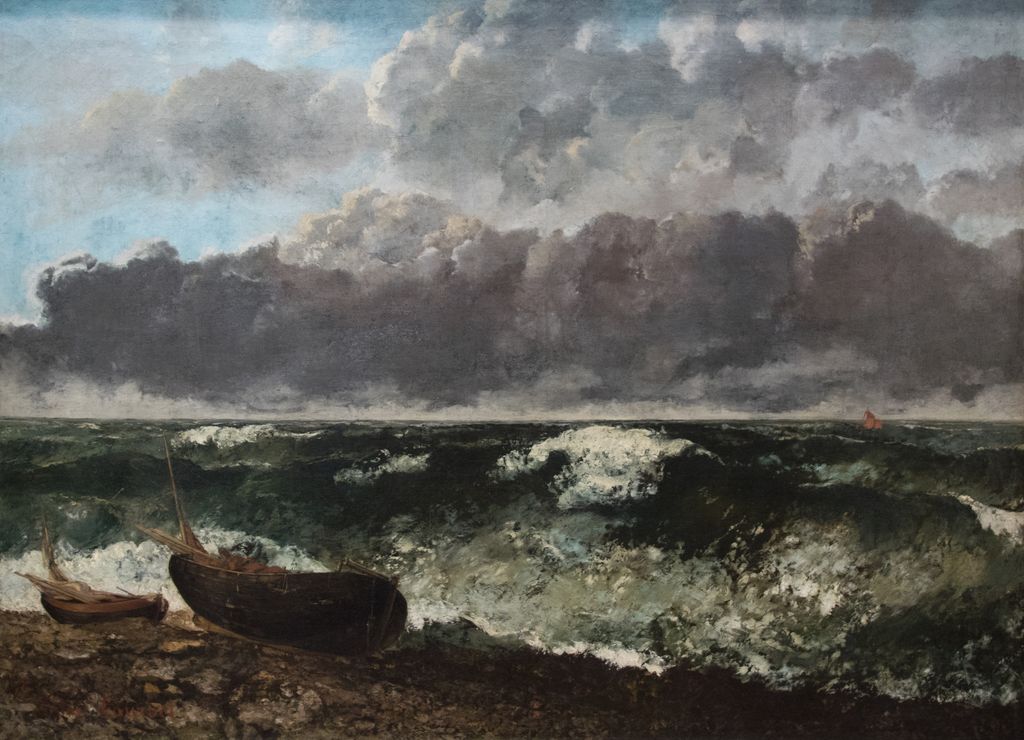
Gustave Courbet, The Stormy Sea, also known as The Wave, 1870. Musée d’Orsay, RF 213. Image source. Public domain. Resized from the complete source image.
Courbet artworks directory
Browse the paintings covered in this guide. Dates identify the specific versions discussed.
Discussion
Look again at the images and ideas explored in The Calm Sea. These editorial prompts invite your observations.
Reader Insights
What do the two boats tell you about the tide?
How does the large area of sky affect your sense of scale?
Which features distinguish this canvas from the earlier Washington painting?
Join the Conversation
Share a detail, comparison or question about The Calm Sea below.
References
- The Metropolitan Museum of Art, The Calm Sea, collection record and reproduction, 29.100.566. View source.
- The Metropolitan Museum of Art, A Concise Catalogue of the European Paintings in The Metropolitan Museum of Art, Gustave Courbet, Calm Sea, 29.100.566. View source.
- Musée Fabre, Le Bord de mer à Palavas, collection record and reproduction, 868.1.24. View source.
- Musée d’Orsay, Mer calme à Palavas, object record, MNR 880. View source.
- National Gallery of Art, Calm Sea, collection record and reproduction, artwork 66408. View source.
- National Gallery of Art, French Paintings of the Nineteenth Century, Part I: Before Impressionism, Calm Sea, p. 134. View source.
- Art Institute of Chicago, Seascape, 1879, cat. 8, scholarly catalogue entry citing Courbet’s 6 September 1869 letter to Jules-Antoine Castagnary. View source.
- Musée d’Orsay, La Falaise d’Étretat après l’orage, object record, MNR 561, including the 1870 Salon pairing. View source.
- Musée d’Orsay, La Mer orageuse, object record, RF 213. View source.
- Musée des Beaux-Arts de Lyon, Gustave Courbet: The Cliff and the Wave, exhibition section and labels, including the Met’s The Calm Sea. View source.
- Musée des Beaux-Arts de Lyon, Étretat, par-delà les falaises. Courbet, Monet, Matisse, exhibition dates and press material. View source.


