



 by Tom Gurney
Tom Gurney BSc (Hons) is an art history expert with over 20 years experience
Published on June 19, 2020 / Updated on October 14, 2023
Email: tomgurney1@gmail.com / Phone: +44 7429 011000
Cliffs at Étretat after the Storm by Gustave Courbet: Introduction
The cliff at the left of Gustave Courbet’s painting ends in an arch. Look through it and you can see a little of the same water that runs across the right half of the canvas. The pale rock rises steeply above that opening, while boats rest on the pebbly shore and clouds break above the horizon. In Cliffs at Étretat after the Storm (La Falaise d’Étretat après l’orage), Courbet makes the calm legible in the light on the rock and the small movements of the sea. The Musée d’Orsay holds the signed and dated 1870 oil on canvas under the number MNR 561. It lists the unframed dimensions as 130 × 162 cm. The French Ministry of Culture’s Rose-Valland record gives 133 × 162 cm for the same canvas. [1] [2]
At a Glance
- Date1870
- MediumOil on canvas
- CollectionIn the custody of the Musée d’Orsay, MNR 561
Contents
- The weight of the cliff
- Light across the beach and water
- Étretat in 1869 and the Salon of 1870
- Other views of the same coast
- The wartime transfer and return to France
The weight of the cliff
Follow the top of the headland from the upper left. A strip of green follows the uneven edge of the grass before the rock drops towards the water. Across the exposed chalk, pale surfaces alternate with cooler seams and shadowed recesses. Some of the marks run across the face of the cliff, giving a sense of its layers. Others travel down its face and break off where one plane meets another. The broad light areas can be read at a distance, while the succession of small changes in colour and direction rewards a closer look. Together they give the headland a particular shape. The cliff projects into the sea, turns away from us and ends in a leg of stone with water on either side. [1]
The arch is the Porte d’Aval, one of the natural openings in the limestone around the bay. Its shaded inside edge is especially useful to the eye. The shadow separates the underside of the rock from the light across its outer face, and the blue of the opening carries the eye beyond it. The long, almost level marks on the water do a different job from the short, irregular ones on the cliff. They help the sea appear continuous even when the headland cuts across it. The arch makes that continuity visible in a small, sharply bounded space. It is also the point where the cliff’s depth is most apparent, because the viewer can see both the face of the rock and the space behind it. [1] [3]
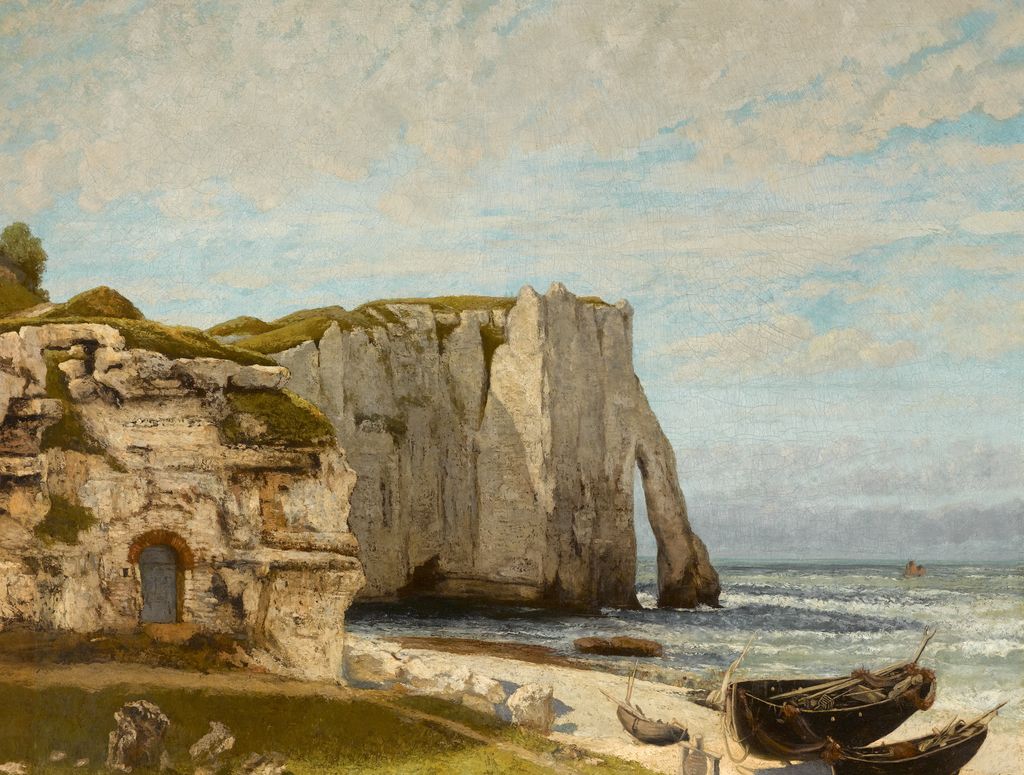
Detail of The Cliffs at Étretat after the Storm, Orsay MNR 561. Shown here, cliff, arch and shoreline. Image source. Public domain. Cropped and resized from the source image.
Light across the beach and water
The shore opens out at the bottom of the picture and narrows towards the foot of the cliff. A few thin, pale lines mark the water’s edge. Their gentle changes of direction make the near shore more irregular than the horizon, which is comparatively straight and quiet. The clouds leave spaces of blue overhead, and the chalk carries much of the brightness from that sky into the left side of the picture. As the eye crosses to the open water, the divisions between one blue or grey and the next grow subtler. The brightness has room to spread because so much of the right side is given to air and water. [1]
The boats on the beach provide a second way to judge the scale of the rock. Their dark hulls are large enough to register at once, and the slight differences in their shapes make the beach feel like a place where people work. The picture leaves that work to the imagination. A boat’s relation to the shore is easier to see than any sign of who hauled it up or when it will go out again. Near the cliff, the small structure by the beach serves a similar purpose. Both details are dwarfed by the headland, and both bring the scale of the shore within reach of a viewer standing before a canvas more than a metre and a half wide. [1] [2]
Étretat in 1869 and the Salon of 1870
Courbet stayed at Étretat in the summer of 1869. The Musée des Beaux-Arts de Lyon identifies his workplace as the former studio of the painter Eugène Le Poittevin, facing the beach near the Falaise d’Aval. Its exhibition research uses Courbet’s correspondence to place the large cliff picture first among the two paintings he undertook there for the Salon. A severe storm struck the Channel coast on 11 and 12 September. Guy de Maupassant later recalled seeing Courbet turn repeatedly from a canvas towards the storm outside his window. The recollection was published in 1886 and concerns a wave painting. It gives a sense of the painter’s proximity to the sea during the visit. The date on the cliff canvas and its exhibition record establish the public chronology more securely than the anecdote can establish the circumstances of each painting. [1] [3] [4]
The 1870 Paris Salon at the Palais des Champs-Élysées listed The Stormy Sea (La Mer orageuse) as no. 671 and Cliffs at Étretat after the Storm as no. 672. Both are now at the Musée d’Orsay. The storm painting, RF 213, is an oil on canvas measuring 116.5 × 160 cm. Its width is close to that of the cliff picture, and there are small boats on the shore in both. In The Stormy Sea, two boats sit below a succession of rising green waves. The white paint of the foam breaks over dark water, while the sky above is crowded with clouds. Orsay describes Courbet working thick paint with a knife in that canvas. The foam can look as substantial as the water supporting it, giving a passing motion the weight of a solid object. [1] [4] [5]
Seen together, the two pictures suggest a storm and its aftermath. The similarity in width and the recurrence of the boats make the difference in weather easy to feel. In the storm painting, the eye keeps returning to the crest of the wave, where dark green meets a broken line of white. In the cliff painting, the horizon gives the eye somewhere to travel, and the strongest interruptions come from the shape of the rock. That sequence from breaking water to clearer air is the sequence the pictures invite a viewer to imagine. Lyon’s account of Courbet beginning with the cliff view puts the making of the pictures in a different order. Orsay cites the critic Jules-Antoine Castagnary’s praise of the feeling of air circulating through the cliff picture. The comment draws attention to what the companion makes easier to appreciate. The calm has as much to do with the space around the headland as with the size of the waves. [1] [3] [4]
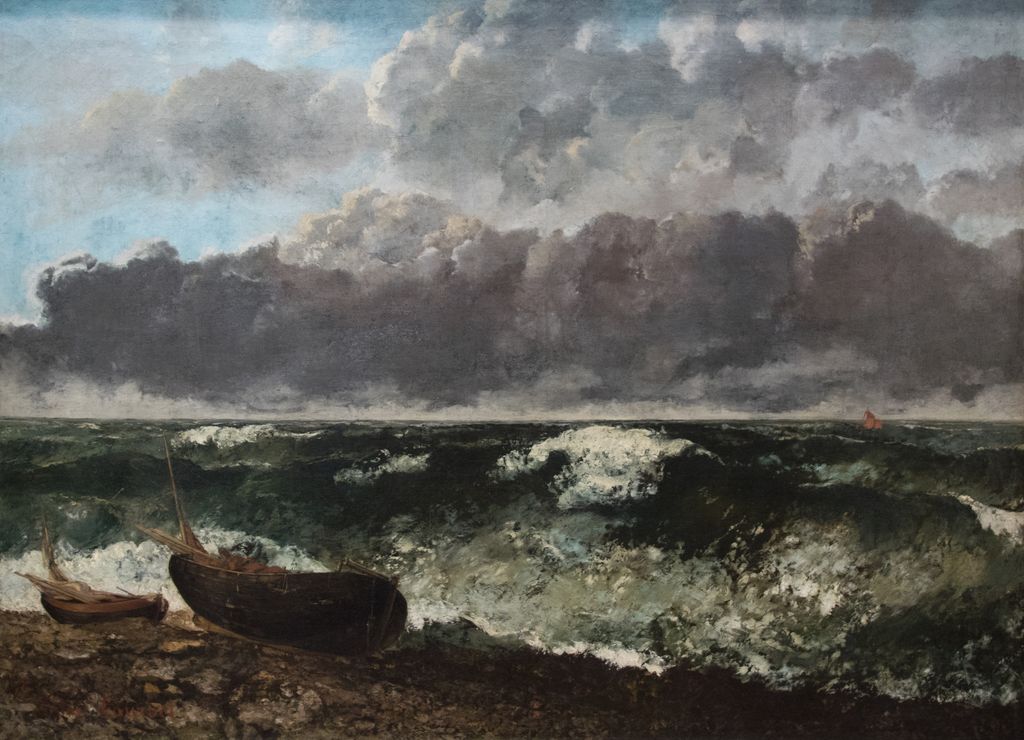
Gustave Courbet, The Stormy Sea, also known as The Wave, 1870. Musée d’Orsay, RF 213. Image source. Public domain. Resized from the complete source image.
Other views of the same coast
Courbet’s The Calm Sea, painted at Étretat in 1869 and now at the Metropolitan Museum of Art, gives the same coast a different set of proportions. Its two boats sit on a beach exposed at low tide, below a sky that takes up most of the canvas. The tide makes the width of the beach intelligible and the horizon sets a steady line across the view. In the Salon cliff picture, the pale rock rises through that arrangement of shore, water and sky and makes the eye turn upward. The scale also sets the objects apart. The Met painting measures 59.7 × 73 cm, less than half the width of the Salon canvas. [1] [6]
The Art Institute of Chicago’s catalogue places the Salon cliff picture and a smaller Courbet at the Wadsworth Atheneum beside a discussion of Monet’s work at Étretat. The Wadsworth’s Cliffs at Étretat, dated about 1868 in that catalogue, measures 38.1 × 46 cm. Chicago’s own Monet, Étretat: The Beach and the Falaise d’Amont, dates to 1885 and depicts the cliff at the opposite end of the bay from Courbet’s Porte d’Aval. The museum’s account calls attention to Monet’s thick yellow and white paint on the sunlit chalk. In Courbet’s Salon painting, much of the modelling comes from the succession of light and shadow across the projecting headland. Both make the cliff’s shape legible through the light on it, even as their choice of viewpoint changes what the eye can see of the bay. [1] [7]
The wartime transfer and return to France
The cliffs and boats readily identify the canvas in exhibition catalogues, but the names attached to those entries tell a less straightforward story. The Rose-Valland record traces the work from the Carlin collection to M. de Candamo at a Paris sale in 1872. At that sale the companion canvas went to the dealer Haro. The French state bought the storm painting in 1878. In 1882, when both canvases appeared in a Courbet exhibition at the École des Beaux-Arts, the catalogue still listed the cliff painting under Candamo’s name. At the Candamo sale in December 1933, the auction minutes record a purchase through the Paris art expert André Schoeller on behalf of Christian-Otto Zieseniss. The 1938 Venice Biennale catalogue and archives list Schoeller as the owner. The record cites an invoice and other archival files for the June 1941 sale by Schoeller to the Folkwang Museum in Essen for 350,000 francs. [2] [4]
In October 1945, answering an inquiry into transactions with the occupying authorities, Schoeller gave a different account of who owned the painting. He said Zieseniss had left it with him and had subsequently transferred it to Marc Wolfson. Schoeller claimed that Wolfson asked him to arrange the sale to Essen and that he acted as an unpaid intermediary. The auction minutes support the account of the 1933 purchase for Zieseniss. The proposed later transfer to Wolfson and the claim about Schoeller’s role in 1941 rest on Schoeller’s testimony. Rose-Valland records corroboration for a separate deposit of money and securities by Wolfson in 1942. The record also flags uncertainties in Schoeller’s account of other works said to have passed through his hands. It classifies the painting’s history between 1933 and 1945 as incomplete. [2]
The postwar route has firmer dates. The painting passed through the Allied collecting point recorded as Wiesbaden/Marburg and returned to France from Düsseldorf on 4 March 1948. A French selection commission retained it in December 1949. It went into the Louvre’s care in 1950 and was assigned to the Musée d’Orsay in 1986. MNR stands for Musées Nationaux Récupération, the designation used here for a recovered work entrusted to a museum. The Ministry of Culture explains that the French state holds such works provisionally. The date in 1948 records the painting’s return to France, and the dates attached to the museums record changes in custody. The question of ownership at the time of the wartime sale remains open in the provenance record. [1] [2] [8]
Courbet artworks directory
Browse the paintings covered in this guide. Dates identify the specific versions discussed.
Discussion
Look again at the images and ideas explored in Cliffs at Étretat after the Storm by Gustave Courbet. These editorial prompts invite your observations.
Reader Insights
How do the boats change your sense of the cliff’s height?
How do the cliff and storm paintings show different aspects of the same coast?
What can the surviving records establish about the painting’s wartime transfer?
Join the Conversation
Share a detail, comparison or question about Cliffs at Étretat after the Storm by Gustave Courbet below.
References
- Musée d’Orsay, La Falaise d’Étretat après l’orage, object record MNR 561. View source.
- Ministère de la Culture, Rose-Valland (MNR–Jeu de Paume), La Falaise d’Étretat, après l’orage, MNR00561. View source.
- Musée des Beaux-Arts de Lyon, Gustave Courbet: The Cliff and the Wave, exhibition research and labels. View source.
- Musée d’Orsay, La Mer orageuse, object record RF 213. View source.
- Musée d’Orsay, Base Salons, La mer orageuse, entry 671 in the Paris Salon catalogue for 1870. View source.
- Metropolitan Museum of Art, The Calm Sea, collection record 29.100.566. View source.
- Gloria Groom and Kimberley Muir, Étretat: The Beach and the Falaise d’Amont, 1885, Art Institute of Chicago scholarly catalogue, cat. 21. View source.
- Ministère de la Culture, Biens Musées Nationaux Récupération (MNR). View source.


