


 Gustave Courbet.jpg)
 by Tom Gurney
Tom Gurney BSc (Hons) is an art history expert with over 20 years experience
Published on June 19, 2020 / Updated on October 14, 2023
Email: tomgurney1@gmail.com / Phone: +44 7429 011000
Woman in a Riding Habit (L’Amazone) by Gustave Courbet: Introduction
The first things to catch the light are a face, a white collar and a pair of gloves. The hat and fitted bodice take longer to come into view. A thin riding crop angles down from the nearer hand, while the other gathers a fold of dark cloth. There is no horse in the picture, but the costume is enough to give the woman her title. Gustave Courbet’s Woman in a Riding Habit (L’Amazone) is an oil on canvas that the Metropolitan Museum of Art dates to about 1855–59. It measures 115.6 × 89.2 cm and is catalogued as 29.100.59. [1]
At a Glance
- Datec. 1855–59
- MediumOil on canvas
- CollectionThe Metropolitan Museum of Art, 29.100.59
Contents
- A figure in black
- What the riding clothes tell us
- A sitter without a confirmed name
- Mary Cassatt and the Havemeyer collection
- Manet’s later horsewoman
A figure in black
Courbet cuts off the figure well before the hem. The skirt broadens towards the lower edge, making the waist appear especially narrow. The woman holds herself upright, with her torso at an angle to the picture plane. Her head tips slightly down and turns enough for us to see both eyes. Her glance passes to the right of the viewer. The distinction between the direction of the body and that of the eyes is small, but it gives the pose a sense of duration. She can keep her shoulders in place while something briefly draws her attention. [1]
At a distance the clothing reads as a single shape. Closer up, a narrow grey highlight at the top of the hat rounds the crown, and a crease below the waist gives the dark bodice a direction of its own. The light along the nearer sleeve is much weaker than the white at the wrist. It still separates the arm from the rest of the figure. Where the other hand holds the skirt, the cloth makes a rounded mass against the background. The little intervals between the pale fingers give the gesture its precision. They also let us see how much of the lower half Courbet has allowed to sink into the same deep tone. [1]
The face is the warmest part of the picture. The brim casts a shadow over the forehead and the eyes, leaving a warmer patch on the cheek and a softer change of colour around the mouth. Loose ends of hair break the outline beneath the hat. Behind them, a bank of blue rises towards a darker band of cloud. At shoulder height the blue gives way to uneven foliage. Courbet lets the trees grow indistinct at the very point where the costume is most particular. The effect is especially clear beside the white collar. Its two small points have a firmness that the broad shapes of the sky and trees rarely have. The setting leaves the figure alone with the viewer and gives her dark outline a different kind of edge from one side to the other. [1]
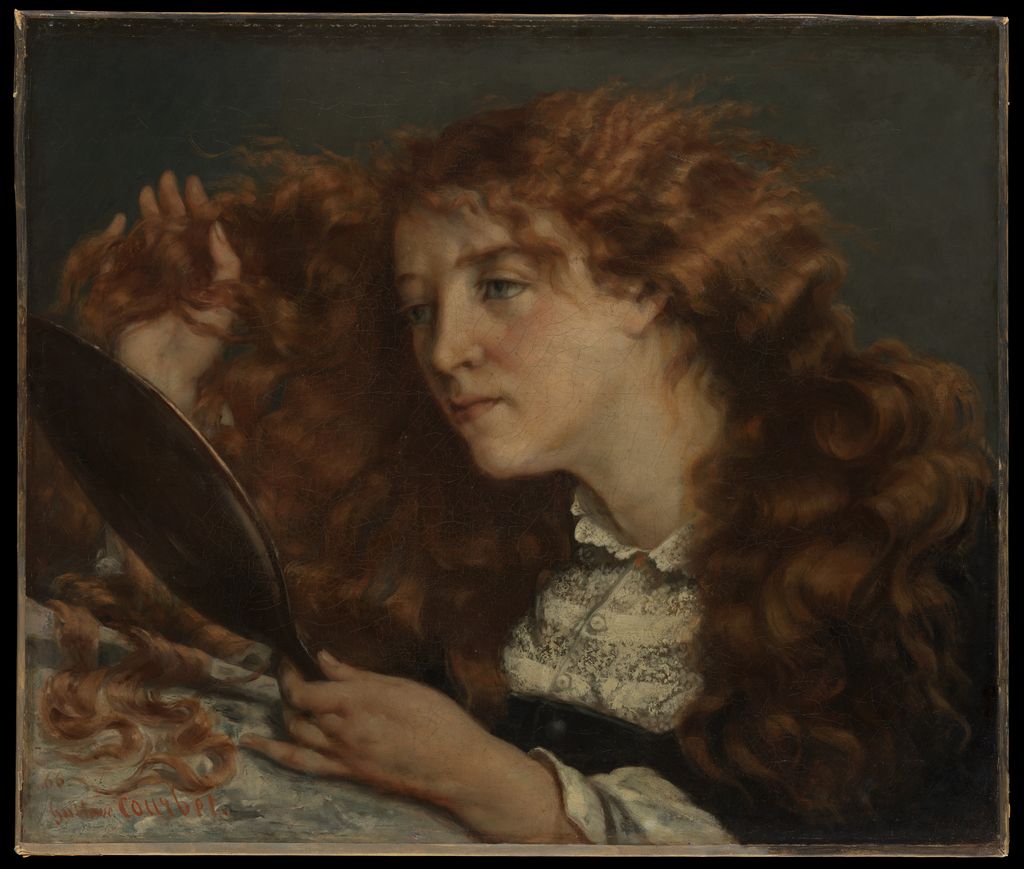
Gustave Courbet, Jo, La Belle Irlandaise. The Metropolitan Museum of Art version. Image source. CC0 / Public domain. Resized from the complete source image.
What the riding clothes tell us
In French, amazone can mean both a woman riding sidesaddle and the habit she wears. In the nineteenth century the tailored jacket of a riding outfit drew on men’s sporting dress, while the volume of the skirt followed women’s fashion and served the practical needs of the saddle. A sidesaddle skirt needed room for the rider to position her right leg. Jean R. Druesedow notes that by 1855 a pouch could be added on that side of a full skirt to accommodate it. Courbet shows just enough cloth to suggest the breadth of a riding skirt. The way he crops the figure leaves the lower construction and any such tailoring out of view. [1] [2]
An earlier example helps make sense of the choice to paint a rider on foot. Théodore Géricault’s Horsewoman, dated 1820 or later by the Met, gives us a woman and her horse in profile. The line of the reins and the woman’s steady seat let us read her bearing in relation to the animal, while the darkening sky opens up around them. Courbet’s sky occupies a similar place behind the figure, but the equipment is reduced to a crop, and the foreground is almost entirely taken up by the woman and her clothes. Her free hand has a task within the portrait. It holds the skirt close enough to give the fabric a contour and show the fingers against it. The title makes riding present in these details, even though the encounter takes place at the scale and distance of a portrait. [1] [3]
A sitter without a confirmed name
The earliest sighting reported by the Met comes from Zacharie Astruc, an artist and critic who visited Courbet’s studio in the late 1850s. In his account published in 1859, Astruc described the costume, pose and setting without naming the woman. The Met’s 1966 catalogue identifies the painting from those details and notes one discrepancy. Astruc called the woman blonde, while the hair beneath Courbet’s painted hat is dark. The studio visit helps place the work in time. The description also shows why even a firsthand account has to be read alongside the canvas. [1] [4]
When the Met showed the portrait in its 1919 Courbet centenary exhibition, the catalogue called it The Amazon—Portrait of Louise Colet and recorded an anonymous loan. The exhibition is documented, but the name in its catalogue was an identification that later scholarship questioned. The Met’s 1966 catalogue pointed out that descriptions and a portrait of Colet by Franz Xaver Winterhalter gave a different impression of the writer’s appearance. The current Met record leaves the sitter’s identity open. It also gives a wider date range than the 1919 catalogue’s estimate of about 1856. [1] [4] [5]
The Met reads the picture today as an image of the independent modern woman. The museum points out that a woman riding without a male escort could provoke disapproval. The idea of independence has a visible counterpart here. The woman stands alone, with her hands occupied and her attention directed beyond us. She does not need to meet our eyes for the portrait to hold our attention. The picture leaves open what she is looking at, where she might ride and whether anyone is waiting for her beyond the frame. The distance between the care with which Courbet depicts her and the little we know about her is part of the experience of looking. [1]
Mary Cassatt and the Havemeyer collection
Mary Cassatt called it “the finest woman’s portrait Courbet ever did,” according to the Met. Her judgment is recorded in Louisine Havemeyer’s memoir. Cassatt had known Havemeyer since the 1870s, when she encouraged the young collector to buy a Degas pastel. Their friendship helped shape the Havemeyer collection. The Met Archives dates the couple’s purchase of the riding portrait through the French critic Théodore Duret to 1906. At the Met, the painting went from an anonymous loan in 1919 to part of Louisine Havemeyer’s bequest in 1929. It appeared the following year in an exhibition of works from the collection. [1] [4] [5] [6] [7]
The same bequest brought in Courbet’s Woman with a Parrot, which had been exhibited at the Salon in 1866. The figures differ as much in posture as in dress. In the riding portrait a gloved hand draws the clothing in towards the body. In the later painting a bare arm reaches out to a bird. Seen together, the canvases show the range of subjects and kinds of figure painting that the Havemeyers collected under one artist’s name. [1] [8]
Manet’s later horsewoman
Édouard Manet painted a separate Horsewoman, Full-Face (L’Amazone) around 1882. The canvas is 73 × 52 cm and belongs to the Museo Nacional Thyssen-Bornemisza in Madrid. The museum proposes Courbet’s painting as a possible precedent. Both painters bring a dark figure close to the viewer and leave sky and foliage broadly worked behind her. Manet brings the head around to face the viewer and uses looser strokes in the costume. Courbet develops the separate parts of the habit far enough for the eye to follow the lines of the tailoring around the body. [1] [9]
The Thyssen’s account of Manet’s posthumous inventory adds something the costume alone could never tell us. His model was the daughter of a bookseller, and a painter friend lent the riding habit. The museum identifies her as a woman dressed for the role. The detail about the borrowed habit shows how readily a portrait can make a role look as if it belongs to the person who poses for it. In Courbet’s painting the gloves, skirt and crop give the sitter a convincing occupation for her hands. The moment still feels particular to her. We can see the way she holds the cloth and where she directs her gaze, even as her name remains open. [1] [9]
Courbet artworks directory
Browse the paintings covered in this guide. Dates identify the specific versions discussed.
Discussion
Look again at the images and ideas explored in Woman in a Riding Habit (L’Amazone) by Gustave Courbet. These editorial prompts invite your observations.
Reader Insights
How does the pose affect what you notice about the riding costume?
Which details distinguish riding clothes from an ordinary dress?
What changes when you compare this portrait with Manet’s horsewoman?
Join the Conversation
Share a detail, comparison or question about Woman in a Riding Habit (L’Amazone) by Gustave Courbet below.
References
- Metropolitan Museum of Art, Gustave Courbet, Woman in a Riding Habit (L’Amazone), object 29.100.59. View source.
- Jean R. Druesedow, essay on women’s riding dress in Man and the Horse: An Illustrated History of Equestrian Apparel, Metropolitan Museum of Art, 1984, pp. 65–68 and glossary. View source.
- Metropolitan Museum of Art, Théodore Géricault, Horsewoman, object 2019.141.11. View source.
- Charles Sterling and Margaretta Salinger, French Paintings: A Catalogue of the Collection of The Metropolitan Museum of Art, vol. 2, 1966, pp. 113–15, entry for 29.100.59. View source.
- Metropolitan Museum of Art, Loan Exhibition of the Works of Gustave Courbet, 1919, cat. no. 6. View source.
- H. Barbara Weinberg, Mary Stevenson Cassatt (1844–1926), Metropolitan Museum of Art, 2004. View source.
- Metropolitan Museum of Art Archives, Havemeyer Family Papers relating to Art Collecting, 1901–1922, selected chronology, p. 3. View source.
- Metropolitan Museum of Art, Gustave Courbet, Woman with a Parrot, object 29.100.57. View source.
- Clara Marcellán, Édouard Manet, Horsewoman, Full-Face (L’Amazone), Museo Nacional Thyssen-Bornemisza, object 659 (1980.5). View source.


