



 by Tom Gurney
Tom Gurney BSc (Hons) is an art history expert with over 20 years experience
Published on June 19, 2020 / Updated on October 14, 2023
Email: tomgurney1@gmail.com / Phone: +44 7429 011000
The Meeting: Introduction
Alfred Bruyas has taken off his hat. He holds it out at waist height, in the open space between himself and the man he has come to greet. Gustave Courbet, his walking staff planted in the road, has taken off his hat too. It hangs low against his thigh. The two men are close enough to talk, but their hands never meet. That small difference in the way they acknowledge each other gives an encounter on a country road the formality of an introduction and makes it surprisingly difficult to say who is doing whom the honour. [1]
Courbet painted The Meeting, also known as Bonjour, Monsieur Courbet, in Montpellier in 1854 for Bruyas. The Musée Fabre’s collection record gives the dimensions of the unframed oil on canvas as 132.4 by 151 centimetres and identifies it as inventory 868.1.23. Bruyas donated it in 1868. The figures have room to stand at full length, with the dry road at their feet and the sky well above their heads. The picture asks for the sustained attention that an actual greeting, over almost as soon as it begins, would seldom get. [1] [2]
At a Glance
- Date1854
- MediumOil on canvas
- CollectionMusée Fabre
Contents
- Three men and a dog on the road
- A visit to Montpellier, staged outdoors
- The painter as a traveller
- The greeting becomes a public joke
- Two salutations in the paintings of 1854
- The patron in a different painter’s portrait
- What the museum catalogue made of the greeting
Three men and a dog on the road
Bruyas stands just left of centre. His dark blue coat is buttoned high, and a pale collar and neckcloth separate it from the copper tones of his hair and beard. He has a slender cane in one hand, close to his leg, and the other arm extends just far enough for the dark hat to stand clear of his body. Follow the arm out towards Courbet and it becomes clear how much of the greeting Bruyas is doing. The turn of his face and the reach of his sleeve carry the eye across the gap before Courbet’s own face comes into view.
The man at the far left is Calas, Bruyas’s servant. He holds his hat at his side and tips his head down more distinctly than either of the other men. A reddish garment lies over his arm. His buff coat and pale trousers give him a separate patch of colour, though the edge of his silhouette is close to Bruyas’s. Between the men and farther back stands Breton, Bruyas’s dog. The dog turns its head towards Courbet. Its dark back and light legs are clear against the road and the grassy strip beyond. For all the care with which the men hold themselves, the dog appears simply to be watching the newcomer. [1] [3]
Courbet occupies the right side alone. His head is shown in profile and held high enough for his beard to project cleanly against the pale sky. Look down from the beard to the light sleeve and the hand gripping the staff. The staff rises beside his chest and runs almost straight to the road, giving his stance a firmness that Bruyas’s finer cane lacks. The weight of Courbet’s pack gathers behind his shoulders, where the rolled and strapped equipment projects into the space behind him. His open collar and loose trousers belong to the same picture of travelling on foot. The equipment gives the walk a purpose. Courbet presents himself as a painter able to carry his work into the landscape. [1] [4]
The three bare heads are nearly level, yet the different angles give each man a separate part in the exchange. Calas looks down, Bruyas turns towards Courbet, and Courbet lifts his chin. Both principal figures are upright and both have uncovered their heads. The greeting can be read as mutual courtesy. Even so, Courbet gives his own face a particularly clear outline and leaves open ground around his figure, while the collector stands close to his companion. The grouping lets the painter keep a distinct presence even though Bruyas stands closer to the centre. At 151 centimetres wide, the canvas gives this ordinary exchange a scale and clarity that the Fabre compares to the treatment of a subject in history painting. There is no ceremony beyond the way the men hold themselves. Calas and Breton lend the scene the particularity of a group portrait, down to the person who carries the extra coat and the animal that has come along. [1] [2]
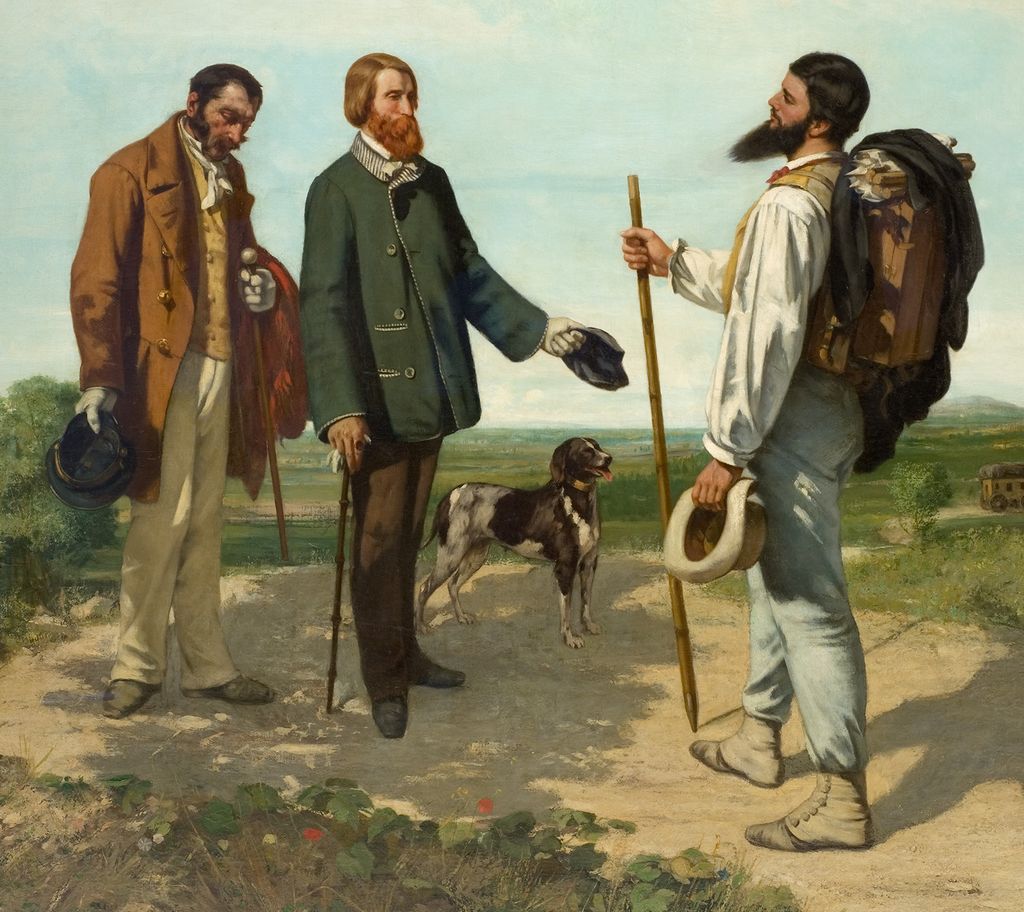
Detail of The Meeting, Musée Fabre 868.1.23. Shown here, the three figures and their greeting. Image source. Public domain. Cropped and resized from the source image.
A visit to Montpellier, staged outdoors
Bruyas had already bought The Bathers and The Sleeping Spinner in 1853 when Courbet made his first portrait of him. In that picture, known as the Tableau-Solution, Bruyas poses beside a green book that bears an inscription about modern art and a solution. The inscription presents collecting as a way to shape the future of painting. By the following spring Bruyas had invited Courbet to Languedoc. In The Meeting, the collector’s commitment takes the form of coming out to greet the person whose work he values. The painter is there with his means of working on his back. A letter of 3 May 1854, as reproduced by the Musée Fabre, shows Courbet using the same idea of a solution to describe what had brought them together. [4] [5] [6]
The visit began in May 1854. The Fabre associates the painted setting with the roads near the Villa Mey outside Montpellier, and a tiny stagecoach can be seen at the far right. Older accounts describe Courbet getting out of a coach before reaching the city and finding Bruyas and Calas on the road. The Fabre and the Metropolitan Museum of Art identify the railway as the means by which Courbet actually reached Montpellier. The work commemorates a documented visit through an imagined roadside encounter. The painter’s light clothes and portable gear would also suit a day spent working outdoors, an alternative the Fabre sees suggested by the scene. [1] [3] [5]
The landscape makes room for these possibilities. The ground in front is broken by low plants, small flashes of red and exposed patches of earth. It flattens into more distant greens behind the men, then drops to a low horizon. The long shadows fall across the pale road, and the men’s boots, cane and staff give those shadows distinct points of origin. At the far edge of this wide space the coach is small enough to miss at first. Once noticed, it brings a suggestion of travel into the stillness of the group. Its scale also draws attention to the distance between the open foreground and the road in the background. [1] [3] [4]
The Fabre describes a contrast between freer passages of paint and firmer modelling in the canvas. It is visible in the difference between the scattered marks of the plants and the closed shape of Bruyas’s coat. The low horizon leaves the upper bodies against large areas of blue, so the smallest gestures there remain legible from across a room. The sharp edges of a beard or hat carry much of the narrative, while the foreground offers enough uneven texture to make the road feel like a place where someone might stop. [1] [4]
The painter as a traveller
The art historian Linda Nochlin linked the composition to a popular print showing two townsmen addressing the figure known as the Wandering Jew, a character from Christian legend condemned to travel without rest. The Musée Fabre reproduces an example attributed to Pierre Leloup du Mans that later appeared as the frontispiece to Champfleury’s Histoire de l’imagerie populaire. Set the two images side by side and the resemblance lies in the arrangement of the bodies. Two people occupy one side, with a single traveller and his staff holding the other. The proposed source helps explain the directness with which Courbet groups the figures, as well as the part he gives himself as the man on the road. Champfleury’s book appeared in 1869, fifteen years after Courbet painted the encounter. The print’s publication there documents the survival of the design. Nochlin’s argument for its use by Courbet rests on the visual comparison. [3] [4] [7]
A much smaller picture from the same year gives a sense of how deliberately Courbet could use his profile. In the Self-Portrait with a Striped Collar, also at the Musée Fabre, he again turns to the left, and the cut of his dark beard gives the head a distinctive outline. The museum identifies the jacket in that portrait as borrowed from Bruyas and finds the garment again in The Meeting. In the small portrait the collar frames a face. On the road the artist builds a whole figure around that profile, with clothing, pack, staff and dusty boots specifying what the traveller does. The borrowed garment is also a reminder of how closely the painter’s self-image was worked out in the company of his host. [8]
The greeting becomes a public joke
Bruyas lent the painting to the Exposition Universelle in Paris in 1855. The Fabre lists it as no. 2803 at the Palais des Beaux-Arts, part of the official exhibition. Courbet’s independent Pavilion of Realism, set up that year after the rejection of works including The Painter’s Studio, was a separate exhibition. In correspondence quoted by the Fabre, Courbet told Bruyas in April that The Meeting had met resistance for being too personal and pretentious. He subsequently reported that the painting was attracting unusual attention and that the greeting Bonjour, Monsieur Courbet was already circulating in Paris. The letters register two sides of the episode as Courbet presented it to the man who had lent the painting. [2] [4] [5]
Two caricatures from 1855 make clear how readily the scene could be turned against its painter. Cham’s Leçon de politesse, published in Le Charivari, made the greeting a lesson in manners. Quillenbois, in L’Illustration, reworked it as L’Adoration de M. Courbet, with a caption invoking the Adoration of the Magi. The shift from a greeting to an act of worship makes a joke of Courbet’s authority. In the painting the men’s heads are almost level. In the caricature the figures who receive him kneel. Théodore de Banville carried the conceit into verse, imagining the vegetation itself joining in the greeting. The joke worked even when the road, the pack and the collector’s purposes had fallen away. [1] [4]
The museum’s exhibition history records a further showing at Courbet’s exhibition near the Pont de l’Alma in 1867, the year before Bruyas gave the painting to the Musée Fabre. By 2019 the greeting had long since become a title by which the painting could be recognised. The Fabre used it for a bicentenary exhibition on the work and its reception. Among the responses on view were Robert De Niro Sr.’s Three Figures after Courbet, painted in 1965, and L’Impossible rencontre, made by Yan Pei-Ming for the exhibition. Their titles pick up two different things that Courbet makes available to later artists, the arrangement of three standing bodies and the promise of an encounter. Even without the familiar greeting, the space between the figures is enough to set an exchange in motion. [2] [9] [10]
Two salutations in the paintings of 1854
In The Seaside at Palavas another figure holds up a hat, but there is nobody across from him to answer. The figure stands near the left edge of a small canvas and the gesture opens onto the sea. The Musée Fabre dates both works to Courbet’s stay in Languedoc and gives the Palavas canvas an unframed width of just over 46 centimetres. The figures in The Meeting stand within reach of one another across a much wider surface. In the seascape the size of the figure against the horizon makes the open space itself part of what is being greeted. [2] [11]
The comparison also helps separate recognition from identification. The staff and the hat could bring to mind the traveller in The Meeting, but the Fabre records that both Courbet and Bruyas have been proposed as the figure at Palavas. Seen from behind, he presents none of the features that make the two profiles in the roadside scene recognisable. The familiar gesture can link the pictures without settling the identity. It shows the painter using the same small action to make a relationship legible, first between people and then between a figure and the place before him. [1] [11]
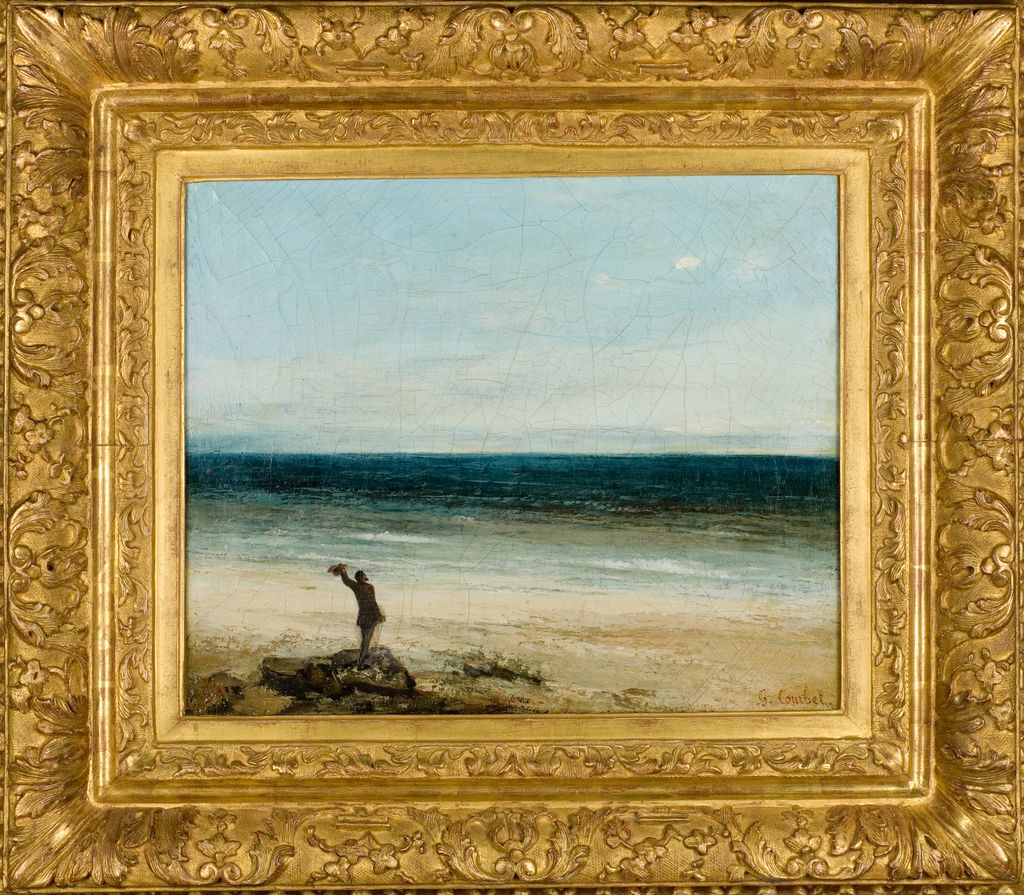
The Seaside at Palavas, Musée Fabre 868.1.24. Image source. Public domain. Resized from the complete source image.
The patron in a different painter’s portrait
The Fabre’s portrait of Bruyas by Eugène Delacroix offers a way to see what Courbet changed when he placed the collector on the road. Painted in 1853, the Delacroix portrait presents Bruyas seated, with his mantle gathered around him. The museum calls attention to his jewellery, his loose posture and his withdrawn gaze. A year later, Courbet kept the distinctive colouring of the face and beard but made the sitter’s posture and attention depend on the presence of another person. The hand that holds the hat makes sense because there is someone there to receive the greeting. [1] [12]
These works were also objects Bruyas could choose to live with. The Fabre notes photographs in which he returned to a costume and pose resembling those in the Delacroix portrait. They suggest a sitter willing to revisit an image another painter had made of him. In The Meeting there is no single pose he can repeat and carry away with the same meaning. Calas stands at his shoulder, Breton looks towards the traveller, and Courbet gives the exchange its other end. The portrait of a collector becomes a scene about how someone enters his circle. [1] [12]
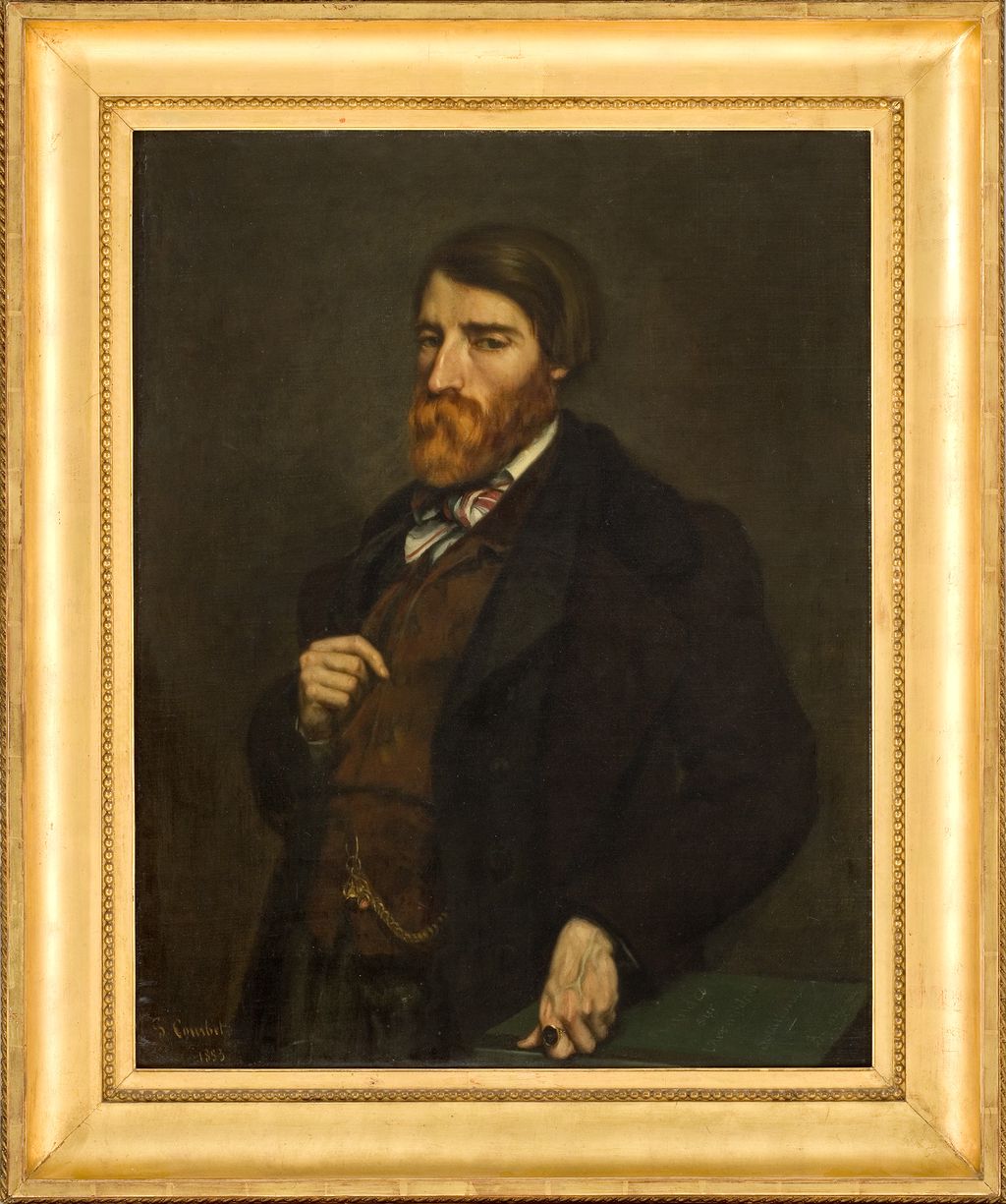
Portrait of Alfred Bruyas, Tableau-Solution, Musée Fabre 868.1.21. Image source. Public domain. Resized from the complete source image.
What the museum catalogue made of the greeting
In the Fabre’s 1910 catalogue the work is described as a meeting on the road near Mey. The small coach was worth recording, along with the particulars of the group. The description took the represented greeting as the scene commemorated by the picture. The present museum account distinguishes the artist’s actual arrival in the region from the composition he made. Read together, the two records show how a painting can make an invented or rearranged encounter convincing enough for later readers to attach it to a specific event. The railway evidence makes it easier to see the coach as one element in the painter’s account of travel. [1] [3] [13]
Courbet artworks directory
Browse the paintings covered in this guide. Dates identify the specific versions discussed.
Discussion
Look again at the images and ideas explored in The Meeting. These editorial prompts invite your observations.
Reader Insights
What can the positions of the three figures tell you about the greeting?
Where do you see signs of each man’s work or position?
How do the painting and its caricatures tell different stories about the encounter?
Join the Conversation
Share a detail, comparison or question about The Meeting below.
References
- Musée Fabre, La Rencontre ou Bonjour Monsieur Courbet, illustrated object essay. View source.
- Musée Fabre, La Rencontre ou Bonjour M. Courbet, inventory 868.1.23, collection record and exhibition history. View source.
- The Metropolitan Museum of Art, Gustave Courbet, 2008 retrospective checklist and illustrated entry for The Meeting. View source.
- Musée Fabre, La Rencontre, teaching dossier with extracts from Courbet’s letters to Bruyas and reproductions of the print and caricatures. View source.
- Musée Fabre, La « Solution » d’Alfred Bruyas, collection and patronage dossier. View source.
- Musée Fabre, Portrait d’Alfred Bruyas dit Tableau-Solution, illustrated object essay. View source.
- Linda Nochlin, Gustave Courbet’s Meeting: A Portrait of the Artist as a Wandering Jew, The Art Bulletin, vol. 49, no. 3, 1967, pp. 209–222. View source.
- Musée Fabre, Autoportrait dit au col rayé, inventory 868.1.22, collection record. View source.
- Musée Fabre, Bonjour Monsieur Courbet ! Fortune d’un chef-d’œuvre, 2019 exhibition. View source.
- Institut Gustave Courbet, Bonjour Monsieur Courbet, record of the Musée Fabre exhibition catalogue and contemporary responses. View source.
- Musée Fabre, Le Bord de mer à Palavas, object essay and dimensions, 868.1.24. View source.
- Musée Fabre, Eugène Delacroix, Portrait d’Alfred Bruyas, object essay, 868.1.41. View source.
- Musée Fabre, Catalogue des peintures et sculptures, 1910 edition, p. 34. View source.


