



 by Tom Gurney
Tom Gurney BSc (Hons) is an art history expert with over 20 years experience
Published on June 19, 2020 / Updated on November 3, 2026
Email: tomgurney1@gmail.com / Phone: +44 7429 011000
Young Woman at a Table: Poudre de riz: Introduction
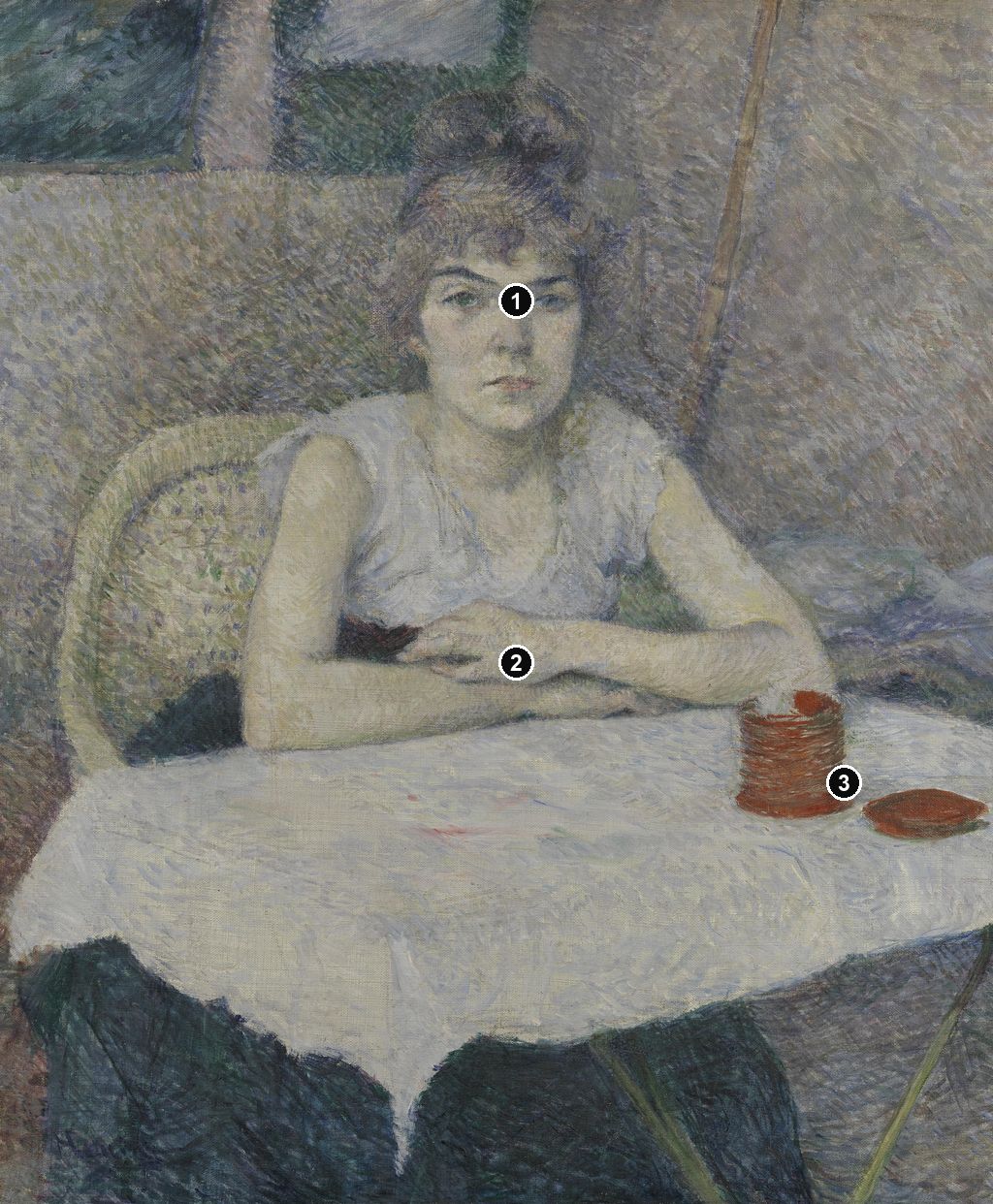
A small red powder jar makes a striking interruption in Toulouse-Lautrec's pale interior. Beside it, a woman rests her arms on a white-covered table and looks towards us. Her face, clothing and surroundings are built from short, restless strokes, yet the encounter feels unusually still. Painted in 1887, Young Woman at a Table, ‘Poudre de riz’ became part of Theo and Vincent van Gogh's collection. Its history joins a closely observed person to a very particular object of everyday grooming. [1]
At a Glance
- ArtistHenri de Toulouse-Lautrec.
- TitleYoung Woman at a Table, ‘Poudre de riz’; the French phrase means rice powder. [2]
- Date1887. [1]
- Medium and sizeOil on canvas, 56 × 46 cm. [1]
- CollectionVan Gogh Museum, Amsterdam, Vincent van Gogh Foundation; s0274V1962. [1]
- Sitter and settingUnresolved in the museum's accompanying interpretation. [3]
- Distinctive detailAn open red container and its separate lid on the table.
This work across Henri de Toulouse-Lautrec’s career
Contents
- The little jar changes the subject
- Meeting the woman's gaze
- A room that remains difficult to name
- Colour travels through separate marks
- Theo's purchase and Vincent's contrasting portrait
- A frontal sitter beside Lautrec's profiles
- From a Paris collection to public exhibitions
- Annotated details
The little jar changes the subject
The French title directs attention away from the woman's identity towards something within reach of her hand. The Van Gogh Museum's Dutch gallery label identifies the red vessel as a container for rice powder, used to give the face a fashionably pale complexion. A grooming product supplies the painting with its memorable name. [2]
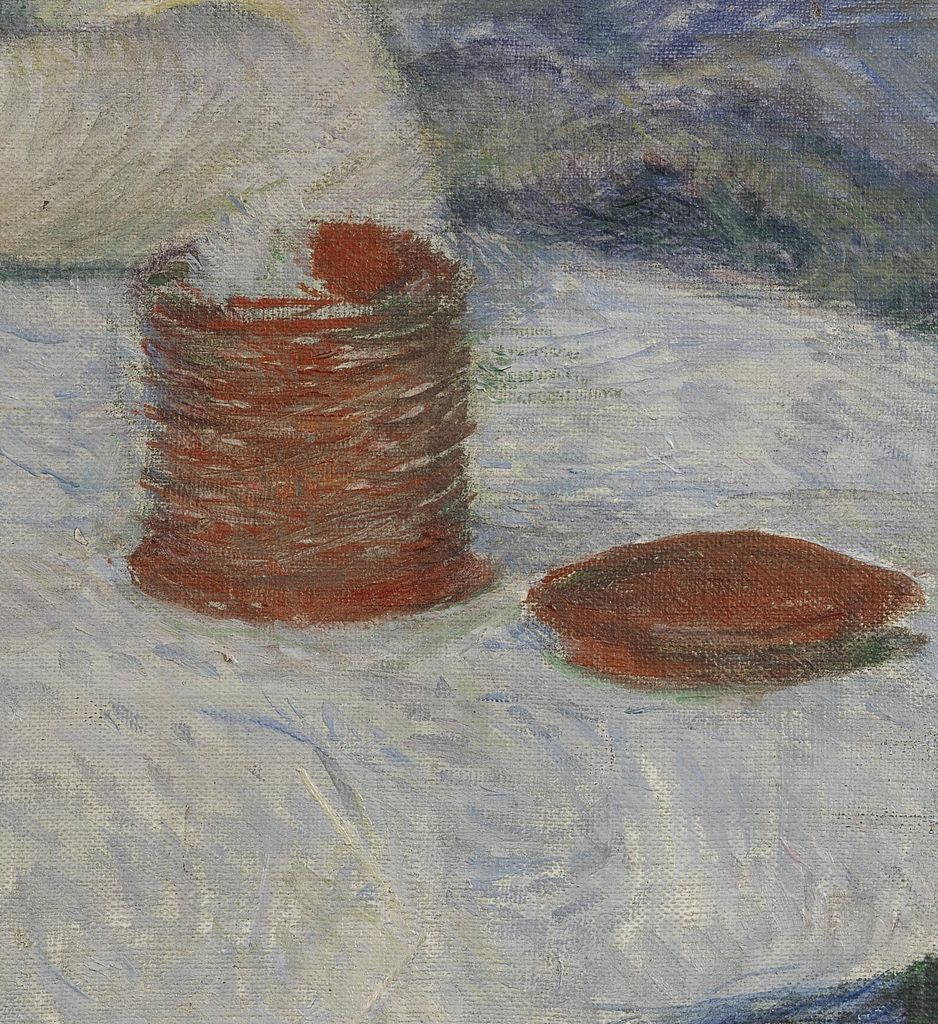
The vessel has a surprisingly definite presence. Its sides are almost straight, its base sits firmly on the cloth, and the curved rim makes the opening clear. Pale strokes run around the red surface, repeatedly interrupting its stronger colour. To the right lies a shallow red lid. Because the two parts are separated, the jar reads as open and available for use. The distance between them creates a tiny still life across an otherwise pale stretch of table.
That red is more concentrated than almost anything else in the image. Warm touches occur in the face, hair and background, but they are dispersed among greys, greens and blues. Here they gather into a small cylinder. Its brightness pulls the eye down from the face, while the surrounding white gives the colour room to register. The lid extends the accent sideways, close to the edge, making the whole tabletop feel wider.
Look at the upper hand, then at the jar. They occupy a similar level in the composition, but they remain apart. The hand rests across the other forearm; it does not reach into the container. No gesture of powdering is actually shown. That distinction gives the scene much of its openness. We encounter an object associated with preparing an appearance alongside a woman who has paused, or has been posed, with her arms at rest. The picture does not settle what happened immediately before or after this arrangement.
The jar also changes how we look at the face. Its pale surface can be understood beside an object whose documented purpose was to produce paleness. That relationship invites attention to self-presentation, without telling us how much powder this woman has applied. The visible complexion belongs to a painted construction, with cool shadows and warm accents of its own. The title makes a connection between person and cosmetic; it does not provide a literal inventory of what is on her skin.
Meeting the woman's gaze
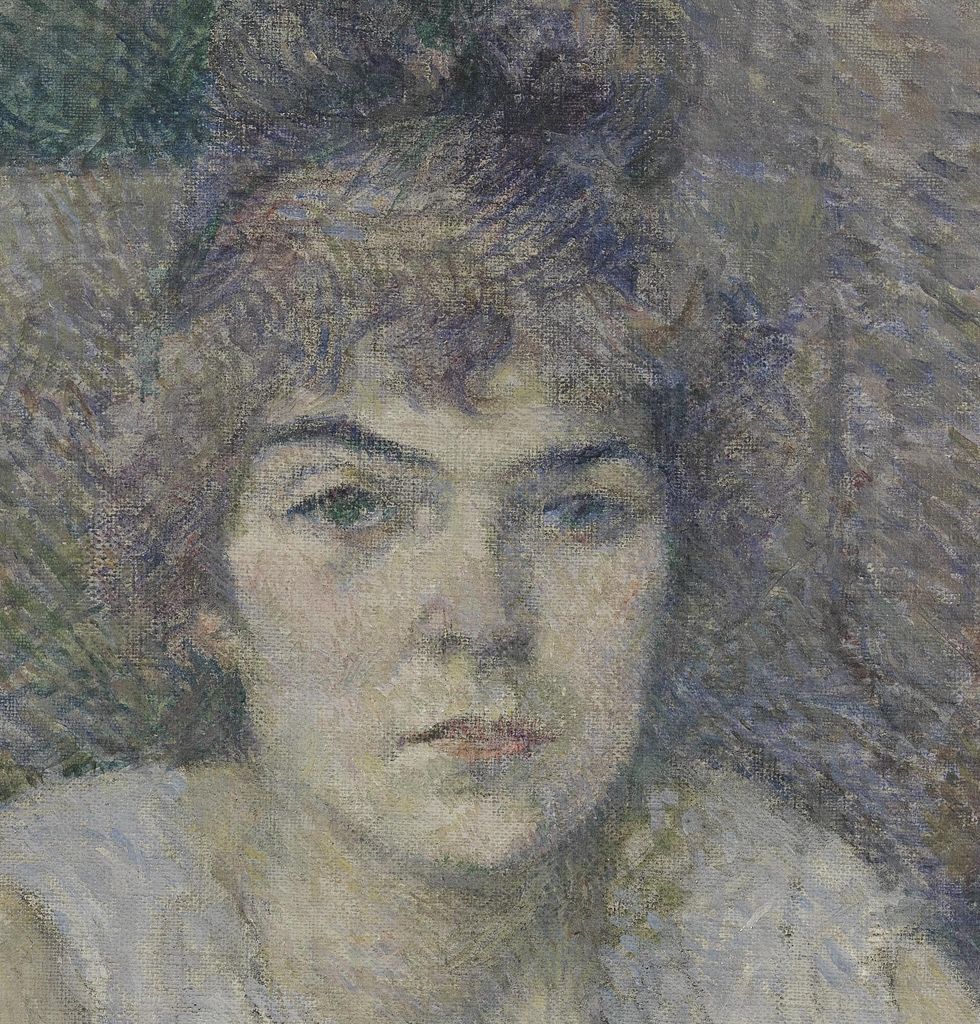
The sitter faces almost directly out of the canvas, with a slight turn of the head. Both eyes are visible. One cheek catches more light, while a cooler passage descends beside the nose towards the mouth. Dark brows and the small red accent of the lips make the features legible within a much larger field of pale colour. Her head is framed by hair that rises into an irregular mass above it.
This is a different encounter from a strict profile. We can follow the edge of one cheek and the jaw, but recognition also depends on the relation between the eyes, the nose and the two sides of the mouth. The face occupies relatively little of the canvas. Its direction nevertheless makes it the centre of the meeting: the table may separate us physically, but the gaze crosses it.
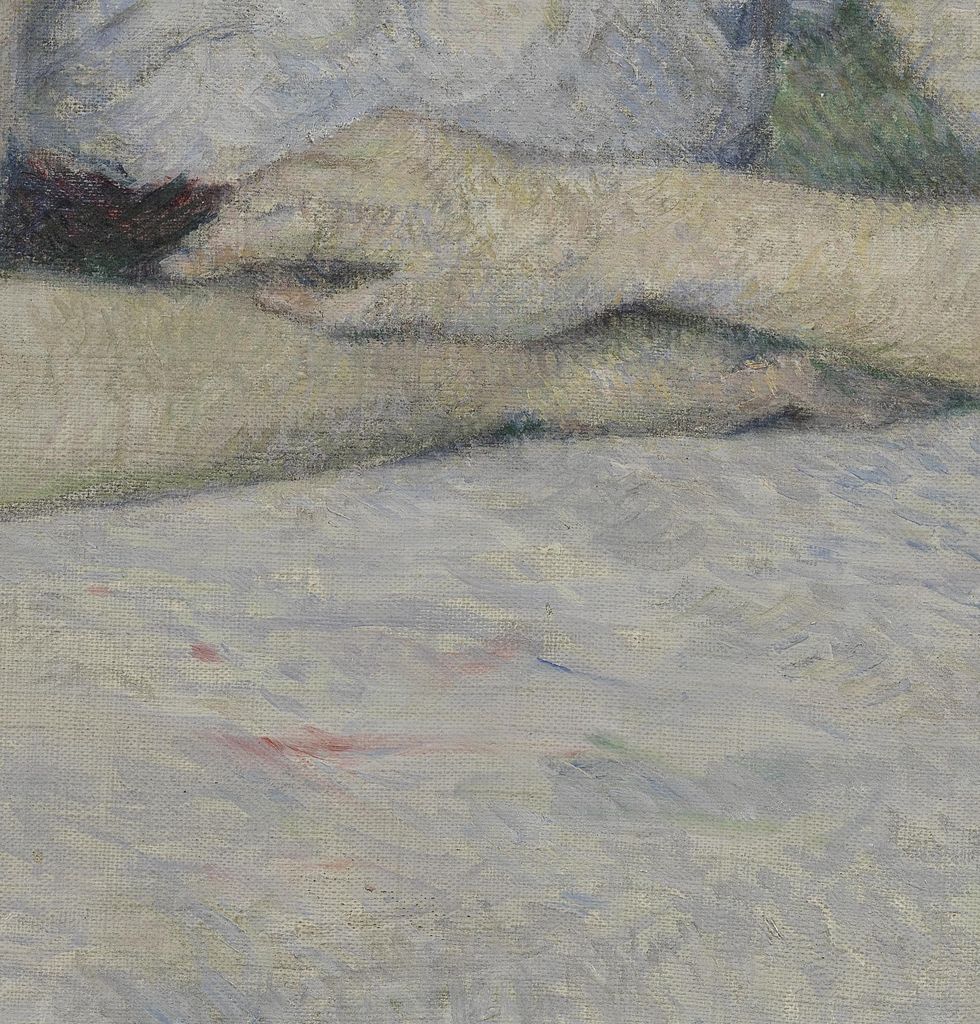
The arms supply a broad horizontal foundation beneath the head. One runs almost parallel to the nearer edge of the table; the other bends above it, bringing a hand back towards the torso. Their overlapping shapes close the space in front of the body. At the left, the upper arm drops steeply from the shoulder before turning into the long forearm. On the right, a shorter descending angle brings the elbow towards the table. The asymmetry keeps the resting pose from becoming a rigid crossbar.
Pale clothing opens around the neck and shoulders. Its folds contain cool blue and violet touches, with darker accents nearer the waist. The garment and skin are close enough in lightness to belong to one larger pale figure, yet the frilled edges and changes in stroke direction let us distinguish cloth from flesh. The much darker skirt below the table makes those upper passages feel lighter still.
A direct gaze and folded arms can prompt many imagined stories. The woman might appear patient, reserved, tired or attentive to different viewers. Those responses describe an encounter with the painting. They cannot establish the sitter's feelings, occupation or relationship to Lautrec. What the pose reliably gives us is a supported body, a face turned towards the viewer, and hands occupied by no explicit task. The absence of a completed action leaves more attention available for her appearance.
Annotated Details from Young Woman at a Table: Poudre de riz
The numbered points identify visible features discussed in this article. Return from each detail to the whole composition. Henri de Toulouse-Lautrec, Young Woman at a Table, Poudre de riz, 1887. Oil on canvas, 56 × 46 cm. Van Gogh Museum, Amsterdam, s0274V1962. Image source. Public domain. Resized only; native appearance preserved.
Details from YOUNG WOMAN AT A TABLE: POUDRE DE RIZ
Compare the cropped details with the complete images above. Notice how their colours, shapes and positions contribute to the larger compositions.
The folded forearms
The folded arms establish a stable horizontal shape at the table.
The red pot and lid
The red container and its separate lid punctuate the pale table covering.
A room that remains difficult to name
At the left, a curved chair back rises behind the shoulder. Small green, red and ochre marks enliven its upholstery. Above it, a dark rectangular area enters from the top edge. Nearer the head, a second patch of deep green meets the brown-grey background. These fragments make the setting look occupied, but they offer few secure clues to its purpose.
The museum's interpretation explicitly leaves the location open: a café or another public interior, or a room in a house. It also questions whether the dark background passages represent a picture or a window. The surroundings do not identify a particular establishment. [3] Their uncertainty is visually productive. We understand that the woman sits among furnishings, while remaining dependent on a few partial shapes to imagine the room beyond her.
The table gives us firmer spatial information. Its surface rises towards the sitter and expands across almost the full width. At the near edge, the cloth falls into a long pale point. Dark fabric appears beneath it, while thin diagonal supports enter at the lower right. Those slanting lines make the tabletop feel tilted towards our view. We can see the open jar and its lid clearly because so much of this surface is exposed.
The far side is less neatly defined. The arms overlap it, and the pale clothing shares several of its colours. The figure seems to emerge from the table's lightness before becoming more clearly separated at the shoulders and head. This is one reason the jar matters: its saturated red supplies a firm point within a broad area whose boundaries continually soften.
The cosmetic object and bare upper arms can make the setting feel private. But neither identifies an address. A cosmetic could be present in more than one sort of room. The image brings the grooming object into a portrait setting while leaving the architecture incomplete. Its intimacy lies in our proximity to the woman and the table, rather than in a recoverable floor plan.
Watch: Toulouse-Lautrec
Choose an artist introduction, a film about graphic design or a closer look at At the Moulin Rouge.
Colour travels through separate marks
From a distance, the cloth seems broadly white and the background broadly grey. Close looking breaks both into many colours. Blue and violet scatter across the foreground, with small pink and yellow interruptions. Above, warmer strokes mingle with green and grey. Lautrec repeatedly changes the direction and concentration of his marks instead of filling each object with one even tone.
The museum relates this short, coloured brushwork to his early engagement with Impressionism. [3] The painting rewards looking beyond the idea of a uniform field of dots. Some touches are tiny and almost isolated; others form longer dashes. The strongest dark accents gather around the eyes, hair and waist, while the pale table lets individual strokes spread more widely. Different objects receive different densities of attention.
Follow the forearm nearest us. Short cool strokes cross the flesh, but they do not break its larger continuity. A darker edge beneath it separates the arm from the cloth. In the tabletop, comparable blue strokes seem freer to move in several directions. Their different arrangement helps one pale passage become a rounded limb and another become a flat, receding surface. The colour recurs, while its descriptive work changes.
The hair is handled more densely. Curved and angled marks accumulate above the forehead and around the sides of the head. Lighter touches prevent the dark mass from becoming a solid cap. They also connect it with the moving texture of the background. Where the face meets that surrounding activity, the smaller features become especially consequential: a short eyebrow or a narrow mouth can stabilise a likeness amid hundreds of looser marks.
The red vessel participates in the same system. It is not simply a block of unbroken scarlet. Pale hatching travels around its sides and traces its lip, giving it volume while preserving the strokes as visible strokes. The brightest object in the painting therefore shares the surrounding manner of construction. Its distinction comes from the concentration of red and the clarity of its contour, rather than from an entirely different degree of finish.
The medium is oil on canvas, despite the dry-looking, pale appearance of some passages in reproduction. [1] The useful visual fact is the persistence of individual marks across almost every passage. Lautrec lets their changing direction describe a person, fabric, furniture and atmosphere within the same small rectangle. His broader style and technique developed these relationships differently in other materials.
Theo's purchase and Vincent's contrasting portrait
Theo bought the painting directly from Lautrec for 150 francs on 12 January 1888. The current provenance and Joost van der Hoeven's history of the brothers' collection agree on the transaction. The latter cites Lautrec's receipt, inventory b1156V1962, and explains that Vincent had pressed Theo to acquire a painting for their collection. Here, an artistic recommendation led to a documented purchase. [1] [13]
The museum's Dutch label records that the picture hung in Theo's Paris apartment. [2] That fact gives the work a domestic history of its own, separate from the unresolved setting depicted within it. The room Lautrec painted need not be Theo's room. Ownership and display tell us where the finished canvas was lived with, rather than where the sitter posed.
Vincent continued to think about its effects after moving south. In a letter to Theo dated 18 August 1888, he proposed placing his portrait of the gardener Patience Escalier beside the Lautrec. He thought the contrast would benefit both: the sun-weathered appearance of his own sitter would become more pronounced beside the other picture's powder and fashionable dress. The scholarly letter edition identifies the work as Poudre de riz in note 6. [14]
This is an unusually specific contemporary response. Vincent treated the painting as something capable of changing when another image became its neighbour. In his comparison, the powdered complexion belonged to a Parisian appearance that could be set against a figure associated with outdoor labour. That interpretation is Vincent's, expressed while discussing his own portrait. It need not become a complete explanation of the woman Lautrec painted.
The proposed pairing also gives us a useful way of looking at the canvas itself. Pale skin, pale cloth and small touches of red acquire their force through nearby differences. The jar intensifies the table's coolness; the skirt darkens its white; the background sets off the face. Vincent imagined extending such relationships beyond the frame, so that the surrounding collection could alter the emphasis of an individual painting.
A frontal sitter beside Lautrec's profiles
Lautrec's 1887 pastel of Vincent van Gogh provides a close comparison with a decisive difference. Van Gogh faces sideways, his attention directed beyond the picture. The woman here looks towards us. Both sit at tables within busy interiors, but the direction of the head changes our place in the encounter. With Van Gogh we look at someone looking elsewhere; with this woman we meet an outward gaze.
Franka Blok's catalogue documents the pastel's layers of unblended lines on prepared paper supported by cardboard. [6] Its coloured hatching can resemble the broken handling of this canvas while belonging to a different medium. In the pastel, the long profile has a clear boundary against the bar behind it. Here, the facial features must hold their relation to one another within a nearly frontal head. The common interest in separate marks produces two different structures of recognition.
The portrait of Adèle reading at Malromé makes the difference in attention clearer still. Her lowered face and the pale pages give the seated pose a visible activity. The woman with the powder jar has no equivalent task underway. The open container suggests a possible action, but her hands remain at rest. Looking across these portraits makes the particular restraint of Poudre de riz easier to see: a person, an available object and a pause occupy the same space without being joined into an explicit story. [6]
From a Paris collection to public exhibitions
The museum's catalogue records the canvas at the 1888 Les XX exhibition in Brussels as number 9, Poudre de Riz. Blok notes that its owner was named there as “M. Van Gogh.” This is firmer exhibition evidence than the proposed identification of the separate Vincent pastel with an entry called Étude de profil. Here the surviving exhibition record provides both the title and an owner's name. [15] [6]
After Theo's death, the painting passed to Jo van Gogh-Bonger and their son, Vincent Willem. It eventually entered the Vincent van Gogh Foundation in 1962 and has been on permanent loan to the museum since its opening in 1973. [1] In 2005 it appeared in Toulouse-Lautrec and Montmartre, whose checklist identifies this same canvas as catalogue number 82. [16] Its preservation allows us to follow both histories at once: Lautrec's intimate arrangement of a figure and a powder jar, and the Van Gogh family's sustained engagement with the work of other artists.
Toulouse-Lautrec artworks directory
Browse 84 identified works and publications in this researched selection. Dates and titles follow the individual records; this is not a complete catalogue of the surviving oeuvre. Print impressions remain attached to their designs. Some listed works do not have a dedicated article. The Drawings guide also contains nine illustrated studies consolidated from former articles.
Frequently Asked Questions
Rice powder. The title refers to the face powder associated with the small red container. [2]
The precise setting remains uncertain. The visible furnishings do not securely distinguish a public interior from a room in a house. [3]
Yes, directly from the artist on 12 January 1888 for 150 francs. [1]
In his letter of 18 August 1888, he proposed juxtaposing it with his portrait of Patience Escalier, expecting their contrasting appearances to strengthen each other. [14]
Discussion
Look again at the images and ideas explored in Young Woman at a Table: Poudre de riz. These editorial prompts invite your observations.
Reader Insights
How do the open jar and its separate lid change your sense of the scene when neither hand is using them?
Compare the blue strokes in the forearm with those in the cloth. What lets the same colour help describe a rounded body and a flat surface?
Join the Conversation
Share a detail, comparison or question about Young Woman at a Table: Poudre de riz below.
References
- Van Gogh Museum, Young Woman at a Table, ‘Poudre de riz’, 1887, s0274V1962, current rendered object record and expanded provenance; oil on canvas, dimensions, purchase and Foundation/museum history. View source.
- Van Gogh Museum, Zaalteksten eerste verdieping vaste collectie, file p. 10, “Een jonge vrouw aan tafel (‘Poudre de riz’)”; powder vessel, Theo's apartment and comparison with Van Gogh's Segatori portrait (in Dutch). View source.
- Van Gogh Museum, Young Woman at a Table, ‘Poudre de riz’, institution-authored Google Arts & Culture record; sitter and setting uncertainties and early Impressionist brushwork. View source.
- Autoportrait, 1880 (in French). View source.
- ALBERTINA: Der Schimmel Gazelle,GE123DL. View source. (in German).
- Franka Blok, “Henri de Toulouse-Lautrec, Portrait of Vincent van Gogh, 1887,” catalogue entry 132, Van Gogh Museum, January 2024; “Pastel crayon,” notes 27–29, and note 45 on the distinct Les XX exhibition evidence. View source.
- Art Institute of Chicago: Moulin Rouge, La Goulue. View source.
- Art Institute of Chicago: At the Moulin Rouge. View source.
- Jane Avril, 1893. View source.
- Au Salon de la rue des Moulins (in French). View source.
- Colta Ives, Toulouse-Lautrec in The Metropolitan Museum of Art, 1996. View source.
- Maurice Joyant (in French). View source.
- Joost van der Hoeven, “The Genesis of the Collection of Art Assembled by Theo and Vincent van Gogh”, Van Gogh Museum, Contemporaries of Van Gogh 1, passage on Lautrec and notes 110–112, especially the purchase receipt b1156V1962. This account cites the original receipt. View source.
- Vincent van Gogh, letter 663 to Theo van Gogh, Arles, Saturday, 18 August 1888, Vincent van Gogh: The Letters, Van Gogh Museum/Huygens Institute; original French text, first page, paragraph 4, and editorial note 6. The comparative argument is paraphrased here (in French, with editorial apparatus in English). View source.
- Van Gogh Museum, Young Woman at a Table, ‘Poudre de riz’, catalogue entry 131, object data and exhibition record, especially Brussels 1888, no. 9. View source.
- Art Institute of Chicago, Toulouse-Lautrec and Montmartre, exhibition checklist, 2005, file p. 6, catalogue no. 82, exact canvas s274V/1962. View source.
- Splash image, Henri de Toulouse-Lautrec, Young Woman at a Table, Poudre de riz, 1887. Oil on canvas, 56 × 46 cm. Van Gogh Museum, Amsterdam, s0274V1962. Image source. Public domain. Resized only; native appearance preserved.


 Henri de Toulouse-Lautrec.jpg)