



 by Tom Gurney
Tom Gurney BSc (Hons) is an art history expert with over 20 years experience
Published on June 19, 2020 / Updated on November 3, 2026
Email: tomgurney1@gmail.com / Phone: +44 7429 011000
Marcelle Lender Dancing the Bolero in Chilpéric: Introduction
Pink petticoats sweep across the stage, a black-stockinged leg reaches towards us, and two enormous flowers rise above a blaze of red hair. Around Marcelle Lender, a court of elaborately dressed figures watches the dance. Henri de Toulouse-Lautrec makes the costume seem to move faster than the people wearing it: fabric opens into loops and folds while faces remain sharply individual. The painting brings together a star's conspicuous presence and the larger theatrical machinery that gives her somewhere to perform.
This is the large oil painting now in the National Gallery of Art, Washington. Its subject is Lender appearing in Hervé's comic operetta Chilpéric, rather than a dancer entertaining customers at the Moulin Rouge. The distinction changes everything around her: the crowned spectator, the court costumes and the architectural backdrop belong to a staged fiction. [1]
At a Glance
- ArtistHenri de Toulouse-Lautrec.
- TitleMarcelle Lender Dancing the Bolero in “Chilpéric”.
- Date1895–96.
- MediumOil on canvas.
- Dimensions145 × 149 cm.
- CollectionNational Gallery of Art, Washington, Collection of Mr. and Mrs. John Hay Whitney.
- Accession number1990.127.1. The exact painting appears as catalogue 227 in the 2005 Toulouse-Lautrec and Montmartre checklist. [2]
- PerformanceThe 1895 revival at the Théâtre des Variétés, Paris; Lender plays Princess Galeswinthe. [1]
This work across Henri de Toulouse-Lautrec’s career
Contents
- An actress inside an operetta
- The skirt draws the dance
- A court built around her movement
- Floor, curtain and painted architecture
- Footlights and the unequal treatment of colour
- What changes in the Lender bust lithograph?
- From the artist's estate to Washington
- Annotated details
An actress inside an operetta
The picture contains several identities at once. Marcelle Lender is the performer named in its title. Within Chilpéric, she plays a princess dancing before a king and his court. The audience at the Théâtre des Variétés watched actors enact that court, while Lautrec's painting gives us another opportunity to watch them. A person can therefore be a spectator inside the story and a performer within the production. Those layers give the ensemble an active part in presenting the star.
The National Gallery dates the revival's Paris run from 1 February to 1 May 1895. Its account identifies the dance as a second-act bolero performed by Galeswinthe for her future husband. At the left sits King Chilpéric; the red-costumed man on the right is the princess's brother, Don Nervoso. These are theatrical roles, not names for people whom Lautrec happened to encounter around a dance floor. [1]
The historical subject is made visibly extravagant. A crown, throne, pointed headwear, ruffs, puffed sleeves and fitted hose share the stage with Lender's flaring skirt. Rather than reconstructing an ancient court, the painting asks us to notice the production's mixture of costume, gesture and display. Florence E. Coman's exhibition essay identifies the court's dress as pseudo-medieval and the princess's retinue as wearing nineteenth-century Spanish costumes. This deliberately mixed wardrobe makes the dance a conspicuous interruption within the courtly scene. [12]
Lautrec returned repeatedly to Lender's performance. Colta Ives, citing the writer Romain Coolus, reports twenty visits to the revival. Coman identifies Coolus's account as a reminiscence published in 1931, thirty years after Lautrec's death. [12] Its value lies in the sustained attention it describes. The painting has the specificity of someone looking at an act closely enough to distinguish the lifted skirt, the inclination of a head and the surrounding cast. [10]
Such attention does not allow us to reconstruct a personal relationship between painter and actress. Here the strongest evidence is professional and visual: a recognisable performer, a particular role and an unusually elaborate representation of a theatrical scene. Her face, costume and dance can be studied without converting an artist's interest in her appearance into knowledge of her private feelings.
The skirt draws the dance
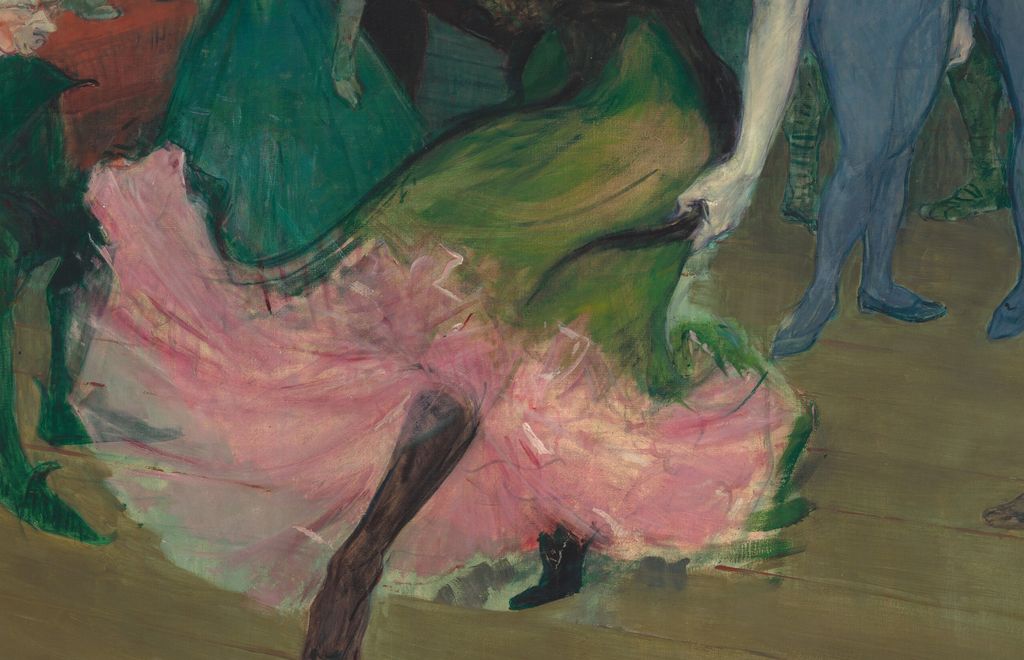
Begin at Lender's hand on our right. Pale fingers gather a dark edge of fabric near the hip. From that point, the green outer skirt stretches diagonally across the body and opens into a great pink expanse. The hand supplies a small, firm point of control; below it, the hem becomes a much looser series of curves. The dance is carried by the relationship between a gripping hand and the cloth it lifts.
The skirt does not form a regular bell. It rises on the left, falls through the middle and curls again near the supporting foot. Dark outlines sometimes describe its edge clearly, then break or disappear among pale strokes. Long pink marks travel through the folds, while greens intrude from the outer fabric. The changes make the material look caught in transition. One can recognise the broad sweep before deciding exactly how every fold connects.
Her extended leg gives the swirling fabric a decisive direction. It emerges from the petticoats near the centre and descends towards a pointed shoe in the foreground. Its dark, narrow form crosses the wide pink field before meeting the quieter brown of the stage. The foot reaches much closer to the lower edge than any other part of her body. This makes the gesture feel expansive even though her shoulders remain well inside the surrounding company.
The other black shoe is tucked beneath the skirt to the right. Its small horizontal shape gives a counterweight to the long diagonal. Our sense of balance depends on that difference: one foot is briefly conspicuous, while the other is almost concealed by the costume. Lautrec makes the dance readable through selected bodily evidence, allowing fabric to do much of the remaining work. The picture preserves a pose without spelling out a full sequence of steps.
Above the skirt, the black bodice has a very different rhythm. Its sleeves swell into large rounded shapes at the shoulders, enclosing the pale chest between them. The sleeve on our right is especially substantial, almost a dark cushion pressed against the upper body. That weight makes the narrow forearm and hand below appear more delicate. The torso is held together by strong dark forms while the lower costume loosens into movement.
Green ornament at the bodice's sides provides an intermediate texture. Its clustered loops are denser than the long marks in the skirt, yet less continuous than the dark sleeves. Lace, cloth and skin are distinguished through the size and direction of painted marks. The costume remains legible even where no single passage is polished into an illusion of smooth material.
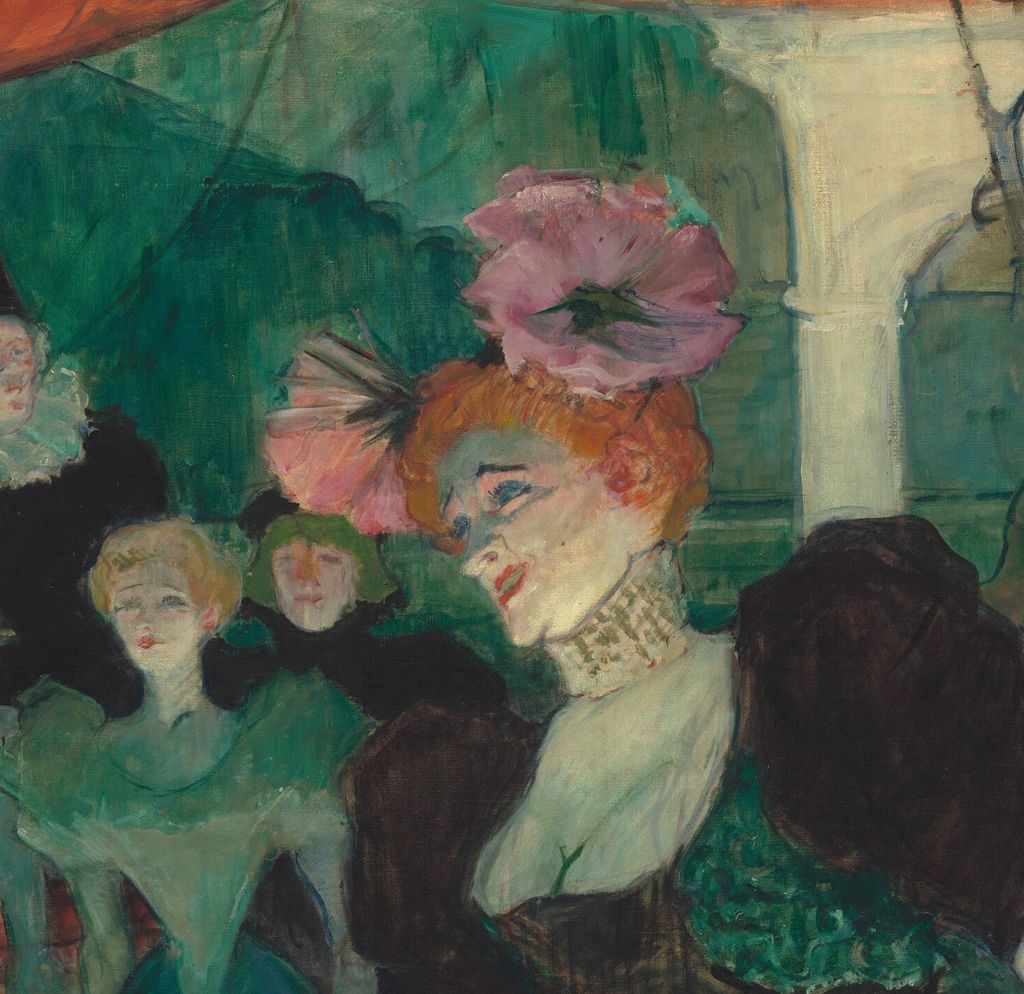
Lender's head inclines towards the left. Her lifted brow, dark eye and red mouth give the face a crispness that contrasts with the billowing hem. The neck is encircled by a high patterned band; the pale area below opens sharply against the bodice. The tilted head and extended leg pull in different directions, making the figure feel turned through space rather than laid out as one flat diagonal.
The pink flowers repeat the petticoats in miniature, but with an exaggerated scale relative to the face. One rises above her head as a broad irregular disc; the other projects to the left in a fan of petals. Hair, flowers and hem therefore form three separated warm attractions. Looking between them carries the eye through the whole height of the dancer, preventing attention from settling only on the exposed leg.
The green skirt also matters as more than the pink's background. Its heavier fold sweeps across the middle and bends back towards the hand. It gives the action a returning curve. Instead of simply bursting outwards, the costume seems gathered, released and gathered again within the single still arrangement. That impression comes from the organisation of folds; it does not establish the precise choreography of the performance.
Annotated Details from Marcelle Lender Dancing the Bolero in Chilpéric
The numbered points identify visible features discussed in this article. Return from each detail to the whole composition. Marcelle Lender Dancing the Bolero in Chilpéric, 1895–96. Oil on canvas, 145 × 149 cm. National Gallery of Art, Washington, Collection of Mr. and Mrs. John Hay Whitney, 1990.127.1. The pink petticoats and flowers stand out within the costumed court. Image source. CC0 / Public domain. Resized only; native appearance preserved.
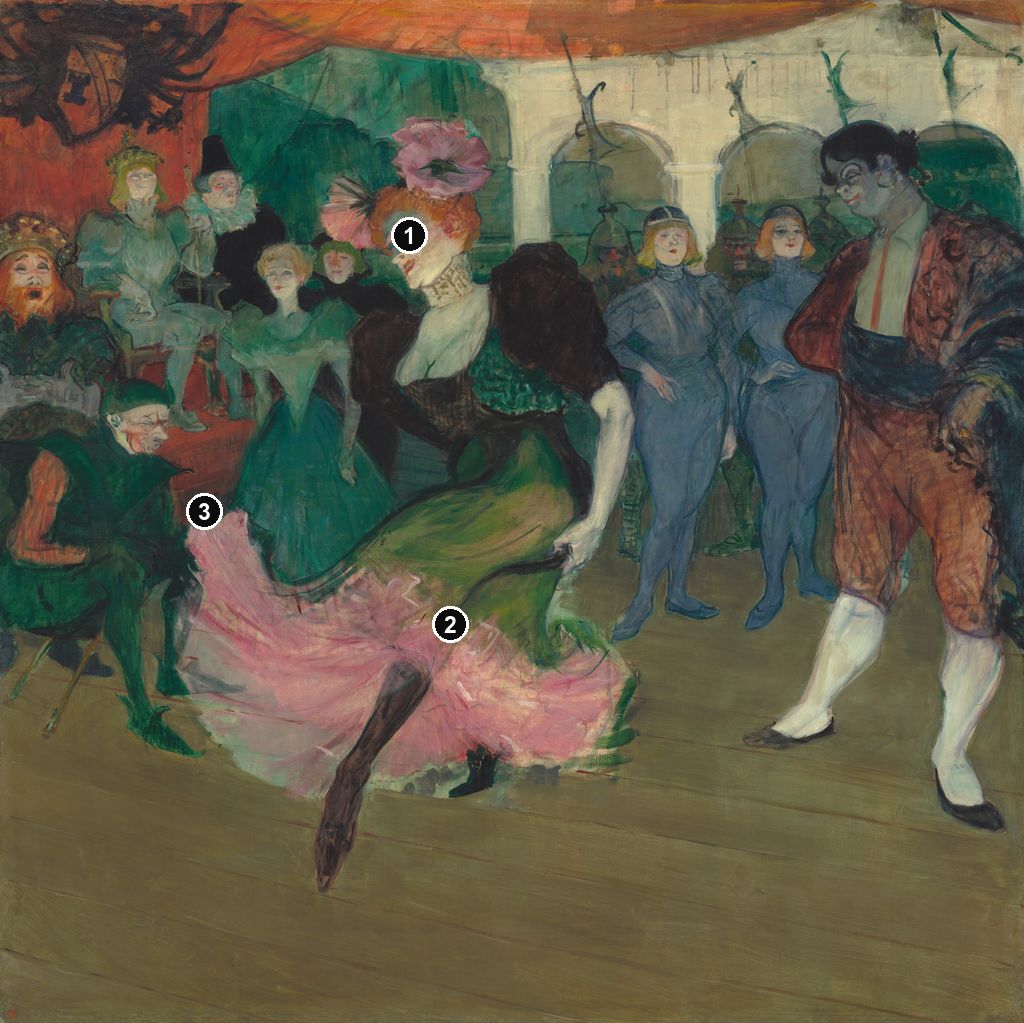
Details from MARCELLE LENDER DANCING THE BOLERO IN CHILPÉRIC
Compare the cropped details with the complete images above. Notice how their colours, shapes and positions contribute to the larger compositions.
Lender’s head and flowers
Orange-red hair and pink flowers sharpen the dancer’s presence.
The lifted skirt
The skirt spreads into a large green shape above the pale petticoats.
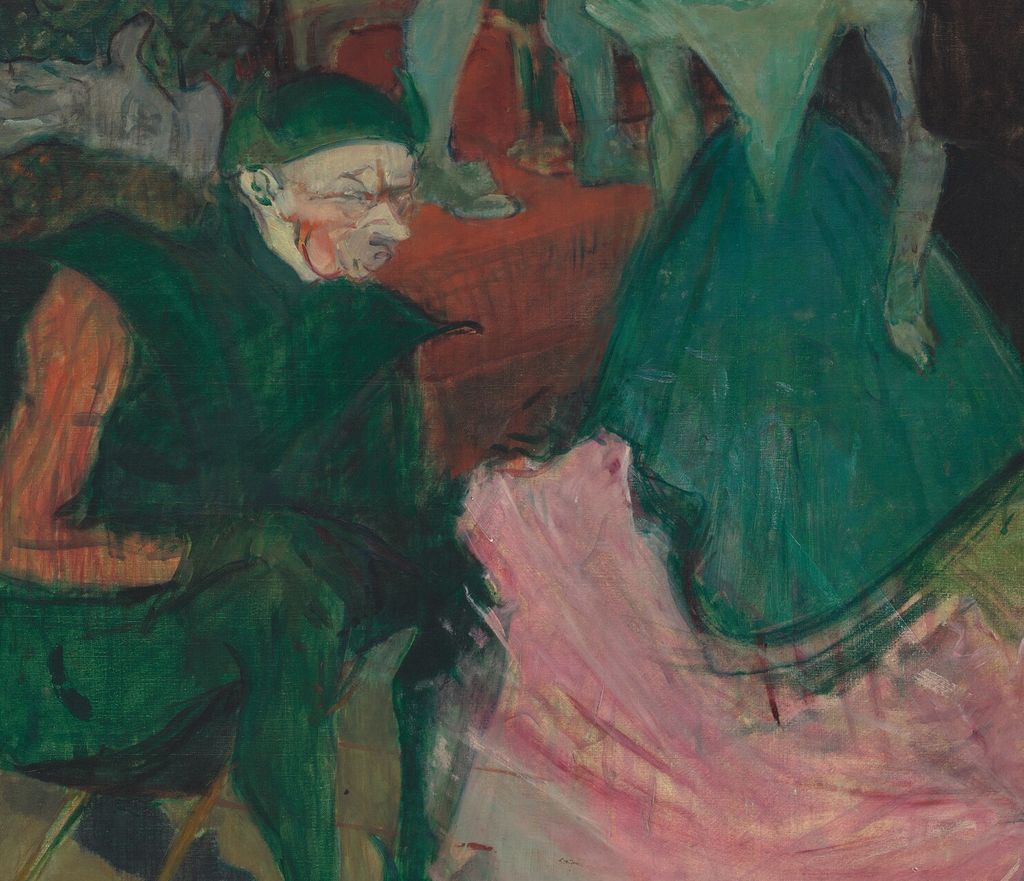
The seated stage figure
The seated figure at the left gives the dance a staged, witnessed setting.
A court built around her movement
The standing man at the right is the dancer's strongest compositional partner. His hands rest at his waist, with elbows projecting outwards. Red-brown sleeves and breeches spread over the upper body; white stockings make two long, exposed forms below. Compared with Lender's sweeping leg, his feet are firmly separated on the floor. His pose offers a broad, relatively stationary frame against which her skirt can move.
His head bends towards her, and dark hair presses into the pale architecture behind. The red of his clothing is deeper and browner than the dancer's pinks. It balances the warm colour on the left without repeating her brightest passage. His position close to the right edge also keeps the stage from becoming a symmetrical arrangement with a star exactly in the middle. Lender dances between unequal groups, with more crowded figures to one side and a single large body to the other.
At the opposite edge, the seated king has an open mouth, reddish beard and emphatic crown. His face is small beside the dancer's costume, yet the orange-red mouth catches the eye. Below him, a figure in green bends forward, the face turning into a compressed, sharply drawn profile. These two heads create different levels of attention near the throne. One rises above the seated body; the other peers from lower down towards the dance.
Coman connects exaggerated expressions near the throne with a running joke about the court physician's supposed cure for the common cold. The comedy gives those emphatic faces another function: they carry stage business alongside their contribution to the watching group. [12]
The green-clad figure's striped sleeve and pointed shoe are easy to overlook. Their narrow alternating marks provide a busy edge beside the great pale skirt. Nearby chair legs cross the brown floor. These details keep the left foreground densely inhabited, while the lower right is comparatively open. The apparent freedom of Lender's movement is sharpened by the bodies and furnishings packed close to it.
Further back, two blue-clad attendants stand close together. Their outlines repeat one another loosely: pale heads, upright torsos and long legs occupy almost parallel strips of space. They form a quieter vertical group between the dark central sleeve and the red figure on the right. Their blue is sufficiently distinct to remain readable without competing with the pink petticoats.
Coman identifies them as pages played by women, another instance of the difference between a character's identity and the performer presenting it. [12]
On the left, seated and standing courtiers overlap in green, black and muted blue. Faces appear at uneven heights. A black hat and pale ruff make one head particularly conspicuous; other heads emerge with only a few marks for eyes and lips. The variety prevents the ensemble from becoming a single decorative band. Even figures with little room around them retain different contours, headwear and directions of looking.
There is a theatrical doubleness to this attention. The characters look at the princess within the story, while their placement also makes Lender's prominence clear to us. Their relative stillness allows the skirt and pointed foot to carry the most emphatic movement. The court supplies the arranged conditions under which the central dance can be seen.
Watch: Toulouse-Lautrec
Choose an artist introduction, a film about graphic design or a closer look at At the Moulin Rouge.
Floor, curtain and painted architecture
The floor takes up a substantial part of the lower canvas. Its olive-brown expanse is crossed by thin, oblique lines and longer strokes. It slopes up into the stage space, allowing us to see the pointed shoe, the supporting foot and the white-stockinged legs on the right at once. The viewpoint gives us information about the performance without placing a row of theatre spectators between us and the actors.
This open foreground is essential to the extended leg. Pink fabric alone would create a richly coloured mass; the dark foot reaching into the relatively empty floor turns that mass into a bodily action. Below the shoe, a further interval of bare stage remains. The movement has room to continue in our imagination because its direction is not stopped immediately by the frame.
Above, orange-red drapery hangs across the composition. Its folds bend down from the left and flatten towards the right. A dark ornamental form crowds the upper-left corner, then gives way to the smoother span over the stage. The overhead material encloses the spectacle, while the low foreground opens towards us. Curtain and floor create opposing pressures around the figures.
The backdrop shifts from deep green on the left to pale architecture on the right. Repeated arches establish a shallow sequence behind the courtiers, and thin dark uprights rise above them. Their pale surface makes a particularly effective setting for the red-clad man's dark hair and for the blue attendants. On the other side, the green field absorbs parts of the darker costumes. The background determines how readily each body separates from its surroundings.
These arches need not persuade us that we are looking into a real building. Their function is already clear as scenery: they provide a courtly setting and organise the upper half of the canvas. Lautrec lets the painting retain that distinction between a represented place and a theatrical construction. The setting supports a story while remaining visibly part of a performance.
Footlights and the unequal treatment of colour
Lender's chest, face and forearm are among the palest passages, but they are far from a single uniform white. Cool green runs across the chest, warmer colour catches the cheek, and dark marks sharpen the eye. The National Gallery connects the green tinge on her exposed upper body with reflected footlight illumination. The painted skin belongs to the lighting of the stage, alongside the heavy make-up and bright costume. [1]
Look across to Don Nervoso and cool colour appears again around the face and chest. Behind him, the attendants' blue costume makes a larger, less startling cool area. The flesh tones therefore participate in a broader colour arrangement, while remaining conspicuous because they occur where a viewer expects a face or exposed body. The lighting joins the cast visually without making all their clothes and skin look alike.
Pink is handled differently. In the petticoats it spreads through pale layers and broken marks; in the flowers it becomes a more compact patch. Red concentrates at mouths and in the right-hand costume. Green occupies both the large backdrop and the dancer's skirt, but changes in darkness and surrounding contrast distinguish those areas. A small palette description cannot convey all these differences in scale, texture and adjacency.
The painting's complementary colours are consequently more than a pair of opposites. The darkest green behind the dancer gives her hair and flowers an emphatic setting. The olive floor softens the transition towards the pink hem. The red-brown of the standing costume holds a different weight from the lighter petals. Each warm or cool passage works through its particular neighbour, rather than through a single rule applied everywhere.
The size of the canvas allows these relationships to extend across a nearly square field. At 145 × 149 centimetres, the picture gives the ensemble almost as much room as the conspicuous dancer. [2] One can look from the large sleeve to a tiny face, then down to the long floor strokes. Its impact depends on that movement between broad attractions and smaller incidents.
Visible brushwork contributes to the energy. The skirt carries long, curving strokes; the background includes vertical runs; faces require much smaller accents. Their difference creates several speeds of looking within the same image. Energetic handling describes what the surface does for us. It cannot by itself determine how many sessions Lautrec spent on the canvas or identify a particular solvent or pigment.
What changes in the Lender bust lithograph?
The familiar Portrait Bust of Mademoiselle Marcelle Lender offers a concentrated comparison. The Met's impression, 1984.1203.161, is an 1895 crayon, brush and spatter lithograph printed in eight colours, fourth state of four, published in Pan. Its image measures 32.9 × 24.4 centimetres on a larger sheet. It is a separate work from the oil painting, even though the red hair, pink flowers and patterned costume immediately connect the two. [13]
In that sheet, Lender faces right and bends her head downwards. The great flowers press against the upper and right boundaries. A patterned background fills the intervals around the hair; green fabric rises close to the face. The skirt, extended leg, court and stage have disappeared. What remains is an encounter between the pale profile, densely coloured hair and ornamental surroundings.
The crop makes the costume behave differently. In the painting, a long green fold helps carry the dance around the body. In the bust, the green fabric becomes a steep shape beneath the jaw. Dark blue ornament concentrates at the lower left, where the body is cut off. The patterns become major structural elements because there is so little surrounding space. Recognition now rests on the face and hair rather than on a full dancing pose.
Ives relates the close-up format and decorative treatment to Kitagawa Utamaro's woodblock portraits. Her comparison is specific to the portrait's concentration of head, coiffure and textiles. It need not make the large stage painting an enlarged Japanese print: the canvas's ensemble, open floor and shifting distances present different problems. The comparison reveals how much Lautrec could change the organisation of attention while continuing to depict the same performer. [10]
The Jane Avril poster offers another route through Lautrec's dance images. Here, the closer comparison remains Lender herself. The painting gives her a stage full of other bodies; the bust sheet makes her profile and ornaments occupy almost the entire image. Medium, scale and framing each contribute to that change.
From the artist's estate to Washington
The National Gallery traces the canvas from the artist's estate through Maurice Joyant and Madame M. G. Dortu. The Whitneys bought it through Hector Brame on 1 August 1950. A partial and promised gift followed in 1990; the gift was completed in 1998. The Whitney collection credit records that history within the National Gallery's collection. [1]
Near the lower-left corner, a small red circular monogram is easy to miss against the brown floor. The museum identifies it as the estate stamp, rather than an ordinary painted signature. [1] Its scale is revealing. Far from the brilliant flowers and emphatic legs, this tiny mark belongs to the painting's history as an object passing through an estate and collections.
From 18 December 1994 to 2 April 1995, the National Gallery devoted a focused exhibition to Lender in Chilpéric, bringing the canvas together with seventeen related lithographs from its collection. [14] Coman's essay also discusses Lautrec's 1897 portrait of Henri Nocq, which includes a reworked version of the Chilpéric painting in its background. The canvas could become scenery itself, carried from the theatrical world into another painted portrait. [12]
The canvas subsequently appeared in the 2005 Toulouse-Lautrec and Montmartre exhibition as catalogue 227. Its checklist preserves the exact 1895–96 oil-on-canvas identity and dimensions. [2] Beside the artist's advertisements and smaller performer images, the large painting makes the ensemble newly consequential: Lender's memorable costume remains its centre, but the watching court, painted scenery and broad stage are indispensable to the experience of her dance.
Toulouse-Lautrec artworks directory
Browse 84 identified works and publications in this researched selection. Dates and titles follow the individual records; this is not a complete catalogue of the surviving oeuvre. Print impressions remain attached to their designs. Some listed works do not have a dedicated article. The Drawings guide also contains nine illustrated studies consolidated from former articles.
Frequently Asked Questions
She appeared as Princess Galeswinthe in the 1895 Théâtre des Variétés revival of Hervé's Chilpéric. The painting shows her bolero before the king and court. [1]
It is a staged operetta scene at the Théâtre des Variétés. The crowned king and costumed court belong to the production. [1]
Discussion
Look again at the images and ideas explored in Marcelle Lender Dancing the Bolero in Chilpéric. These editorial prompts invite your observations.
Reader Insights
How do the two pink flowers change your experience of the pink petticoats? Consider their different sizes, positions and painted edges.
Compare Lender's extended foot with the planted white-stockinged legs at the right. How does the contrast between those poses make the dance more visible?
Join the Conversation
Share a detail, comparison or question about Marcelle Lender Dancing the Bolero in Chilpéric below.
References
- National Gallery of Art, Washington, Marcelle Lender Dancing the Bolero in “Chilpéric”, 1895–96, accession 1990.127.1, current collection narrative, provenance and inscriptions. The narrative supplies the production dates, roles and footlight interpretation; the provenance records completion of the gift in 1998. View source.
- Art Institute of Chicago and National Gallery of Art, Toulouse-Lautrec and Montmartre, exhibition checklist, 2005, cat. 227, painting identification, date, medium, dimensions and collection credit. View source.
- Autoportrait, 1880 (in French). View source.
- ALBERTINA: Der Schimmel Gazelle,GE123DL. View source. (in German).
- Franka Blok, Portrait of Vincent van Gogh, 2024. View source.
- Art Institute of Chicago: Moulin Rouge, La Goulue. View source.
- Art Institute of Chicago: At the Moulin Rouge. View source.
- Jane Avril, 1893. View source.
- Au Salon de la rue des Moulins (in French). View source.
- Colta Ives, Toulouse-Lautrec in The Metropolitan Museum of Art, 1996, p. 50, Marcelle Lender, the Coolus account of repeated attendance and the Utamaro portrait comparison; figs. 55–57 distinguish the first-state lithograph from the colour impression. View source.
- Maurice Joyant (in French). View source.
- Florence E. Coman, Toulouse-Lautrec: Marcelle Lender in Chilpéric, National Gallery of Art exhibition essay, 1994, archived institutional brochure text: “Chilpéric,” costume and scenery; “Marcelle Lender,” Coolus's 1931 reminiscence; “The Legacy of Chilpéric,” the Nocq portrait. View source.
- Metropolitan Museum of Art, Portrait Bust of Mademoiselle Marcelle Lender, 1895, accession 1984.1203.161, exact Pan impression: fourth state of four, eight-colour medium, image and sheet measurements; collection image examined. View source.
- National Gallery of Art, Toulouse-Lautrec, 18 December 1994–2 April 1995, retrospective exhibition record: Coman's focused presentation of the painting with seventeen related lithographs. View source.
- Splash image, Marcelle Lender Dancing the Bolero in Chilpéric, 1895–96. Oil on canvas, 145 × 149 cm. National Gallery of Art, Washington, Collection of Mr. and Mrs. John Hay Whitney, 1990.127.1. The pink petticoats and flowers stand out within the costumed court. Image source. CC0 / Public domain. Resized only; native appearance preserved.


 Henri de Toulouse-Lautrec.jpg)