


 by Tom Gurney
Tom Gurney BSc (Hons) is an art history expert with over 20 years experience
Published on June 19, 2020 / Updated on November 3, 2026
Email: tomgurney1@gmail.com / Phone: +44 7429 011000
Dancer Adjusting Her Tights by Henri de Toulouse-Lautrec: Introduction
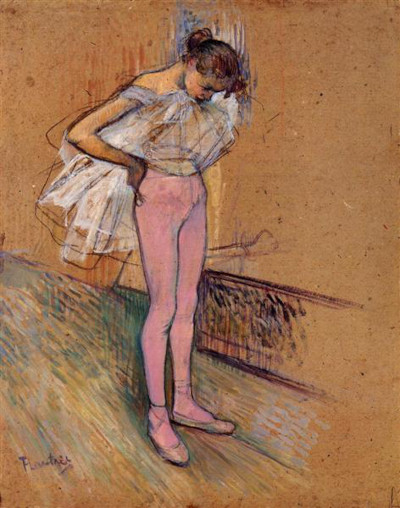
A dancer bends her head towards her waist, gathering the pale fabric of her costume while pink tights extend down to her feet. Her body stands at an oblique angle within a sparsely described room. Henri de Toulouse-Lautrec makes a practical adjustment the subject of Dancer Adjusting Her Tights: the viewer's attention follows the relationship between hands, clothing and the body that must make the costume work.
Christie's identifies the painting as Danseuse ajustant son maillot (Le premier maillot), painted in Paris in 1890. Its record gives oil on board, 59 × 46.5 centimetres, and a signature at the lower left. The work is therefore a particular painted object, distinct from Lautrec's other seated dancers and figures adjusting stockings. [1]
At a Glance
- ArtistHenri de Toulouse-Lautrec.
- French titleDanseuse ajustant son maillot (Le premier maillot).
- Date and placeParis, 1890.
- Mediumoil on board.
- Dimensions59 × 46.5 cm.
- Signaturelower left.
- Catalogue referenceDortu P.371, as cited by Christie's. [1]
This work across Henri de Toulouse-Lautrec’s career
Contents
- A standing body bends towards a task
- White fabric and pink tights
- An oblique position within the room
- Selective finish makes the action clear
- A practical moment beside performance
- A documented exhibition and collecting life
A standing body bends towards a task
The dancer's legs provide the long upright structure of the image. Above them, her upper body tilts across the composition, bringing her head closer to her hands. The change of direction makes the pose intelligible: a standing figure momentarily reorganises herself around a small practical action. The body is neither presented frontally nor arranged in a conspicuous performance gesture.
Her bowed head limits our access to the face. Hair and the upper contour of the head receive stronger emphasis than a clearly displayed expression. This helps direct attention towards what she is doing rather than towards a portrait-like exchange with the viewer. We can follow the act of adjustment without assuming that we know her thoughts or whether she was aware of being observed.
The arms create a more compressed arrangement around the waist. Their angles bring the hands into contact with the costume, concentrating the action within a small part of the painted surface. The rest of the figure supports that focus: the legs hold the body, the shoulders incline and the head follows the hands. Lautrec makes the gesture convincing through coordination among these parts.
White fabric and pink tights
The pale costume spreads around the dancer's upper body and hips in a series of angular folds. Some strokes are light and thin, allowing the warm ground to remain present beneath them. Other edges are more sharply accented. The fabric seems gathered and moved rather than simply draped around a motionless model, because its directions respond to the hands and the bent torso.
The pink tights offer a different kind of surface. Their colour forms long, relatively continuous areas down the legs. Beside the more broken pale costume, that continuity makes the legs immediately legible. The contrast is especially effective around the waist, where the broader pink passage meets the gathered white fabric and the darker accents of the hands.
The feet complete the action's bodily logic. They rest at slightly different angles, giving the figure a workable stance beneath the forward inclination. The painting does not need a theatrical leap to make us aware of balance. A small redistribution of weight is enough. The costume adjustment becomes interesting partly because the body must remain supported while the hands attend to something else.
An oblique position within the room
The dancer is set across the picture rather than aligned neatly with its edges. Her upper body inclines towards the left while the legs carry a longer downward movement. Behind her, dark lines suggest the room's lower boundary. The floor extends beneath her through slanting strokes rather than through a fully described pattern of boards or tiles.
This arrangement gives the figure enough setting to stand in space while leaving much of the background open. The room does not compete with the costume. Its horizontal and diagonal marks supply a framework against which the body's angles become clearer. We understand a place for the action without receiving a complete architectural account of it.
The difference between floor and wall is also carried by the handling of colour. Cooler, busier marks gather low in the image, while the warmer ground remains more exposed above. The dancer therefore occupies a zone where the setting changes. Her long pink legs and pale clothing bridge those areas, keeping the body present against passages that vary in density and direction.
Watch: Toulouse-Lautrec
Choose an artist introduction, a film about graphic design or a closer look at At the Moulin Rouge.
Selective finish makes the action clear
The painting's surface remains visibly made of strokes. A dark line can define an arm, while a thin pale passage suggests the translucency or lightness of fabric. Around the hair and hands, more concentrated marks provide small areas of emphasis. The surrounding room receives less sustained description, allowing the principal bodily relationship to remain clear.
Such uneven finish does not establish that the painting was abandoned or considered unsaleable. Its composition depends on a deliberate difference between what is strongly stated and what remains open. The figure can be understood through a few essential contours and colour areas; the setting needs only enough information to hold her in place. Greater detail everywhere would produce a different experience of the gesture.
The medium matters here as well. This is oil on board, not a pencil drawing enlarged by reproduction. The lines belong within a painted surface, and the colour relationships are central to the image. Calling the handling “sketch-like” can describe its economy, but should not erase the material identity supplied by the object record. [1]
A practical moment beside performance
The dancer's costume establishes her association with performance, but the depicted activity is preparatory. Clothing must be arranged around a moving body before it can become part of a public appearance. By concentrating on that task, Lautrec makes performance visible as work involving hands, fabric, posture and balance, rather than only as an image presented to an audience.
This is a useful distinction from a scene in which the gesture itself is designed to attract attention. Here, the bowed head and gathered costume turn the action inward. The painting can still be compelling to an outside viewer, but its visual interest comes from the body's temporary absorption in a practical problem. The face does not have to explain the act because the pose already does so.
The auction essay compares the oblique placement with Degas's treatment of dancers. That comparison helps identify a shared interest in bodies seen away from a formal stage pose. It does not make the two artists' works interchangeable. In this painting, the long pink legs, compressed hands and thin pale costume form a very particular arrangement around the waist. [1]
A documented exhibition and collecting life
The catalogue records an appearance in Lautrec's 1902 exhibition at Galerie Durand-Ruel. Its ownership history includes Michel Manzi, Pierre Decourcelle, Reynaldo Hahn and Paul Rosenberg. These particulars give the painting a documented life beyond the moment it depicts. They also caution against describing its loose surface as evidence that no audience or collector could value it. [1]
The history should remain attached to this object. Similar descriptions of dancers, pink tights or adjustments can lead reproductions of different works to be confused. The French title, 1890 date, board support and catalogue reference P.371 help keep the painting distinct. They are more reliable identifiers than the general subject of a woman attending to her costume.
For a different practical gesture, compare Woman Pulling Up Her Stocking. The useful question is how each image organises the body around clothing, rather than whether both can be given the same broad label. Here, the act is concentrated high at the waist while the legs remain long and nearly upright. That relation determines the painting's whole structure.
Return to the meeting of white fabric and pink. It is the point at which colour, touch and bodily adjustment become inseparable. The darker hands interrupt the lighter costume, the bowed head directs attention towards them and the legs support the entire arrangement. A modest action becomes a substantial subject because Lautrec makes every part of the figure participate in it.
Toulouse-Lautrec artworks directory
Browse 84 identified works and publications in this researched selection. Dates and titles follow the individual records; this is not a complete catalogue of the surviving oeuvre. Print impressions remain attached to their designs. Some listed works do not have a dedicated article. The Drawings guide also contains nine illustrated studies consolidated from former articles.
Discussion
Look again at the images and ideas explored in Dancer Adjusting Her Tights by Henri de Toulouse-Lautrec. These editorial prompts invite your observations.
Reader Insights
How do the legs support the dancer’s bent upper body?
Where do the pale costume and pink tights receive different kinds of paint?
How much of the room is needed to place this practical gesture?
Join the Conversation
Share a detail, comparison or question about Dancer Adjusting Her Tights by Henri de Toulouse-Lautrec below.
References
- Christie's, Danseuse ajustant son maillot (Le premier maillot), 1994, sale 8026, lot 17: description, provenance, exhibition history and catalogue essay; Dortu P.371 is reported by the auction record. The original Dortu entry was not directly consulted, and the essay's claim that the sitter was unaware of observation is not adopted. View source.
- Autoportrait, 1880 (in French). View source.
- ALBERTINA: Der Schimmel Gazelle,GE123DL. View source.
- Franka Blok, Portrait of Vincent van Gogh, 2024. View source.
- Art Institute of Chicago: Moulin Rouge, La Goulue. View source.
- Art Institute of Chicago: At the Moulin Rouge. View source.
- Jane Avril, 1893. View source.
- Au Salon de la rue des Moulins (in French). View source.
- Colta Ives, Toulouse-Lautrec in The Metropolitan Museum of Art, 1996. View source.
- Maurice Joyant (in French). View source.
 Henri de Toulouse-Lautrec.jpg)