


 by Tom Gurney
Tom Gurney BSc (Hons) is an art history expert with over 20 years experience
Published on June 19, 2020 / Updated on November 3, 2026
Email: tomgurney1@gmail.com / Phone: +44 7429 011000
Hélène Vary: A Portrait in Toulouse-Lautrec’s Studio: Introduction
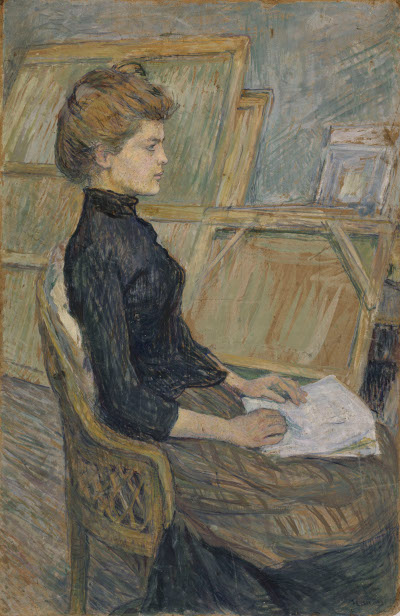
Hélène Vary sits sideways in a wicker chair, her hands resting on pale papers spread across her skirt. Behind her, canvases crowd together, their wooden edges making a second, angular composition around her head and shoulders. Henri de Toulouse-Lautrec’s portrait, dated 1889 in the Toulouse-Lautrec and Montmartre exhibition checklist, gives this quiet arrangement a restless surface. The upright figure seems still; almost every painted surface around her is moving with strokes. The checklist identifies the painting as the Kunsthalle Bremen’s inventory 188-1914/2. [1]
At a Glance
- ArtistHenri de Toulouse-Lautrec
- TitleHélène Vary, also called Young Girl in the Studio. [1] [2]
- Date1889 in the 2005 checklist; circa 1889 in Bremen’s partner entry. [1] [2]
- MediumOil on cardboard in the 2005 checklist; Bremen’s partner entry describes gouache on cardboard. [1] [2]
- Dimensions74.5 × 49 cm in the 2005 checklist; 74.8 × 49.3 cm in Bremen’s partner entry. [1] [2]
- Collection identificationKunsthalle Bremen, inventory 188-1914/2. [1]
- SitterBremen identifies Vary as a seventeen-year-old neighbour who posed for Lautrec several times. [2]
This work across Henri de Toulouse-Lautrec’s career
Contents
- A Named Model in a Working Room
- The Profile and Its Surroundings
- Black Clothing, an Active Skirt
- Canvases That Make the Background
- Line as the Leading Voice
- A Comparison with Jeanne Wenz
- A Portrait That Survived the War
A Named Model in a Working Room
Bremen’s identification of Vary as a neighbour and recurring model gives the portrait a specific human setting. It does not establish another occupation for her. [2] The painting’s familiar name preserves her identity, while the alternative title, Young Girl in the Studio, draws attention to the place and activity surrounding the sitting. Both approaches matter. We see an individual face within a room visibly occupied by the materials of painting.
Looking at the composition, Vary’s chair is turned enough to show its curved side, while her head is presented almost entirely in profile. Her body has weight and breadth: the skirt spreads across her lap and continues beyond the right edge. The narrow vertical format accommodates much of the seated figure without showing a complete body or a complete room. There is no floor plan to reconstruct and no distant view to explore. The space is measured through the immediate relations between chair, figure and stacked canvases.
The papers introduce a quieter kind of activity. One hand lies farther forward, with fingers extending across their upper edge; the nearer hand rests lower down. The sheets catch the eye because their pale surface interrupts the darker clothing. No legible text identifies them as a particular newspaper or publication. Nor is Vary visibly absorbed in reading them: her face is turned outward, above the papers. The painting holds her between an available activity and the stillness of posing, without explaining what has just happened or what she will do next.
The Profile and Its Surroundings
Vary’s head occupies a remarkably clear area within a busy picture. Her forehead, nose, lips and chin form a sequence of small changes in direction against the cooler background. The eye is indicated with little surrounding detail, and the mouth is drawn through a delicate meeting of light and dark. Her hair supplies a much larger, warmer shape, swept upward and gathered behind the head. Dark curves describe its arrangement, while ochre and brown strokes give it volume. These observations concern the painted construction; they cannot tell us what Vary was thinking during the sitting.
The high dark collar makes the transition from blouse to face abrupt. Below it, the clothing absorbs much of the light; above it, the exposed neck and cheek become a continuous pale passage. This is one reason the face can command attention without occupying the centre of the picture. Lautrec gives it a strong tonal setting, then allows the intricate silhouette to do much of the descriptive work. Seen from farther away, the head remains legible even when its smallest marks disappear.
There is also room in front of the profile. The nose points into the open, bluish area above the large foreground canvas, toward the smaller framed shapes at the right. This interval prevents the face from being pressed against another object. Behind the hair, by contrast, a broad rectangular frame rises close to the head. The difference makes the surrounding arrangement feel responsive to the sitter’s orientation. The picture is crowded behind her and opens in the direction she faces. That visual effect does not require a story about the unseen object of her attention.
Black Clothing, an Active Skirt
The blouse initially reads as the painting’s most compact dark mass. Closer looking breaks it into many strokes, including blue, greenish and brown passages within the near-black. Lines descend along the upper arm and turn around the bent elbow; shorter marks collect at the waist and sleeve. The clothing follows the body while also displaying the painter’s handling. Its darkness is varied enough to distinguish the upright back, projecting chest and forward movement of the forearms.
The skirt changes the picture’s rhythm. Its broader area is crossed by loosely organised bands and angled marks, with warm browns passing through cooler grey-green tones. Some strokes follow the curve of the lap, while others cross them and make the fabric appear patterned. It is unnecessary to identify an exact textile to appreciate the effect. Against the narrower, darker upper body, the spreading skirt gives the seated figure a substantial base. The pale papers lie across that base like a smaller, irregular plane.
This relationship between clothing and posture is especially clear at the right edge. The skirt is cut off, leaving the viewer to imagine its continuation. Below, a dark passage descends toward the bottom of the painting, while the chair’s front support appears at the left. The figure therefore extends beyond the image through several different routes. Cropping makes the sitting feel close: we are within reach of the chair and papers, without seeing Vary’s feet or the full extent of her clothing.
The wicker chair contributes another pattern, distinct from those of the blouse and skirt. Its rounded arm sweeps forward beneath the nearer forearm, and the woven side is suggested by crossing strokes. That curve helps carry the eye from the sitter’s back toward her lap. It also separates the figure from the lower-left background, where slanting marks might otherwise merge with the clothing. The chair is both a recognisable furnishing and an essential piece of the composition’s structure.
Watch: Toulouse-Lautrec
Choose an artist introduction, a film about graphic design or a closer look at At the Moulin Rouge.
Canvases That Make the Background
The room behind Vary is organised through rectangles of different sizes. A large canvas rises behind her hair, another narrower one projects above the horizontal crosspiece, and a broad canvas occupies much of the right side. Their overlapping wooden edges create steps, diagonals and interruptions. The smaller shapes near the upper right repeat this construction on a reduced scale. Looking from one to another, we become aware of how much of the studio is represented by pictures turned away from us or only partly available to view.
The broad canvas behind Vary’s hands is particularly important. Its pale interior creates breathing space beside the dark blouse, while the wooden framework introduces strong lines close to her elbows. A diagonal brace points down toward the lap. Above it, the long horizontal edge cuts across the room behind the sitter. The geometry is assertive, but the loosely painted surfaces keep it from appearing mechanically regular. Edges waver, and strokes cross the areas they describe.
These shapes offer a useful way to understand the studio setting. The portrait includes the practical things that surround the act of making a picture: supports, wooden structures and stored work. Yet those objects also make the portrait possible as a design. The canvases establish a framework against which the figure’s curves can be seen. Vary’s coiffure, shoulder, bent arm and rounded skirt become more distinct because they are placed among straight edges.
The room’s colour also passes into the figure. Cooler strokes in the wall and canvases have counterparts in the dark blouse and patterned skirt. Warm ochres connect the wooden frames, wicker chair and hair. These correspondences make the sitter belong visually to her surroundings, even where her outline separates her sharply from them. The portrait’s unity comes partly from this circulation of colour across apparently different materials.
Line as the Leading Voice
An early reader of the painting drew attention to precisely this balance between structure and atmosphere. In the Kunsthalle’s official 1919 guide, Emil Waldmann reproduced Young Girl in the Studio beside a discussion of Renoir. He compared the firmness of the head in Renoir’s work with the drawing of Degas and Lautrec, then distinguished their priorities through a musical analogy: in Degas and Lautrec, line leads and atmosphere accompanies it; in Renoir, the relationship is reversed. This was a historical interpretation offered in the museum’s guide, rather than a statement by Lautrec. [12]
Waldmann’s distinction gives a useful starting point for looking again. The profile, collar, chair arm and wooden frames all depend on recognisable outlines. Those boundaries remain effective through a surface filled with separate marks. The room does not dissolve into coloured air, even though the strokes make its surfaces restless. Equally, the outline alone would give only a fraction of the picture’s effect. Directional marks animate the forms it contains.
The contrast is clearest if the face and skirt are considered together. The face needs the exact placement of a few edges; the skirt is built through a much broader accumulation of strokes. Both belong to the same seated body, but they ask for different kinds of attention. The head encourages us to follow a contour closely. The lap encourages us to take in a field of intersecting colour and direction. More about these relationships across Lautrec’s work can be explored in his style and technique.
The published descriptions of the materials require care. The 2005 checklist calls this an oil painting on cardboard; Bremen’s partner entry calls it gouache on cardboard and gives slightly larger measurements. The difference remains unresolved by those sources. [1] [2] Visible streaks and thin-looking passages cannot, by themselves, settle the identity of the binding medium. The portrait can be discussed closely without treating a reproduction as a technical examination.
A Comparison with Jeanne Wenz
Lautrec’s Portrait of Jeanne Wenz, dated 1886 by the Art Institute of Chicago, provides a revealing comparison. The museum describes Wenz’s full profile and notes its relationship to a device familiar from Renaissance portraiture. It also draws attention to the restrained colouring and accents of pink and green. [13] Both portraits place a pale face above dark clothing, turn the sitter toward the right and use the visible chair to help define the figure’s position.
The differences show what the expanded studio setting contributes to Hélène Vary. Wenz is framed more closely around the upper body, with a relatively continuous blue-green background behind her face. Her chair’s upright post appears beside the back of her head. Vary’s portrait opens downward to the lap and papers, and outward to the surrounding canvases. The sharpness of the profile survives within a much more complicated network of forms. These are differences in composition, rather than evidence that the two sitters shared a temperament or experience.
The comparison also makes Vary’s particular outline easier to appreciate. Wenz’s hair sits closer to her head, with a fringe extending across the forehead; Vary’s rises in a fuller arrangement above the face. A familiar portrait format can therefore accommodate very different rhythms. The individuality of Hélène Vary is carried through such precise relationships between hair, forehead, collar and background, as well as through the larger setting of the sitting.
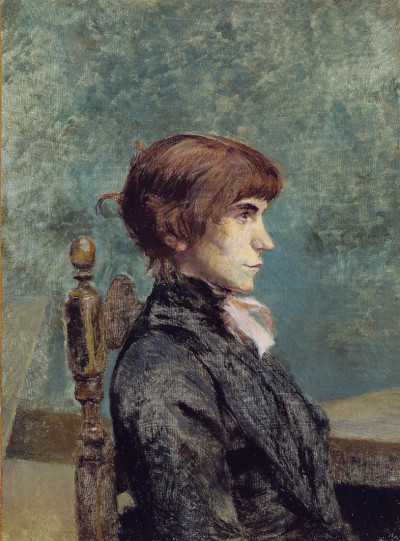
Henri de Toulouse-Lautrec, Portrait of Jeanne Wenz, 1886. Oil on canvas, 80.7 × 59.5 cm. Art Institute of Chicago, 1941.824. Also historically titled Woman with Pink Bow. Image source. Public domain. Resized only; native appearance preserved.
A Portrait That Survived the War
Bremen credits the sculptor Kurt Reutti with recovering the portrait at Karnzow Palace, a wartime storage site. Recalling the discovery in 1966, he described its use as a surface for cutting wallpaper. In his account, the painted side faced downward and escaped damage. [2]
The earlier museum guide supplies a different, quieter point in that history. Its 1919 reproduction already presents the same seated figure, with the conspicuous pale papers and stacked canvases. Waldmann treated it as an example through which visitors could understand Lautrec’s drawing. [12] The 2005 exhibition checklist subsequently records the Bremen portrait under its specific inventory number. [1] These documented appearances establish useful points in the object’s history; they do not supply a complete chain of ownership or establish its present gallery display.
Toulouse-Lautrec artworks directory
Browse 84 identified works and publications in this researched selection. Dates and titles follow the individual records; this is not a complete catalogue of the surviving oeuvre. Print impressions remain attached to their designs. Some listed works do not have a dedicated article. The Drawings guide also contains nine illustrated studies consolidated from former articles.
Frequently Asked Questions
The Kunsthalle Bremen identifies her as a seventeen-year-old who lived with her parents near Lautrec’s Montmartre studio and modelled for him several times. [2]
Pale papers rest on her lap, but their text is not legible in the reproduction and her face is turned above them. Calling them a specific newspaper would go beyond what can be seen.
Look at the small framed shapes above the papers, the crossing strokes in the wicker chair and the cooler colours running through the dark blouse. Each helps connect the figure with the room around her.
Discussion
Look again at the images and ideas explored in Hélène Vary: A Portrait in Toulouse-Lautrec’s Studio. These editorial prompts invite your observations.
Reader Insights
Which draws your attention first: the clear profile, the wicker chair’s curve or the intersecting edges of the canvases?
Does the portrait support Waldmann’s comparison of line to a leading melody, or do its strokes and colour seem equally decisive? [12]
Join the Conversation
Share a detail, comparison or question about Hélène Vary: A Portrait in Toulouse-Lautrec’s Studio below.
References
- Art Institute of Chicago, Toulouse-Lautrec and Montmartre: exhibition checklist, 2005, p. 6, cat. 87, Hélène Vary. Entry for the Bremen portrait, inventory 188-1914/2. View source.
- Kunsthalle Bremen, Young Girl in the Studio (Hélène Vary), museum partner entry on Google Arts & Culture: image, description, object details and Kurt Reutti’s 1966 recollection as reproduced by the museum. View source.
- Autoportrait, 1880 (in French). View source.
- ALBERTINA: Der Schimmel Gazelle,GE123DL. View source. (in German).
- Franka Blok, Portrait of Vincent van Gogh, 2024. View source.
- Art Institute of Chicago: Moulin Rouge, La Goulue. View source.
- Art Institute of Chicago: At the Moulin Rouge. View source.
- Jane Avril, 1893. View source.
- Au Salon de la rue des Moulins (in French). View source.
- Colta Ives, Toulouse-Lautrec in The Metropolitan Museum of Art, 1996. View source.
- Maurice Joyant (in French). View source.
- Emil Waldmann, Die Bremer Kunsthalle: Ein Führer zur Vorbereitung und zur Erinnerung, official publication, Berlin: Julius Bard, 1919, pp. 46–47, especially the reproduction and comparison on p. 47 (in German). View source.
- Art Institute of Chicago, Portrait of Jeanne Wenz, 1886, inventory 1941.824; museum description and object data consulted through the public collection API. View source 1. View source 2.
- Splash image, Hélène Vary, circa 1889, Kunsthalle Bremen, 188-1914/2. Kunsthalle Bremen reproduction via Wikimedia Commons. Image source. Public domain. Resized only; native appearance preserved.
 Henri de Toulouse-Lautrec.jpg)