



 by Tom Gurney
Tom Gurney BSc (Hons) is an art history expert with over 20 years experience
Published on June 19, 2020 / Updated on November 3, 2026
Email: tomgurney1@gmail.com / Phone: +44 7429 011000
Toulouse-Lautrec's Self-Portrait in Front of a Mirror: Introduction
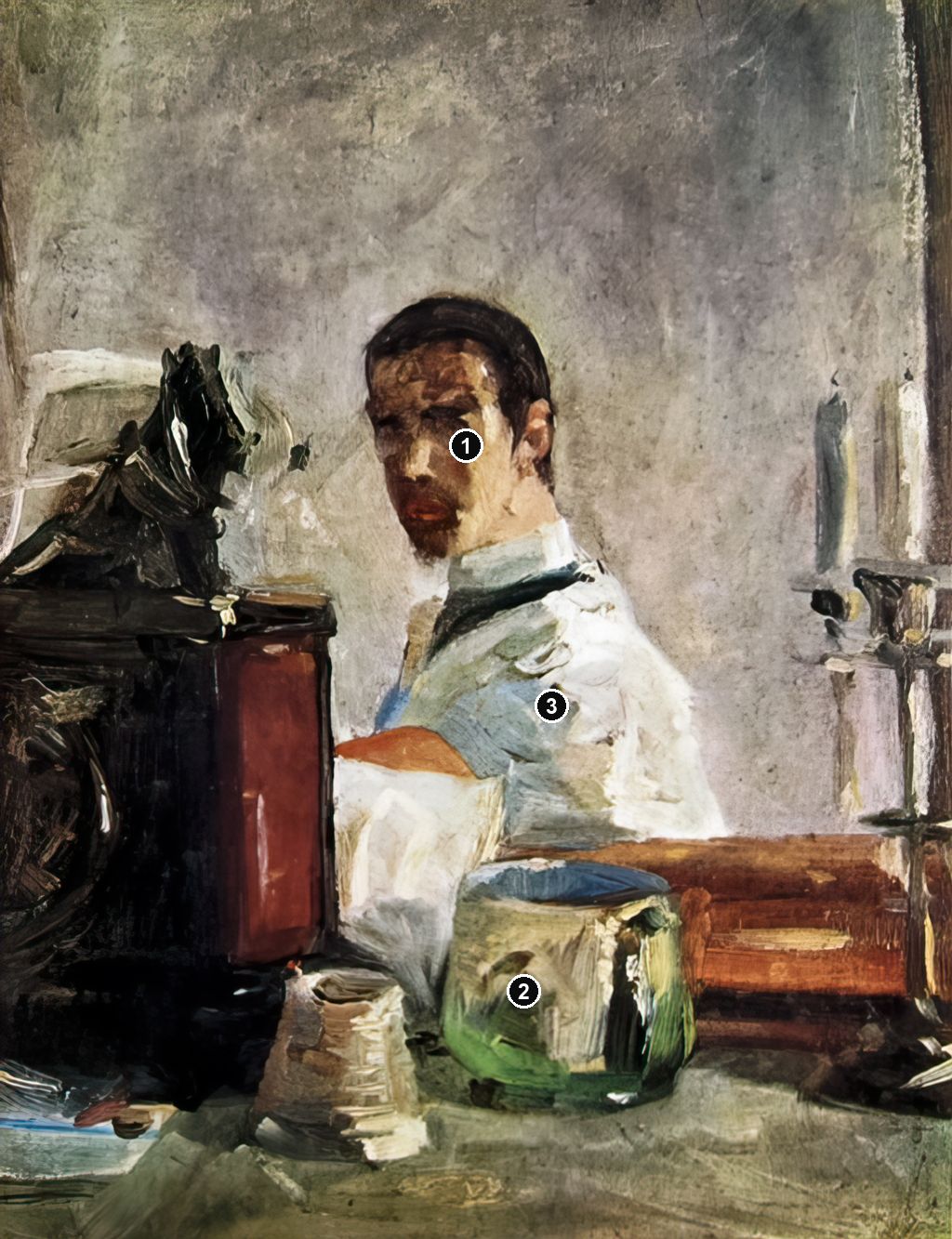
A green vessel, a pale little container and a dark ornamental clock occupy the foreground. Behind them, Henri de Toulouse-Lautrec turns his head towards us. His white clothing catches more light than his face; an expanse of grey opens above him. In Self-Portrait in Front of a Mirror, the person named by the title has to share our attention with things that seem almost within reach. The reflected head is small, but the composition repeatedly brings the eye back to it. [1] [2]
The painting belongs to the Musée Toulouse-Lautrec in Albi, where it bears the inventory number MTL.20. Looking carefully at its arrangement reveals an early experiment in making a likeness through surrounding objects, differences of scale and uneven illumination. [1]
At a Glance
- ArtistHenri de Toulouse-Lautrec
- TitleSelf-Portrait in Front of a Mirror; also exhibited as Toulouse Lautrec par lui-même. [3]
- Date1880 in the museum-contributed Occitanie record; approximately 1880 in the Musée Bonnard exhibition record. [1] [3]
- Medium and sizeOil on cardboard, approximately 40 × 32 cm. [1]
- CollectionMusée Toulouse-Lautrec, Albi, MTL.20; gift of Countess Adèle de Toulouse-Lautrec. [1]
- Principal visual relationshipA small reflected figure behind a much larger foreground still life.
This work across Henri de Toulouse-Lautrec’s career
Contents
- Why the date needs a little care
- Finding the person inside the reflection
- A still life that changes the scale of the portrait
- Light reaches the shirt before the eyes
- Reading the marks on a small painted surface
- Other portraits make the choices clearer
- An early likeness in a later exhibition
- Annotated details
Why the date needs a little care
The date attached to a reproduction is not always the date used by the institution responsible for the object. The museum's entry on Musées Occitanie explicitly gives 1880. A second institutional record supports that early placement: the Musée Bonnard included the painting in its 2021 exhibition Face à face: L'autoportrait de Cézanne à Bonnard, labelling it approximately 1880. Its caption also identifies oil on cardboard and the Albi collection. [1] [3]
The familiar photograph on Wikimedia Commons, meanwhile, carries 1882 in its filename and object data, and 1882–83 in its English caption. These labels refer to the same composition and inventory number; they do not identify a second self-portrait. The institutional dating of 1880 is followed here, while acknowledging why readers may encounter the later years elsewhere. Neither the filename nor the image itself explains the origin of the discrepancy. [2]
That difference affects the painting's place in Lautrec's education. Albi's recent chronology dates his entry into Léon Bonnat's studio, followed by Fernand Cormon's, to 1882. With the earlier date, the self-portrait belongs before those successive periods of formal Paris training. The painting offers a view of his handling before those lessons began. The broader sequence is explored in his biography. [12]
Finding the person inside the reflection
The head is close to the centre horizontally, yet it occupies only a small portion of the upright picture. Above it, the pale field continues for a considerable distance. Below, the body is interrupted by the objects and the brown horizontal edge behind them. These unequal areas make the portrait feel embedded in a room rather than presented as an isolated head and shoulders. The arrangement can be followed without reconstructing the entire room. [2]
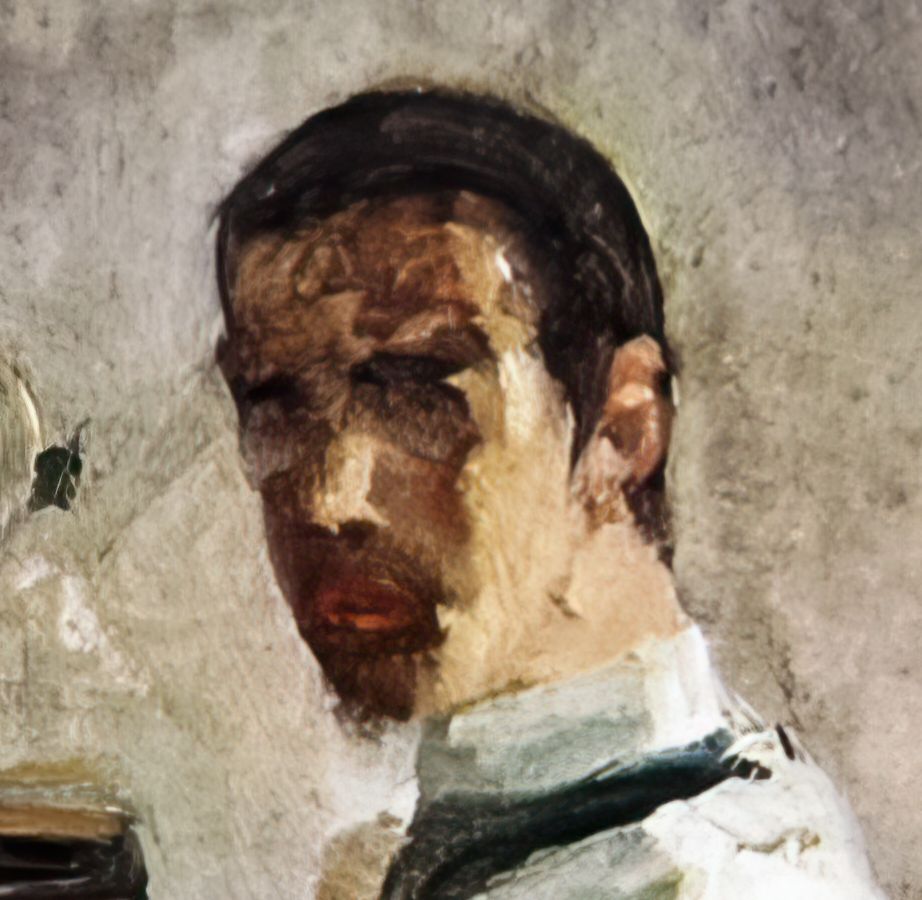
The torso angles away while the head turns back. Dark hair makes a strong upper boundary; the ear and the side of the face catch warmer light. The nose has a pale ridge, but the eye sockets remain dark. A white collar and narrow dark band at the neck separate the face from the much larger light shape of the clothing. Those boundaries keep the head distinct even where its internal features are difficult to resolve.
The reflected body is partly concealed below the face. An ochre passage suggesting the forearm runs leftwards and disappears behind the large dark clock. Broad folds of white descend towards the pale vessel at the bottom. The obstruction matters: we can follow the direction of the arm without seeing its complete extent or assigning an action to the hand. No palette or paintbrush is clearly displayed among the furnishings. Recognition rests on the face and the documented identity of the portrait. [2]
Annotated Details from Toulouse-Lautrec's Self-Portrait in Front of a Mirror
The numbered points identify visible features discussed in this article. Return from each detail to the whole composition. Henri de Toulouse-Lautrec, Self-Portrait in Front of a Mirror, circa 1880. Oil on cardboard. Musée Toulouse-Lautrec, Albi, MTL.20. Photograph: Didier Descouens, CC BY-SA 4.0; resized only. Photograph: Didier Descouens / CC BY-SA 4.0. Image source. CC BY-SA 4.0. Numbers added to a separately resized overview; detail crops taken from the immutable original. These overview and crop derivatives are shared under CC BY-SA 4.0. No recolouring or retouching.
Details from TOULOUSE-LAUTREC'S SELF-PORTRAIT IN FRONT OF A MIRROR
Compare the cropped details with the complete images above. Notice how their colours, shapes and positions contribute to the larger compositions.
The reflected head
The small reflected head is surrounded by the larger mirror and room.
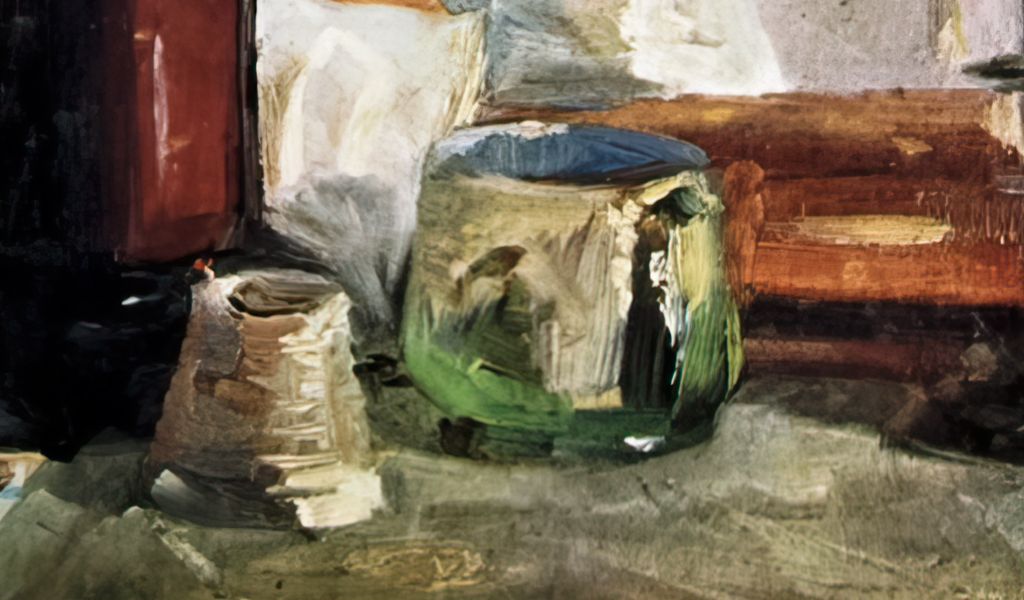
Objects on the mantel
Foreground objects compete in scale with the reflected figure.
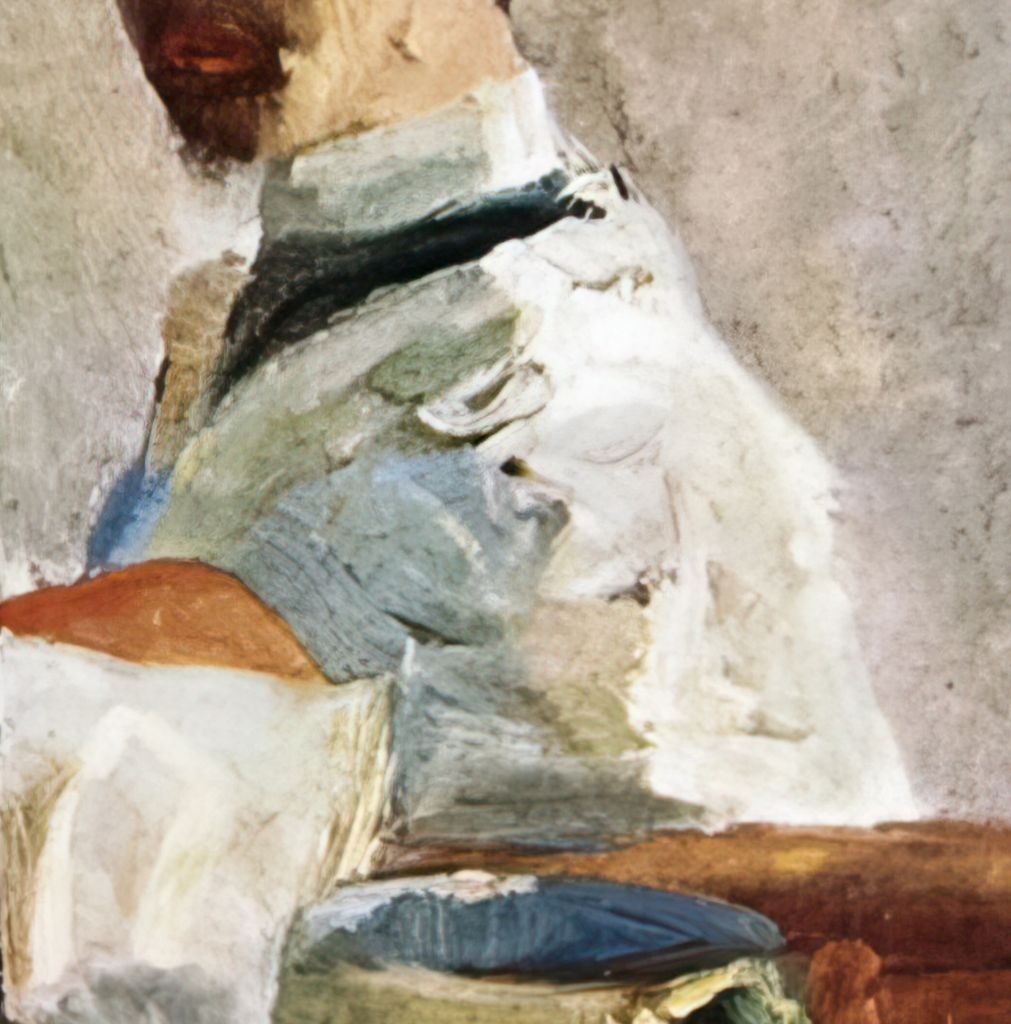
The pale jacket
The pale clothing makes the small figure visible within the darker setting.
A still life that changes the scale of the portrait
The foreground objects make the painting unusually substantial for such a modestly sized work. At the left, the clock forms a dark upright mass with a reddish-brown side. Its elaborate upper ornament includes a horse shape, rising almost as high as Lautrec's head. The left edge cuts through the object, so its full width remains outside our view. Our proximity turns a mantel furnishing into a major obstruction. [2]
Near the bottom centre, the green vessel has a dark open rim and pale, broken marks across its front. Its rounded body offers a different kind of weight from the clock's vertical side. The smaller cream-coloured object in front and to the left has a hollow top and a tapering, irregularly described outline. A tall candlestick enters at the right. The picture provides enough information to distinguish these forms while leaving their finer ornament and exact uses less certain.
Together they create a sequence across the lower picture: tall dark mass, low pale form, broad green vessel and narrow upright at the edge. The intervals are unequal. The clock almost presses against the reflected figure, while the candlestick leaves a wider pale opening beside his shoulder. The arrangement keeps the still life from becoming a neat row of specimens. Each object changes how much of the figure and surrounding space we can see. [2]
The green vessel is especially effective as a measure of distance. It is at least as wide as the reflected head, although it is an ordinary object placed nearer the viewer. That relationship makes the head seem farther away without requiring a long view across a fully described room. A few overlapping forms establish the intervening space. Their comparative sizes within the picture give the arrangement its depth.
The brown horizontal band behind the vessel provides another useful interruption. It runs across the lower body and meets the right-hand furnishing, making a firm division within an otherwise loosely painted interior. Above it, a human shoulder curves into light; below it, vessels occupy the near surface. Following this boundary helps disentangle the reflected person from the objects in front of the mirror. The still life is therefore part of the portrait's spatial construction, rather than an accessory to be passed over on the way to the face. [2]
Watch: Toulouse-Lautrec
Choose an artist introduction, a film about graphic design or a closer look at At the Moulin Rouge.
Light reaches the shirt before the eyes
The brightest large area belongs to the clothing. White, blue-grey and greenish strokes spread over the shoulder and down the sleeve. Darker marks describe folds without enclosing every one. Against this luminous passage, the face appears concentrated and relatively obscure. Its warmer browns make it distinct from the surrounding grey, but the eyes do not offer the bright, sharply stated contact that might first be expected from a self-portrait. [2]
The museum's commentary describes backlighting and finds gravity and melancholy in the relationship between the shadowed face and the dark palette. Those are interpretive responses to the picture. The visible evidence is more specific: the lips, nose and ear are clearer than much of the gaze, while foreground objects hold the figure at a distance. These observations can explain the portrait's reserve without establishing what Lautrec felt while painting it. [1]
The still life gives the light other surfaces to cross. A pale flash catches the dark horse ornament; narrow strokes run along the clock's edges. The green vessel gathers bright, angular patches on its curved front. The small cream object is built from several close-valued bands rather than one even colour. These changes make the foreground responsive to illumination even where its objects remain darker than the shirt. [2]
Colour also connects the separate areas. The reddish-brown clock side answers the horizontal wood behind the vessel, while the warmer face occupies a smaller interval above them. Cool greens and greys move between the vessel, the light clothing and the surrounding field. Looking at those repetitions helps explain why the head belongs within the room despite its small scale. The composition holds together through exchanges of colour as well as through overlap.
Reading the marks on a small painted surface
The support is cardboard, and the painting is only about forty centimetres high. That physical scale matters when looking at an enlarged photograph: the broad white strokes across the shoulder and the tiny accents around the nose belong to the same small object. They offer very different degrees of description within a limited area. [1] [2]
In the pale background, strokes remain visible across an extensive, relatively open field. Near the face they become smaller and more closely packed. At the bottom, wider sweeps cross the near surface, meeting the much firmer dark boundary beneath the green vessel. The eye moves between paint that describes a thing and paint whose movement remains conspicuous. The differences make adjacent surfaces distinct. [2]
This photograph supports observations about visible handling, but cannot establish an exact pigment, solvent mixture or sequence of revisions. The documented medium is oil on cardboard; it does not by itself establish peinture à l'essence, the thinned-oil method associated with particular later works. Keeping those distinctions clear makes the surface more interesting: what we can actually follow is the change from broad light strokes to tightly gathered facial marks. The style and technique article compares documented methods across other objects. [1] [2]
Other portraits make the choices clearer
Lautrec's Self-Portrait from the Back, dated 1884 by the museum at Fontevraud, supplies a useful counterpoint. There he sits before a canvas, showing the back of his dark waistcoat and his head. The face is unavailable because it turns away. The museum identifies a deliberately comic inscription on the depicted canvas and treats the work as one of his rare self-portraits. It is a separate painting, rather than an alternative title for the Albi mirror scene. [13]
The contrast concerns how the viewer gains access to the artist. In the Fontevraud picture, the canvas and seated working figure make painting itself the subject, while the head remains turned away. At Albi, the face is offered through reflection but the foreground furnishings interrupt our approach. One composition announces the activity of painting; the other gives its objects much more prominence. The two pictures demonstrate the variety of his self-portraiture. [2] [13]
A comparison with the 1887 portrait of Vincent van Gogh brings a different decision into view. In that pastel, the clearly articulated profile stands against horizontal bands of café furnishings, with a glass near the sitter's arms. Franka Blok's catalogue entry describes layers of separate, unblended pastel strokes on prepared paper stretched over cardboard. Here the face is made exceptionally legible through coloured lines and contrasts at its edge. [5]
The early mirror portrait distributes that clarity differently. Its pale clothing attracts light, the eye remains shadowed and the near vessels compete in scale with the head. Both pictures arrange a likeness among furnishings, but the means and results differ. The comparison lets the early painting retain its own problem: how to make a face matter when it occupies relatively little of the surface and shares the image with much nearer things. [2] [5]
An early likeness in a later exhibition
The painting's inclusion in the Musée Bonnard's Face à face exhibition in 2021 offered a setting beyond Lautrec's individual career. The show brought together self-portraits by artists including Cézanne, Vuillard and Bonnard, asking how artists represent themselves. Its entry for the Albi work used the title Toulouse Lautrec par lui-même. That phrasing places the maker and sitter together, while the familiar English title draws particular attention to the mirror. [3]
Each title encourages a slightly different first glance. Looking for Lautrec, we find the face; looking for the mirror, we begin examining the picture's layers. The clock, vessels and candlestick then become difficult to ignore. The portrait gives a likeness, but also makes us negotiate the objects and light through which that likeness appears. Returning to the whole composition after inspecting the face restores the scale of that encounter. [2]
Toulouse-Lautrec artworks directory
Browse 84 identified works and publications in this researched selection. Dates and titles follow the individual records; this is not a complete catalogue of the surviving oeuvre. Print impressions remain attached to their designs. Some listed works do not have a dedicated article. The Drawings guide also contains nine illustrated studies consolidated from former articles.
Frequently Asked Questions
It belongs to the Musée Toulouse-Lautrec in Albi, inventory MTL.20. The collection record credits a gift from his mother, Countess Adèle de Toulouse-Lautrec. [1]
Their proximity, cropping and overlap give them much more pictorial space than the reflected head. This scale relationship helps establish distance between the near still life and the figure. The near objects supply a scale against which to read the reflection. [2]
No. Fontevraud holds Self-Portrait from the Back, dated 1884. Its turned-away figure, depicted canvas and comic inscription produce a very different kind of self-presentation. [13]
Discussion
Look again at the images and ideas explored in Toulouse-Lautrec's Self-Portrait in Front of a Mirror. These editorial prompts invite your observations.
Reader Insights
Follow the pale accents from the small foreground container through the vessel and shirt to the nose and ear. Which change of light first draws your attention towards the head? [2]
Join the Conversation
Share a detail, comparison or question about Toulouse-Lautrec's Self-Portrait in Front of a Mirror below.
References
- Musée Toulouse-Lautrec, Autoportrait, 1880, MTL.20, museum-contributed record on Musées Occitanie: date, medium, dimensions, gift and commentary on the reflected face, foreground still life and light (in French). View source.
- Didier Descouens, photograph of Self-Portrait in Front of a Mirror, Musée Toulouse-Lautrec, MTL.20, photographed 21 May 2021; full image examined for the visual observations in this article. The file's 1882 and 1882–83 labels differ from the institutional dating in references 1 and 3. View source.
- Musée Bonnard, Face à face: L'autoportrait de Cézanne à Bonnard, exhibition, 26 June–3 October 2021; “Zoom sur les œuvres,” entry for Toulouse Lautrec par lui-même, approximately 1880, oil on cardboard, 40.6 × 32.5 cm, Musée Toulouse-Lautrec, Albi (in French). View source.
- ALBERTINA: Der Schimmel Gazelle,GE123DL. View source. (in German).
- Franka Blok, “Henri de Toulouse-Lautrec, Portrait of Vincent van Gogh, 1887,” cat. 132, in Contemporaries of Van Gogh 1: Works Collected by Theo and Vincent, Van Gogh Museum, 2024, “Pastel crayon,” especially notes 27 and 29 on support and unblended strokes; portrait image also examined. View source.
- Art Institute of Chicago: Moulin Rouge, La Goulue. View source.
- Art Institute of Chicago: At the Moulin Rouge. View source.
- Jane Avril, 1893. View source.
- Au Salon de la rue des Moulins (in French). View source.
- Colta Ives, Toulouse-Lautrec in The Metropolitan Museum of Art, 1996. View source.
- Maurice Joyant (in French). View source.
- Musée Toulouse-Lautrec, Toulouse-Lautrec et l'art de l'affiche: 2025 exhibition press dossier, chronology, p. 13: Bonnat and Cormon in 1882 (in French). View source.
- Fontevraud, le musée d'Art moderne, Autoportrait de dos, 1884, collection commentary and image; rear view, depicted canvas and comic inscription (in French). View source.
- Splash image, Henri de Toulouse-Lautrec, Self-Portrait in Front of a Mirror, circa 1880. Oil on cardboard. Musée Toulouse-Lautrec, Albi, MTL.20. Photograph: Didier Descouens, CC BY-SA 4.0; resized only. Photograph: Didier Descouens / CC BY-SA 4.0. Image source. CC BY-SA 4.0. Photograph resized proportionally; colour and content preserved. Photographic derivative available under CC BY-SA 4.0.


 Henri de Toulouse-Lautrec.jpg)