 by Tom Gurney
Tom Gurney BSc (Hons) is an art history expert with over 20 years experience
Published on June 19, 2020 / Updated on November 3, 2026
Email: tomgurney1@gmail.com / Phone: +44 7429 011000
Henri de Toulouse-Lautrec Biography: Introduction
Henri de Toulouse-Lautrec learned to draw among horses, dogs and the amateur artists of his family. He became famous through the dancers, singers and audiences of Paris. Between those worlds lay years of training, experimentation and deliberate professional work: a career that joined intimate portraiture to images made for the crowded walls of a modern city. Born in Albi on 24 November 1864, he died at Malromé on 9 September 1901, aged thirty-six. His short life produced a remarkably varied account of people at work, at leisure and on display. [1]
The familiar figure of the artist at the Moulin Rouge can obscure the working relationships behind his pictures. Friends supplied studios and introductions; performers commissioned advertisements and sometimes objected to them; printers turned his drawings into editions; dealers found different audiences for posters and collectible prints. Following those relationships reveals the sustained effort behind pictures that often look instantaneous. [2]
At a Glance
- Born24 November 1864, Albi, France. [1]
- Died9 September 1901, Malromé, Gironde, aged thirty-six. [1]
- ParentsCount Alphonse de Toulouse-Lautrec and Countess Adèle, née Tapié de Céleyran. [3]
- Early instructionRené Princeteau; then Léon Bonnat and Fernand Cormon in Paris, entering their studios successively in 1882. [1]
- Principal working environmentMontmartre, with a career extending through Parisian theatres, publishers, galleries and international print markets. [2]
- Major public breakthroughThe lithographic poster Moulin Rouge: La Goulue, 1891. [1]
- Posthumous centreThe family donation to Albi in 1922 formed the core of the Musée Toulouse-Lautrec. [4]
Henri de Toulouse-Lautrec in context
Impressionist exhibitions
1874–1886 [5]Art Nouveau
1880s–1914: broad development [8]Paul Cézanne
1839–1906 (lifespan) [6]Paul Gauguin
1848–1903 (lifespan) [6]Vincent van Gogh
1853–1890 (lifespan) [6]Georges Seurat
1859–1891 (lifespan) [6]Henri de Toulouse-Lautrec
1864–1901 (lifespan) [1]Four stages of Henri de Toulouse-Lautrec’s career
These broad phases overlap: painting, drawing and printmaking continued alongside one another.
Drawing, training and first publications
Drawing began in childhood. In 1882 Lautrec entered the studios of Bonnat and Cormon; published journal illustrations followed in 1886. [1]
Portraits and Montmartre
Independent practice brought portraits of fellow artists and experiments in representing performers, spectators and public rooms. [1]
 Henri de Toulouse-Lautrec.jpg)
Posters, paintings and albums
The Moulin Rouge poster began a major lithographic career, alongside paintings, the La Goulue booth panels and the Elles portfolio. [1]
Books, circus drawings and late portraits
Book illustration, the London Yvette Guilbert album, circus drawings and the portrait of Maurice Joyant show continued work across media. [1]
Contents
- A Childhood Already Full of Drawing
- Illness, Fractures and Education
- Learning a Profession in Paris
- Montmartre, Friends and the First Published Images
- Vincent and Theo van Gogh
- From Dance Halls to a Public Breakthrough
- Performers Who Helped Shape the Work
- Publishers, Galleries and Work Beyond the Cabaret
- Women, Private Interiors and the Limits of Access
- The Clinic, Circus Drawings and Continued Work
A Childhood Already Full of Drawing
Toulouse-Lautrec was born into a wealthy aristocratic family with estates and relatives across southwestern France. His parents, Alphonse and Adèle, were first cousins. The household moved between country properties, Paris and places visited for health treatments, giving Henri an upbringing that was privileged but geographically unsettled. The social world surrounding him included hunting, riding, family gatherings and the management of inherited property. These were also subjects available to a child who watched adults draw and model for pleasure. [3]
Drawing began well before the two leg fractures that dominate many accounts of his childhood. Colta Ives, writing about the Metropolitan Museum's collection, records his grandmother's delight in his sketching when he was only three. His father and uncles made watercolours and small sculptures; his uncle Charles helped him with drawing and watercolour. These examples matter because they place his early activity within ordinary family encouragement. Art was present before prolonged convalescence gave him still more time to practise it. [3] [16]
Animals supplied an inexhaustible repertoire. Horses, hunting dogs and farm animals belonged to the family's daily life, while less familiar creatures appeared in the households of relatives. Henri drew bodies in action and at rest, learning to make a few marks carry the weight or movement of an animal. His later attention to circus horses therefore had a history extending back into childhood. [3] [16]
His own acknowledgement of Charles's encouragement survives in a letter of May 1881. As cited by the Van Gogh Museum's modern catalogue, Henri credited his uncle with lighting the “sketching spark.” The phrase is modest and affectionate. It places an emerging professional ambition within a continuing exchange with his family. [11]
Paris entered his childhood as an educational setting. In 1872 he began attending the Lycée Fontanes, now the Lycée Condorcet. There, around 1872–73, he encountered Maurice Joyant, whose importance would unfold much later. Their friendship eventually connected school days to gallery exhibitions and the preservation of the artist's estate. A biographical relationship that began among children would become one of the strongest practical supports of Lautrec's adult career. [1] [17]
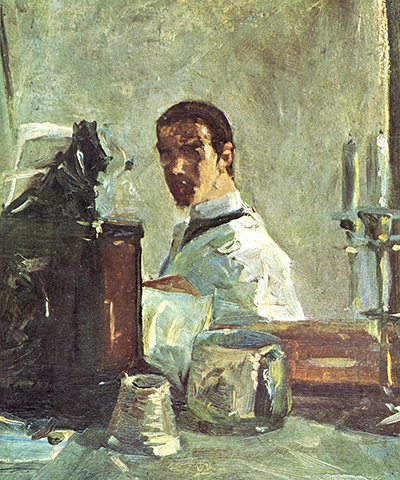
Henri de Toulouse-Lautrec, Self-Portrait in Front of a Mirror, circa 1880. Oil on cardboard. Musée Toulouse-Lautrec, Albi, MTL.20. Photograph: Didier Descouens, CC BY-SA 4.0; resized only. Photograph: Didier Descouens / CC BY-SA 4.0. Image source. CC BY-SA 4.0. Photograph resized proportionally; colour and content preserved. Photographic derivative available under CC BY-SA 4.0.
Illness, Fractures and Education
Henri's health interrupted his schooling before adolescence. Julia Frey's biographical essay draws on Adèle's letters to describe treatments, periods of restricted movement and disagreements over medical advice. These documents show a family seeking help without a reliable understanding of his condition. Adèle's journeys and care were substantial parts of his childhood, while the competing opinions surrounding his treatment make a simple account of one decisive medical error inadequate. [3]
In 1878 he fractured his left femur at Albi; in 1879 he fractured the right at Barèges. The Musée Toulouse-Lautrec's chronology places these accidents against a background of bone fragility. His legs did not develop normally, and he lived with short stature and restricted mobility. Pycnodysostosis has been proposed retrospectively as an explanation, notably in medical scholarship discussed by Frey, but that proposal should remain distinct from a diagnosis established during his lifetime. Neither the fractures nor a later diagnostic name can explain the particular artistic decisions he would make. [1] [3]
Convalescence did give him long stretches in which to draw. It did not confine his imagination to one kind of subject. The Album de Marine of 1879–80, now at the Metropolitan Museum, includes boats, sailors and rowing scenes associated with travel near Nice. Ives describes the excitement prompted by the arrival of an American frigate and Henri's parallel enthusiasm for making model ships. The sketchbook preserves curiosity directed outwards, towards unfamiliar vessels and activities, alongside the horses more often associated with his youth. [16]
His education continued through private teaching and family supervision. He obtained the baccalaureate in 1881, after an unsuccessful first attempt. Frey's account of this period shows the difference between the family's acceptance of drawing as an accomplishment and the more difficult prospect of art becoming a profession. Henri had the financial security to study, but the status of a working artist did not fit easily with aristocratic expectations of inherited independence. That tension would recur when his name began appearing on commercial images. [1] [3]
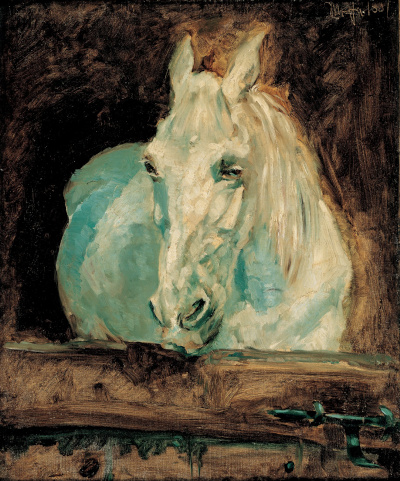
A surviving horse painting makes the transition from childhood observation to sustained painting concrete. In The White Horse Gazelle, dated 1881 and now in the ALBERTINA's Batliner Collection, the horse's pale head leans over a stable door. Blue-green shadows give substance to the white coat against the brown enclosure. The museum identifies Gazelle with the stud of his mother's family and locates the painting's making at Le Bosc that summer. Its economical treatment of a familiar animal belongs to an established practice of looking, not merely to an exercise in filling time. [10]
Learning a Profession in Paris
René Princeteau, an animal painter and friend of Alphonse, offered an early connection to professional art. Henri knew his work and received instruction from him; by 1881 he was frequenting Princeteau's Paris studio. The older artist's sporting subjects provided a bridge between the family's interests and a career based on trained observation. They also offered a professional example close enough to Henri's existing experience to make the next stage conceivable. [1] [3]
The decisive academic transition came in 1882: Léon Bonnat's studio in the spring, followed by Fernand Cormon's in the autumn. Both the current Albi chronology and Phillip Dennis Cate's study of Lautrec's career support this sequence. Bonnat was an established portrait and history painter; Cormon also worked within an academic tradition. The young artist therefore acquired his skills through sustained study of the figure, anatomy and drawing, even as his interests increasingly carried him beyond the subjects and forms valued by his teachers. [1] [2]
Training was also social. At Bonnat's he met René Grenier, with whom he later studied under Cormon. Other students and acquaintances included François Gauzi, Louis Anquetin and Émile Bernard. The studio offered shared models and exercises, but its friendships continued into apartments, cafés and exhibitions. The distinction between academic instruction and independent experiment was therefore porous: artists could practise conventional drawing in class and try brighter colour or looser handling elsewhere. [16] [11]
Lautrec sought opportunities to publish while he was still a student. In 1884 Cormon enlisted him and Henri Rachou to prepare illustrations for a deluxe edition of Victor Hugo's La Légende des siècles. His drawings were not ultimately used. Cate also records another unsuccessful submission to Figaro illustré that year. These disappointments belong to the practical history of an aspiring illustrator learning where work might appear, rather than to a sweeping story of rejection by every institution. [2]
He had exhibited in Pau in 1883, although his submission to the Paris Salon was refused. That specific refusal did not end his access to an audience. During the following years he would develop a career through independent exhibitions, illustrated journals and commercial commissions. Publishers, critics and fellow artists offered ways to build a career beyond the official Salon's hierarchy. [1] [2]
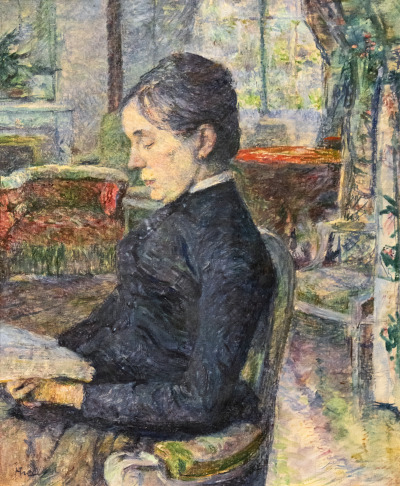
Henri de Toulouse-Lautrec, Countess Adèle in the Salon at Malromé, circa 1886–87. Oil on canvas. Musée Toulouse-Lautrec, Albi, MTL.122. Photograph: Didier Descouens / CC BY-SA 4.0. Image source. CC BY-SA 4.0. Photograph resized proportionally; colour and content preserved. Photographic derivative available under CC BY-SA 4.0.
Montmartre, Friends and the First Published Images
In the summer of 1884 Lautrec moved from his father's Paris residence to the apartment of René and Lili Grenier at 19 bis rue Fontaine. Cate stresses the social significance of a move that covered little physical distance. The Greniers' home was a gathering place for artists, and Ives identifies it as the setting in which Lautrec encountered Degas, who also had premises in the building. By 1886 Lautrec had established his own quarters in the rue Caulaincourt. Montmartre became the durable centre of his working life. [2] [16]
This independence did not sever his family connections. He continued to receive an allowance, remained close to his mother and maintained friendships with relatives, especially Gabriel Tapié de Céleyran and Louis Pascal. Frey's use of family correspondence shows both pride in his achievements and unease at professional or commercial exposure. For a time he used names including Monfa and the anagram Treclau. Eventually the Toulouse-Lautrec name and his compact monogram would become public signatures on the very advertisements that made him famous. [3]
The first successful journal illustrations preceded his celebrated lithographic posters. Gin Cocktail appeared in Le Courrier français on 26 September 1886. On 29 December that year Le Mirliton reproduced his scene of the quadrille at the Élysée-Montmartre. In 1887 several covers for the latter journal combined printed black line with stencil colour. His early experience of reproduction was photomechanical, with colour sometimes applied through stencils. [2]
Cate shows how Lautrec made the limitations of these small publications productive. A red scarf could seize attention within a black-and-white scene; a few coloured areas could concentrate the image around a face or figure. White paper remained an active part of the design. This was practical training in directing a reader's glance, and helps explain why the later posters appear so assured. The famous public language of the 1890s had been tested in modest, repeatable images for journal readers. [2]
Le Mirliton linked Lautrec to Aristide Bruant, the singer and cabaret proprietor whose songs and performances drew on Parisian street life. Bruant displayed his work, while the artist supplied illustrations and song-sheet designs. Their relationship joined friendship, subject matter and publicity. It also brought Lautrec into a setting where entertainers and audiences from different social backgrounds met, and where a performer consciously fashioned a recognisable public identity. [2] [16]
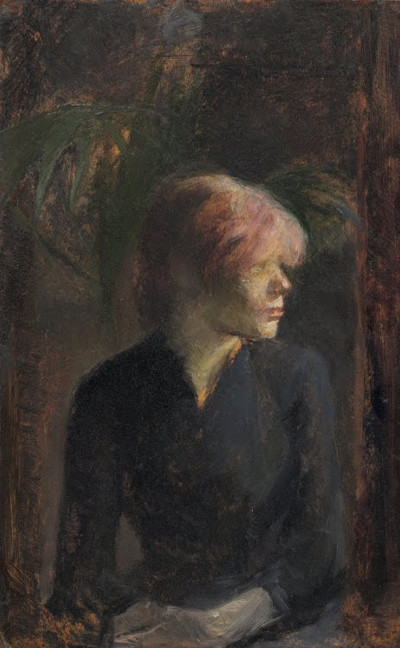
Portraiture continued alongside these publications. The 1886 Portrait of Jeanne Wenz shows a woman connected to his studio circle, presented in a firm profile with restrained pink and green accents. The Art Institute of Chicago links her to Frédéric Wenz, a fellow student of Cormon, and to Suzanne Valadon, herself an artist as well as a frequent sitter. Such connections caution against treating the women in Lautrec's paintings as an anonymous population outside artistic life. Models, artists, friends and performers occupied overlapping networks, even when the surviving documentation gives unequal access to their lives. [18]
Vincent and Theo van Gogh
Lautrec first crossed paths with Vincent van Gogh in Cormon's studio in March 1886. Their contact grew within a circle that included Bernard and Anquetin, particularly after Vincent had left the studio that summer. Franka Blok's 2024 Van Gogh Museum catalogue entry places their work within a shared environment of artistic argument, cafés and experiment. Both looked closely at contemporary art, including Degas, and explored short brushstrokes, brighter colour and diluted oil paint. The evidence suggests exchange and parallel investigation more readily than a simple account of one artist teaching the other a finished style. [11]
The Portrait of Vincent van Gogh of 1887 makes that exchange visible. Vincent sits in profile at a café table, with a glass in front of him and his forearms resting near its edge. Lautrec builds the image from numerous coloured pastel strokes, allowing the paper to remain visible. Blok's account, informed by examination with a paper conservator, notes that the pastel was not rubbed into a smooth surface. The portrait's alertness comes partly from these separate, directional marks and the contrasts around the head. [11]
Its precise circumstances are less secure. Bernard later identified the setting as Le Tambourin, but the museum cautions that his recollection cannot be verified from the generic café interior. Nor is it known whether Lautrec completed the whole portrait during one sitting. A beginning made in the café and further work in the studio remain possible. These uncertainties leave the picture's remarkable specificity intact: it is a portrait of an identifiable colleague, made through concentrated decisions about colour, contour and setting. [11]
Theo van Gogh belongs to this history as a dealer and collector in his own right. He took some of Lautrec's work on consignment, and, acting on Vincent's recommendation, acquired Young Woman at a Table, known as Poudre de Riz. A receipt is dated 12 January 1888. The pastel portrait also entered the brothers' collection, although the means of its acquisition is uncertain. Suggestions of a gift or exchange remain suggestions, and the attractive idea that the portrait appeared at Les XX in Brussels in 1888 lacks documentary proof. [11]
Contact diminished after Vincent moved to Arles, but did not disappear. Jo van Gogh-Bonger later remembered the friends enjoying one another's company during a Paris visit in July 1890. More direct evidence survives in Lautrec's condolence letter to Theo on 31 July: “You know what a friend he was to me.” Blok cites the original letter in the museum's collection. That brief declaration carries more weight than attempts to reconstruct every episode of their friendship from later anecdotes. [11]
From Dance Halls to a Public Breakthrough
Lautrec left Cormon's studio in 1887 and exhibited with Les XX in Brussels in 1888. By then his activity extended across portraiture, entertainment subjects and reproduced illustration. The circus was already among his interests: Equestrienne dates from 1887–88, well before the drawings associated with his clinic stay. Family sporting culture, contemporary spectacle and the challenge of depicting moving bodies could meet within the same career without one replacing the others. [1] [16]
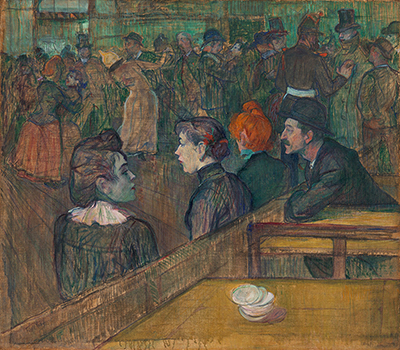
The painting Moulin de la Galette, dated 1889, gives a particularly clear account of his developing interest in spectatorship. A wooden barrier divides the dance floor from women waiting in the foreground. The Art Institute identifies the use of turpentine-thinned oil paint, or peinture à l'essence, applied in loose washes. Movement and stillness are organised within the same room. The result asks us to notice the arrangement of people around entertainment, rather than only the dancers at its centre. [19]
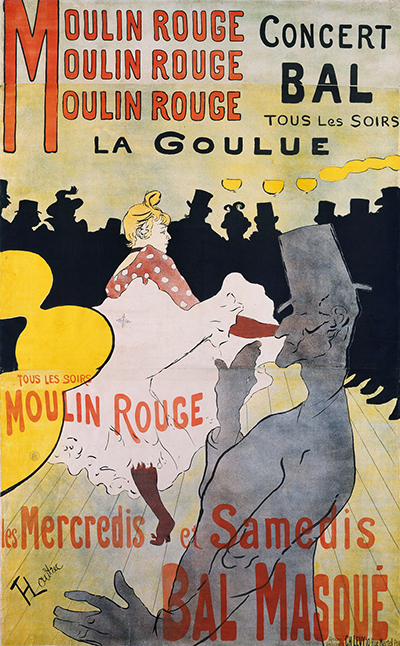
The Moulin Rouge opened in 1889 and provided another setting, patron and subject. Lautrec's 1891 poster Moulin Rouge: La Goulue became his decisive breakthrough in lithographic advertising. It promoted both the venue and a named dancer. His familiarity with the performers and their setting thus acquired an unusually public form, making an image that could be encountered in the street by people who never entered a gallery. [1] [2]
This achievement depended on the print workshop as well as the artist's drawing. Cate describes the successive colour stones and the proofs through which a design was checked. Lautrec soon moved beyond the colour scheme of his first poster: in The Englishman at the Moulin Rouge of 1892, for example, the prominent purple was a premixed ink. He adjusted his methods to the effect he wanted, working with printers who pulled proofs and produced the edition. The posters' apparent ease should not conceal a sequence of preparation, translation and approval. [2]
Recognition quickly extended beyond advertising display. In 1892 posters appeared in exhibitions in Paris and Antwerp, including progressive proofs that exposed stages of their making. Edmond Sagot offered them to collectors. The same kind of object could therefore function as publicity in the city and as a work acquired for private scrutiny. Lautrec's career developed through that movement between street, shop and exhibition, with each setting offering a different way to encounter his images. [2]
Performers Who Helped Shape the Work
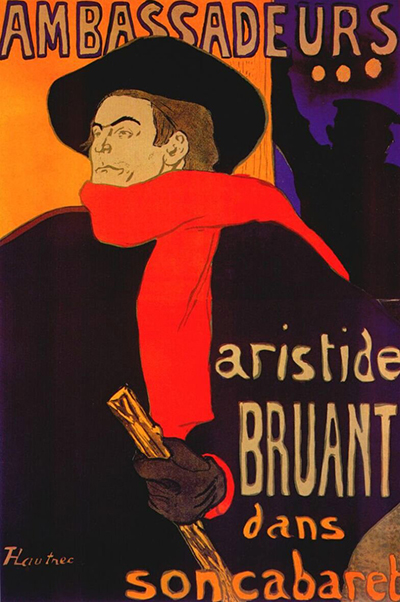
Bruant's commission for an appearance at the Ambassadeurs in 1892 shows how actively a performer could support Lautrec. The singer's red scarf, dark cloak and broad hat made an immediately legible identity. According to the Albi museum's account, the venue's director objected to the poster and sought a more conventional alternative, but Bruant insisted on Lautrec's image. This was a disagreement between people with different commercial judgements, resolved through the performer who wanted the design. It reveals advocacy within the entertainment business as clearly as resistance to an unfamiliar image. [1]
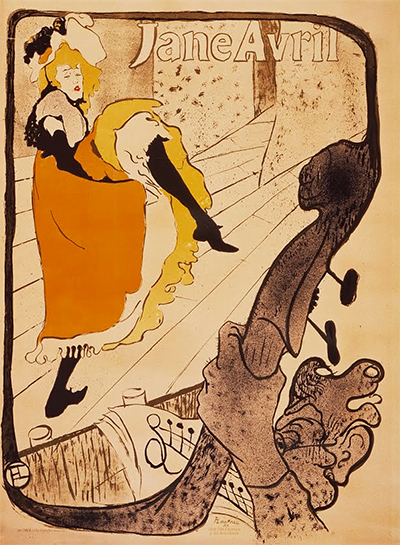
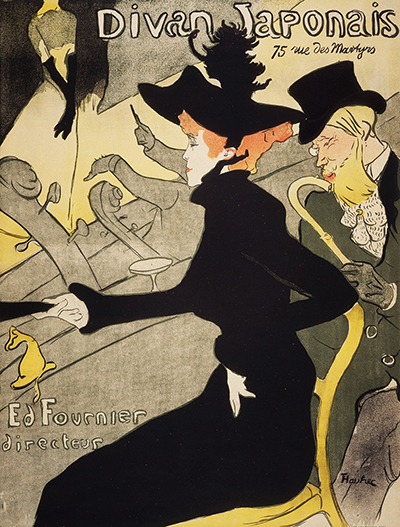
Jane Avril offered another sustained association. She appeared in paintings, posters and lithographs, sometimes as a performer and sometimes among spectators. The 1893 poster bearing her name and the Divan Japonais design belong to this developing repertoire, while Le Café Concert placed her among a wider group of entertainers. The recurrence of one person in different formats allowed Lautrec to vary the relation between individual likeness, characteristic movement and the demands of publication. [2] [16]
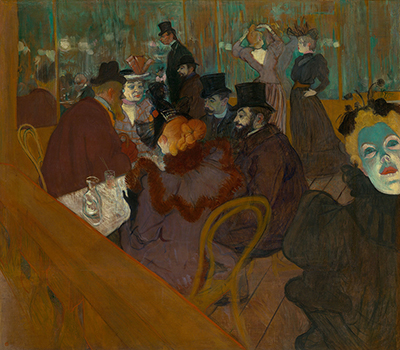
The At the Moulin Rouge painting, now dated 1892–95 by the Art Institute, brings several strands of his social world together. The museum identifies Avril, the photographer Paul Sescau, the writer Édouard Dujardin and Maurice Guibert among the table group. Lautrec himself walks in the background beside his taller cousin Gabriel. At the right edge, May Milton's face catches startling green light. The artist's own presence makes the painting especially revealing as biography: he places himself within the people he depicts while constructing an elaborate view of their shared surroundings. [20]
Yvette Guilbert's response was more resistant. She commissioned a poster for the 1894–95 Ambassadeurs season, but rejected Lautrec's project because she found its presentation unflattering, preferring Steinlen's alternative. The refusal asserted her own judgement over the image through which audiences would recognise her. It did not end their work together. Albums devoted to Guilbert appeared in 1894 and 1898, extending his study of her gestures and distinctive black gloves across sequences of prints. [1]
La Goulue also remained a client after the first Moulin Rouge poster. In 1895 she commissioned decorative panels for her fairground booth. The commission extended Lautrec's work for her into a different place and scale of public presentation. It is a useful reminder that performers' careers moved between settings, and that his images followed some of those changes. Their collaboration was more sustained than the single celebrated advertisement through which both are now so often remembered. [1]
The variety of other performers also mattered. Loïe Fuller's veils and theatrical lighting called for a different kind of image from the emphatic contour of Bruant. May Belfort's costume and song persona differed from May Milton's dancing, although Lautrec made posters for both in 1895. Marcelle Lender, portrayed in relation to Chilpéric, generated a substantial group of works and an elaborate colour lithograph. Each association posed a new problem of recognition: what could a picture retain of a voice, a costume or a moving body? [16]
Publishers, Galleries and Work Beyond the Cabaret
Maurice Joyant re-entered Lautrec's professional life when he succeeded Theo van Gogh at the boulevard Montmartre gallery in 1890. He organised an exhibition of Lautrec and Charles Maurin from 30 January to 11 February 1893. The two-artist character of the show is worth preserving: it placed Lautrec within an active contemporary scene. Thadée Natanson's enthusiastic review in La Revue blanche contributed to the recognition of the posters as serious art, even while their unsettling effects remained part of their attraction. [2]
The publishing network widened rapidly. André Marty published the collaborative Le Café Concert by Lautrec and Henri-Gabriel Ibels in 1893, as well as the first Guilbert album the following year. Édouard Kleinmann distributed lithographs and special proofs of journal illustrations. Sheet-music publishers commissioned designs that travelled with songs into new settings. Lautrec's work was consequently available through magazines, portfolios and inexpensive music covers as well as large advertisements. His reputation depended on many forms of circulation rather than one spectacular poster alone. [2]
The theatre supplied further work. He designed programmes for André Antoine's Théâtre Libre and for Lugné-Poe's Théâtre de l'Œuvre, joining a circle of artists who treated printed programmes as opportunities for invention. In 1895 he also worked on the programme, book cover and a stage setting for Le Chariot de terre cuite. These commissions show a broader interest in performance than the familiar cabaret subjects suggest. He worked around both contemporary theatrical experiment and popular entertainment. [2] [16]
Japanese prints offered important formal resources in these years. Ives compares the forceful actor portraits of Sharaku with Lautrec's treatment of entertainers, and Utamaro's close-up figures with the cropped presentation of Lender. Such comparisons help explain the emphasis on contour, costume, compressed space and selective detail. They do not require the assumption that every picture borrowed from one identifiable Japanese sheet. Lautrec's printmaking developed through an active engagement with available images, contemporary colleagues and the possibilities of his own medium. [16]
His association with La Revue blanche connected him to writers, critics, artists and the Natanson circle. The journal supported his work and commissioned the elegant poster of 1895. At the same time, commercial success remained uneven. Cate's discussion of letters to Gustave Pellet shows that limited editions could sell slowly, and that Lautrec monitored deposits and unsold impressions. Public visibility, critical enthusiasm and sales were related but distinct. The evidence permits a successful professional career without turning every venture into a triumph. [2]
The correspondence surrounding the second Guilbert album, published by Bliss, Sands & Co. in 1898, brings the business of making prints into focus. Cate describes exchanges about the cover process, fees, preparation of stones and packing. Henry Stern's itemised bill separates work on the stones from their material value and the cases needed to transport them. Such documents restore the printer and publisher to a history too often told through the artist alone. They also show Lautrec still making precise decisions for a publication directed towards an international market during the later years of his career. [2]
Women, Private Interiors and the Limits of Access
Lautrec's work in brothels became one of the most discussed parts of his biography. Accounts gathered by Frey and Ives describe periods when he lodged in such establishments and worked there. His access enabled pictures of daily routines and shared rooms, alongside more explicitly regulated aspects of sex work. Yet access is not complete understanding. The surviving record is largely shaped by the artist, his acquaintances and later commentators; the women themselves are much less often heard. [3] [16]
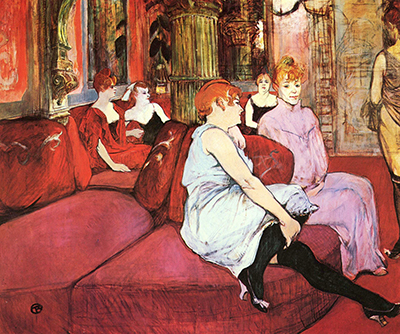
In In the Salon of the Rue des Moulins of 1894, the red upholstery curves through an enclosed space occupied by several women. The Musée Toulouse-Lautrec stresses the composition's ambition and the individualisation of faces. Looking closely, the extensive unoccupied seat in the foreground is as consequential as the figures: it gives the viewer space to enter imaginatively while keeping us separate from the women farther inside the room. Their differing postures resist the reduction of the scene to one emotion shared by everyone. [15]
The lithographic portfolio Elles, published by Gustave Pellet in 1896, returned to women's rooms and everyday actions through a sequence. Its ten image plates, title page and cover need to be distinguished when counting its contents. These were deliberately composed prints made for publication and sale. Their concentration on washing, resting and dressing redirects attention from the encounter expected by a male customer towards time and activity around it. That shift is significant without making the pictures transparent records of every sitter's experience. [2] [16]
These subjects also require care in identifying people. A performer portrayed in one print is not thereby documented as living in the same establishment as the women in another. A model's appearance in a scene cannot establish her occupation or private relationships. The tenderness or reserve a viewer finds in an interior may be a persuasive response to the work, but it does not supply missing testimony. Lautrec's attention can be recognised while the unequal circumstances of artist, subject and audience remain visible. [16]
The Clinic, Circus Drawings and Continued Work
During the later 1890s Lautrec's dependence on alcohol increasingly affected his health and work. Frey cites a letter to his mother describing lethargy and difficulty painting. By early 1899 a serious crisis led to admission to a private clinic at Neuilly. The biographical evidence supports a period of severe illness; it does not justify using every unusual image or change of handling as a symptom, or treating uncertain retrospective accounts of other diseases as settled clinical history. [3]
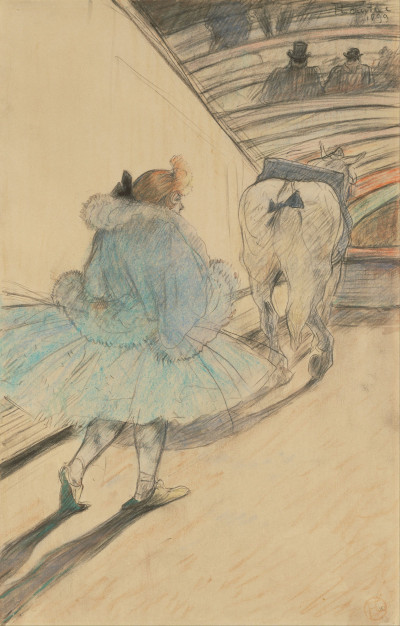
The circus drawings made during his confinement show how purposefully he continued to work. Ives relates their making to his effort to demonstrate his capacity to remember and produce art. Riders, clowns, trained animals and ring-side figures returned in a substantial group of coloured-chalk sheets. These motifs drew upon years of experience looking at the circus. The memory involved was therefore both personal and professional, supported by a repertoire of bodies, costumes and actions that he had studied long before entering the clinic. [16]
On 17 May 1899 his doctors confirmed improvement, according to the documentation cited by Ives. The familiar story that he obtained his release through drawing comes through later accounts, including Joyant's. The drawings were clearly bound up with his wish to leave, but their artistic accomplishment cannot itself serve as medical proof of recovery. They deserve attention as works with their own formal decisions as well as documents of an unusually constrained period in his life. [16]
Sporting subjects also continued in print. The Jockey of 1899 was the only published part of a racing series planned for the publisher Pierrefort. Its existence prevents the final years from collapsing into an account of artistic silence. Lautrec remained concerned with ways of bringing movement into a reproducible image, returning to a subject with roots in childhood but developing it within the professional print culture of his maturity. [16]
After the clinic he travelled, with Paul Viaud accompanying him, and spent time in southwestern France and Bordeaux. Frey's account records both continued painting and renewed drinking. The difficulties of these years were real, but later works do not all have to be read as illustrations of a single downward trajectory. The continued exchange with friends, commissions and familiar subjects gives the period a more varied shape than the language of inevitable decline allows. [3]
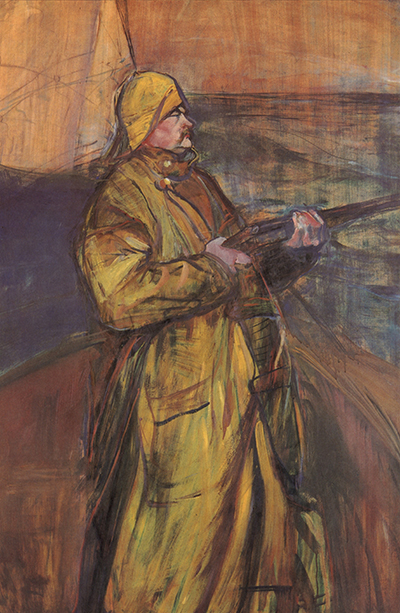
The 1900 portrait of Maurice Joyant in the Bay of Somme is an especially strong example. In Albi's oil painting on wood, Joyant stands in a boat wearing a yellow oilskin and holding a gun. The broad upright figure, the long horizontal weapon and the lightly indicated setting make a forceful arrangement. The museum links the subject to the friends' shared visits to Le Crotoy. It is a substantial late portrait of a particular companion, rather than an abstract emblem of the artist's illness. [17]
Death and the Preservation of a Career
Lautrec suffered a final deterioration in health in the summer of 1901 and was taken to Malromé, his mother's property in the Gironde. He died there on 9 September. Frey records how quickly stories accumulated around his last moments, including a purported final exchange with his father transmitted as a rumour in Jules Renard's journal. Such anecdotes belong to the history of his reputation; they cannot safely provide the final scene of a documented life. [1] [3]
The work's survival depended on people already active around him. Joyant had promoted exhibitions during his lifetime and became central to the future of the studio holdings. Together with Gabriel Tapié de Céleyran, he helped bring about the family's gift to Albi. The exceptional donation of 1922 gave the present Musée Toulouse-Lautrec its core in the Palais de la Berbie. The collection brought early paintings, drawings, posters and late work into a setting where the career could be seen across its different forms. [17] [4]
Other collections formed through different patterns of purchase and generosity. Ives traces the Metropolitan Museum's early commitment to Lautrec through prints: the 1898 Guilbert album arrived as a gift in 1917, followed by the purchase of the earlier album in 1918. Paintings and drawings entered more gradually. This sequence helps explain the endurance of the public image-maker in his reputation. Reproduced works carried his name widely before many museums could show an equally substantial account of the painter. [16]
The biography that emerges from these objects and records has room for privilege, disability, friendship, addiction, ambition and professional negotiation. None is a sufficient explanation for the art on its own. A childhood horse, a student's portrait, a journal cover, a performer's advertisement and a late image of Joyant each required a new act of attention. The continuity lies in the work of selecting and drawing: the ability to make a particular person or action legible within a few charged decisions, then to reshape those decisions for a different material and audience. [2] [16]
Toulouse-Lautrec artworks directory
Browse 84 identified works and publications in this researched selection. Dates and titles follow the individual records; this is not a complete catalogue of the surviving oeuvre. Print impressions remain attached to their designs. Some listed works do not have a dedicated article. The Drawings guide also contains nine illustrated studies consolidated from former articles.
Frequently Asked Questions
Yes. Their contact began around Cormon's studio in 1886, and Lautrec portrayed Vincent in 1887. A surviving condolence letter to Theo documents his affection. The precise closeness of the friendship and several stories surrounding the portrait remain less certain. [11]
Discussion
Look again at the images and ideas explored in Henri de Toulouse-Lautrec Biography. These editorial prompts invite your observations.
Reader Insights
Compare the 1887 Van Gogh pastel with the 1900 Joyant portrait. How do pose, setting and material establish a particular friendship without telling its whole history?
Lautrec's images moved through magazines, theatre programmes, city streets and collectors' portfolios. How does knowing the intended audience change your response to one of his works?
Join the Conversation
Share a detail, comparison or question about Henri de Toulouse-Lautrec Biography below.
References
- Musée Toulouse-Lautrec, Toulouse-Lautrec et l'art de l'affiche: 2025 exhibition press dossier, especially pp. 3–13: exhibition context, Bruant, Guilbert and chronology (in French). View source.
- Phillip Dennis Cate, “The Popularization of Lautrec,” in Toulouse-Lautrec: Images of the 1890s, Museum of Modern Art, 1985, pp. 77–92, including notes: journals, commissions, printers, publishers, exhibitions and markets. View source.
- Julia Frey, “Henri de Toulouse-Lautrec: A Biography of the Artist,” in Toulouse-Lautrec: Images of the 1890s, Museum of Modern Art, 1985, pp. 19–35, including documentary notes. View source.
- Musée Toulouse-Lautrec, “Histoire du musée”, especially “Une collection unique au monde”: the 1922 family donation and the Palais de la Berbie (in French). View source.
- Margaret Samu, Impressionism: Art and Modernity, Heilbrunn Timeline of Art History, 2004. View source.
- James Voorhies, Post-Impressionism, Heilbrunn Timeline of Art History, 2004. View source.
- Colta Ives, Japonisme, Heilbrunn Timeline of Art History, 2004. View source.
- Cybele Gontar, Art Nouveau, Heilbrunn Timeline of Art History, 2006. View source.
- Autoportrait, 1880 (in French). View source.
- ALBERTINA, Der Schimmel “Gazelle”, 1881, GE123DL, Batliner Collection; object record and embedded Koella/Billeter catalogue entry, 2005, no. 210 (in German, with an English summary). View source.
- Franka Blok, “Henri de Toulouse-Lautrec, Portrait of Vincent van Gogh, 1887”, in Joost van der Hoeven, ed., Contemporaries of Van Gogh 1: Works Collected by Theo and Vincent, Van Gogh Museum, 2024; especially “Friendship,” “Pastel crayon” and “Vincent and Theo's collection,” with notes 1–17, 27–43. The 1881 letter to Charles and 1890 condolence letter are cited through this entry. View source.
- Art Institute of Chicago: Moulin Rouge, La Goulue. View source.
- Art Institute of Chicago: At the Moulin Rouge. View source.
- Jane Avril, 1893. View source.
- Musée Toulouse-Lautrec, Au Salon de la rue des Moulins, 1894; collection record and commentary (in French). View source.
- Colta Ives, Toulouse-Lautrec in The Metropolitan Museum of Art, 1996, especially pp. 23–26, 30–58 and the Elles checklist on pp. 68–69: collection history, training, performers, printmaking and late work. View source.
- Musée Toulouse-Lautrec, Maurice Joyant, 1900, oil on wood; collection record, friendship and posthumous stewardship (in French). View source.
- Art Institute of Chicago, Portrait of Jeanne Wenz, 1886, 1941.824; collection description and object record. View source.
- Art Institute of Chicago, Moulin de la Galette, 1889, 1933.458; collection description and object record. View source.
- Art Institute of Chicago, At the Moulin Rouge, 1892–95, 1928.610; collection description and current dating. View source.