


 by Tom Gurney
Tom Gurney BSc (Hons) is an art history expert with over 20 years experience
Published on June 19, 2020 / Updated on November 3, 2026
Email: tomgurney1@gmail.com / Phone: +44 7429 011000
Nice, Souvenir of the Promenade des Anglais by Henri de Toulouse-Lautrec: Introduction
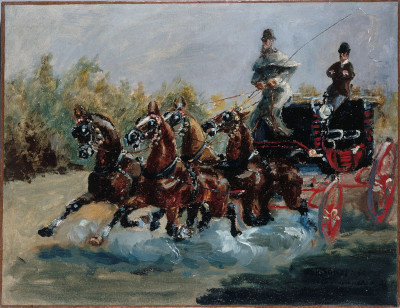
Four horses surge across the foreground, pulling a black-and-red carriage whose wheels nearly touch the picture's right edge. The driver sits high above the team; a groom occupies the rear seat. Henri de Toulouse-Lautrec brings the whole vehicle towards us on a diagonal, making heads, harness, wheels and flying legs participate in the same forward movement.
The Petit Palais identifies the painting as Nice, souvenir de la promenade des Anglais, dated 1880. It was formerly called Le mail-coach and is often known in English as Count Alphonse de Toulouse-Lautrec Driving His Mail-Coach. The museum describes the vehicle as a hunting brake, rather than a coach carrying public mail. Its inscription names Nice and the Promenade des Anglais. [1]
At a Glance
- ArtistHenri de Toulouse-Lautrec.
- Current museum titleNice, souvenir de la promenade des Anglais.
- Date1880.
- Mediumoil on canvas.
- Dimensions38.5 × 50 cm.
- CollectionPetit Palais, Paris, PPP770; gift of Joseph Duveen, 1925.
- Subjecta four-horse team drawing a hunting brake, traditionally associated with the artist's father. [1]
This work across Henri de Toulouse-Lautrec’s career
Contents
- A team advances across the canvas
- The carriage gives movement a framework
- Driver and groom occupy different roles
- The road makes speed visible
- Red accents and dark coats
- An early equestrian subject with a named place
A team advances across the canvas
The horses form the painting's most complicated mass. Their heads cluster towards the left, while their bodies lead back to the carriage at the right. Because the team is viewed obliquely, the animals overlap rather than standing in a clear row. Dark bridles, bright harness fittings and different patches of coat help us separate them without eliminating their collective force.
Their movement is spread across several directions. Heads incline, necks curve and legs reach forward or fold beneath bodies. The line of the team cuts across the lighter road, giving the group an immediate outline against the ground. The effect is energetic even before we untangle every limb. Lautrec asks us to register a coordinated rush first and inspect its parts afterwards.
This order of attention matters. A completely separated view of four animals would make counting them easier but could weaken the sense that they are working together. Here, overlaps and repeated accents connect the horses into a moving unit. We understand the team through a succession of heads, collars and legs, with each recurrence reinforcing the direction established by its neighbours.
The carriage gives movement a framework
At the right, the vehicle introduces firmer geometry. Its dark body, red undercarriage and circular wheels contrast with the shifting shapes of the animals. These recognisable mechanical forms make the horses' activity purposeful: the movement is attached to a vehicle carrying people, rather than dispersed across an open field.
The bright wheel is particularly effective. It stands near the edge, where part of the vehicle feels pressed against the frame. Its red colour links it to other small warm accents in the team and carriage. The circle supplies a stable form within the rush of diagonals, while its placement makes the vehicle seem to have very little space left before it would pass beyond the picture.
Look at the different heights within the structure. The driver's raised seat, the lower carriage body and the wheels establish a stepped arrangement above and beside the horses. This gives the group depth without a long, visible stretch of road. We read how the vehicle is assembled through its own relationships, while the surrounding landscape remains comparatively abbreviated.
Driver and groom occupy different roles
The driver is traditionally identified as Count Alphonse de Toulouse-Lautrec, the artist's father. The Petit Palais describes the high-seated driver and the groom on the rear bench as parts of this particular hunting-brake scene. That identification provides the familiar personal title, while the current museum title foregrounds the place named in the inscription. Both titles help explain the painting, but they emphasise different things. [1]
Visually, the driver is defined by posture and equipment more than by a detailed face. His upright body rises above the team, and the long lines associated with handling the horses extend out from his position. The elevated seat makes his role immediately legible. The horses occupy most of the activity below, but the driver remains its organising human presence.
The groom sits farther back, producing another dark vertical accent near the right edge. His stiller pose contrasts with the energetic team. These two people do not need equal amounts of detail to have distinct roles in the scene. Their positions within the vehicle establish a working arrangement, while the difference between seated figures and moving animals gives the painting a varied rhythm.
Watch: Toulouse-Lautrec
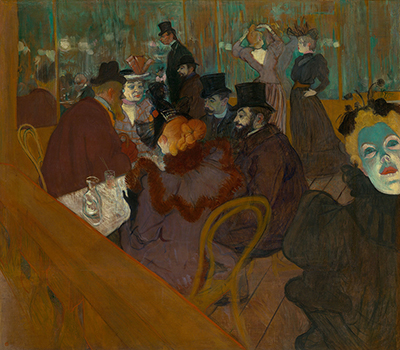
Choose an artist introduction, a film about graphic design or a closer look at At the Moulin Rouge.
The road makes speed visible
A pale road opens beneath the horses and carriage. Against it, dark hooves and shadows become easy to register. The light ground is not a smooth, empty strip: broken strokes interrupt its surface, especially around the team. Those marks make the road seem to participate in the passage of the vehicle, without requiring a carefully described sequence of individual stones or tracks.
The lower foreground is darker, creating a band from which we look towards the brighter movement. Behind the horses, trees and foliage establish the route's edge. Above, the cooler sky leaves room around the raised driver and the taller outlines of the team. These broad divisions give the central action a setting while preserving its dominance.
The diagonal view is essential to the effect. A strict side view would make the vehicle's length clearer, but this arrangement pushes its different parts into overlap. The nearest forms seem larger and more emphatic, while the carriage recedes behind them. The painting's sense of advance comes from that change of scale and visibility as much as from the particular positions of the legs.
Red accents and dark coats
Much of the picture is built from dark browns, blacks and greys. Within that restrained setting, the red carriage parts become especially forceful. They make the vehicle distinct from the animals while connecting scattered areas of the composition. The eye can move from a warm harness detail towards the wheel and then back through the dark team.
The horses' coats also contain changing light. Small pale touches break up the heads and necks, while deeper passages hold the bodies together. The difference between these concentrated accents and the looser landscape prevents the whole painting from becoming equally busy. Lautrec gives the central team enough definition to remain recognisable amid energetic handling.
The result rewards looking at two scales. From a distance, the team and carriage form a single dark-and-red movement against the road. Closer up, the scene separates into eyes, straps, collars, wheels and strokes of reflected light. Neither view replaces the other. The broad movement depends on the smaller details that hold the group together.
An early equestrian subject with a named place
The inscription's reference to Nice gives the work a particular geographical identity. It should not be treated as an anonymous scene on a family estate merely because Lautrec painted horses when young. The Petit Palais connects his early equestrian practice with René Princeteau and with sporting imagery. That context helps place the work within an established field of subjects without explaining every formal choice through family biography. [1]
A useful comparison is Artilleryman Saddling His Horse. There, a person attends to equipment beside a standing animal. Here, several horses, two seated men and a vehicle must remain intelligible while appearing to move together. The subjects share an interest in handling and coordination, but pose different problems for the painter.
The museum's 1925 acquisition through Duveen brought this small canvas into a public collection. Its historical mail-coach title remains familiar, yet the hunting brake and named promenade keep the subject more precise. Return to the red wheel at the right and follow the team towards the left. The painting's energy comes from making all those separate bodies and working parts seem to belong to one advancing passage. [1]
Toulouse-Lautrec artworks directory
Browse 84 identified works and publications in this researched selection. Dates and titles follow the individual records; this is not a complete catalogue of the surviving oeuvre. Print impressions remain attached to their designs. Some listed works do not have a dedicated article. The Drawings guide also contains nine illustrated studies consolidated from former articles.
Discussion
Look again at the images and ideas explored in Nice, Souvenir of the Promenade des Anglais by Henri de Toulouse-Lautrec. These editorial prompts invite your observations.
Reader Insights
How do the overlapping horses become readable as a single team?
What does the red wheel contribute beside the moving animals?
How do the positions of driver and groom establish their roles?
Join the Conversation
Share a detail, comparison or question about Nice, Souvenir of the Promenade des Anglais by Henri de Toulouse-Lautrec below.
References
- Paris Musées / Petit Palais, Nice, souvenir de la promenade des Anglais, PPP770: current title, former Le mail-coach title, 1880 date, oil/canvas, dimensions, inscription, iconography and Duveen acquisition. The record's inconsistent age/training-year wording is not adopted. View source.
- Autoportrait, 1880 (in French). View source.
- ALBERTINA: Der Schimmel Gazelle,GE123DL. View source.
- Franka Blok, Portrait of Vincent van Gogh, 2024. View source.
- Art Institute of Chicago: Moulin Rouge, La Goulue. View source.
- Art Institute of Chicago: At the Moulin Rouge. View source.
- Jane Avril, 1893. View source.
- Au Salon de la rue des Moulins (in French). View source.
- Colta Ives, Toulouse-Lautrec in The Metropolitan Museum of Art, 1996. View source.
- Maurice Joyant (in French). View source.
 Henri de Toulouse-Lautrec.jpg)