Henri de Toulouse-Lautrec.jpg)
 by Tom Gurney
Tom Gurney BSc (Hons) is an art history expert with over 20 years experience
Published on June 19, 2020 / Updated on November 3, 2026
Email: tomgurney1@gmail.com / Phone: +44 7429 011000
Portrait of Vincent van Gogh, 1887: Introduction
Vincent van Gogh sits with his forearms on a café table, his head raised towards someone or something beyond the picture. Around his pale face, blue, green, yellow and orange strokes remain separate and visible. Toulouse-Lautrec's portrait of 1887 makes the likeness emerge from an entire room of coloured lines. Its intimacy lies in the care of that construction: a fellow artist has been observed closely, without being isolated from the place around him. [1]
At a Glance
- ArtistHenri de Toulouse-Lautrec.
- TitlePortrait of Vincent van Gogh.
- Date1887; the work is undated, and the first half of the year is a scholarly proposal. [1]
- MediumPastel on wove paper on cardboard; the technical account specifies prepared paper stretched over the cardboard. [1]
- Dimensions54.2 × 46 cm. [1]
- CollectionVan Gogh Museum, Amsterdam, Vincent van Gogh Foundation; inventory d0693V1962. [1]
- SettingA café interior; identification as Le Tambourin rests on Émile Bernard's later recollection. [1]
- Distinctive featureSeveral layers of unblended pastel lines, with the paper visible throughout. [1]
This work across Henri de Toulouse-Lautrec’s career
Contents
- The profile holds a busy room together
- Drawing colour in layers
- Table, glass, bar and mirror
- Which café, and which moment in 1887?
- Two artists sharing experiments
- A frame, an acquisition and an exhibition hypothesis
- Jo van Gogh-Bonger: a private likeness made public
- Annotated details
The profile holds a busy room together
The head occupies a surprisingly small part of the sheet. Most of the surface belongs to the coat, table and café furnishings, yet the face is immediately legible. A high forehead leads into the long nose; the mouth interrupts the contour before the reddish beard carries it downwards. Behind the nose and mouth, a broad horizontal band of blue sets the warm profile apart. Above the forehead, a darker patch makes the pale skin stand forward. The likeness depends on those encounters between adjacent colours as well as on the shape of the face itself.
Inside the contour, Lautrec works with much smaller differences. Pale pink and yellow cross the cheek, cool blue and green gather around the temple, and short orange marks enliven the beard. The ear is bounded more firmly than the surrounding hair. Individual strokes turn across the skull without being forced into a continuous smooth covering. At a distance the head has volume; closer attention returns us to the separate marks from which that volume has been assembled. Franka Blok's Van Gogh Museum catalogue account identifies this delicacy around the head as a contrast with the coarser, sketchier handling of the surroundings. [1]
The pose contributes another kind of clarity. The torso rises from the lower left, the shoulders turn towards the table, and the head faces right. A relatively straight back supports the raised head, while the forearms hold the body in contact with the tabletop. The sitter is neither facing the viewer nor disappearing into the distance. We see him from nearby, across an interval that the table makes tangible. His attention passes beyond our view.
It is tempting to fill that interval with conversation. Blok records interpretations in which the hands and posture suggest a determined debater. Those are readings of a pose, rather than documentation of the portrait session. The fingers are gathered and the head is lifted, but neither establishes what Van Gogh was saying or feeling. The image sustains an impression of concentrated attention while leaving its immediate object unknown. That openness helps distinguish the represented person from the many anecdotes later attached to him. [1]
Lautrec used profile views elsewhere in these years, including portraits of Jeanne Wenz and his mother, Adèle. Blok particularly compares the dense short strokes of Adèle's portrait in the salon at Malromé, dated about 1886–87. The relationship places Van Gogh's likeness within an active portrait practice. A side view could organise recognition, a seated body and a surrounding interior without requiring the person to address us directly. The pastel's exceptional material elaboration developed within those familiar compositional questions. [1]
Drawing colour in layers
This is a finished pastel portrait of unusual ambition within Lautrec's work. Blok identifies only one other known pastel portrait, the less elaborate Portrait of Georges Henri-Manuel of 1891. Lautrec more commonly made independent portraits in oil, often diluted, and used charcoal, pencil, crayon and ink for drawing. The rarity of the medium here makes its particular handling worth following. It does not make the sheet an uncharacteristic interruption: the varied hatching remains closely related to the way he constructed figures in paint. [1]
The support has a specific structure. Drawing on observations by the Van Gogh Museum's paper conservator Nico Lingbeek, Blok describes prepared paper stretched over sturdy cardboard. The catalogue's object record identifies the paper as wove. Ready-made pastel panels were available, so Lautrec may have bought it already prepared, although that possibility is not established for this object. The distinction between the paper receiving the marks and the cardboard supporting it matters; describing the work simply as pastel on board loses part of its construction. [1]
Over that surface Lautrec built several layers of lines, varying their direction, length and shape. Blok reports that he did not blend the pastel with a finger or stump anywhere, leaving paper visible throughout. The softness we perceive from a distance therefore results from neighbouring and overlapping strokes, whose edges remain distinct. The gaps remain part of the completed surface, connecting densely worked passages to those where the marks are more widely spaced. [1]
Look at the sleeve nearest us. Brown marks curve around the upper arm, blue lines travel through them, and lighter strokes pick up the bending cloth. As the arm approaches the wrist, the direction changes. At the elbow the concentrated curve helps the sleeve turn back into the body; across the forearm, longer marks carry it towards the hands. The coat contains many colours that also occur in the room, but their orientation makes them belong to a particular body. Colour alone does not separate sitter from background. The way each passage is drawn supplies structure.
A firm brown accent along the back and collar gives that structure a boundary. Blok singles out these reinforced contours as ways Lautrec distinguished Van Gogh from the surrounding café. Within the jacket, however, the lines repeatedly cross and loosen. The alternation is effective: the edge holds the figure together while the interior can remain open and mobile. A viewer can read a substantial coat without expecting an uninterrupted brown surface. [1]
The head uses a related system at a finer scale. Marks in the hair sweep back from the forehead; those on the cheek and beard change angle and hue. This is where the portrait's apparent energy becomes most specific. It belongs to the pattern of coloured marks, to their changes of direction and their uneven concentration. That pattern gives us an intensely worked image of his appearance, without establishing his temperament or state of health.
The degree of finish also leaves the timing unresolved. Blok proposes two possibilities: Lautrec could have completed the portrait during a café meeting, or laid it out there and refined it later in his studio. The materials made working in colour on the spot practical, but the elaborate surface does not decide between those accounts. Nor does the catalogue offer pigment analysis or identify a precise sequence for every colour. Its technical contribution concerns the support, layering, unblended lines and handling of particular passages. Those findings explain much of what we see without turning an impression of immediacy into a record of a single session. [1]
Annotated Details from Portrait of Vincent van Gogh, 1887
The numbered points identify visible features discussed in this article. Return from each detail to the whole composition. Portrait of Vincent van Gogh, 1887. Pastel on wove paper supported by cardboard, 54.2 × 46 cm. Van Gogh Museum, Amsterdam (Vincent van Gogh Foundation), d0693V1962. Separate coloured strokes construct the profile, coat and café furnishings. Van Gogh Museum,Amsterdam,d0693V1962. Image source. Public domain. Resized only; native appearance preserved.
.jpg)
Details from PORTRAIT OF VINCENT VAN GOGH, 1887
Compare the cropped details with the complete images above. Notice how their colours, shapes and positions contribute to the larger compositions.
The profile
Separate coloured strokes build the forehead, nose and beard.
 Detail 01 the-profile.jpg)
The jacket
Hatching changes direction across the jacket instead of dissolving into a smooth tone.
 Detail 02 the-jacket.jpg)
The table and forearms
The diagonals of the forearms and table hold the forward-leaning pose.
 Detail 03 the-table-and-forearms.jpg)
Table, glass, bar and mirror
The table makes an extensive pale field beneath the sitter. Blue and white lines spread across it at a different angle from the largely upright figure. They gather around the hands, then move towards the glass near the right edge. Because the arms rest on it, the tabletop supplies a physical plane; because its surface is so actively drawn, it also participates in the larger movement of colour. The foreground has room to breathe even though it is far from empty.
The glass is slender and lightly described. Its rim and stem interrupt the denser surrounding strokes without acquiring the weight of the coat. The catalogue identifies the drink as absinthe, connecting the image to contemporary café subjects. That identification comes from the scholarly interpretation of the picture and its context; the pale contents cannot establish it by colour alone. Looking at the vessel itself, its chief compositional work is to create a small upright accent beside the sitter's much larger upright body. [1]
Behind Van Gogh, the bar top runs almost horizontally across the sheet. Its long blue passage crosses the more oblique lines of the table, giving the room two distinct spatial directions. The head rises between them. The furniture supplies a stable armature around a surface that otherwise seems full of tiny changes. Above, the mirror's vertical divisions hold the upper half together and create a darkened central area behind the pale hair.
Below the bar top, broad curved decoration appears at either side of the torso. Blok identifies the relief on the front of the bar as the sole passage where Lautrec used the broad side of the crayon. That is a small technical distinction with a conspicuous visual result. These wider, more continuous sweeps differ from the accumulated narrow lines in the sleeve. Their curves partly echo the body's rounded forms while surrounding it with another scale of mark. The room's decoration helps frame the sitter. [1]
This creates several enclosures within the rectangle. The mirror panel contains the space above the head; the decorative curves flank the body; the table supports the arms. None is a perfectly closed outline. The figure can still share blue, green and ochre marks with the surroundings. The result, in my reading, is a likeness anchored through repeated relationships rather than set against a neutral background. Remove the furnishings and much of the portrait's particular balance would disappear.
The density of description changes gradually across these structures. Small objects at the upper left remain lightly indicated; the bar becomes firmer as it approaches the head; the face concentrates the finest transitions. We can identify enough of the café to understand the situation while leaving parts of it unresolved. This distribution of attention gives the sheet a different rhythm from a portrait in which every accessory is rendered with equal precision. Its principal divisions make the room coherent even where individual contents remain indistinct.
Watch: Toulouse-Lautrec
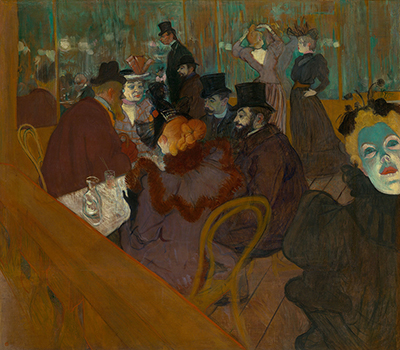
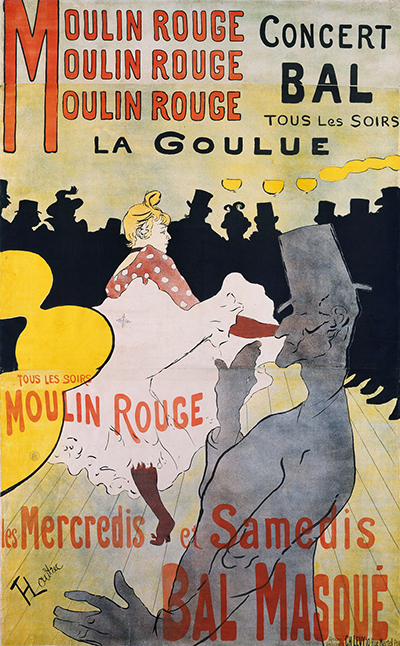
Choose an artist introduction, a film about graphic design or a closer look at At the Moulin Rouge.
Which café, and which moment in 1887?
Le Tambourin is the traditional answer to the location question. The identification comes from Émile Bernard's recollection, published in 1924, that Lautrec made the pastel there. Blok treats it cautiously: Bernard's memories were not consistently accurate, and the generic furnishings could belong to other Montmartre establishments. There are no surviving photographs of Le Tambourin's interior to settle the comparison. Its name remains a plausible association, rather than a location visibly proved by the drawing. [1]
The table complicates the identification. Van Gogh's portrait of the owner, Agostina Segatori, shows the establishment's distinctive tambourine-shaped tables. The table in Lautrec's pastel is ordinary. As Blok explains, Bogomila Welsh-Ovcharov proposed that Van Gogh might have been sitting in a restaurant area furnished differently. That could reconcile the images, but it adds another hypothesis. The useful conclusion is that the portrait shows a café, with its exact identity still open. [1]
The date needs a similar distinction. Lautrec did not date the sheet. The accepted year is 1887, supported by contemporary acquaintances' later accounts and by affinities with other work. Dating it more closely to the first half of that year partly depends on the Tambourin recollection: Van Gogh frequented the café before his understanding with Segatori ended in July. The proposed location and proposed narrower date therefore do not independently confirm one another. Blok regards the first half of 1887 as reasonable while making the underlying evidence visible. [1]
Two artists sharing experiments
The two painters first crossed paths at Fernand Cormon's teaching studio in March 1886. Lautrec already belonged to a group with Bernard and Louis Anquetin; Van Gogh joined this environment shortly after arriving in Paris. Studies from the period show Lautrec and Van Gogh drawing from the same plaster casts. Their contact extended beyond such exercises, particularly from the autumn of 1886, after Van Gogh had left the studio. The immediate background to the portrait was an exchange among artists still testing the possibilities of their work. [1]
Shared interests included Degas, Jean-François Raffaëlli and prints and illustrations by artists such as Daumier. Both painters experimented with short parallel strokes and diluted oil paint. Blok presents scholarly disagreement about which artist affected the other most, alongside the possibility of a joint investigation shaped by this wider environment. The pastel makes that shared investigation tangible: its coloured strokes have affinities with Van Gogh's work while retaining Lautrec's particular handling. [1]
Pastel was also circulating within their circle. Anquetin favoured it, and his study of Bernard for The Interior at Bruant's: Le Mirliton, about 1887, provides a close contemporary instance of one artist drawing another in the medium. Bernard used pastel too. Van Gogh's coloured-crayon drawings of early 1887 offer a related comparison, although their wax crayons should be distinguished from the powdery pastel used here. Similar-looking coloured lines can belong to different materials and different habits of drawing. [1]
Blok distinguishes Lautrec's shorter, more erratic strokes from Van Gogh's bolder, tauter lines. The portrait's coat rewards that distinction: small changes of direction keep interrupting its larger form. The sitter's own artistic practice supplies a suggestive context, but the marks remain those of the person drawing him. Their relationship is better understood as reciprocal attention within a group than as a single arrow of influence. The wider account of Lautrec's style and technique develops the differences among these materials and procedures. [1]
A frame, an acquisition and an exhibition hypothesis
The portrait passed from Lautrec into the collection of Vincent or Theo van Gogh, but the transaction is undocumented. Blok considers a gift likely and also discusses an exchange, possibly involving Van Gogh's View from Theo's Apartment. Even the identification of the Van Gogh painting once owned by Lautrec is uncertain. A different possibility is that Lautrec presented the pastel to Theo, whose position as a dealer and support for his work might have mattered. These remain alternatives; the survival of the portrait among the brothers' possessions does not establish which occurred. [1]
The frame offers firmer material evidence. It was made by Pierre Cluzel, whose label survives on the back. Cluzel worked for artists including Degas and Camille Pissarro, and both Lautrec and Theo used his services. Blok interprets the fashionable, expensive frame as evidence of the brothers' appreciation. The object was given a substantial setting, treating this pastel as something to preserve and present. The frame confirms the care given to presenting a work on paper. [1]
A letter from Lautrec to Theo, dated December 1887 or January 1888, asks for Cluzel's advice about framing a study. It may refer to this portrait, but the identification is uncertain. A further suggestion links that study with Étude de profil, number 8 in Lautrec's contribution to Les XX in Brussels in 1888. Blok finds no source proving that the pastel was exhibited there. Lautrec made many profile portraits and used the title “study” for numerous works, so the catalogue wording cannot carry the identification by itself. [1]
There is a useful comparison within the same documentary history. Theo's acquisition of Young Woman at a Table, ‘Poudre de riz’ has a receipt dated 12 January 1888, inventory b1156V1962. Theo was also named as its owner in the 1888 Les XX catalogue; no comparable ownership designation accompanies the proposed profile entry. The receipt concerns Poudre de riz, a different picture. It supplies no purchase date or payment evidence for the Van Gogh portrait. Keeping those objects separate allows the contrast between a documented acquisition and an unresolved one to remain clear. [1]
Jo van Gogh-Bonger: a private likeness made public
Contact between the artists became less frequent after Vincent moved to Arles in February 1888. They nevertheless saw one another again in July 1890 at Theo and Jo's home in Paris. Jo later remembered their amusement together at lunch. More direct testimony to Lautrec's regard survives in his condolence letter to Theo, dated 31 July 1890: “You know what a friend he was to me and how eager he was to demonstrate his affection.” This is the English translation reproduced in Blok's catalogue, which cites the French letter, inventory b1276V1962, and Ronald Pickvance's published translation. It is a statement of friendship by Lautrec himself, preserved separately from the portrait's visual evidence. [1]
After Theo's death in January 1891, the portrait was inherited by Jo and their son, Vincent Willem. Jo administered the collection until her death in 1925. Her treatment of this sheet gives its later history a particular personal dimension. Blok reproduces a photograph by Bernard Eilers, dated 1925–26, of the living room at Jo's house at 77 Koninginneweg in Amsterdam. The portrait hangs to the right of a doorway, separately and at eye level, while many other pictures occupy closely packed rows. [1]
That arrangement gives the likeness a distinct place within a room full of art. Blok reads it as evidence of Jo's attachment to the portrait and her sense that it represented her brother-in-law. The photograph supports the observation about placement; the personal significance is a persuasive curatorial interpretation. It cannot tell us how every visitor responded, but it shows that the sheet had become part of the family's daily visual surroundings. A portrait made in a café had acquired another intimate interior around it. [1]
Jo also lent it with Van Gogh's paintings to exhibitions, including Groningen in 1896 and the Vienna Secession in 1903. Blok notes that the reviews she discusses do not mention the pastel. Its presence nevertheless allowed audiences to encounter Van Gogh through another artist's eyes alongside his own work. The portrait could serve simultaneously as Lautrec's accomplished drawing and as an image of the painter whose reputation Jo was helping to establish. [1]
In July 1962 Vincent Willem transferred it with the collection to the Vincent van Gogh Foundation. It has been on permanent loan to the museum since its opening in 1973. That chain of preservation connects the café likeness to its present institutional home and to an enduring part of its value: Van Gogh appears here as the subject of another painter's sustained looking. The pale profile, busy coat and surrounding furnishings preserve a particular visual encounter even where the circumstances of making and acquisition remain incomplete. [1]
Toulouse-Lautrec artworks directory
Browse 84 identified works and publications in this researched selection. Dates and titles follow the individual records; this is not a complete catalogue of the surviving oeuvre. Print impressions remain attached to their designs. Some listed works do not have a dedicated article. The Drawings guide also contains nine illustrated studies consolidated from former articles.
Frequently Asked Questions
It is a pastel drawing: pastel on wove paper supported by cardboard. The museum's technical account describes prepared paper stretched over the cardboard, with layered lines left unblended. Its elaborate colour and finish make it an independent portrait. [1]
Possibly. Émile Bernard later placed the portrait session there, but the café interior is not specific enough to confirm his recollection. The ordinary table also differs from the tambourine-shaped tables known through Van Gogh's portrait of Agostina Segatori. [1]
A gift is likely, but no document establishes the transaction. An exchange or a presentation to Theo has also been proposed. The receipt dated 12 January 1888 concerns Poudre de riz, not this pastel. [1]
That has been suggested through the title Étude de profil, but the identification is unproven. Blok's catalogue stresses the absence of confirming evidence. [1]
Their shared studio environment, the portrait and Lautrec's condolence letter establish contact and affection. The precise closeness of their friendship is harder to reconstruct: no correspondence between the two survives, and later recollections vary. [1]
Discussion
Look again at the images and ideas explored in Portrait of Vincent van Gogh, 1887. These editorial prompts invite your observations.
Reader Insights
Compare the fine strokes around the ear and cheek with the broad curves on the front of the bar. How does that change of handling help the head remain distinct within the busy room? [1]
Follow the table towards the glass, then the blue bar top behind the face. How do their different directions shape the sitter's place in the café?
Join the Conversation
Share a detail, comparison or question about Portrait of Vincent van Gogh, 1887 below.
References
- Franka Blok, “Henri de Toulouse-Lautrec, Portrait of Vincent van Gogh, 1887,” catalogue entry 132, in Contemporaries of Van Gogh 1: Works Collected by Theo and Vincent, edited by Joost van der Hoeven, Van Gogh Museum, January 2024, DOI 10.58802/ERNF3739. Full essay, object details and provenance; especially “Pastel crayon,” notes 27–32; café and dating, notes 1–2; acquisition and frame, notes 35–39; condolence letter and Jo's display, notes 42–46. English text with French documentary quotations; the French letter and memoir publications are cited here through Blok rather than as independently consulted originals. View source.
- Autoportrait, 1880 (in French). View source.
- ALBERTINA: Der Schimmel Gazelle,GE123DL. View source. (in German).
- Art Institute of Chicago: Moulin Rouge, La Goulue. View source.
- Art Institute of Chicago: At the Moulin Rouge. View source.
- Jane Avril, 1893. View source.
- Au Salon de la rue des Moulins (in French). View source.
- Colta Ives, Toulouse-Lautrec in The Metropolitan Museum of Art, 1996. View source.
- Maurice Joyant (in French). View source.
- Splash image, Portrait of Vincent van Gogh, 1887. Pastel on wove paper supported by cardboard, 54.2 × 46 cm. Van Gogh Museum, Amsterdam (Vincent van Gogh Foundation), d0693V1962. Separate coloured strokes construct the profile, coat and café furnishings. Van Gogh Museum,Amsterdam,d0693V1962. Image source. Public domain. Resized only; native appearance preserved.