



 by Tom Gurney
Tom Gurney BSc (Hons) is an art history expert with over 20 years experience
Published on June 19, 2020 / Updated on November 3, 2026
Email: tomgurney1@gmail.com / Phone: +44 7429 011000
Maurice Joyant at the Somme Bay: Introduction
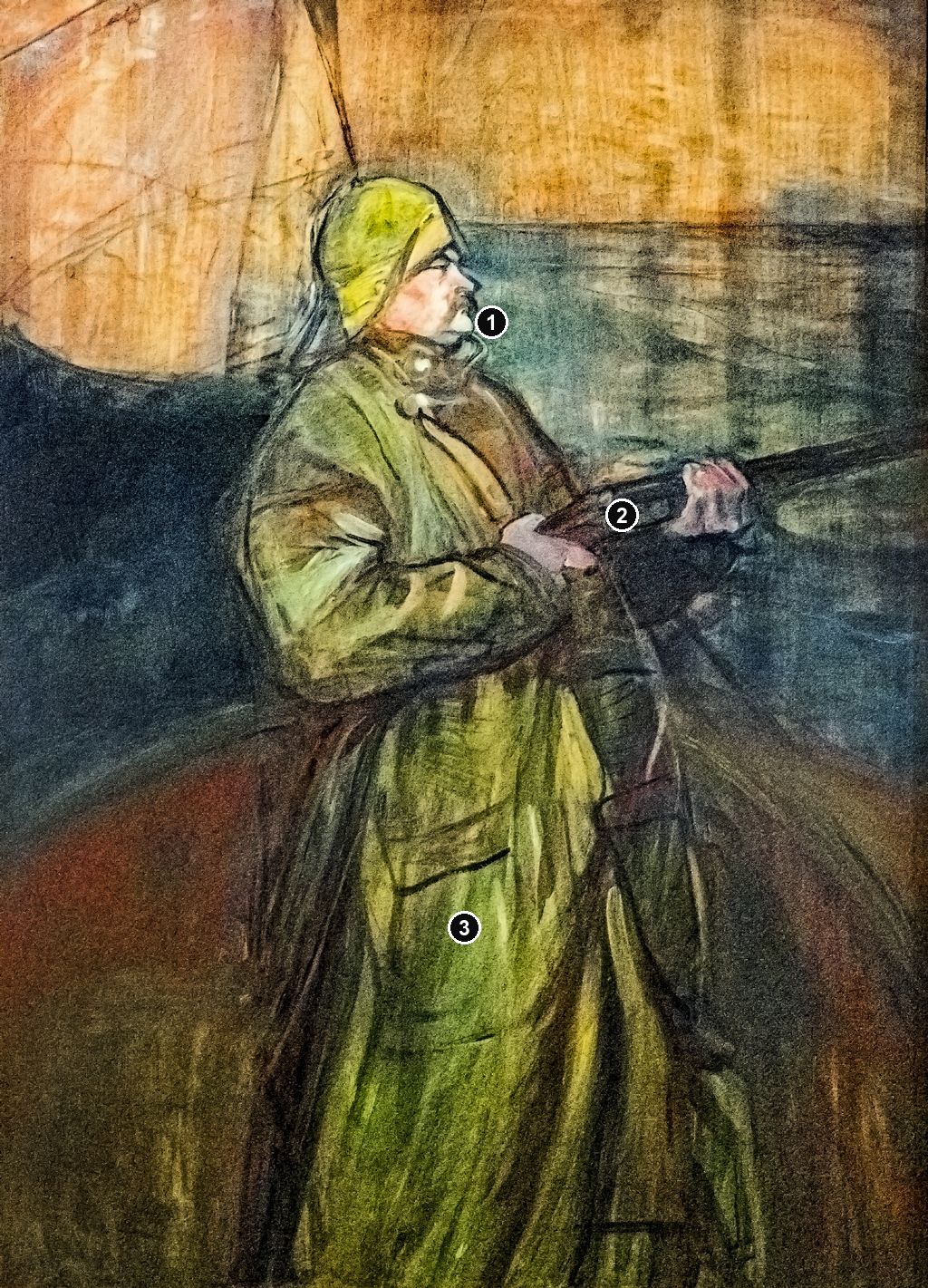
A yellow coat fills almost the whole height of the painting. Above its raised collar, Maurice Joyant’s face turns towards the right; his hands hold a gun across his chest. The water and the curved sides of a boat establish his surroundings with remarkably few marks. Painted in 1900, this portrait brings a lifelong friend into the foreground of Toulouse-Lautrec’s art. It also gives that friend a physical presence quite different from the work he performed as a dealer, publisher and advocate. The painting belongs to the Musée Toulouse-Lautrec in Albi, where Joyant’s own gift helped preserve their relationship in public view. [1]
At a Glance
- ArtistHenri de Toulouse-Lautrec
- TitleMaurice Joyant, also described as M. Maurice Joyant and Maurice Joyant at the Somme Bay
- Date1900
- MediumOil on wood
- Dimensions116 × 81 cm in the museum’s current entry; 116.5 × 81 cm in the regional collection record
- CollectionMusée Toulouse-Lautrec, Albi
- InventoryMTL.207
- AcquisitionGift of Maurice Joyant, 1922
- SubjectJoyant in yellow oilskin, holding a gun in a boat on the Bay of the Somme
The object details above follow the Albi and Musées Occitanie records. A separate portrait in the Musée d’Orsay is an oil on cardboard, inventory RF 1951 19. [1] [2] [3]
This work across Henri de Toulouse-Lautrec’s career
Contents
- A figure larger than his surroundings
- Yellow oilskin and the work of the brush
- The boat, water and gun
- The friend who brought Lautrec’s work to an audience
- A separate study in the Musée d’Orsay
- A portrait made over time
- From private possession to Albi
- Annotated details
A figure larger than his surroundings
The first impression is of a person occupying space with unusual certainty. Joyant’s body extends below the lower edge, so the viewer never sees his feet. His head stands clear against the lighter upper background. Between them, the coat spreads into a broad, irregular triangle. Its weight comes from the widening silhouette, the folded sleeve and the long falls of fabric, rather than from an elaborately described body underneath. Looking at the contour before the details makes the construction particularly clear: the rounded shoulder on the left leads into an elbow, then the coat expands downwards towards the narrow boat’s sides.
Yet the position is more complicated than a straightforward upright stance. The face looks right, the gun travels diagonally across the body, and the arms gather around it. The sleeve makes a bent, almost horizontal band across the chest. The body therefore supplies an anchor while the hands and equipment carry attention towards the edge. That movement continues beyond the picture, where the gun barrel is cut off. We are given the direction of Joyant’s attention without being shown what he sees.
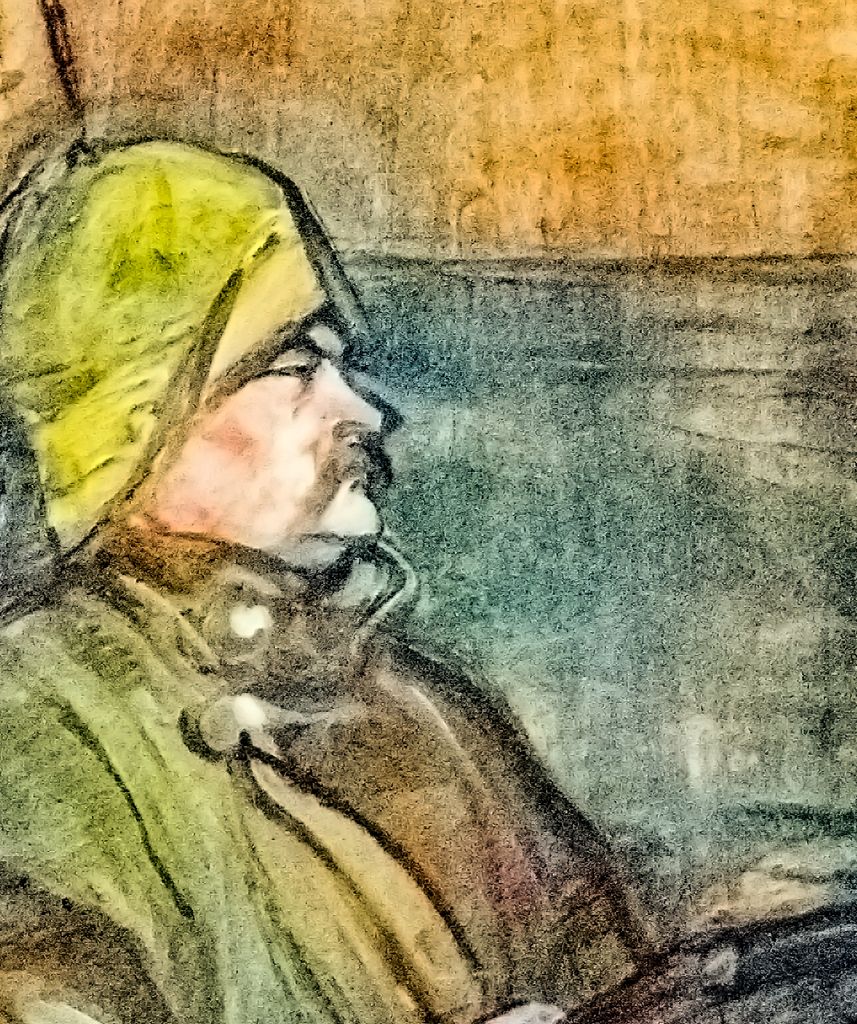
His face occupies only a small part of the surface. A dark outline distinguishes the nose, brow and moustache, while a patch of pink warms the cheek. The hat brim compresses the visible forehead and brings the eye close to the boundary between hat and face. Nothing here requires a detailed account of his expression. Recognition is achieved economically, within a much larger arrangement of coat, arms and equipment. The picture remains a portrait because those few facial marks are held within such a specific bodily configuration.
This is also a close viewpoint. There is no stretch of foreground shore separating the spectator from Joyant, and little room around the coat. We seem near enough to follow a sleeve fold or the turn of a wrist. The setting has not disappeared, but it has been fitted around the figure. His prominence is something the painting constructs through scale and cropping, before any knowledge of his biography enters the encounter.
Yellow oilskin and the work of the brush
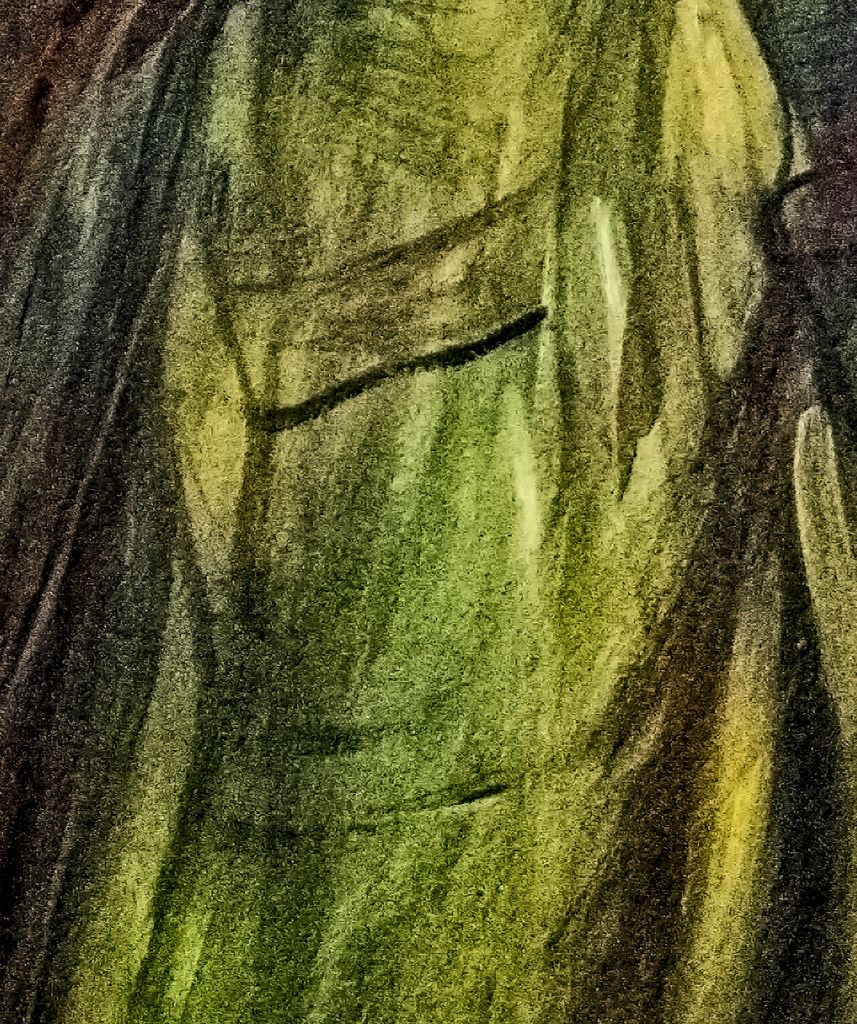
Yellow binds the hat and coat together, but it is far from uniform. The sleeve contains pale, almost creamy strokes beside olive folds. Lower down, ochre and brown passages run through the yellow; dark lines interrupt them at the pockets and along the coat’s opening. A viewer following these changes sees the garment alternately as a solid covering and as an arrangement of painted strokes. The cloth has volume without becoming a smooth, continuous illusion.
The buttons at the throat are especially economical. Their light spots punctuate the darker collar, helping to distinguish the small head from the mass below it. The broad pocket flaps lower down work differently: a few angular boundaries suggest their shape and placement, while the yellow continues across them. Lautrec varies the degree of description. Certain details receive a firm mark because they clarify the garment; others dissolve into the surrounding paint.
Danièle Devynck’s account for Musées Occitanie draws attention to the broad brushwork and to the diluted green through which the warmth of the wooden panel remains visible. Her observation helps explain why the figure and background belong to one colour arrangement. The warm support participates in the image, rather than serving only as an invisible foundation. [2]
Looking closely, the contrast between open background and densely articulated coat becomes as important as the contrast between yellow and green. Behind the head, long lines remain exposed against warm colour. Around the sleeve, shorter dark accents and overlapping strokes build a thicker visual fabric. The difference directs attention towards Joyant without requiring a bright spotlight or a fully modelled shadow. It is the distribution of marks that makes one part of the picture more substantial than another.
The colour connects the figure with the landscape. Yellowish warmth extends into the upper background, while greens and browns enter the coat. These exchanges make the figure prominent without cutting him completely away from his surroundings. His outline is emphatic, but the colour moves across it. The combination gives the painting both a strong silhouette and an unsettled, visibly worked surface.
Annotated Details from Maurice Joyant at the Somme Bay
The numbered points identify visible features discussed in this article. Return from each detail to the whole composition. Maurice Joyant at the Somme Bay, 1900, Musée Toulouse-Lautrec, Albi, MTL.207. Photograph by Didier Descouens, CC BY-SA 4.0; resized. Photograph: Didier Descouens / CC BY-SA 4.0. Image source. CC BY-SA 4.0. Numbers added to a separately resized overview; detail crops taken from the immutable original. These overview and crop derivatives are shared under CC BY-SA 4.0. No recolouring or retouching.
Details from MAURICE JOYANT AT THE SOMME BAY
Compare the cropped details with the complete images above. Notice how their colours, shapes and positions contribute to the larger compositions.
Hat and profile
The oilskin hat frames a right-facing moustached profile.
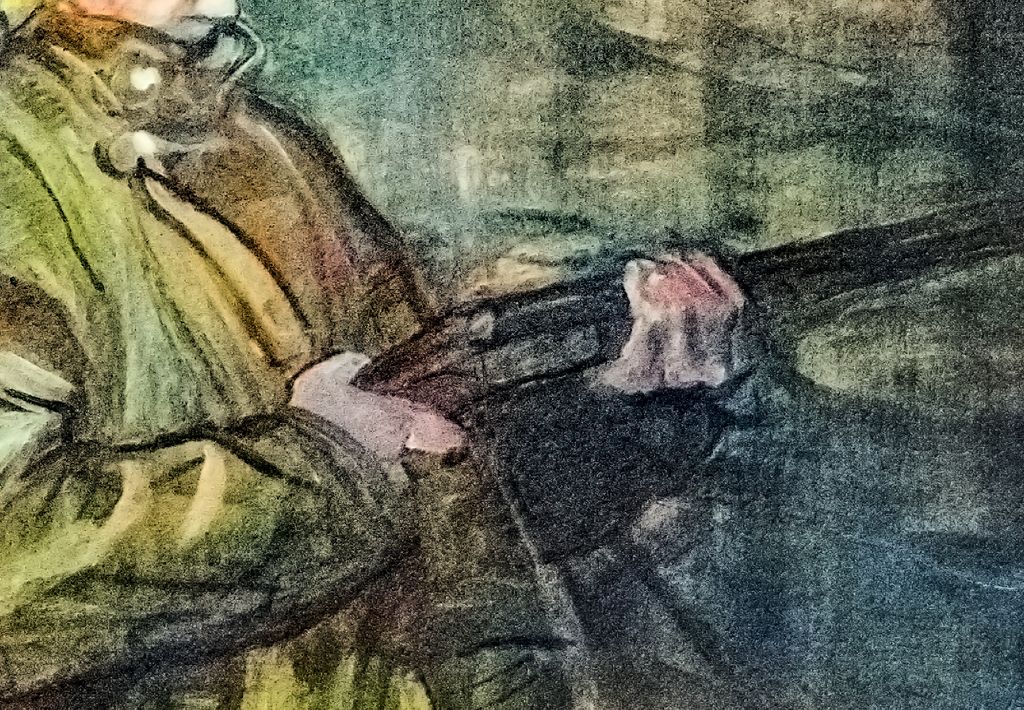
Hands and gun
The hands gather around the diagonal gun across the body.
The broad oilskin coat
Large yellow-green areas make the coat the portrait’s dominant shape.
The boat, water and gun
The boat is easiest to recognise through its edges. Brown forms rise on either side of Joyant, enclosing the lower figure; a diagonal boundary passes behind his arm. There is enough information to establish a vessel, but no complete diagram of its construction. The water likewise appears as a band of greenish and dark horizontal passages with few individually described waves. With the upper warm field, these areas give the upright figure a small number of broad spatial divisions.
Look at how many directions meet at the hands. The gun crosses the coat; the forearms bend towards it; the boat’s sides lead into the same crowded central zone. The instrument of the activity also becomes an instrument of composition. It connects the two hands and cuts across the long downward movement of the oilskin. Its narrow, dark form makes the surrounding yellow seem broader, and the pale hands become more conspicuous against its surface.
The sling introduces another kind of line. Hanging below the gun, it continues down the front of the coat, giving the equipment a loose vertical extension. This echoes the folds while remaining distinguishable from them. Together, the gun, strap, buttons and pockets locate the figure in an activity without filling the picture with accessories. There is no need to supply a sequence of shots or an account of an excursion to make these details meaningful.
The museum connects the setting with the Bay of the Somme and Joyant’s invitations to Le Crotoy. That geographical identification supplies something the spare painted surroundings alone could not establish with certainty. [1] The image itself leaves much outside the frame: the object of the hunt, the extent of the boat and the wider shoreline. Its concentration falls on a recognisable person equipped for an outdoor pursuit. The partly specified setting makes that concentration stronger.
Watch: Toulouse-Lautrec
Choose an artist introduction, a film about graphic design or a closer look at At the Moulin Rouge.
The friend who brought Lautrec’s work to an audience
Joyant and Lautrec met at the lycée Fontanes in Paris around 1872–73. Their connection later became professional as well as personal. In 1890 Joyant succeeded Theo van Gogh in the management of the boulevard Montmartre gallery associated with Goupil. The museum records exhibitions he arranged in Paris in 1893 and 1896 and in London in 1898. The friendship also included travel, visits to Le Crotoy and an interest in food. These documented activities give the portrait a context beyond either a formal business likeness or an anonymous sporting subject. [1]
Phillip Dennis Cate’s study of Lautrec’s popularisation makes Joyant’s contribution more concrete. At Boussod and Valadon, he organised a joint exhibition of Lautrec and Charles Maurin from 30 January to 11 February 1893. Cate relates this event to Thadée Natanson’s enthusiastic response in La Revue blanche. By the end of that year Joyant was a partner in the firm, which became Boussod, Manzi and Joyant. He was situated where publication, exhibition and the sale of art could reinforce one another. [12]
Cate also reports Jean Adhémar’s account that Ancourt printed the 1892 lithograph The Englishman at the Moulin Rouge for Boussod. The example shows why a dealer mattered to Lautrec’s work beyond the eventual sale of a painting. Prints needed an organisation capable of bringing them into circulation. Joyant’s friendship formed part of that practical network, while his gallery supplied a place where the work could be encountered and discussed. [12]
The portrait presents him at a considerable distance from that public role. It gives no gallery interior, stock of pictures or book to identify his profession. Instead, clothing and equipment establish another aspect of his life. This choice allows readers who know his importance to feel the distance between a historical résumé and a particular likeness. Joyant’s work explains why he matters to Lautrec’s history; the painting insists that he also deserves sustained attention as a figure in his own right.
A separate study in the Musée d’Orsay
The Musée d’Orsay’s Maurice Joyant is another painting of 1900, measuring 95 × 65.5 cm and painted on cardboard. Its inventory number is RF 1951 19. Devynck identifies the Orsay work as an earlier exploration of the Albi composition. These two objects share a sitter, costume and broad arrangement, but their different supports, dimensions and histories must remain distinct. [3] [2]
The comparison is particularly revealing at the sleeve and below the waist. In the Orsay image, long blue and dark outlines travel across a largely exposed brown field. Multiple lines describe the arm, torso and lower garment, making the process of locating the figure conspicuous. The yellow is lighter and more dispersed. The gun and hands seem caught within a web of searching contours, whereas the Albi figure has a more continuous painted weight.
There are changes in the surrounding space too. Both works give lines and warm colour a role behind the head, but the Albi water forms a more sustained dark field around the shoulders and arms. That contrast increases the solidity of the yellow figure. Seen together, the pictures make development visible through specific decisions about density, boundary and colour. The larger work does not simply add more detail everywhere; it strengthens selected relationships while keeping much of the environment abbreviated.
The Orsay picture has its own provenance. The museum records the collections of Manzi, Bollog and Dortu, followed by the 1951 donation of Mr and Mrs Georges Dortu to the national museums, with a reserved life interest. This is separate from Joyant’s 1922 gift of the wooden Albi portrait. [3] Similar titles can obscure this distinction, particularly when an illustration is detached from its caption. Looking at the surfaces makes the difference immediate; the collection records give it a durable documentary basis.
A portrait made over time
The vigorous brushwork can make the Albi painting feel quickly seized. Its documented history invites a slower reading. Devynck reports Joyant’s statement in his biography that the portrait required seventy-five sittings. This is Joyant’s recollection as transmitted by the curator, rather than an independently verified count of dated sessions. Nevertheless, it is valuable evidence against equating abbreviated description with an effortless or momentary execution. [2]
The Grand Palais’s 2019 accessible exhibition booklet places the painting in May 1900 and states that Lautrec drew upon a photograph taken in 1899. Read alongside the related Orsay work and the reported sittings, that account points towards an image assembled through several forms of preparation. It should not be mistaken for a transparent record of a single encounter in a boat. [13]
Time remains visible in a different sense within the finished arrangement. Some passages are decisive and compact, such as the profile and buttons; others preserve a loose accumulation of strokes. The contrast allows the eye to move between recognition and making. Joyant is firmly present, yet the labour of giving him that presence has not been concealed under an even surface. The work belongs to Lautrec’s late career, but its artistic interest lies in those active decisions about how a figure takes shape.
From private possession to Albi
Joyant retained this portrait in his collection before giving it to the museum in 1922. [1] The museum’s history identifies the family donation of that year as the foundation of its present collection at the Palais de la Berbie. The portrait therefore entered a larger act of preservation involving the sitter, the artist’s family and his native city. [14] The city’s centenary account describes the practical work behind this outcome: Joyant joined Adèle de Toulouse-Lautrec and Gabriel Tapié de Céleyran in approaching Albi, then took responsibility for transporting and hanging the works. His own pictures supplemented the family gift. Advocacy extended into the physical making of a collection. [15]
That history adds another dimension to the relationship pictured here. The man whose yellow coat commands the painted space later helped determine where many of Lautrec’s works would be seen. Personal attachment became collection building. His gift also allowed a privately owned likeness to join the broader account of Lautrec’s career, where it could be considered alongside posters, drawings and paintings of other subjects.
The Grand Palais booklet notes Joyant’s posthumous exhibitions in 1902 and 1914, undertaken to bring attention to Lautrec’s painting as well as his reputation for posters and illustration. [13] The Somme Bay portrait makes that distinction tangible. Its broad silhouette has an immediate visual force, but prolonged looking reveals the varied density of oil paint, the warmth of the support and the uncertain edges of the surrounding space. It offers precisely the kind of sustained encounter with painting that Joyant’s later advocacy helped make possible.
Toulouse-Lautrec artworks directory
Browse 84 identified works and publications in this researched selection. Dates and titles follow the individual records; this is not a complete catalogue of the surviving oeuvre. Print impressions remain attached to their designs. Some listed works do not have a dedicated article. The Drawings guide also contains nine illustrated studies consolidated from former articles.
Frequently Asked Questions
Discussion
Look again at the images and ideas explored in Maurice Joyant at the Somme Bay. These editorial prompts invite your observations.
Reader Insights
How do the cropped gun and unseen feet affect your sense of Joyant’s size and position?
In comparing the Albi painting with the Orsay study, where does added colour change the figure’s weight most strongly?
Join the Conversation
Share a detail, comparison or question about Maurice Joyant at the Somme Bay below.
References
- Musée Toulouse-Lautrec, “Maurice Joyant”, collection entry and image: 1900, oil on wood, dimensions, acquisition and friendship (in French). View source.
- Danièle Devynck, “M. Maurice Joyant”, Musées Occitanie, inventory MTL.207: object details, material observations, related study and Joyant’s reported sittings (in French). View source.
- Musée d’Orsay, “Maurice Joyant,” RF 1951 19, separate 1900 oil on cardboard: object record, provenance and collection image (record principally in French). View source.
- Autoportrait, 1880 (in French). View source.
- ALBERTINA: Der Schimmel Gazelle,GE123DL. View source. (in German).
- Franka Blok, Portrait of Vincent van Gogh, 2024. View source.
- Art Institute of Chicago: Moulin Rouge, La Goulue. View source.
- Art Institute of Chicago: At the Moulin Rouge. View source.
- Jane Avril, 1893. View source.
- Au Salon de la rue des Moulins (in French). View source.
- Colta Ives, Toulouse-Lautrec in The Metropolitan Museum of Art, 1996. View source.
- Phillip Dennis Cate, “The Popularization of Lautrec,” in Toulouse-Lautrec: Images of the 1890s, Museum of Modern Art, 1985, p. 83: Joyant, Boussod and Valadon, the 1893 joint exhibition and publication of The Englishman at the Moulin Rouge. View source.
- Réunion des musées nationaux–Grand Palais, Toulouse-Lautrec, résolument moderne: accessible exhibition booklet, 2019, printed pp. 28–29, especially p. 29: portrait, photograph, May 1900 dating and Joyant’s posthumous exhibitions (in French). View source.
- Musée Toulouse-Lautrec, “Histoire du musée”, institutional history of the Palais de la Berbie and the 1922 family donation (in French). View source.
- Ville d’Albi, “Les donateurs,” Albimag, no. 248, March 2022, pp. 32–33: the donors, transfer and hanging of the collection; illustrated caption identifying MTL.207 and Joyant’s gift (in French). View source.
- Splash image, Maurice Joyant at the Somme Bay, 1900, Musée Toulouse-Lautrec, Albi, MTL.207. Photograph by Didier Descouens, CC BY-SA 4.0; resized. Photograph: Didier Descouens / CC BY-SA 4.0. Image source. CC BY-SA 4.0. Photograph resized proportionally; colour and content preserved. Photographic derivative available under CC BY-SA 4.0.


 Henri de Toulouse-Lautrec.jpg)