


 Henri de Toulouse-Lautrec.jpg)
 by Tom Gurney
Tom Gurney BSc (Hons) is an art history expert with over 20 years experience
Published on June 19, 2020 / Updated on November 3, 2026
Email: tomgurney1@gmail.com / Phone: +44 7429 011000
“A Montrouge”–Rosa La Rouge by Toulouse-Lautrec: Introduction
A loose lock of red hair curls across a woman's face. Behind it, a pale window gives the turned profile a bright setting, while both arms hang towards the lower edge. The body occupies the room with extraordinary directness; the eyes remain elusive. In “A Montrouge”–Rosa La Rouge, Toulouse-Lautrec makes a figure easy to recognise without making her attention easy to read.
Barnes identifies the model as Carmen Gaudin, posing as Rosa, a character from Aristide Bruant's songs. That distinction opens the painting: a particular sitter supplies the body and face of someone already imagined in words and performance. [1]
At a Glance
- ArtistHenri de Toulouse-Lautrec.
- Title“A Montrouge”–Rosa La Rouge.
- Date1886–87.
- Mediumoil on canvas.
- Dimensions72.1 × 48.6 cm.
- Collection and accessionBarnes Foundation, Philadelphia, BF263.
- Model and roleCarmen Gaudin posing as Bruant's song character Rosa La Rouge. [1]
This work across Henri de Toulouse-Lautrec’s career
Contents
- A head turned within an upright body
- The blouse carries the weight of the composition
- The arms make the stillness specific
- A window that does more than illuminate
- Paint that remains visible as paint
- A painted role in Bruant's cabaret
- One sitter, three arrangements
- Annotated details
A head turned within an upright body
The first thing to notice is the difference between the head's direction and the body's. The blouse spreads towards us, describing the width of the shoulders and chest. The face turns decisively to our right. Its nose and chin project beyond the warm mass of hair, while the neck bridges that turn and the more frontal torso. We meet the woman at an angle even though her body fills the centre. The full reproduction makes these differences particularly clear. [11]
The hair creates several different edges around the head. Across the crown, interlaced reddish and brown strokes follow a broad backward sweep. Behind the visible ear they collect into a darker gathered shape. In front, a hanging section bends down over the forehead and cheek, then curls outward. Its tip is almost as important to the silhouette as the nose. Looking from the back of the head towards that small curl, the eye encounters a series of changes in density and direction rather than a single continuous red patch.
The ear is a small, pale interruption within those warmer marks. Beneath it, the neck broadens into the blouse's open collar. The transition gives the head physical attachment to the shoulders; it also creates another route through the picture. We can follow the face sideways towards the window, or travel down through the neck and opening of the garment. The profile directs attention away from us while the light chest brings it back towards the centre.
The eyes are largely hidden. That concealment changes the encounter because we cannot easily complete the familiar exchange of looking at someone who looks back. Yet other features remain emphatic: the short nose, the line of the mouth, the chin and the ear. The face is selective rather than indistinct. Its individuality depends partly on how those exposed features meet the hair that conceals the rest.
The red is also distributed more subtly than the title might lead us to expect. It is strongest above the face, with warmer accents around the mouth and in the room's brown surfaces. Around the neck, cooler grey-green touches interrupt the warmth. The hair commands attention through its position and concentration as well as its hue. Its contrast with the blouse matters as much as its contrast with the dark background.
The blouse carries the weight of the composition
The blouse is the broadest light form in the painting. It expands at the shoulders, falls loosely around the chest and narrows unevenly towards the skirt. An opening at the neck descends diagonally into a central line. Lower down, the two sides part into a dark slit. These small interruptions prevent the large pale area from settling into one unbroken block.
Its two sleeves behave differently. On our left, the sleeve falls in a broad, comparatively straight passage and gathers at a turned cuff. On our right, the arm lies closer to the body's contour; its sleeve narrows towards another irregular cuff. The unequal outlines give the torso a slight shift. The shoulders do not form a rigid horizontal, and the garment's lower edge rises and falls rather than cutting cleanly across the skirt.
Within the cloth, long strokes take several routes. Some descend from the shoulders; some curve across the chest; others sharpen a fold or disappear into a lightly occupied patch. Grey, greenish, violet and warm cream notes complicate the apparent white. They give the fabric volume without a smoothly shaded finish. The most open passages still contain small variations, so the blouse retains both its broad shape and the activity of its surface.
Follow its bottom edge from left to right. A gathered corner meets the exposed forearm; the central hem descends; the dark slit breaks the outline; the other side lifts before meeting the hanging arm. That uneven meeting of pale and dark is one of the picture's strongest boundaries. It tells us where the blouse ends while leaving the exact construction of the clothing loosely described.
The skirt below forms a broad dark base. Slanting marks and folds remain visible inside it, but they have less contrast than those on the blouse. This difference gives the upper body prominence without removing weight from the lower figure. The skirt continues beyond the bottom edge, making the represented body feel larger than the visible portion. We see enough to register her stance, although neither feet nor floor provides an ordinary measure of balance.
Annotated Details from “A Montrouge”–Rosa La Rouge by Toulouse-Lautrec
The numbered points identify visible features discussed in this article. Return from each detail to the whole composition. Henri de Toulouse-Lautrec, “A Montrouge”–Rosa La Rouge, 1886–87. Oil on canvas, 72.1 × 48.6 cm. Barnes Foundation, BF263. Carmen Gaudin poses as Bruant’s song character. Barnes Foundation, Philadelphia. Image source. Public domain. Resized only; native appearance preserved.
.jpg)
Details from “A MONTROUGE”–ROSA LA ROUGE BY TOULOUSE-LAUTREC
Compare the cropped details with the complete images above. Notice how their colours, shapes and positions contribute to the larger compositions.
The red-haired profile
Red hair and a turned face establish the portrait’s direction.
 Detail 01 the-red-haired-profile.jpg)
The white blouse
Pale strokes make the blouse stand out against the darker room.
 Detail 02 the-white-blouse.jpg)
The lowered arm and hand
The lowered arm and hand extend the figure’s quiet vertical pose.
 Detail 03 the-lowered-arm-and-hand.jpg)
The arms make the stillness specific
Both arms descend, but their relation to the rest of the figure is different. The arm on our left emerges below a folded cuff as a relatively straight pale strip. Its lower end meets the edge of the picture. On our right, more of the hand is available: long fingers continue the downward movement beside the dark skirt. The limbs extend the blouse's vertical rhythm while exchanging loose fabric for narrower passages of exposed skin.
Small changes of colour articulate the forearms. Pale touches break across warmer and greyer areas; darker marks strengthen a boundary near the skirt. The hand on our right is especially legible because it overlaps darkness. Its fingers remain separate enough to give the lower body a human scale after the broader areas of clothing above.
These hanging arms do not perform an obvious task. There is no elaborate gesture to explain the figure, and no object in the hands that fixes the moment as an activity. The resulting stillness is quite particular: the torso faces us, the head turns away and the arms lead down. Calling the pose tired, defiant or resigned would decide more than its painted arrangement establishes. What we can follow securely is a body whose different parts carry our attention in different directions.
The lower cropping contributes to that effect. The picture gives considerable space above the hair, but little room beyond the hands and skirt. The head has an environment; the lower figure presses against the limits of the canvas. The unequal space keeps the standing body from becoming a neatly isolated full-length study. It seems to continue below our field of view.
Watch: Toulouse-Lautrec
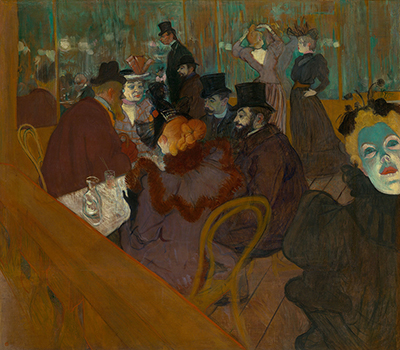
Choose an artist introduction, a film about graphic design or a closer look at At the Moulin Rouge.
A window that does more than illuminate
The background is constructed from substantial vertical divisions. A broad reddish-brown strip rises at the left; a darker field occupies the right. Between them, the window opening introduces another set of uprights and crossbars. These divisions almost frame the figure again inside the outer rectangle, but the body sits across them rather than fitting neatly within one compartment.
The panes also differ. The upper-left area is comparatively subdued and greenish; the upper-right rectangle is lighter and warmer. Beneath the crossbar, pale strokes become more conspicuous behind the turned face and shoulder. The window is therefore not one evenly bright opening. Its shifting values place particular parts of the figure against distinct surroundings.
The profile falls close to the boundary between hair, pale pane and dark edge. A small area of light makes the nose and mouth readable without requiring a continuous dark outline. Farther left, darkness behind the gathered hair and shoulder produces a different separation. One side of the head is distinguished by warmth against shadow; the other is sharpened by adjacent light. Following both sides reveals how the background participates in constructing the face.
The window's geometry remains simpler than the figure. Horizontal bars give the upper half a few stable measurements, while the shoulder, collar and hair create irregular curves and diagonals. The body interrupts a rectilinear setting. That opposition makes even the loose edge of a sleeve consequential: a small deviation becomes clear against the room's stronger uprights.
The opening provides little detailed view beyond the room. Pale, angled touches suggest brightness rather than a legible street or landscape. Consequently, the turned head does not lead us towards a second scene that could explain the woman's attention. Our looking stays close to the body and its immediate surroundings. The window opens the space through light while withholding the sort of exterior incident that might supply a narrative.
Paint that remains visible as paint
At a distance, the contrast between pale blouse and dark skirt organises the whole figure. Closer looking reveals a more uneven distribution of marks. The hair is densely worked with curving strokes. The blouse contains longer lines separated by broader, quieter intervals. In the left surround, reddish touches and darker zigzags remain less tied to a recognisable object. Each passage has a different degree of descriptive precision.
A woven texture is visible across the reproduction, including through some relatively light areas. That is useful to notice as part of the image's surface, but it does not establish a complete technical history. The documented material is oil on canvas. The reproduction alone cannot determine particular pigments, a solvent recipe or the order of every layer. [1] [11]
The varied handling nevertheless makes a clear visual difference. A patch in the blouse can suggest both a fold and a group of brush marks. The hair can feel substantial while remaining a network of moving lines. The room can enclose the body without every part of its furnishing being described. Such differences make the figure emerge through degrees of attention rather than through a uniform level of finish.
This is one reason the painting rewards a return from the face to the margins. The outer background is broader and darker, but it is active enough to keep the body inside a painted environment. The brown surround does not simply disappear once the head has been found. Its strokes, upright divisions and uneven edges continue to affect how firmly the figure stands out. The wider discussion of Lautrec's technique offers other examples of this balance between a readable image and an exposed working surface.
A painted role in Bruant's cabaret
Barnes connects the title with Bruant's repertoire and records the painting's former display at Le Mirliton. [1] The connection makes this interior portrait part of a performance setting even though the image contains no singer, stage or audience. Its role could arise from its title and surroundings as well as from what was depicted.
Phillip Dennis Cate's account places Lautrec within the cabaret's broader activity as a publisher. Bruant established Le Mirliton in the Chat Noir's former premises in 1885; the associated journal circulated his songs. Lautrec's work appeared in it in December 1886, followed by cover illustrations in 1887. Those printed contributions used photorelief, with stencil colour on several covers. They belong to the same period as the canvas, but involve a different material and route to an audience. [12]
The song-linked painting and the journal thus offer two ways an image could become part of Bruant's world: hanging within the establishment and travelling on a printed page. The relation is worth keeping concrete. A canvas displayed in a cabaret remains an individual painting; a reproduced illustration reaches readers through multiple printed copies. This work shows how Lautrec's Montmartre connections involved places where art was encountered as well as people who posed.
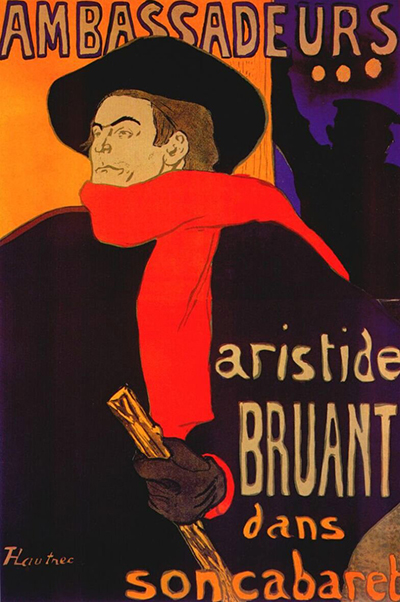
Bruant's own later public image offers a useful point of contrast. Albi's 2025 exhibition dossier explains the reduction of his appearance to decisive features in the 1892 Ambassadeurs poster: black hat and coat, red scarf and strongly simplified face. [13] Here the warm hair is equally conspicuous, but the broken transitions between light and shade, the cloth's many small changes and the room's uncertain depth sustain a slower encounter. The Bruant advertisement addresses recognition across a public sheet; this portrait makes recognition unfold within an enclosed space.
One sitter, three arrangements
The National Gallery of Art's Carmen Gaudin, dated 1885, is a small oil on wood measuring 23.8 × 14.9 cm. [14] In that picture, a seated figure wears a dark blouse and turns her head to our right. Her hands rest low in her lap. The pale face emerges from a much darker body, while surrounding foliage-like strokes complicate the small interior of the frame.
The Barnes canvas reverses much of that light-dark balance. The blouse becomes the principal pale mass, giving the head a lighter continuation below it. The arms descend beside the body rather than closing into the lap. In both paintings, red hair and a turned profile hold attention, but their supporting structures differ. A repeated sitter is a way to see Lautrec varying a problem: how much can the face depend on the clothing, pose and space around it?
The Laundress, Dortu P.346, gives Gaudin a third arrangement. Christie's dates that separate canvas to 1886–87 and records 93 × 75 cm. [15] The woman leans towards the left, with a hand supported on a table. Its broad, oblique movement contrasts with the more upright figure here. The difference is clearest below the shoulders: one composition extends the body into a piece of furniture, while the other lets the hanging arms accompany its descent towards the edge.
The comparisons also change how we read a title. Carmen Gaudin names the sitter; The Laundress directs attention towards occupation; “A Montrouge”–Rosa La Rouge introduces a character. The present picture holds portraiture and an imagined role together. Its visible face remains particular even when its title belongs to a song. Looking from one painting to another gives that distinction substance: the same model can participate in several different kinds of representation.
Barnes's exhibition history records this canvas in the touring Great French Paintings from The Barnes Foundation exhibition of 1993–95. [1] That later museum setting offered another context in which to encounter it. The composition continues to make sense through its own close relationships: hair against pane, loose cloth against dark skirt, a turned head within an upright body. The title adds a performed identity, while the paint keeps returning us to a person occupying a particular amount of space.
Toulouse-Lautrec artworks directory
Browse 84 identified works and publications in this researched selection. Dates and titles follow the individual records; this is not a complete catalogue of the surviving oeuvre. Print impressions remain attached to their designs. Some listed works do not have a dedicated article. The Drawings guide also contains nine illustrated studies consolidated from former articles.
Frequently Asked Questions
Barnes identifies Carmen Gaudin as the model posing as Bruant's song character Rosa. The sitter and the represented character have separate identities. [1]
It belongs to the Barnes Foundation in Philadelphia, accession BF263. [1]
Hair falls across the upper face. The concealment makes the profile and the direction of the head more prominent than an exchange of gazes with the viewer; it cannot establish the sitter's thoughts. [11]
Discussion
Look again at the images and ideas explored in “A Montrouge”–Rosa La Rouge by Toulouse-Lautrec. These editorial prompts invite your observations.
Reader Insights
Where does the window make an edge of the head clearer, and where does darkness do the same work? Follow the profile and gathered hair separately.
Compare the hanging arms here with the hands in Washington's Carmen Gaudin. How does their position alter the body's relationship to the lower edge? [14]
Join the Conversation
Share a detail, comparison or question about “A Montrouge”–Rosa La Rouge by Toulouse-Lautrec below.
References
- Barnes Foundation, “A Montrouge”–Rosa La Rouge, 1886–87, BF263, rendered collection record: object information, commentary and expanded exhibition history. View source.
- Autoportrait, 1880 (in French). View source.
- ALBERTINA: Der Schimmel Gazelle,GE123DL. View source. (in German).
- Franka Blok, Portrait of Vincent van Gogh, 2024. View source.
- Art Institute of Chicago: Moulin Rouge, La Goulue. View source.
- Art Institute of Chicago: At the Moulin Rouge. View source.
- Jane Avril, 1893. View source.
- Au Salon de la rue des Moulins (in French). View source.
- Colta Ives, Toulouse-Lautrec in The Metropolitan Museum of Art, 1996. View source.
- Maurice Joyant (in French). View source.
- Barnes Foundation reproduction via Wikimedia Commons, full image of “A Montrouge”–Rosa La Rouge, BF263, 4096 × 6054-pixel reproduction. View source.
- Phillip Dennis Cate, “The Popularization of Lautrec,” in Henri de Toulouse-Lautrec: Images of the 1890s, Museum of Modern Art, 1985, pp. 77–79: Le Mirliton, Bruant's journal, Lautrec's 1886–87 illustrations and the distinction between photorelief, stencil colour and later lithography. View source.
- Musée Toulouse-Lautrec, Albi, Toulouse-Lautrec et l'art de l'affiche, 2025 press dossier, pp. 7–8, Ambassadeurs and Bruant's public image (in French). View source.
- National Gallery of Art, Carmen Gaudin, 1885, accession 1970.17.85, medium, dimensions, visual description and image; Dortu P.244. View source.
- Christie's, La blanchisseuse, 1886–87, Dortu P.346, 2005 auction catalogue, object facts, image and sitter identification. This is a separate canvas from Barnes BF263. View source.
- Splash image, Henri de Toulouse-Lautrec, “A Montrouge”–Rosa La Rouge, 1886–87. Oil on canvas, 72.1 × 48.6 cm. Barnes Foundation, BF263. Carmen Gaudin poses as Bruant’s song character. Barnes Foundation, Philadelphia. Image source. Public domain. Resized only; native appearance preserved.
 Henri de Toulouse-Lautrec.jpg)