



 by Tom Gurney
Tom Gurney BSc (Hons) is an art history expert with over 20 years experience
Published on June 19, 2020 / Updated on November 3, 2026
Email: tomgurney1@gmail.com / Phone: +44 7429 011000
Countess Adèle in the Salon at Malromé: Introduction
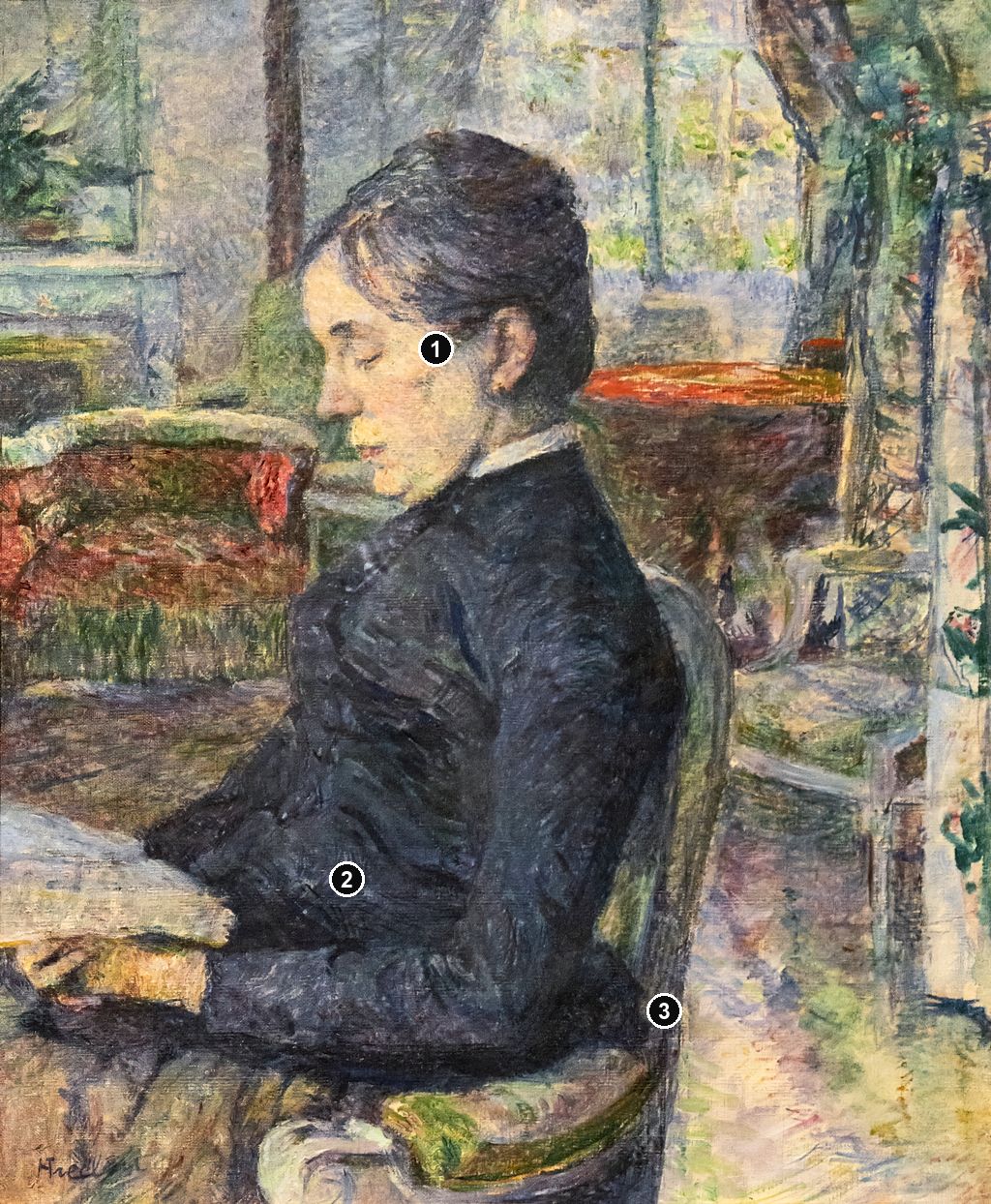
A woman reads beside a window, her dark dress surrounded by restless colour. The lowered face gives Toulouse-Lautrec's portrait of his mother a quiet centre, but almost everything around it flickers: green upholstery, red furniture, pale reflections and strokes of violet in the light. Painted about 1886–87, Countess Adèle in the Salon at Malromé brings an experimental handling of paint into a familiar family room. The picture belongs to the Musée Toulouse-Lautrec in Albi, inventory MTL.122. [1]
At a Glance
- ArtistHenri de Toulouse-Lautrec.
- SubjectHis mother, Countess Adèle de Toulouse-Lautrec, née Tapié de Céleyran. [1]
- DateAbout 1886–87. [1]
- MediumOil on canvas. [1]
- SettingThe salon of the Château de Malromé, near Bordeaux. [1]
- CollectionMusée Toulouse-Lautrec, Albi; MTL.122, gift of Countess Adèle. [1]
- Look closelyThe dark blue dress, the profile against green, and the changing directions of the strokes.
This work across Henri de Toulouse-Lautrec’s career
Contents
- A family interior during years of experiment
- A profile directed towards the page
- The room opens around the dark dress
- Broken strokes hold the image together
- A useful comparison: Vincent van Gogh in profile
- From family possession to Albi
- Annotated details
A family interior during years of experiment
Adèle belonged to the landowning Tapié de Céleyran family. She and Henri's father, Alphonse, lived largely apart, and she played a substantial role in her son's upbringing and education. Julia Frey's biographical essay draws on family correspondence to describe that involvement. These circumstances establish the sitter's place in Lautrec's life; they do not tell us what she was thinking while he painted her. The wider biography follows those family relationships through his career. [11]
Adèle acquired Malromé in 1883. The house gives this portrait its particular furnishings and light. [1] It is a recognisable domestic environment, sufficiently occupied by furniture and decoration to feel inhabited before we identify any individual object. The reader occupies one place within it. Her chair fits between the foreground table and the brighter space at the right; behind her head, the room continues towards its windows and reflections.
The date falls within Lautrec's final years of formal study. Albi's chronology places his entry into the studios of Léon Bonnat and then Fernand Cormon in 1882, and his departure from Cormon in 1887. It also records his involvement with Montmartre cabarets by 1886. Family portraits and Parisian subjects therefore belonged to overlapping years of work. [12] Here, the familiar setting offered scope for an unusually active painted surface. The room receives sustained attention of its own, although its many marks continually direct us back towards the face.
A profile directed towards the page
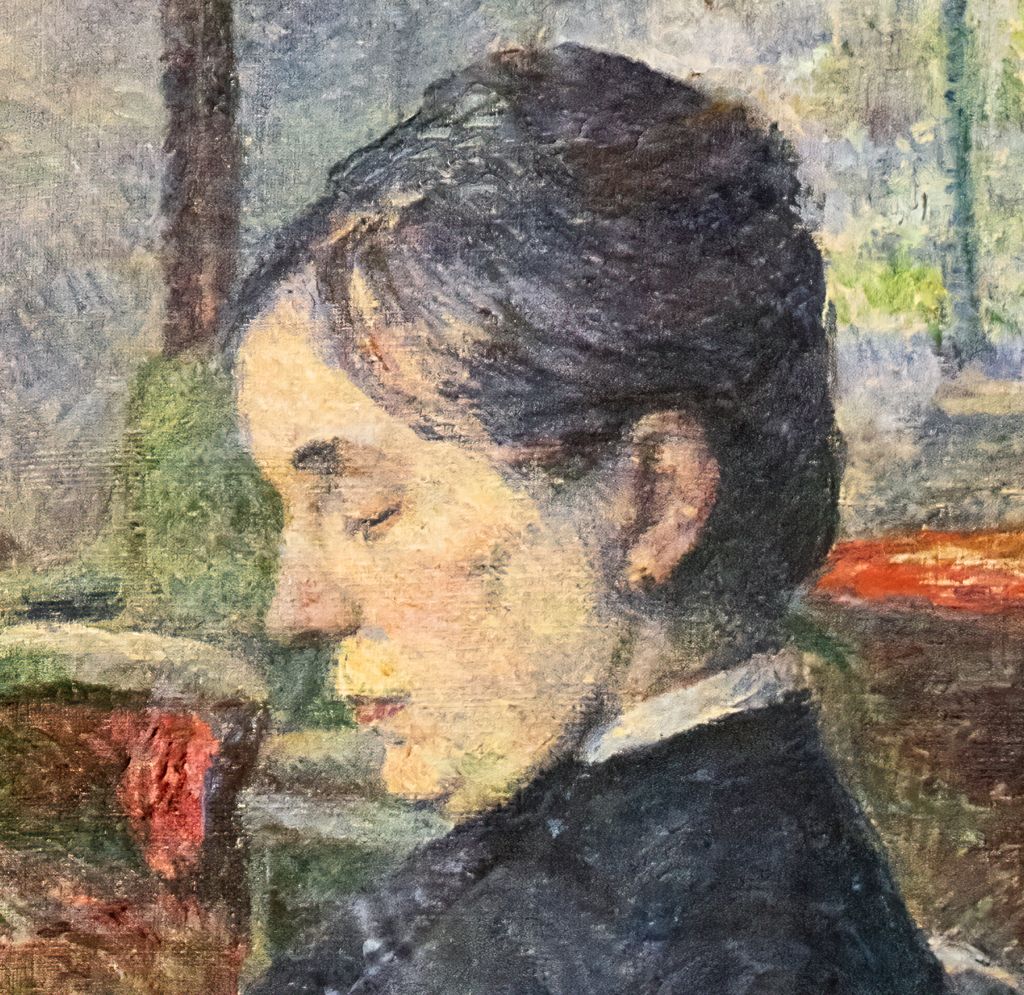
Adèle faces left, with her eyes lowered towards the reading matter held across her lap. The forehead, nose and lips make a clear outer sequence against the greenish space beyond. The head bends slightly forward, while the body sits back within the chair. Those two directions give the pose its particular balance: the torso is supported, but the face inclines towards an activity.
The pale area below the head is almost as important as the profile. A narrow white collar separates the jaw from the dark dress, defining the turn of the neck. Beneath it the fabric expands into a broad, comparatively uninterrupted mass. Because the collar is so small, its brightness has unusual force. It lets the head remain distinct without the emphatic gesture or frontal stare that might dominate another kind of portrait.
The hair gathers into a dark rounded form behind the forehead. Individual strokes sweep across it, some cool and pale, others close to black. Their curve is different from the sharper descent of the face. Seen together, hair and profile make a head with volume, rather than a silhouette filled with one colour. The ear supplies a small warm opening within the darker surrounding hair and shadow.
There is little direct exchange with the viewer. We see the countess at close range while her attention remains elsewhere. The reading gives that separation a concrete cause. It also joins the face and hands across the intervening dark fabric: our glance can travel down from the eye to the pale pages, then towards the warm hand near their lower edge. The picture gives us enough information to follow the action without resolving the printed contents.
This difference between a visible activity and an inaccessible private thought is part of the portrait's interest. The lowered eyelid establishes the direction of looking; the relaxed continuation of the body establishes the seated pose. A viewer may find the arrangement absorbed or reserved. The painting leaves room for that response without providing a particular story of sadness, disappointment or solitude.
Annotated Details from Countess Adèle in the Salon at Malromé
The numbered points identify visible features discussed in this article. Return from each detail to the whole composition. Henri de Toulouse-Lautrec, Countess Adèle in the Salon at Malromé, circa 1886–87. Oil on canvas. Musée Toulouse-Lautrec, Albi, MTL.122. Photograph: Didier Descouens / CC BY-SA 4.0. Image source. CC BY-SA 4.0. Numbers added to a separately resized overview; detail crops taken from the immutable original. These overview and crop derivatives are shared under CC BY-SA 4.0. No recolouring or retouching.
Details from COUNTESS ADÈLE IN THE SALON AT MALROMÉ
Compare the cropped details with the complete images above. Notice how their colours, shapes and positions contribute to the larger compositions.
The reading profile
The profile is separated from the green surroundings by small changes of colour.
Dress and hands
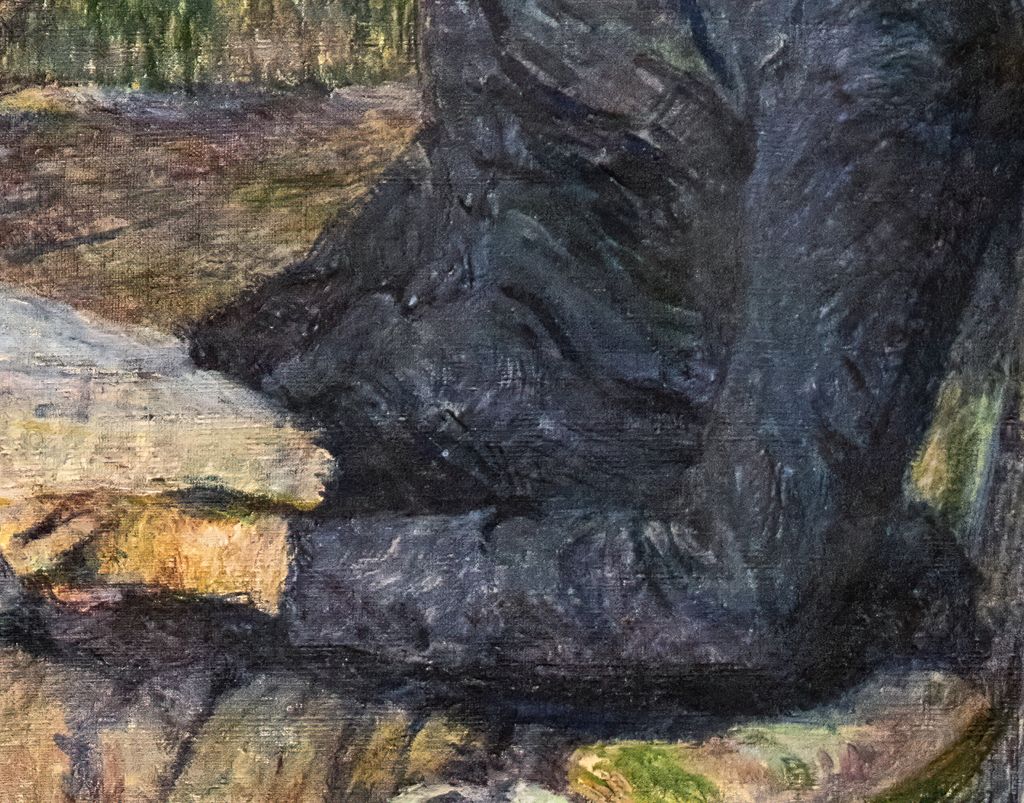
Dark blue strokes and the hands organise the seated pose.
The patterned chair
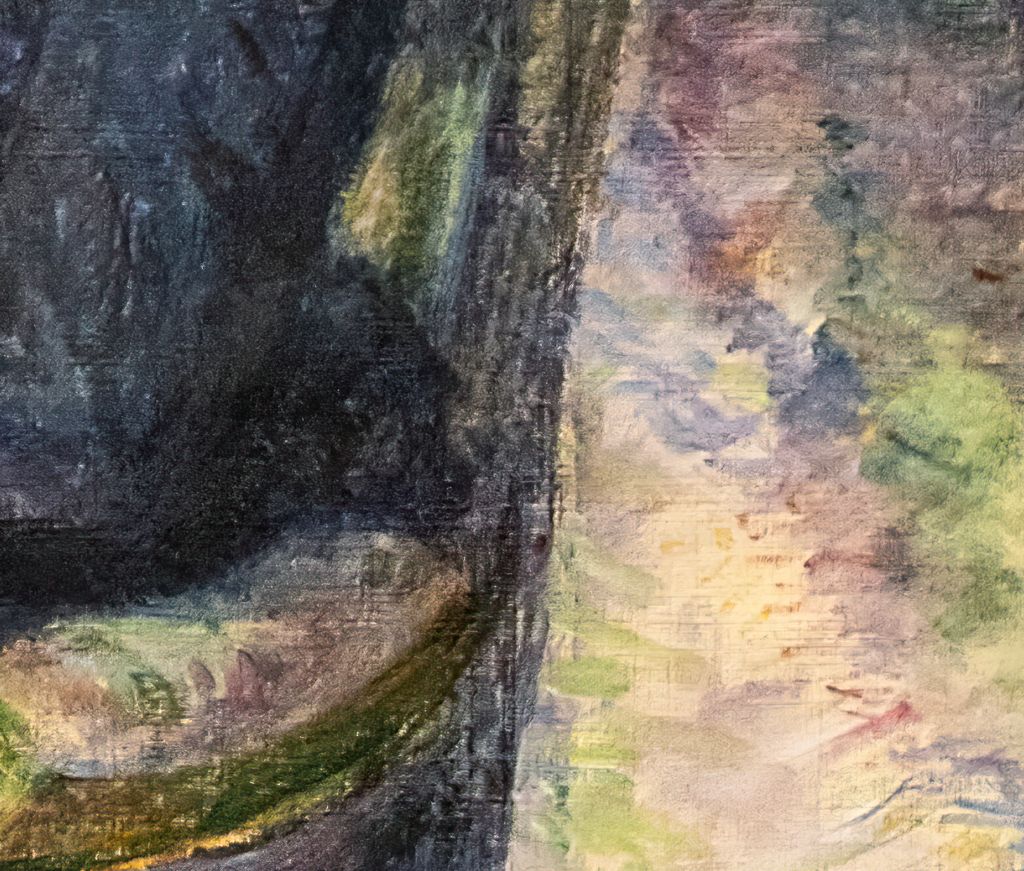
The chair’s marks and colours remain distinct from the sitter’s dress.
The room opens around the dark dress
The brightest passages are distributed unevenly. Light gathers around the upper left of the face, then spreads through the room behind and beside it. At the right edge a pale vertical strip descends almost the whole height of the canvas. Green, yellow and violet interrupt its brightness, keeping it connected to the surrounding furnishings. The illumination has texture and changes of colour, even where it seems strongest.
In the museum-contributed account, curator Danièle Devynck identifies the window and the amplification of its light by a mirror. [1] Looking across the picture, the relationship matters more than a complete floor plan. Uprights behind the head indicate divisions in the room; pale and green passages beyond them suggest further space. The reflections allow light to occupy a larger part of the canvas than a single opening would suggest.
The countess's shoulder interrupts that bright interior. Along its right edge the dark blue meets the lighter chair and room, producing a clear boundary. At the left, the body turns towards the table and reading matter. The figure thus has different surroundings on its two sides. One side faces a broad horizontal foreground; the other is enclosed by curving furniture and a narrow vertical interval of light.
The table enters from the left and cuts across the lower part of the room. Its oblique edges make our viewpoint tangible: we are close enough for the furniture to extend beyond what the painting includes. The pale reading matter sits between this foreground plane and the dress. That arrangement brings the activity towards us while leaving the face higher and further away. The distance is small, but the diagonal gives it structure.
Behind the sitter, a red horizontal passage introduces a more distant plane. Its warm edge crosses the cooler upright divisions, helping the room avoid a simple grid. Elsewhere, smaller red and brown touches recur in the patterned furnishings. They form a loose chain across the interior, with enough repetition to connect objects that remain only partly described.
The chair makes another kind of enclosure. Its curved back follows the body without duplicating its contour exactly. Below the forearm, a green-and-gold accent on the chair's arm becomes conspicuous against the dress. It has both a practical and a decorative function: we understand the seated support, and we notice a bright, patterned form. Furnishings locate the countess physically while distributing colour around her.
Watch: Toulouse-Lautrec
Choose an artist introduction, a film about graphic design or a closer look at At the Moulin Rouge.
Broken strokes hold the image together
From a distance the dress appears dark and substantial. Closer looking reveals blue, violet, grey and green strokes running through it. Some bend around the upper arm, others shorten across the sleeve, and others follow the forearm towards the wrist. The changing direction describes the body beneath the fabric. Its apparent solidity is made out of differences that remain visible on the surface.
The skirt receives a looser treatment. Longer strokes and wider changes of colour spread below the reading matter, while the upper body contains tighter turns. This uneven handling keeps the sleeve and torso comparatively firm. It also prevents the large dark area from becoming inert. The eye can keep moving within it, picking up passages that echo colours in the room.
The face uses a finer version of this fragmented colour. Pale yellow dominates its illuminated portions, with pink around the cheek and mouth and cooler touches near the temple and jaw. Adjacent tones make the nose legible. A few darker accents establish the eyebrow, lowered eyelid and nostril. Their concentration makes these small features easy to find within the more broadly worked head.
Devynck relates the juxtaposed touches and vivid hues to Lautrec's encounter with Seurat's divisionist painting, also comparing Poudre de riz. Her account places this experiment within a relatively brief phase of his development. [1] The visible marks here vary greatly in length and weight. Small touches in the face coexist with broad sweeps in the clothing and long strokes across the furnishings. Looking for those variations is more revealing than expecting a uniform field of dots.
The background changes its handling again. Pale strokes cross the light areas almost like a loose mesh, while darker uprights and warm horizontal edges give the room its larger structure. Some marks describe the direction of an object; others make the surrounding illumination seem to tremble. The painting lets both functions coexist. A stroke can contribute to a curtain or a piece of furniture and remain an emphatic piece of paint.
This is especially clear where the patterned chair meets the dress. Green and violet occur on both sides, but the chair is lighter and more decorative, while the garment's marks gather into a darker volume. The transition depends on concentration, direction and neighbouring values. An isolated patch of colour would tell us much less than its relationship to the marks around it. The broader account of Lautrec's style and technique follows related decisions across paint, drawing and print.
A useful comparison: Vincent van Gogh in profile
Lautrec's Portrait of Vincent van Gogh, dated 1887, brings a different sitter into a similarly active interior. Franka Blok's Van Gogh Museum catalogue entry explicitly compares its composition and dense short marks with the Malromé portrait. The Van Gogh work is pastel on paper supported by cardboard; its documented layers of unblended lines belong to that object, rather than providing a technical description of Adèle's oil painting. [4]
The profiles face in opposite directions. Adèle lowers her head towards her reading, while Van Gogh raises his above a café table. In each, the space immediately before the face remains open enough for the contour to register. Furnishings then build a larger framework around the body. A table occupies the lower field, and upright divisions organise the upper background. The surrounding room helps determine how we encounter the sitter.
Colour produces a different balance in each picture. Van Gogh's jacket shares so many ochres and blues with the café that its outer contour becomes especially important. Adèle's dress makes a much darker central mass. Its blue-violet strokes remain varied, but the large difference in lightness separates it immediately from the room. She is more strongly enclosed by that tonal division even though the colours themselves recur beyond her body.
The two pictures also distribute detail differently. In the pastel, the reddish beard and high forehead rise above the hands and table. In the oil, dark hair caps a face inclined towards a pale opening below. Following those directions changes the rhythm of looking. One portrait carries attention up and out through the raised head; the other folds it down towards the pages.
The comparison makes the work of portraiture unusually clear. Similar arrangements of seated bodies, tables and surrounding decoration can produce distinct encounters. The countess's identity is carried by the particular head, pose and setting, while the visible strokes connect her portrait to experiments extending beyond this household. The domestic subject participates fully in Lautrec's exploration of how a person can emerge from a busy coloured surface.
From family possession to Albi
The regional collection record identifies the painting as Adèle's gift. Albi's museum history places the exceptional family donation of 1922 at the foundation of the present Musée Toulouse-Lautrec, housed in the Palais de la Berbie. Its account credits both the count and countess and introduces the gift through a statement associated with Adèle, Maurice Joyant and Gabriel Tapié de Céleyran. The preservation of Lautrec's work was a collective undertaking in which his mother had a consequential role. [1] [13]
Her presence in the collection has two dimensions. She is the person seated in this room, and she helped bring a substantial body of her son's work into public ownership. The painting lets those histories meet without requiring the pictured reading session to anticipate the later gift. Its immediate concerns remain visible: a face turned towards a page, a supported body, and a room whose light has been rebuilt through separate coloured marks.
Toulouse-Lautrec artworks directory
Browse 84 identified works and publications in this researched selection. Dates and titles follow the individual records; this is not a complete catalogue of the surviving oeuvre. Print impressions remain attached to their designs. Some listed works do not have a dedicated article. The Drawings guide also contains nine illustrated studies consolidated from former articles.
Frequently Asked Questions
Countess Adèle de Toulouse-Lautrec, the artist's mother. [1]
About 1886–87. [1]
The Musée Toulouse-Lautrec in Albi, inventory MTL.122. [1]
The page contents are not legible in the painting. Its arrangement makes the act of reading clear while leaving the text unidentified.
Discussion
Look again at the images and ideas explored in Countess Adèle in the Salon at Malromé. These editorial prompts invite your observations.
Reader Insights
Where does the dress first appear solid, and where do its separate blue and violet strokes become most noticeable?
Compare the pale collar with the bright strip at the right edge. How do these very different areas of light help define the seated figure?
Join the Conversation
Share a detail, comparison or question about Countess Adèle in the Salon at Malromé below.
References
- Danièle Devynck, “La comtesse Adèle de Toulouse-Lautrec dans le salon du Château de Malromé”, Musée Toulouse-Lautrec contribution to Musées Occitanie: object record MTL.122 and complete accompanying commentary (in French). View source.
- Autoportrait, 1880 (in French). View source.
- ALBERTINA: Der Schimmel Gazelle,GE123DL. View source. (in German).
- Franka Blok, “Henri de Toulouse-Lautrec, Portrait of Vincent van Gogh, 1887,” catalogue entry 132, in Contemporaries of Van Gogh 1: Works Collected by Theo and Vincent, edited by Joost van der Hoeven, Van Gogh Museum, January 2024; “Pastel crayon” and “Place in Toulouse-Lautrec's oeuvre,” especially figure 8 and notes 27–34. English with French documentary citations. View source.
- Art Institute of Chicago: Moulin Rouge, La Goulue. View source.
- Art Institute of Chicago: At the Moulin Rouge. View source.
- Jane Avril, 1893. View source.
- Au Salon de la rue des Moulins (in French). View source.
- Colta Ives, Toulouse-Lautrec in The Metropolitan Museum of Art, 1996. View source.
- Maurice Joyant (in French). View source.
- Julia Frey, “Biography of the Artist,” in Toulouse-Lautrec: Images of the 1890s, Museum of Modern Art, 1985, pp. 19–35; especially pp. 21–23 on family circumstances and upbringing. These passages were consulted directly; the original family letters were not independently consulted. View source.
- Musée Toulouse-Lautrec, Toulouse-Lautrec et l'art de l'affiche, press dossier, 2025, pp. 12–13, biography and chronology (in French). View source.
- Musée Toulouse-Lautrec, “Histoire du musée”, especially “Une collection unique au monde,” on the 1922 donation (in French). View source.
- Splash image, Henri de Toulouse-Lautrec, Countess Adèle in the Salon at Malromé, circa 1886–87. Oil on canvas. Musée Toulouse-Lautrec, Albi, MTL.122. Photograph: Didier Descouens / CC BY-SA 4.0. Image source. CC BY-SA 4.0. Photograph resized proportionally; colour and content preserved. Photographic derivative available under CC BY-SA 4.0.


 Henri de Toulouse-Lautrec.jpg)