



 by Tom Gurney
Tom Gurney BSc (Hons) is an art history expert with over 20 years experience
Published on June 19, 2020 / Updated on November 3, 2026
Email: tomgurney1@gmail.com / Phone: +44 7429 011000
White Horse Gazelle by Henri de Toulouse-Lautrec: Introduction
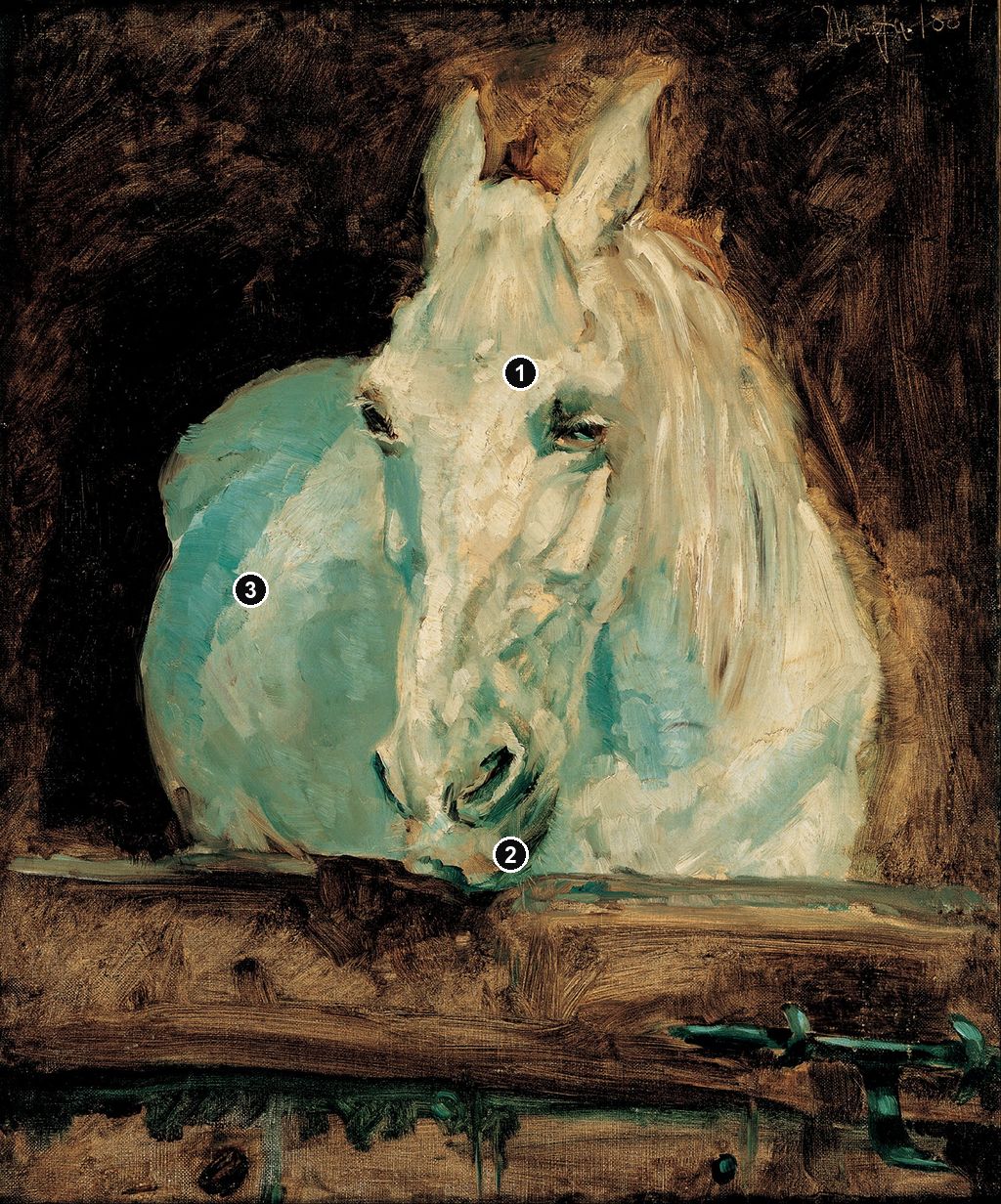
A white horse lowers its head towards a wooden stable door. Its ears reach upwards, its mane falls along the neck, and cool blue-green shadows turn the pale body into something substantial. In White Horse Gazelle, Toulouse-Lautrec makes a familiar animal fill almost the whole canvas. The encounter is close enough for the dark nostrils, uneven forelock and small shifts around the eyes to matter.
Painted in 1881, this upright oil painting belongs to the ALBERTINA's Batliner Collection in Vienna. It offers a concentrated view of Lautrec's early attention to horses: a head and upper body observed at close quarters, with the stable providing both setting and compositional structure. [1]
At a Glance
- ArtistHenri de Toulouse-Lautrec
- Museum titleDer Schimmel “Gazelle”
- Date1881
- MediumOil on canvas
- Dimensions61 × 49.5 cm
- CollectionALBERTINA, Vienna, Batliner Collection
- Inventory numberGE123DL
- Catalogue referenceDortu P.103, as cited in the museum record
- Inscription“Monfa 1881,” upper right
The object details above refer to the upright painting in Vienna. [1]
This work across Henri de Toulouse-Lautrec’s career
Contents
- A horse from the family's world
- The head turns a broad body into a close encounter
- How a white coat becomes blue, grey and cream
- The door gives the animal weight and the viewer a position
- Two Gazelle paintings, two ways of looking
- An early work with a longer exhibition history
- Annotated details
A horse from the family's world
The ALBERTINA identifies Gazelle with the stud of the Counts of Céleyran, Lautrec's mother's family, and places the painting's making at Le Bosc near Albi in the summer of 1881. This was a subject available within the country-house world he knew. The animal painter René Princeteau, a family friend, had already given him instruction. [1] Lautrec's relationship with horses therefore joined access to living animals with an introduction to professional painting.
He was sixteen that summer. The Musée Toulouse-Lautrec's chronology records his birth on 24 November 1864 and places his attendance at Princeteau's Paris studio in 1881, the year he obtained his baccalaureate. His successive periods with Léon Bonnat and Fernand Cormon followed in 1882. [10] Gazelle belongs to the interval before those more formal Paris studies, when the sporting subjects of his upbringing remained central to his developing work.
Drawing had occupied him much earlier. Colta Ives records his grandmother's enthusiasm for his childhood sketching and the lessons in drawing and watercolour he received from his uncle Charles. Horses and hunting dogs recur among the subjects of his early sketchbooks. [8] These precedents give the painting a history of practice behind it. He had already spent years attending to animal bodies and putting what he saw on paper.
The signature is another connection with that early setting. At the upper right, the pale inscription stands against the dark brown background. The ALBERTINA transcribes it as “Monfa 1881” and explains Monfa as an additional family name used on early works. [1] It remains a small, legible part of the surface, placed away from the light body. The fuller account of his family, education and move into a profession belongs to his biography; here those circumstances help locate an unusually direct study of a familiar subject.
The head turns a broad body into a close encounter
The painting initially seems almost frontal, yet the horse is not arranged as a symmetrical emblem. The long face descends at a slight angle, with the muzzle moving towards the left of the picture. The rounded shoulder expands much further on that side, while the falling mane gives the right side a different contour. These unequal masses make the animal feel physically placed within the opening. They also prevent the white shape from settling into a static triangle.
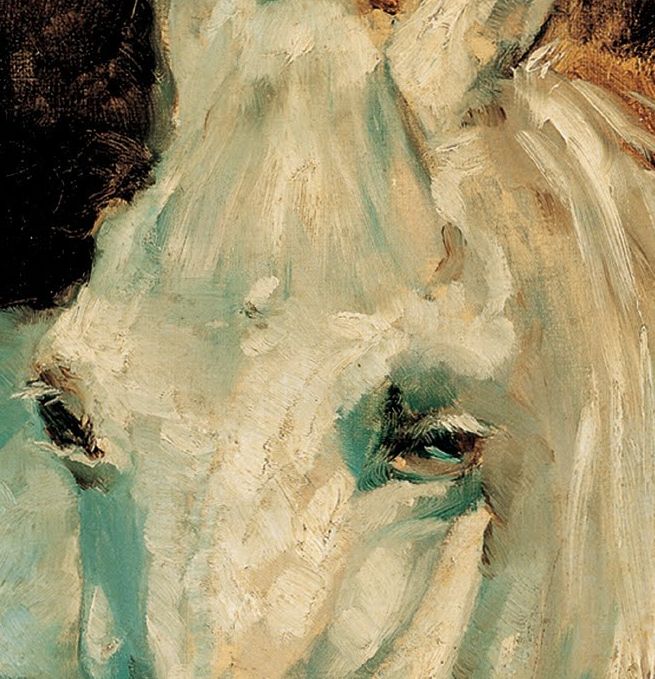
Follow the forehead downwards. Between the ears, a few darker and warmer interruptions break the pale crest. Below, strokes change direction around the brow, then travel along the bridge of the nose. At the cheeks, smaller patches gather into more angular transitions. The head reads as a continuous form, although its surface is made from many conspicuous changes of colour and direction. The visible brushwork does not have to disappear for the anatomy to become convincing.
The eyes are especially economical. Each occupies a small dark interval within the much larger light head. Warm touches sit beside blue-green shadows, so that the openings remain connected with the surrounding planes rather than looking pasted onto a white mask. Their different apparent shapes follow the slight turn of the head. They give the face particularity without demanding an elaborate description of eyelashes or reflected objects.
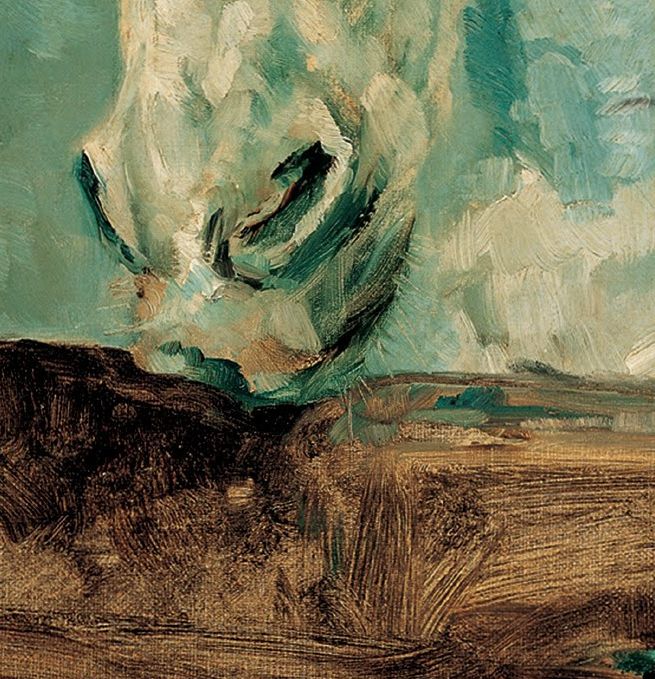
Lower down, the nostrils introduce deeper black accents and more abrupt curves. They are stronger interruptions than the soft colour changes of the forehead. The muzzle meets the door near the horizontal centre of the picture, where pale fur, dark wood and shadow gather tightly together. That contact gives the descending head a destination. Without it, the animal might seem suspended against a dark field; with it, the posture becomes an action within a usable space.
The upright ears carry attention in the opposite direction. Their narrow tips rise towards the upper edge, leaving only a limited interval of dark background above them. The inner surfaces contain cool shadows and pale strokes that distinguish one side from the other. Between ears and muzzle, the painting stretches the head across much of its height. Looking at the whole canvas, we move between those high points and the low point of contact rather than simply taking in an evenly lit likeness.
Annotated Details from White Horse Gazelle
The numbered points identify visible features discussed in this article. Return from each detail to the whole composition. Henri de Toulouse-Lautrec, White Horse Gazelle, 1881. Oil on canvas, 61 × 49.5 cm. ALBERTINA, Vienna, Batliner Collection, GE123DL. Image source. Public domain. Resized only; native appearance preserved.
Details from WHITE HORSE GAZELLE
Compare the cropped details with the complete images above. Notice how their colours, shapes and positions contribute to the larger compositions.
The horse’s head
Pale and coloured strokes describe the horse’s lowered head.
The stable door
The broad brown door forms a barrier across the foreground.
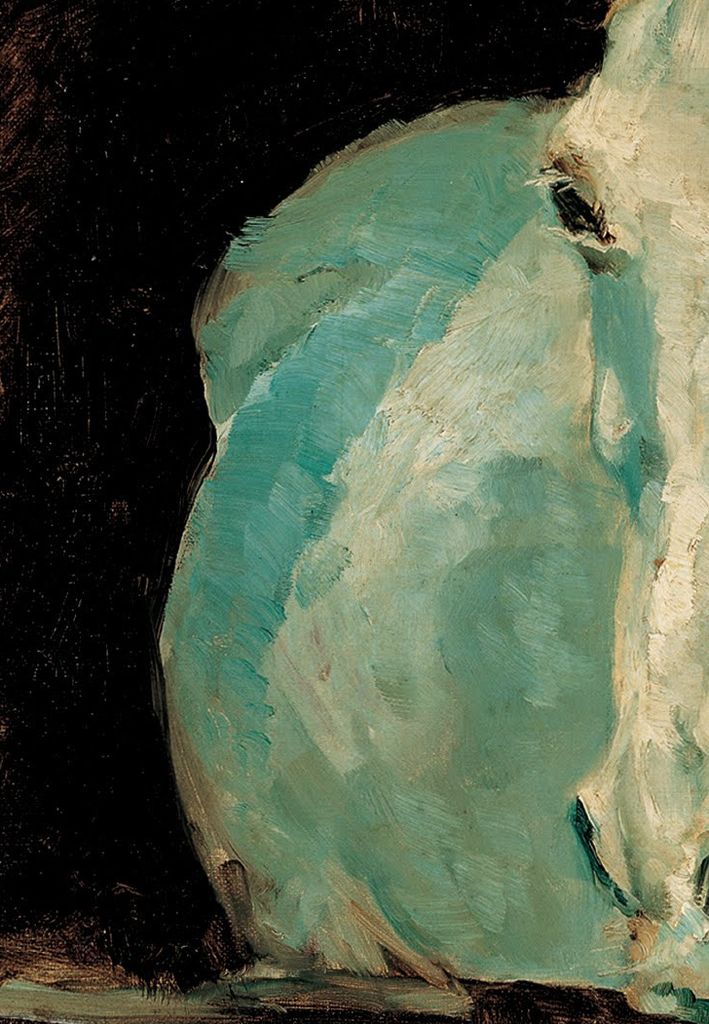
Cool shadows
Cool blue-green patches distinguish the shaded body from the pale head.
How a white coat becomes blue, grey and cream
White is the subject's identifying colour, but much of the painted horse is cooler and darker than the word suggests. The large shoulder at the left contains a broad turquoise-blue passage, broken by lighter grey and cream strokes. Across the face, blue-green patches alternate with warmer lights. Along the mane and the right edge of the neck, the paint moves closer to yellowish white. These differences establish the body through relationships among colours rather than through an outline filled with one uniform pale tone.
The Koella/Billeter catalogue passage reproduced by the ALBERTINA draws attention to this economy: warm brown holds together door and background, while the cold white coat deepens into light blue in shadow. [1] Looking closely extends that observation. The shoulder's cool area is large enough to register immediately, but it does not remain a flat block. Marks of different widths turn across it, letting the rounded mass emerge within the shadow.
The mane changes both colour and the movement of the paint. Long, descending strokes suggest hair falling along the neck. They contrast with the shorter, interlocking touches across the cheek and the wider strokes over the shoulder. A few strands separate from the larger light mass near the upper neck. This is a selective account of texture: the mane needs a different rhythm from the coat, although neither is described hair by hair.
The brown surroundings are equally important to the apparent brightness. At the left, the horse's pale outer contour meets an almost black interval. Above and to the right, warmer, more open strokes come closer to the colour of the wood below. The background therefore varies without becoming a competing scene. Its dark areas make the animal's edges clear, while its warmer passages give the cream paint something against which to appear cool or luminous.
The separate passages coordinate the whole image: cold shoulder, warmer mane, dark eyes and brown enclosure. The horse remains recognisably white because those parts work together. Its solidity comes from their differences. This early canvas rewards the same attention to selective marks that becomes useful when exploring Lautrec's later style and technique, even though each medium and subject poses different problems.
Watch: Toulouse-Lautrec
Choose an artist introduction, a film about graphic design or a closer look at At the Moulin Rouge.
The door gives the animal weight and the viewer a position
The stable door occupies a substantial strip across the lower canvas. Its top edge sits just beneath the head, making a firm horizontal counterweight to the long face and upright ears. The horse's lower body disappears behind it. We are given enough of the shoulders and chest to feel the animal's size, while the wood prevents us from seeing its legs or reconstructing a complete standing pose.
This obstruction creates the close encounter. The viewer looks towards a horse leaning over a barrier, rather than observing a full animal at a distance. The door is also near enough for its fittings to become distinct. At the right, a green latch extends horizontally across the brown plank. Smaller green marks and dark holes interrupt the lower woodwork. They locate the image in a practical stable interior without requiring a wide view of the building.
The wood is handled differently from the coat. Long brown strokes run across the door, with dark interruptions suggesting knots, edges and worn irregularities. A heavily darkened patch lies beneath the muzzle, where the horse and barrier meet. The painter has concentrated both forms and colour changes at that junction. Further down, the broad plank and horizontal fitting let the composition settle after the more intricate activity of the head.
The catalogue extract describes Gazelle as nibbling the wood and reads the animal as restless and irritated. [1] The visible contact of muzzle and door makes that reading understandable. Raised ears, lowered head and the confined opening give a viewer several signs of activity to connect. Yet the picture's interest does not depend on assigning one definite emotion. Its observed posture already makes the horse an active presence, engaged with the enclosure rather than merely standing before a backdrop.
Two Gazelle paintings, two ways of looking
A second painting titled Cheval blanc gazelle belongs to the Musée Toulouse-Lautrec in Albi. The Musées Occitanie record dates it to 1881 and identifies it as MTL.55, an oil on canvas measuring 49.6 × 56.1 cm. Its image shows the horse's head in profile within a horizontal rectangle. It is a separate object from the upright Vienna canvas. [11]
The comparison changes what becomes prominent. In the Albi picture, the long profile leads leftwards towards the dark muzzle. The pale yellow surrounding field leaves considerable space around the head, while cool blue-green strokes articulate cheek and neck. With no equivalent broad stable door across the foreground, attention falls on the outer profile and the irregular boundary of the painted neck. The ALBERTINA's embedded catalogue account also records a second profile treatment from the same summer. [1]
In the Vienna painting, the head turns towards us and the shoulders spread behind it. The door adds a second kind of physical information: it establishes a barrier against which we judge the head's descent and the body's breadth. The darker setting makes the pale animal emerge more dramatically. Comparing the two canvases thus reveals different problems of observation, even when date and title are similar. A profile clarifies the head's silhouette; a near-frontal view requires the painter to organise unevenly seen eyes, cheekbones, muzzle and shoulders into one substantial presence.
An early work with a longer exhibition history
The ALBERTINA's record associates this canvas with Dortu's catalogue number P.103 and reproduces an exhibition history drawn from Koella/Billeter. It includes the Galerie Rosenberg's Toulouse-Lautrec exhibition in Paris in 1914 and the equestrian-themed Chevaux et cavaliers at Galerie Charpentier in 1948. [1] Those entries document later settings in which the work was presented; they do not establish its original audience or a complete chain of ownership.
The two exhibition contexts suggest useful ways to approach the canvas now: within Lautrec's career, and within the painting of horses. The first encourages attention to an artist still developing before his better-known Paris subjects. The second asks how effectively the picture conveys a particular animal through colour, mass and posture. Both lead back to the same painted decisions. The enormous pale shoulder, the angled face and the muzzle at the woodwork carry the encounter, giving this early subject enough specificity to sustain looking without borrowing a story from the artist's later fame.
Toulouse-Lautrec artworks directory
Browse 84 identified works and publications in this researched selection. Dates and titles follow the individual records; this is not a complete catalogue of the surviving oeuvre. Print impressions remain attached to their designs. Some listed works do not have a dedicated article. The Drawings guide also contains nine illustrated studies consolidated from former articles.
Frequently Asked Questions
The blue and blue-green passages describe shadow and help turn the body. Koella/Billeter specifically discusses the contrast between the warm brown enclosure and cold white coat shaded into light blue. [1]
The museum transcribes the upper-right inscription as “Monfa 1881.” Monfa was an additional family name used by Lautrec on early works. [1]
Discussion
Look again at the images and ideas explored in White Horse Gazelle by Henri de Toulouse-Lautrec. These editorial prompts invite your observations.
Reader Insights
How does the broad cool shadow on the left shoulder change your sense of the horse's volume compared with the long pale strokes of the mane?
Compare the two Gazelle paintings. What does the stable door add to the Vienna picture that the open field around the Albi profile leaves out? [11]
Join the Conversation
Share a detail, comparison or question about White Horse Gazelle by Henri de Toulouse-Lautrec below.
References
- ALBERTINA, Der Schimmel “Gazelle”, 1881, GE123DL, Batliner Collection: complete object record, inscription, bibliography, exhibition list and embedded entry from Rudolf Koella and Felix Billeter, Verborgene Meisterwerke, 2005, p. 34, no. 210 (in German, with an English object summary). View source.
- Autoportrait, 1880 (in French). View source.
- Franka Blok, Portrait of Vincent van Gogh, 2024. View source.
- Art Institute of Chicago: Moulin Rouge, La Goulue. View source.
- Art Institute of Chicago: At the Moulin Rouge. View source.
- Jane Avril, 1893. View source.
- Au Salon de la rue des Moulins (in French). View source.
- Colta Ives, Toulouse-Lautrec in The Metropolitan Museum of Art, 1996, pp. 24–26, especially p. 25: childhood sketchbooks, family encouragement and instruction from Charles. View source.
- Maurice Joyant (in French). View source.
- Musée Toulouse-Lautrec, Toulouse-Lautrec et l'art de l'affiche: exhibition press dossier, 2025, p. 13, chronology: birth, Princeteau in 1881, Bonnat and Cormon in 1882 (in French). View source.
- Musées Occitanie / Musée Toulouse-Lautrec, Cheval blanc gazelle, 1881, MTL.55, object record and reference image: the separate horizontal profile painting, 49.6 × 56.1 cm (in French). View source.
- Splash image, Henri de Toulouse-Lautrec, White Horse Gazelle, 1881. Oil on canvas, 61 × 49.5 cm. ALBERTINA, Vienna, Batliner Collection, GE123DL. Image source. Public domain. Resized only; native appearance preserved.


 Henri de Toulouse-Lautrec.jpg)