


 by Tom Gurney
Tom Gurney BSc (Hons) is an art history expert with over 20 years experience
Published on June 19, 2020 / Updated on November 3, 2026
Email: tomgurney1@gmail.com / Phone: +44 7429 011000
Toulouse-Lautrec Quotes: Friendship, Art and the Business of Printing: Introduction
Henri de Toulouse-Lautrec's letters bring us close to an artist attending to other people: a bereaved friend, his mother, a publisher and a prospective buyer. Their subjects are often practical. A cover needs a printing process; a proof needs a price. Read together, these small exchanges reveal more than a collection of pronouncements about artistic genius. They show how affection, judgement and negotiation entered his working life. The five passages below come through museum scholarship and commentary, with their documentary limits identified. One is a remembered remark rather than a surviving letter. [1] [2] [3] [4]
At a Glance
- Friendship with Vincent van GoghDocument and date: To Theo van Gogh, 31 July 1890; What survives in the source used here: French sentence reproduced in the Van Gogh Museum catalogue; letter b1276V1962. [1]
- Encouragement from DegasDocument and date: To his mother, 1891; What survives in the source used here: English excerpt published by the Phillips Collection; exact day and original letter number not supplied. [2]
- Choosing a cover processDocument and date: To W. H. B. Sands, 1898 context; What survives in the source used here: English excerpt in Phillip Dennis Cate's essay; correspondence edition, letter 29, pp. 68–69. [3]
- Pricing a Lender proofDocument and date: To E. Deman, 2 December 1896; What survives in the source used here: English excerpt in Cate's note 21; correspondence edition, letter 209, p. 191. [3]
- Drawings and departure from a clinicDocument and date: Reported remark, 1899; What survives in the source used here: English wording in Colta Ives, traced through later scholarship to Maurice Joyant, 1926, p. 222. [4]
Contents
- A friend remembered: the letter to Theo van Gogh
- Hearing encouragement from Degas
- A cover is a conversation
- Two prices for one proof
- Drawings as an argument for independence
- Reading a quotation beyond its first impression
A friend remembered: the letter to Theo van Gogh
“You know what a friend he was to me, and how much he wished to prove it to me.” [1]
This is our translation of the French sentence reproduced by Franka Blok in the Van Gogh Museum's catalogue, note 43. Toulouse-Lautrec wrote to Theo van Gogh on 31 July 1890 after Vincent's death. The original letter is identified as b1276V1962; the French has been consulted through the catalogue's transcription, rather than the handwritten document. [1]
The sentence gives Vincent an active role in the friendship. Lautrec remembers a man who wanted to demonstrate his attachment. That emphasis matters because it lets Vincent appear through something he gave another person. The letter is addressed to a brother who knew him intimately, and its opening appeal assumes shared understanding. Its emotional force comes from that small circle of recognition. We need not enlarge it into an account of everything the two painters said or felt.
A condolence letter also has a particular purpose. Lautrec is comforting Theo, not reviewing the development of modern painting. His words can bear witness to affection without becoming evidence for every anecdote later attached to their relationship. Blok stresses the limited surviving documentary record: the portrait and the condolence letter are especially important, while recollections require individual assessment. [1]
Read beside the portrait of Vincent van Gogh, the sentence offers a useful division of attention. The image rewards looking at how Lautrec represented another artist; the letter supplies an explicit statement about friendship. Neither needs to act as a complete explanation of the other. A portrait can be visually searching without disclosing the whole history of a relationship, just as a moving sentence can remain brief.
Hearing encouragement from Degas
“Degas has encouraged me by saying my work this summer wasn’t too bad. I’d like to believe it.” [2]
The Phillips Collection publishes this passage from Toulouse-Lautrec to his mother in 1891. The words appear here in the museum's English rendering; its commentary supplies neither the French text nor an exact day or original letter number. [2]
There are two voices inside the passage. Lautrec reports Degas's assessment, then adds his own response. We hear the older artist through the younger one's account to a third person. The compact exchange preserves the relationship between hearing, interpreting and passing on a judgement; Degas's exact spoken words remain outside our reach.
The restraint of the reported praise makes Lautrec's final sentence particularly engaging. In this rendering, he welcomes encouragement while leaving a little distance between another artist's opinion and his own confidence. This could be modesty, humour or uncertainty; a single line cannot settle his habitual state of mind. It does, however, show the significance he gave the encounter when choosing what to tell his mother.
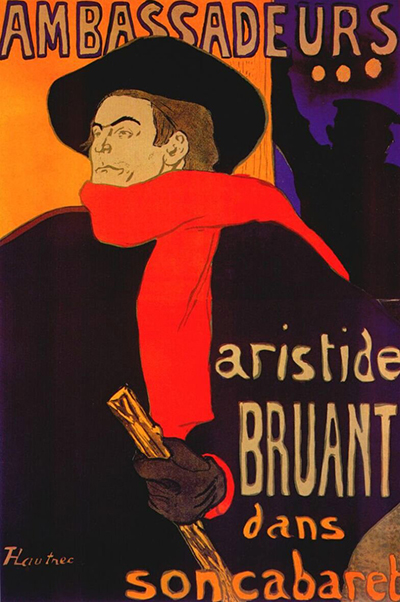
For a reader of his art, the passage opens a question about admiration rather than resolving it. How does an artist learn from someone whose approval matters? The Phillips commentary places the quotation beside a comparison between a café-concert image by Degas and Lautrec's later At the Ambassadeurs, Singer at the Café-Concert. That pairing directs attention back to the works. The letter expresses the importance of judgement; comparison can then examine what Lautrec made of an artistic example. The sentence itself does not establish that Degas taught him a particular technique or directed a particular composition. [2]
A cover is a conversation
“As for the cover, how do you want it?” [3]
This question appears in Cate's The Popularization of Lautrec, printed page 82. It comes from a letter to the British publisher W. H. B. Sands concerning the 1898 Yvette Guilbert album. Cate's note 8 identifies letter 29, pages 68–69, in Herbert D. Schimmel and Cate's 1983 edition of their correspondence. The English is Cate's printed wording; an exact date is not supplied in this passage. [3]
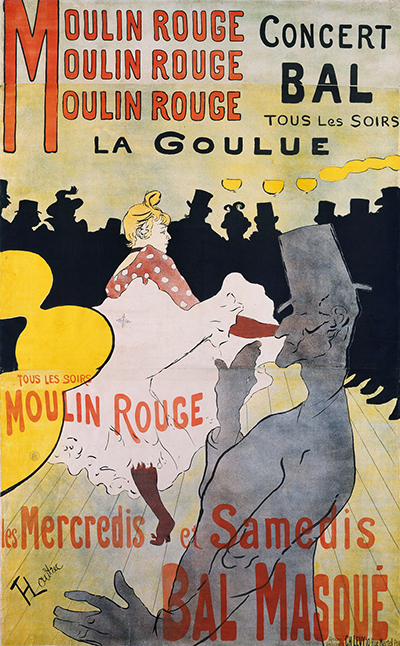
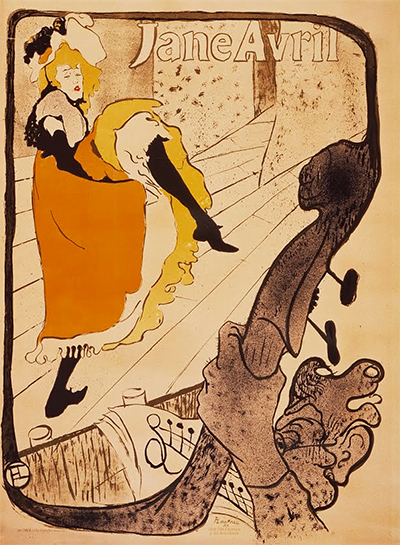
Lautrec continues by offering a choice between lithography and the process used for a children's picture-book cover. Cate identifies that alternative as colour photorelief and records that lithography was chosen for the Guilbert album. The question therefore concerns how an image would become a printed object. It is more specific than an invitation to choose an attractive design. [3]
Its directness makes the publisher visible as a participant. We can hear an artist asking what the project requires before treating one medium as inevitable. A cover has a job to do: it introduces the publication that contains it. Reading the exchange encourages us to consider that relationship between an individual image and the larger object a reader would hold. The artist's decision occurs within a conversation about making that object.
The line is also a useful corrective to the impression that a strongly recognisable style must come from an artist working alone. Asking a collaborator for a preference does not tell us that Lautrec surrendered his judgement. It tells us that the choice was discussable. His originality can coexist with consultation. In this instance, the documentary interest lies in the available alternatives and the decision between them, rather than in an imagined moment when a finished image arrived fully formed.
For the history of his prints, the practical question is especially revealing. It reminds us to ask how a design was reproduced and what sort of publication it served. Recognising Lautrec's hand is the beginning of understanding the object; the letter supplies another question to bring to it.
Watch: Toulouse-Lautrec
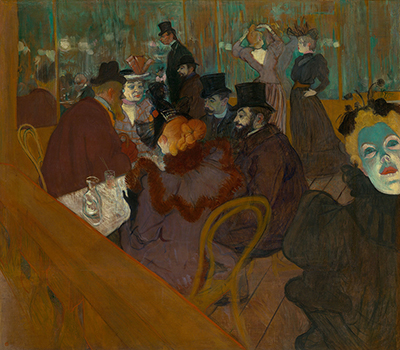
Choose an artist introduction, a film about graphic design or a closer look at At the Moulin Rouge.
Two prices for one proof
“For you 30 francs, for the public 50 francs.” [3]
Lautrec wrote this to the Brussels publisher E. Deman on 2 December 1896, after saying that he had sent him a Lender proof. Cate reproduces the passage in note 21, printed page 92, citing Lucien Goldschmidt and Herbert Schimmel's Unpublished Correspondence of Henri de Toulouse-Lautrec, letter 209, page 191. The wording here is the English printed in Cate; the original letter and its French text have not been consulted for this selection. [3]
The sentence puts two audiences into a few words. One is a named correspondent, addressed personally; the other is an anticipated public. The difference is twenty francs, but the distinction between the recipients is at least as interesting as the arithmetic. Lautrec could state a public price while offering different terms to the person reading his letter. The document shows that differentiation clearly without explaining every reason behind it.
It would be easy to call the lower figure a friendship price or a trade discount. The excerpt does not say which. Preserving that uncertainty allows the actual evidence to remain useful: a specific work was being offered, a specific person received it, and two prices were stated. The sentence records an offer, not proof that a purchase followed. Nor can the quoted figures stand for the value of every Lautrec print.
That distinction changes how we read an artist's commercial correspondence. A price can express an intention or a negotiating position before it records an achieved sale. The personal address also reminds us that an art market consists of exchanges between people, not simply a sequence of values attached to objects. Here Lautrec speaks as someone able to specify terms for his work. The letter gives that practical activity a voice without requiring us to infer either prosperity or failure from one transaction.
The contrast with the Sands question is instructive. In one exchange, Lautrec asks a publisher to help determine a production choice; in the other, he states an offer. Collaboration did not give every participant the same role on every occasion. These two short passages allow us to see the artist adjusting what he says to the business at hand.
Drawings as an argument for independence
“I've bought my release with my drawings” [4]
This is reported speech. Colta Ives prints it on page 58 of Toulouse-Lautrec in The Metropolitan Museum of Art in connection with his departure from the Neuilly clinic in 1899. Her citation traces it to Maurice Joyant's 1926 account, page 222, as quoted by Anne Roquebert in a 1991 publication, page 481. The English wording has been checked visually in Ives's scanned catalogue. It is not presented as a sentence transcribed from a letter or a medical record. [4]
Ives connects the remark with circus drawings Lautrec made during his confinement to demonstrate his capacity for work. That context gives the verb a pointed meaning. In the reported sentence, drawings have become something he could offer as evidence on his own behalf. The familiar activity of making images acquires a further purpose: persuading other people to recognise his abilities. [4]
The phrase is memorable enough to invite an overly tidy story. We should resist turning it into a medical explanation. A reported remark cannot establish the complete grounds for discharge, and a drawing cannot serve as a diagnosis. What the words offer is an account of agency attributed to Lautrec: he describes himself as having done something consequential through his work. That is worth hearing while preserving the distance between his reported explanation and the decisions of the clinicians.
The change in source type matters too. The letters above address identifiable recipients at particular moments. This sentence reaches us through an account published much later and subsequently quoted by other writers. It belongs in a selection of Lautrec's words because its history can be named, but its memorable form should not make it seem more immediate than the letters. Keeping that distinction visible lets the reader appreciate the remark without mistaking recollection for a surviving written declaration.
Reading a quotation beyond its first impression
The different addressees give this selection much of its range. To Theo, Lautrec recalls affection; to his mother, he reports encouragement; with publishers, he discusses means and terms. These are acts performed through language, each shaped by what the recipient already knows. Removing the recipient makes a sentence easier to circulate, but often removes the reason it was written.
Dates and locators restore some of that particularity. So does knowing whose English we are reading. A French sentence reproduced in a modern catalogue can support a fresh translation, while an English excerpt without its French original must remain identified as the consulted writer's rendering. A source can establish a quotation's wording without supplying every detail of the original document. Those differences help us decide which questions a passage can answer.
The most rewarding approach is to let the words retain their small scale. A condolence need not become a complete theory of friendship, nor a cover question a manifesto about modern media. Their interest lies in the actions they preserve. Lautrec remembers, hopes, asks, offers and, in the reported clinic remark, claims an achievement. Together they give us several ways to encounter the artist, while leaving room for the pictures and the rest of the correspondence to complicate what we think we know.
Toulouse-Lautrec artworks directory
Browse 84 identified works and publications in this researched selection. Dates and titles follow the individual records; this is not a complete catalogue of the surviving oeuvre. Print impressions remain attached to their designs. Some listed works do not have a dedicated article. The Drawings guide also contains nine illustrated studies consolidated from former articles.
Frequently Asked Questions
Yes. His letter to Theo van Gogh of 31 July 1890 recalls Vincent's friendship. The Van Gogh Museum identifies the document as b1276V1962 and reproduces the French sentence quoted in translation above. [1]
Cate quotes it on printed page 82 of Toulouse-Lautrec: Images of the 1890s. His note 8, page 91, directs readers to letter 29, pages 68–69, in Schimmel and Cate's 1983 edition of the Sands correspondence. That edition is identified through Cate here, not claimed as an independently consulted source. [3]
No. The wording used here is reported speech printed by Ives, with a citation chain leading to Joyant's 1926 account. It should retain that qualification whenever it is quoted. [4]
Discussion
Look again at the images and ideas explored in Toulouse-Lautrec Quotes: Friendship, Art and the Business of Printing. These editorial prompts invite your observations.
Reader Insights
How does the offer of two prices change your reading of the artist's role in distributing his prints? [3]
Does the clinic remark feel different when you know it comes through later recollection rather than a surviving letter? [4]
Join the Conversation
Share a detail, comparison or question about Toulouse-Lautrec Quotes: Friendship, Art and the Business of Printing below.
References
- Franka Blok, Portrait of Vincent van Gogh, Van Gogh Museum online catalogue, 2024, “Friendship” and the condolence-letter passage, especially note 43. English scholarship with French documentary transcription. Letter: Toulouse-Lautrec to Theo van Gogh, 31 July 1890, b1276V1962. French text consulted through this catalogue; English translation on this page is our own. View source.
- The Phillips Collection, “Toulouse-Lautrec Reinterprets Degas”, 16 February 2017, opening quotation and accompanying comparison. English rendering of a letter to Lautrec's mother, dated 1891 by the museum; exact day, original letter number and French text not supplied. View source.
- Phillip Dennis Cate, “The Popularization of Lautrec,” in Toulouse-Lautrec: Images of the 1890s, Museum of Modern Art, 1985, printed p. 82 and note 8, p. 91, for the Sands cover question; note 21, p. 92, for the Deman letter. Both English excerpts visually checked in the scanned catalogue. Original correspondence editions identified through Cate, not independently consulted. View source.
- Colta Ives, Toulouse-Lautrec in The Metropolitan Museum of Art, 1996, printed p. 58. Circus drawings and English rendering of reported speech; Ives cites Joyant, 1926, p. 222, through Roquebert in Frèches-Thory et al., 1991, p. 481. Actual scanned page visually consulted; earlier accounts not independently read here. View source.
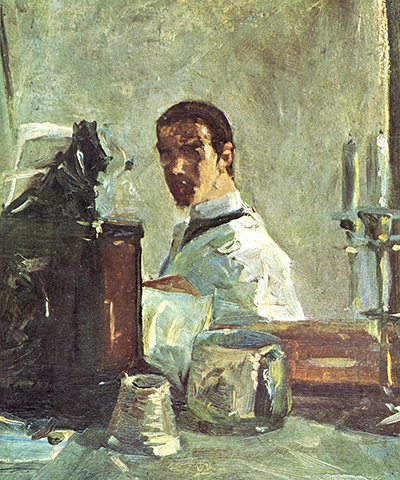
- Splash image, Self-Portrait in Front of a Mirror, circa 1880, Musée Toulouse-Lautrec, Albi, MTL.20. Photograph by Didier Descouens, CC BY-SA 4.0; resized. Photograph: Didier Descouens / CC BY-SA 4.0. Image source. CC BY-SA 4.0. Photograph resized proportionally; colour and content preserved. Photographic derivative available under CC BY-SA 4.0.
 Henri de Toulouse-Lautrec.jpg)