



 by Tom Gurney
Tom Gurney BSc (Hons) is an art history expert with over 20 years experience
Published on June 19, 2020 / Updated on November 3, 2026
Email: tomgurney1@gmail.com / Phone: +44 7429 011000
Émile Bernard by Toulouse-Lautrec: Introduction
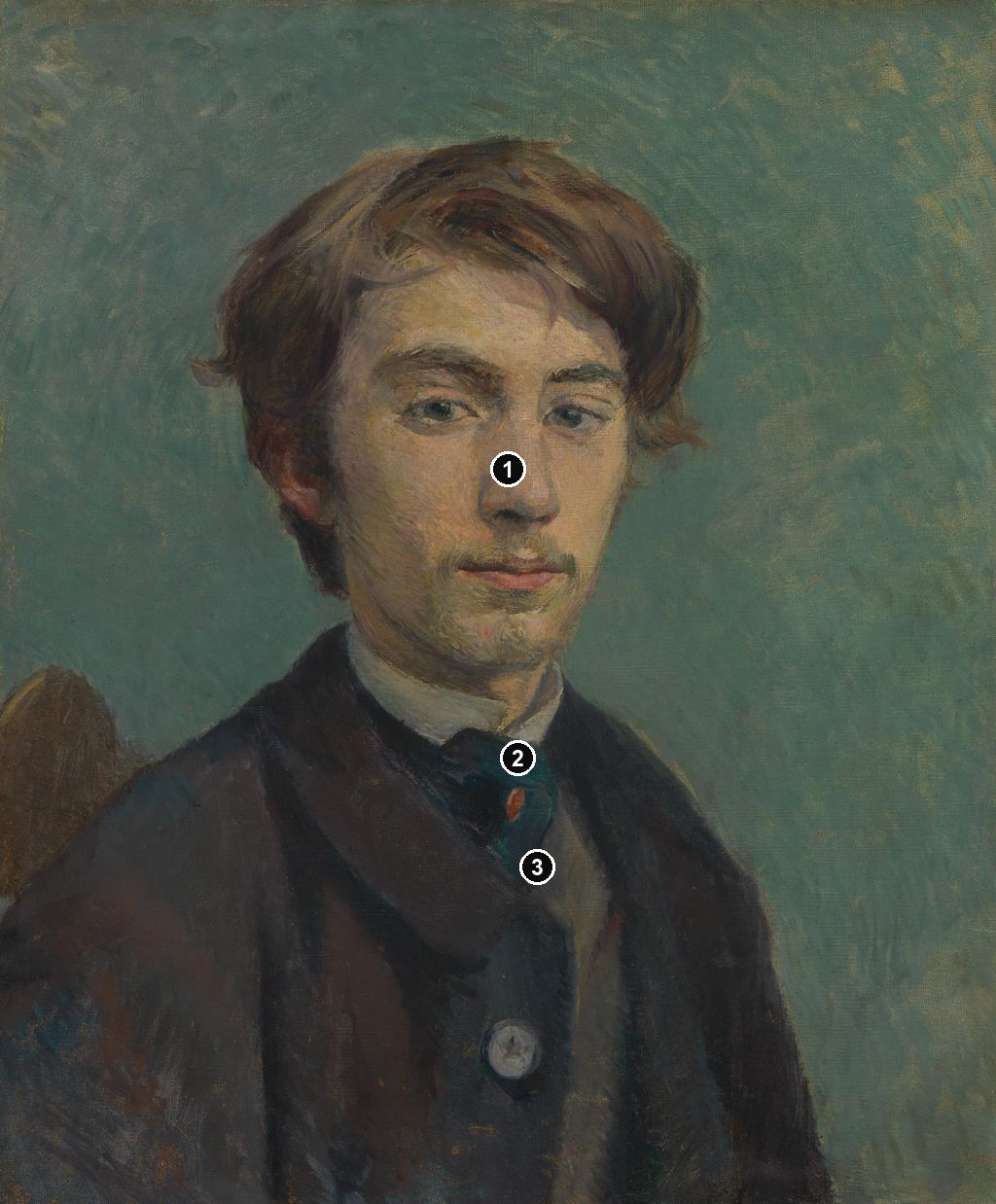
A small red pin catches the eye in Émile Bernard's dark cravat. Above it, a pale collar supports a finely worked face; behind the head, blue-green paint spreads in restless strokes. Toulouse-Lautrec's portrait brings the young painter close to us while leaving the nature of his attention unresolved. The eyes approach ours, but the head turns a little aside. This encounter between fellow students, made around 1885–86, depends as much on the surrounding colour as on the likeness itself. [1] [2]
At a Glance
- ArtistHenri de Toulouse-Lautrec.
- SitterÉmile Bernard, a fellow student at Fernand Cormon's Paris studio. [1]
- DateCirca 1885–86. Matthias Arnold dates it to winter 1885–86; the National Gallery gives 1886 in its facts and 1885 in its commentary. [2] [1]
- MediumOil on canvas. [1]
- Dimensions54 × 44.5 cm. [1]
- CollectionTate, T00465; on loan to the National Gallery, London, as L732. [3] [1]
- AcquisitionBequeathed by Arthur Jeffress, 1961. [1]
This work across Henri de Toulouse-Lautrec’s career
Émile Bernard by Toulouse-Lautrec (current article)
Circa 1885–86At the Moulin Rouge
1892–1895 [8]Jane Avril
1893 [9]Contents
- A head turned just enough
- The colour around the face
- Clothes, a pin and the edge of a chair
- Fellow students, working in one another's company
- A background remembered as hard work
- Why circa 1885–86 is the useful date
- Another painter, another surrounding space
- Annotated details
A head turned just enough
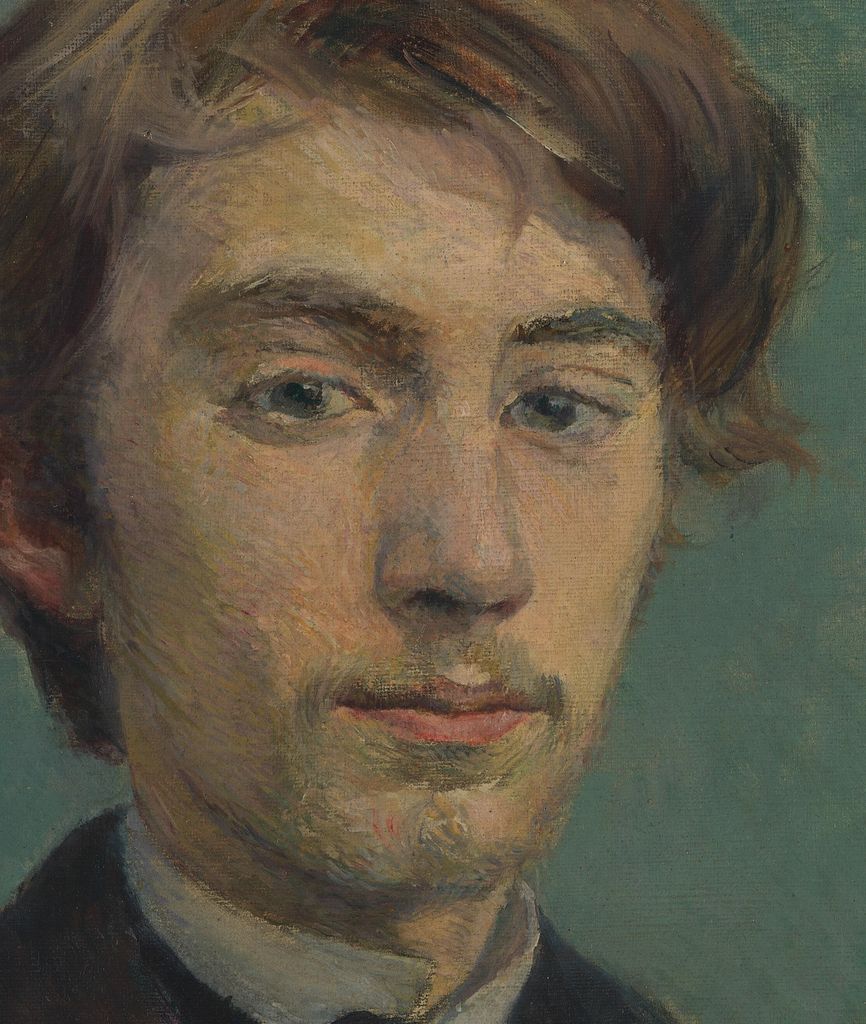
Bernard sits close to the front of the picture, his chest filling most of its lower half. His shoulders turn slightly, and his head follows them without settling into a full profile. We see both eyes, both eyebrows and almost the whole breadth of the mouth. The nose shifts towards the right of the face, making one cheek appear broader than the other. That small turn gives the likeness tension: it offers a direct encounter without the symmetry of a person squarely facing us.
The eyes do not behave like two identical points along a horizontal line. Their lids have different shapes, and the shadow around the farther eye is more compressed. Fine dark touches fix their direction within a face otherwise made from many lighter marks. The eyebrows give another pair of unequal accents. Their larger, more continuous shapes sit above the smaller interruptions of the eyes, concentrating attention in a narrow band across the head.
Below, the mouth has its own asymmetry. A warm pink line is interrupted by darker touches, while the slight moustache softens its upper boundary. Shadow beneath the lower lip separates it from the chin. The lips can suggest the beginning of a smile, but the painted difference between their corners does not settle the sitter's mood. The National Gallery likewise treats the expression as ambiguous. Small differences in the features keep the face from becoming a fixed, impersonal mask. [1]
The hair is much more expansive. Sweeps of brown, black and ochre curve over the skull, interrupting one another as they follow its rounded shape. Small projections break the silhouette on either side. Above the forehead, the lightest strokes link the hair to the pale face, while the darkest passages produce a firm upper enclosure. These changes give the head volume without describing every lock. The curls also make an irregular edge against the background, quite different from the straighter boundaries of collar and lapel below.
The colour around the face
The background first appears to be a single cool field. Looking longer reveals yellowish marks, patches of deeper blue and numerous changes in direction. Some strokes rise beside the body; others cross obliquely behind the hair. Near the outer edges, the paint becomes particularly varied and open. No furniture, window or hanging picture supplies a definite setting. The colour has to establish the space around the sitter with remarkably little descriptive assistance.
That space changes as it touches different parts of the figure. Along the dark jacket it offers a relatively light boundary; beside the cheek it becomes the cooler neighbour to warm skin. Around the hair, the balance is less regular because both background and head contain broken, curved marks. The edge becomes clear through their differences in value and direction. In my reading, these encounters make the blue-green area integral to the portrait. Its colour changes the effect of the whole contour.
The forehead is a good place to follow those relationships. Ochre and pale yellow meet greyer touches beneath the hair, then descend into the warmer bridge of the nose. Cooler strokes gather at the side of the face. The cheek does not have one continuous flesh colour: small variations turn it towards and away from the light. At the jaw, a darker band gives the head a lower limit before the collar provides a sharply different pale surface. Light is built through adjacent colours and changes of tone, with no visible lamp or window to explain its source.
The background occupies especially generous space to the right. Bernard's body narrows towards the lower edge, leaving that cool area to run down beside him. To the left, the chair interrupts it and draws the viewer nearer to an ordinary seated arrangement. The two sides consequently do different work. One places an object close behind the shoulder; the other lets the figure remain alone against colour. Their inequality gives the composition room without requiring a deeper room to be described.
Annotated Details from Émile Bernard by Toulouse-Lautrec
The numbered points identify visible features discussed in this article. Return from each detail to the whole composition. Henri de Toulouse-Lautrec, Émile Bernard, circa 1885–86. Oil on canvas, 54 × 44.5 cm. Tate, T00465; National Gallery loan L732. Reproduction via Wikimedia Commons; source Julia Frey, Henri de Toulouse-Lautrec, BB art, Praha, 1999. Image source. Public domain. Resized only; native appearance preserved.
Details from ÉMILE BERNARD BY TOULOUSE-LAUTREC
Compare the cropped details with the complete images above. Notice how their colours, shapes and positions contribute to the larger compositions.
The face
The head turns slightly within a largely frontal arrangement.
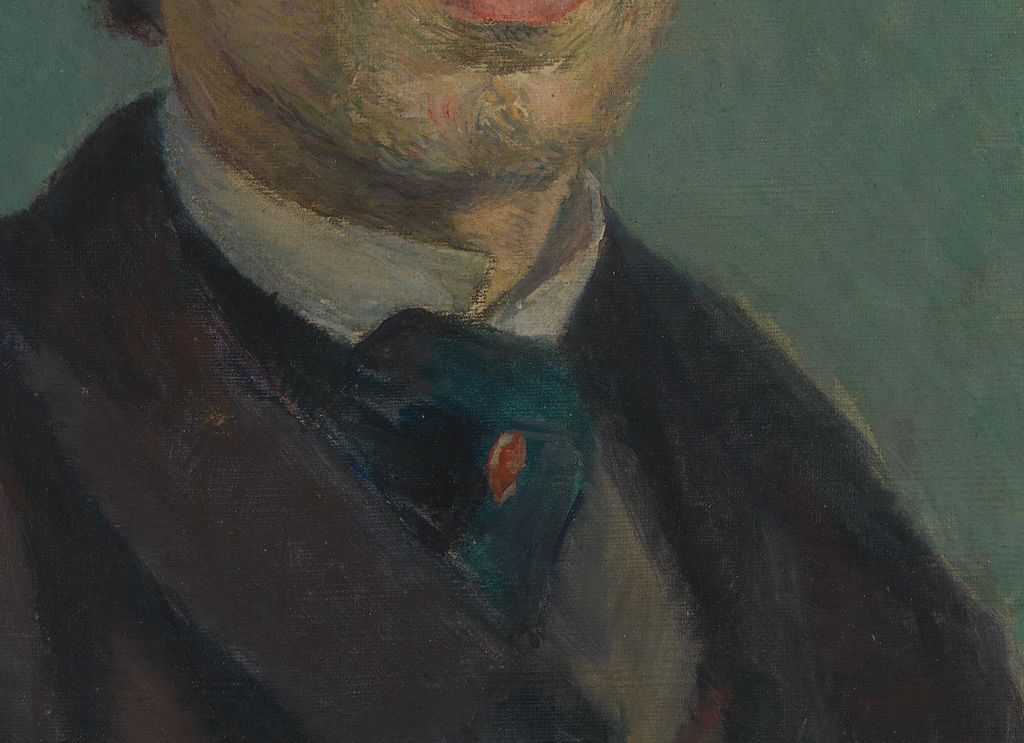
The collar and cravat
A pale stiff collar and dark cravat divide the head from the jacket.
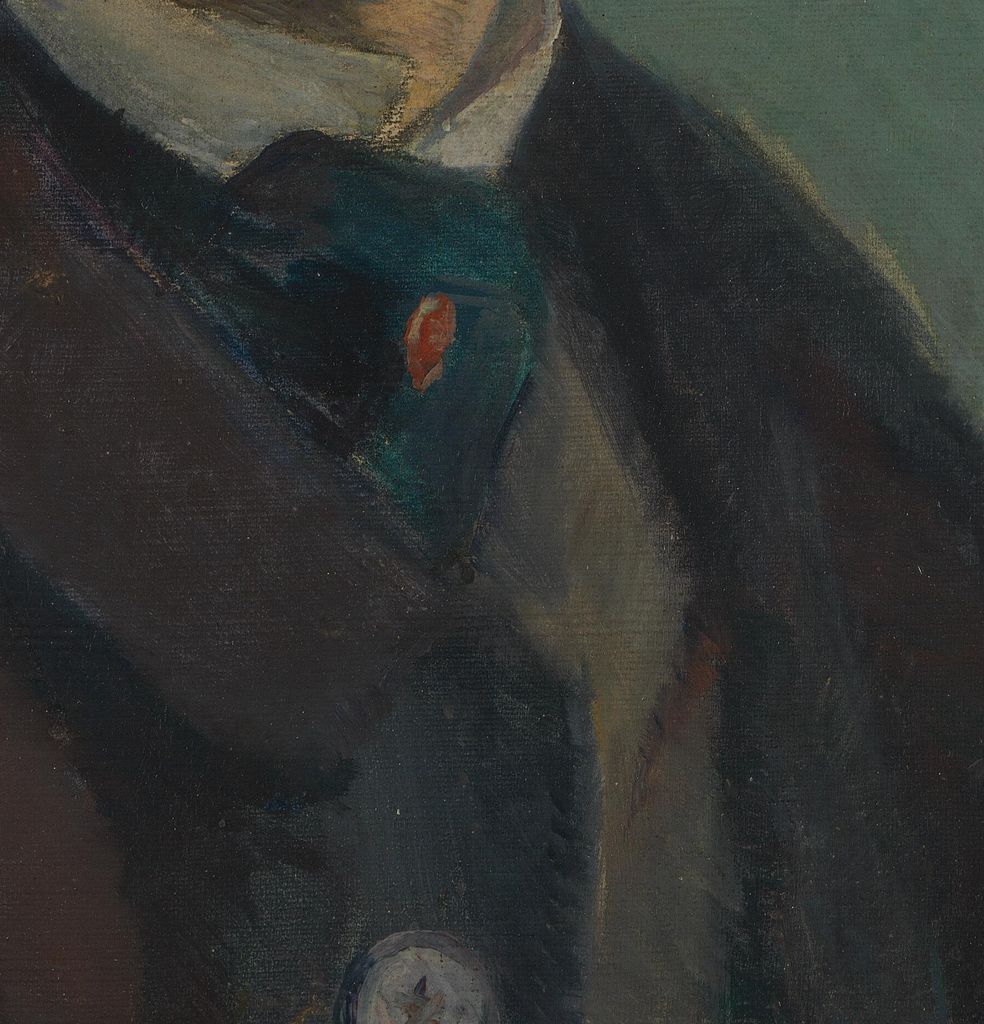
Jacket and waistcoat
Changes in the darker strokes distinguish layers of clothing.
Clothes, a pin and the edge of a chair
Bernard's clothing supplies several overlapping dark shapes. A pale upright collar meets the cravat beneath the chin. The jacket lapels descend around the waistcoat, with narrow changes of colour distinguishing one layer from another. The National Gallery identifies the costume as formal dress, including a waistcoat and what appears to be a velvet morning coat. Its qualified identification of the fabric is useful: painted softness and sheen suggest material, but a reproduction cannot tell us everything about the garment. [1]
The cravat contains some of the painting's deepest blue-green colour. It connects the clothes with the surrounding field while remaining much darker. In its middle, the red pin introduces a small warm interruption. It is easy to find because the surrounding cloth is restrained and the collar above is pale. Follow the pin downwards and a light circular waistcoat button supplies another compact accent. These two details establish a loose vertical sequence beneath the face, preventing the dark torso from becoming an undivided mass.
The jacket itself has considerable internal variety. Muted violet, brown and blue move across the broad shoulder nearest us. Shorter, scattered marks appear towards the lower left, whereas longer dark passages establish the lapel. The farther side is more compressed and sinks towards the edge. Although the clothing occupies a large part of the canvas, its distinctions remain less insistently described than the eyes and mouth. Lautrec gives us enough structure to understand how the garments overlap while keeping the face the place of finest differentiation.
The chair is even more economical. A brown curved fragment rises at the left, directly behind the shoulder. Its warm colour distinguishes it from the surrounding blue-green and echoes some of the hair. The rest of the seat lies outside the frame or behind the body. That fragment is sufficient to make sitting tangible. There is no need for a complete chair, a visible floor or the sitter's hands: the relationship between the upper body and the curved wooden edge supplies a convincing physical situation.
These details establish appearance more securely than character. A red pin can organise colour without revealing political convictions; an escaping curl can enliven a contour without disclosing rebelliousness. The distinction matters particularly here because Bernard would become known for arguments about painting. The portrait asks us to look carefully at a particular young man's clothes and face, and leaves substantial room between that appearance and his later reputation.
Watch: Toulouse-Lautrec
Choose an artist introduction, a film about graphic design or a closer look at At the Moulin Rouge.
Fellow students, working in one another's company
Bernard entered Cormon's studio in October 1884, where he met Lautrec and Louis Anquetin. Arnold's catalogue essay identifies two caricatures by Bernard showing Lautrec at work as evidence of their proximity as practising artists. Seen in that setting, the oil portrait belongs to an exchange in which the person sitting could also draw the person painting. A fellow student offered a familiar face and an opportunity to watch another artist solve a pictorial problem. [2]
The broader studio circle was changing rapidly. Franka Blok's Van Gogh Museum account places Vincent van Gogh's arrival at Cormon's in March 1886. Bernard, Anquetin and Lautrec were already associated, and experimented with brighter colour and freer handling outside their classes. Such experiments coexisted with work from models and plaster casts. The setting allowed formal training and independent exploration to develop beside one another. [6]
Bernard's subsequent recollections help reconstruct those encounters, but their dates require scrutiny. Blok notes that one memory places shared studio work with Van Gogh in the autumn of 1886, after Vincent had actually left. That correction does not erase Bernard's testimony about the group. It does show why the vividness of a remembered episode cannot guarantee its chronology. The same care is useful when reading his accounts of posing for this portrait. [6]
A background remembered as hard work
The National Gallery recounts Bernard's later statement to the art historian Douglas Cooper that the portrait required thirty-three sittings, ten devoted to its background. The museum presents this as a story told afterwards by the sitter. It supplies a striking account of sustained labour, rather than a surviving diary of the sessions. [1]
Another published version differs. Arnold, writing in the Museum of Modern Art's 1985 catalogue, cites Pierre Mornand's Émile Bernard et ses amis of 1957 for Bernard's recollection of twenty sessions spent unsuccessfully bringing background and face into harmony. Both accounts describe difficulty, but give different numbers. Combining them cannot establish a precise total. Their common point is more useful to looking: the apparently simple surrounding colour was remembered as a demanding part of making the likeness. [2]
Return to the painting with that problem in mind. The head must stand forward, yet belong to the rectangle around it. A completely uniform background would change the effect of the broken facial marks; a heavily furnished interior would introduce other objects competing for attention. Here the varied cool field allows both separation and continuity. The skin remains warmer and lighter, while small related colours pass between hair, face, cravat and surroundings. That visible balance helps explain why the background could matter so much, without proving which strokes were made at a particular sitting.
The story also changes how the surface's looseness reads. Individual marks may look quick, but that appearance cannot measure the time taken over their arrangement. A portrait can retain broad strokes after repeated reconsideration. We see a resolved relationship of colours, rather than a reliable sequence of the painter's actions. Bernard's recollections direct attention towards the effort involved; they cannot assign an exact duration to the passages we now examine.
Why circa 1885–86 is the useful date
The date varies even within the National Gallery's account: its factual listing gives 1886, while its commentary says 1885. The Morgan Library & Museum's checklist for Painted with Words in 2007 listed this same Tate canvas, T00465, as 1885. Arnold had placed it more specifically in winter 1885–86. Using circa 1885–86 accommodates these published positions while preserving the distinction between a date supplied by a catalogue and a date securely fixed by a contemporary document. [1] [3] [2]
The range places the work within the period when painter and sitter shared the Cormon environment. It also keeps the portrait separate from the artistic positions Bernard developed subsequently. Looking backwards from his later work can make every early detail seem prophetic. The more immediate achievement is already substantial: a young painter has made another young painter's appearance convincing through the organisation of limited space, layered clothes and closely differentiated colour.
Another painter, another surrounding space
The Portrait of Vincent van Gogh of 1887 offers a specific comparison. There, Lautrec used pastel on prepared paper over cardboard, building an unblended network of coloured lines. Blok's technical account distinguishes the fine work around the head from coarser surrounding marks. The café furnishings also help enclose and separate the sitter. That is a different material solution from Bernard's oil on canvas, and its technical findings belong to the pastel. [6]
Placed beside Bernard, the difference in setting is particularly revealing. Van Gogh's table, bar and mirror give his profile several intersecting structures. Bernard has scarcely more than a chair edge and a field of colour. The first portrait directs attention through a room; the second makes the transition from person to background its principal spatial event. Both reward following the surrounding marks before returning to the face. They show how much a likeness can depend on decisions made beyond the likeness's most recognisable features.
Toulouse-Lautrec artworks directory
Browse 84 identified works and publications in this researched selection. Dates and titles follow the individual records; this is not a complete catalogue of the surviving oeuvre. Print impressions remain attached to their designs. Some listed works do not have a dedicated article. The Drawings guide also contains nine illustrated studies consolidated from former articles.
Frequently Asked Questions
Émile Bernard, a painter who studied alongside Toulouse-Lautrec and Louis Anquetin at Fernand Cormon's Paris studio. He entered the atelier in October 1884. [2]
No. The head turns slightly, but both eyes and most of the face remain visible. It differs markedly from the strong side view of Lautrec's Van Gogh portrait.
Discussion
Look again at the images and ideas explored in Émile Bernard by Toulouse-Lautrec. These editorial prompts invite your observations.
Reader Insights
Compare the hair against the blue-green background with the collar against the cravat. How do broken and firmer edges give these passages different kinds of clarity?
Find the red pin, the pale button and the wooden chair fragment. Which draws your eye first, and how does each help organise the much larger dark area of the clothes?
Join the Conversation
Share a detail, comparison or question about Émile Bernard by Toulouse-Lautrec below.
References
- National Gallery, London, Henri de Toulouse-Lautrec, Emile Bernard, L732, current object facts, overview, in-depth commentary and image, consulted 29 October 2026. Facts give 1886; commentary gives 1885. Bernard's account to Douglas Cooper is cited through the museum's commentary. View source.
- Matthias Arnold, “Toulouse-Lautrec and the Art of His Century,” in Riva Castleman and Wolfgang Wittrock, eds., Henri de Toulouse-Lautrec: Images of the 1890s, Museum of Modern Art, 1985, pp. 53–54 and notes 86–88 on p. 74. Portrait dated winter 1885–86 on p. 54; Bernard's account of background work cited there through Pierre Mornand, Émile Bernard et ses amis, 1957, p. 57. Mornand's book was not independently consulted. View source.
- Morgan Library & Museum, Painted with Words: Vincent van Gogh's Letters to Émile Bernard, exhibition checklist, 28 September 2007–6 January 2008, item 2: Toulouse-Lautrec, Portrait of Émile Bernard, 1885, oil on canvas, 54 × 44.5 cm, Tate T00465. Item read through the museum's indexed checklist text. View source.
- Autoportrait, 1880 (in French). View source.
- ALBERTINA: Der Schimmel Gazelle,GE123DL. View source. (in German).
- Franka Blok, “Henri de Toulouse-Lautrec, Portrait of Vincent van Gogh, 1887,” catalogue entry 132, in Contemporaries of Van Gogh 1: Works Collected by Theo and Vincent, Van Gogh Museum, 2024; “Friendship,” notes 7–11, and “Pastel crayon,” notes 27–31. English catalogue with French documentary passages; Bernard's studio recollections are consulted through Blok, whose note 9 corrects their chronology. View source.
- Art Institute of Chicago: Moulin Rouge, La Goulue. View source.
- Art Institute of Chicago: At the Moulin Rouge. View source.
- Jane Avril, 1893. View source.
- Au Salon de la rue des Moulins (in French). View source.
- Colta Ives, Toulouse-Lautrec in The Metropolitan Museum of Art, 1996. View source.
- Maurice Joyant (in French). View source.
- Splash image, Henri de Toulouse-Lautrec, Émile Bernard, circa 1885–86. Oil on canvas, 54 × 44.5 cm. Tate, T00465; National Gallery loan L732. Reproduction via Wikimedia Commons; source Julia Frey, Henri de Toulouse-Lautrec, BB art, Praha, 1999. Image source. Public domain. Resized only; native appearance preserved.


 Henri de Toulouse-Lautrec.jpg)