



 by Tom Gurney
Tom Gurney BSc (Hons) is an art history expert with over 20 years experience
Published on June 19, 2020 / Updated on November 3, 2026
Email: tomgurney1@gmail.com / Phone: +44 7429 011000
Carmen Gaudin by Henri de Toulouse-Lautrec: Introduction
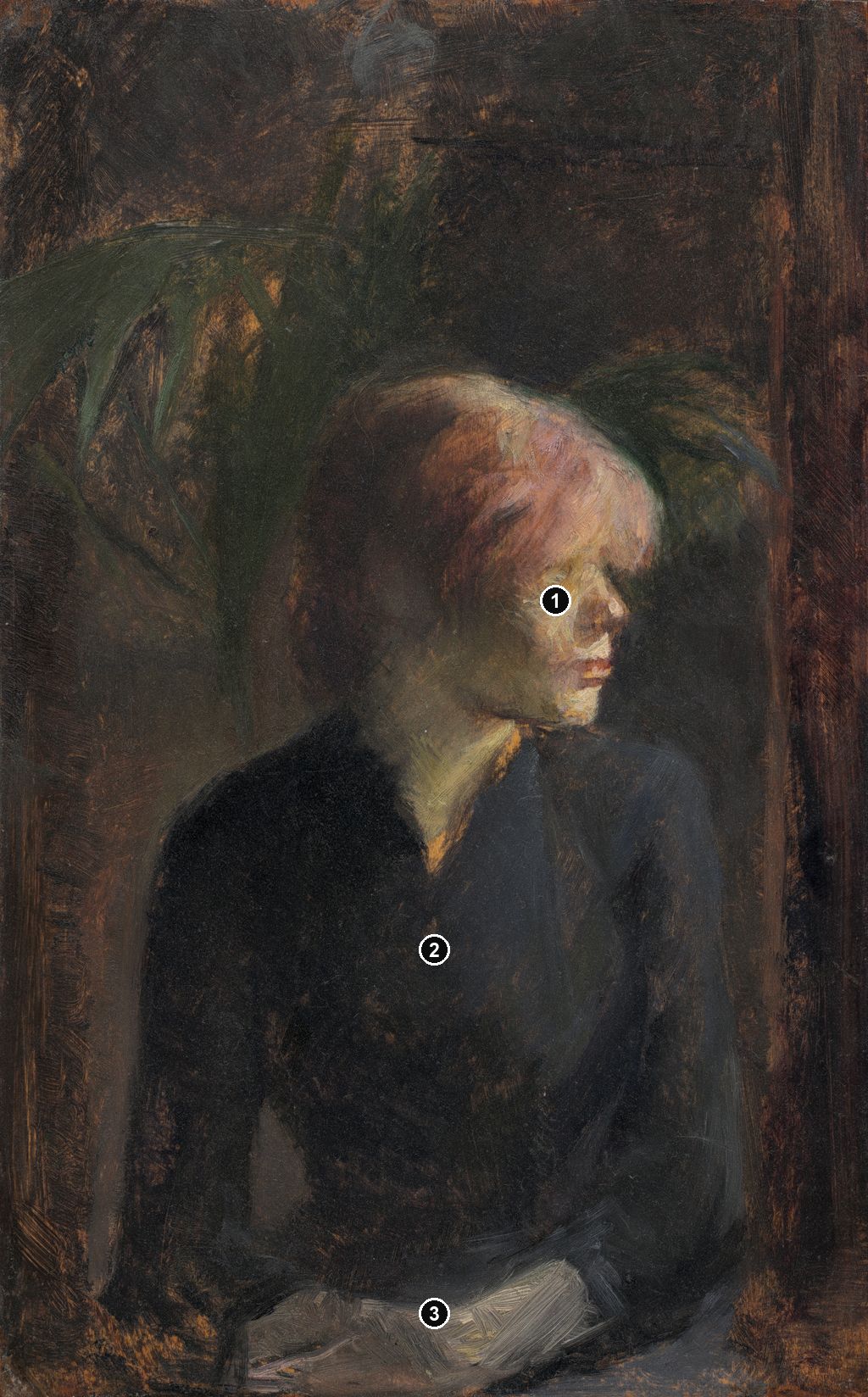
The face turns towards the light; the shoulders remain almost square to us. That small disagreement gives Toulouse-Lautrec's Carmen Gaudin its movement. A bright fringe, a short nose and a pale chin emerge above a dark blouse, while loosely painted hands close the composition below. The narrow picture contains a whole seated presence without showing a complete body.
Painted in 1885, this is the small oil on wood in Washington's National Gallery of Art, accession 1970.17.85. Its enclosed darkness and concentrated light make the face unusually prominent. [1]
At a Glance
- ArtistHenri de Toulouse-Lautrec.
- TitleCarmen Gaudin.
- Date1885.
- Mediumoil on wood.
- Dimensions23.8 × 14.9 cm.
- CollectionNational Gallery of Art, Washington, Ailsa Mellon Bruce Collection.
- Accession and catalogue identity1970.17.85; Dortu P.244. [1]
This work across Henri de Toulouse-Lautrec’s career
Contents
- A small picture with room above the head
- Red hair divided by light
- A profile above a frontal torso
- A background that encloses without explaining
- The work of making a likeness
- Carmen Gaudin as a working model
- The same face, different encounters
- From Gauzi's collection to Washington
- Annotated details
A small picture with room above the head
The portrait is less than twenty-four centimetres high, a scale that invites close attention. [1] On a screen it can appear much larger, making the visible brushwork seem more expansive than the object itself. Remembering its size changes the encounter: the face, hands and surrounding darkness have been coordinated within a surface small enough to take in at once.
The figure fills roughly the lower three-quarters. Above her hair is a substantial area of brown, dark green and loosely crossing strokes. This upper space gives the head room even though the body is closely cropped. At the bottom, the hands approach the edge; at either side, narrow passages of background surround the shoulders and arms. The sitter feels contained without being fitted tightly against every boundary. These relationships are especially clear in the full reproduction. [11]
The upright format also makes the sideways turn conspicuous. Our eye can descend from the crown through the neckline to the lap, but the nose and mouth direct us towards the right. Those two routes coexist. The figure offers a stable central mass and an outward orientation, allowing a very quiet pose to carry several directions of attention.
Red hair divided by light
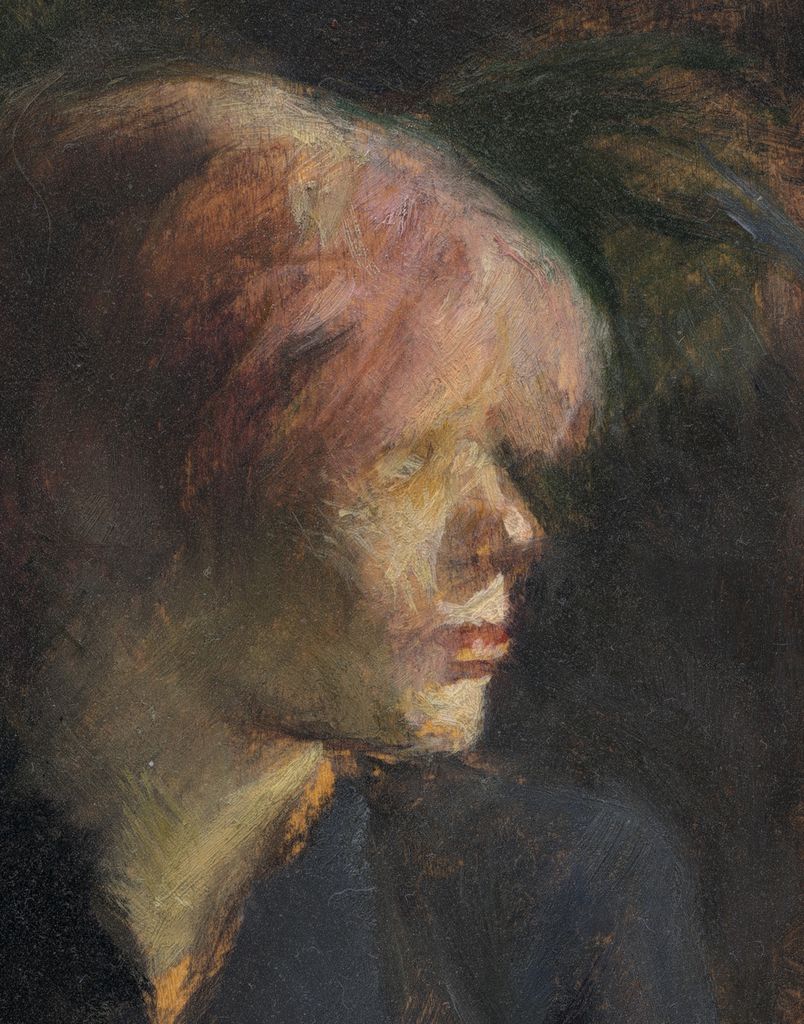
The hair is more varied than its first impression of redness suggests. At the crown, greyish and pale strokes interrupt the warmer colour. Across the fringe, salmon, ochre and reddish-brown marks gather into a broad sweep. Behind the head, the gathered hair falls into much deeper shade. Its volume depends on this change from light to darkness as much as on the shape of its outer edge.
Look at the front of the head, where the fringe spreads above the nose. The hair's curved boundary overhangs the eye region, while the small exposed features project below it. The contrast makes the upper face difficult to read but leaves the lower profile sharply distinctive. We do not need a clear view of both eyes to recognise the particular relationship between this hair, nose, mouth and chin.
The brightest passages occupy the front of the head and face. At the back, the hair nearly merges with its surroundings. The result is a head that seems to emerge unevenly from the background: one part is separated through light, another through the softer difference between adjoining dark colours. Follow the complete contour and its firmness repeatedly changes.
The red also gains force from the clothing below. Against the blouse, the hair is a concentrated warm area above a much larger dark one. A small orange accent at the neckline repeats that warmth lower down, drawing attention through the neck towards the torso. It creates a connection between two bright passages without making the garment compete with the head.
Annotated Details from Carmen Gaudin
The numbered points identify visible features discussed in this article. Return from each detail to the whole composition. Henri de Toulouse-Lautrec, Carmen Gaudin, 1885. Oil on wood, 23.8 × 14.9 cm. National Gallery of Art, Washington, 1970.17.85. National Gallery of Art,Washington,1970.17.85. Image source. CC0 / Public domain. Resized only; native appearance preserved.
Details from CARMEN GAUDIN
Compare the cropped details with the complete images above. Notice how their colours, shapes and positions contribute to the larger compositions.
The red-haired profile
Warm light and red hair concentrate attention on the turned face.
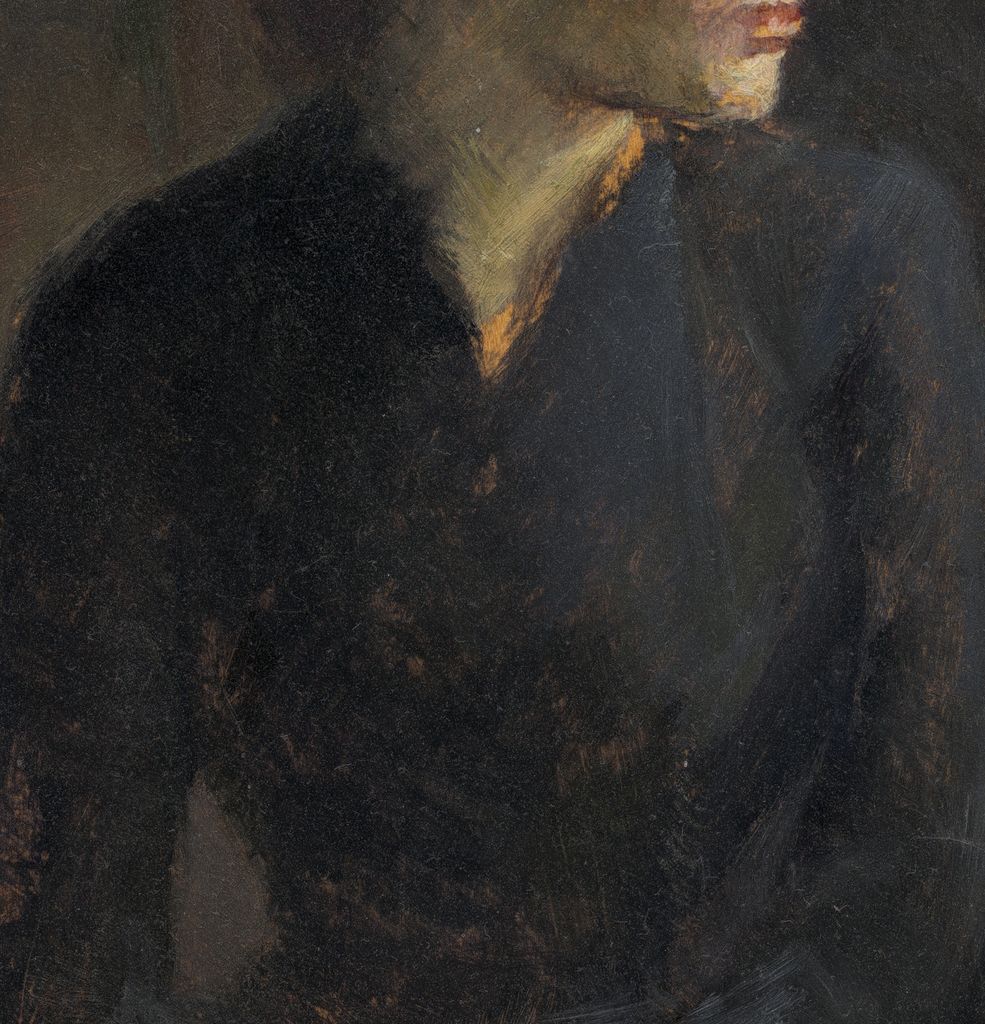
The dark blouse
The dark clothing gives the small portrait a strong vertical mass.
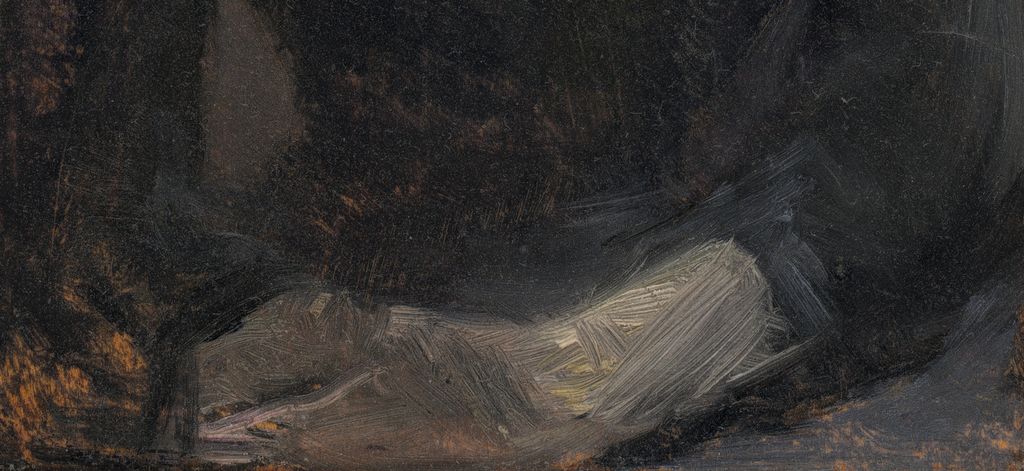
The hands and cuffs
Pale strokes distinguish the hands and cuffs from the dark clothing.
A profile above a frontal torso
The face is turned to our right, but the blouse presents the breadth of the chest and both shoulders. The neck has to connect these different orientations. Its pale diagonal rises from the V-shaped opening towards the jaw, making the turn physically intelligible. We can follow the turn through the neck into the shoulders.
Around the cheek and mouth, short marks break up what might otherwise be a continuous area of skin. Yellowish lights, cooler shadows and small reddish touches distinguish the nose, lips and chin. The jaw is clearer than the transition behind it, where neck, shaded cheek and background draw closer in value. The face becomes readable through a few unequal accents.
Below, the apparently black blouse contains substantial variations. The sleeve at our right contains broader blue-grey passages, while the other side remains darker. A few warm marks interrupt the central body. At the waist, the silhouette narrows before reaching the hands. These changes preserve the torso's substance inside a garment that initially looks almost continuous.
The hands form a second pale concentration near the bottom. Their overlapping shapes are much less finely articulated than the face. Long, angled strokes establish the nearer wrist and hand, with darker lines distinguishing parts of the fingers. We can understand the resting position before identifying every anatomical detail. The lap gives the composition a lower anchor: from the head, the eye travels through the dark body to another small gathering of light.
There is no direct exchange of gazes to organise this portrait. Instead, its human presence develops through a turned profile, the width of shoulders and hands brought together. The arrangement can feel absorbed or reserved to a viewer, but the pose supplies no reliable account of Gaudin's thoughts. Its specificity lies in these observable bodily relationships.
A background that encloses without explaining
Broad green strokes arc behind and above the head, suggesting leaves without resolving into a fully described plant. The sweep at the left is particularly conspicuous: it bends through the surrounding brown and turns towards the darker space above the crown. Smaller green passages appear behind the face. Together they make the setting active while leaving its exact arrangement uncertain.
The greens also bring the background into a relationship with the sitter's warmer hair. They are darker and more dispersed, so they do not become an equal competing patch. The hair concentrates colour around a recognisable form; the background distributes it through less definite ones. A sense of enclosure comes from that unequal organisation.
Along the outer sides, vertical brown passages create another kind of boundary. They are more upright than the foliage-like curves, and their streaked surfaces remain evident. The painted margins give the image a narrow surrounding structure without requiring us to identify a particular screen, wall or piece of furniture. The setting establishes limits more clearly than it establishes an address.
Light arrives from the right, yet its source remains outside the picture. Unlike the visible windows in some other Gaudin portraits, there is no clearly depicted opening to explain it. The face and the brighter shoulder are enough to make the direction convincing. This withholding keeps our attention close to the body: following the profile outwards brings us to darkness rather than to a second scene.
Watch: Toulouse-Lautrec
Choose an artist introduction, a film about graphic design or a closer look at At the Moulin Rouge.
The work of making a likeness
The wood support distinguishes this portrait from several larger Gaudin canvases. [1] In the reproduction, warm brown remains visible between darker strokes around the margins and in the upper background. These intervals help the setting feel open and worked rather than sealed beneath an even finish. Their appearance alone cannot establish whether we are seeing bare wood, a preparation or a thin paint layer.
The marks change scale as they change purpose. Around the mouth, small accents make a feature legible; across the lap, longer strokes stand for larger anatomical divisions. In the surrounding darkness, crossing and curving marks describe much less. Lautrec allows these different levels of information to coexist. A highly specific face does not require every part of the picture to receive an equally detailed treatment.
Even the nearly black clothing retains visible activity. Look into the chest after looking at the bright hands: small brownish marks and blue-grey passages start to register. The body becomes more articulated as the eye adjusts to the lower contrast. Darkness consequently delays information rather than removing it altogether.
This is a useful example of Lautrec's style and technique at an intimate scale. The portrait combines a readily grasped bodily arrangement with marks that remain individually apparent. Its immediacy is an effect of those relationships; the visible surface cannot establish the number or length of the sittings.
Carmen Gaudin as a working model
Gaudin's repeated appearances belong to Lautrec's developing independent portrait practice. In the Clark Art Institute's collection catalogue, Sarah Lees places her among the models he chose for sittings outside his teacher's studio, during the period when he worked alongside Henri Rachou. Her repeated sittings helped Lautrec explore subjects beyond his established circle of family and studio sitters. [12]
Grand Palais's French account of the Gaudin pictures stresses the variety of viewpoints: front, back, profile and lowered head. It treats the repeated encounters as an investigation of a particular person's appearance. [13] That is a productive way to approach this panel. Its sideways turn is one solution among several, rather than the single posture through which Gaudin must always be understood.
Her occupation outside modelling requires more care. Christie's calls her a laundress, while Lees explicitly cautions that the written sources do not establish that profession. [14] [12] The disagreement matters because titles and later accounts can make uncertain information sound settled. In this small portrait, neither a laundry setting nor the activity of washing is depicted. The dark blouse and resting hands establish appearance and pose, while the title names the sitter.
Lees also traces the familiar story of Lautrec and Rachou encountering Gaudin to François Gauzi's later account. [12] Remembered dialogue can tell us how their meeting was subsequently narrated, but it should not replace the model's repeated participation with a dramatic moment of discovery. The paintings offer firmer evidence of the continuing work: changing poses, garments, scale and lighting around a recognisable face.
The same face, different encounters
The Clark's Carmen, dated about 1884 in its catalogue, is a separate oil on canvas, accession 1955.525. Its reproduced figure faces forward in a dark blouse, with both eyes visible beneath parted hair. [12] The contrast with Washington is instructive. The frontal head makes the face's two sides available together; the little panel turns one side away and concentrates the light on a projecting profile. Recognition is reorganised around the angle of the head.
The Clark picture also gives the hair a broad, almost balanced spread around the forehead. Here the lit fringe and shaded back divide it more unevenly. Dark clothing connects the two portraits, but its relationship to the head changes. The frontal figure sets a pale face centrally above the garment's opening; the Washington sitter carries the face towards one shoulder. A small turn alters the balance of the whole body.
A later comparison changes the tonal structure more dramatically. In Barnes's “A Montrouge”–Rosa La Rouge, 1886–87, BF263, Gaudin poses as a character from Aristide Bruant's songs. [15] The large pale blouse extends brightness down through the torso, and the arms hang beside the body. A window behind the turned head supplies a lighter surrounding field. Washington concentrates its light in smaller islands of face, neckline and hands; Barnes opens it across an extensive garment.
The Laundress, Dortu P.346, is another distinct canvas, dated 1886–87 by Christie's. [14] Its figure leans towards the left and presses a hand onto a table. That extended arm gives the body a support and a sideways reach absent from the seated panel. The comparison reveals how much the small picture achieves with the hands contained in the lap. Here the body closes towards its centre even while the head turns outwards.
The three titles also ask different things of us. A personal name identifies a sitter; a work title can suggest an occupation; a song title can introduce a performed role. Their shared model does not make those meanings interchangeable. Returning to Carmen Gaudin after the larger canvases, the economy of its encounter becomes clearer: a name, a body at rest and light falling across a particular head.
From Gauzi's collection to Washington
The National Gallery traces the panel through François Gauzi and his estate, then the Geneva dealer Durand-Matthiesen and Edward Molyneux. Ailsa Mellon Bruce bought it in 1955; her bequest brought it to the museum in 1970. The provenance cites a 1935 letter signed by Germaine Gauzi and a dealer label formerly on the back. Such details give the small object a documentary history beyond the sitter's name. [1]
In 2005 it appeared as number 81 in Toulouse-Lautrec and Montmartre. The exhibition checklist confirms the same wood support, dimensions and accession number. [16]
Toulouse-Lautrec artworks directory
Browse 84 identified works and publications in this researched selection. Dates and titles follow the individual records; this is not a complete catalogue of the surviving oeuvre. Print impressions remain attached to their designs. Some listed works do not have a dedicated article. The Drawings guide also contains nine illustrated studies consolidated from former articles.
Frequently Asked Questions
It is Washington's small 1885 oil on wood, accession 1970.17.85, catalogued as Dortu P.244. Larger canvases depicting Gaudin are separate works. [1]
She repeatedly modelled for Toulouse-Lautrec during the 1880s. Claims that she worked as a laundress are repeated in some accounts, but the Clark catalogue cautions that written evidence for that occupation is lacking. [12]
Her torso faces broadly towards us, while the head turns to our right. The contrast between those directions is central to the composition. [11]
Barnes identifies Gaudin as the model for its separate 1886–87 painting. There she poses as Rosa, a character associated with Bruant's songs; the role does not establish the model's biography. [15]
Discussion
Look again at the images and ideas explored in Carmen Gaudin by Henri de Toulouse-Lautrec. These editorial prompts invite your observations.
Reader Insights
How do the small bright areas at the neckline and hands change the balance of the much larger dark blouse?
Compare Washington's turned head with the frontal face in the Clark's Carmen. Which features become more prominent when only one profile is available? [12]
Join the Conversation
Share a detail, comparison or question about Carmen Gaudin by Henri de Toulouse-Lautrec below.
References
- National Gallery of Art, Carmen Gaudin, 1885, accession 1970.17.85, object facts, provenance with supporting notes, exhibition history and bibliography identifying Dortu P.244. View source.
- Autoportrait, 1880 (in French). View source.
- ALBERTINA: Der Schimmel Gazelle,GE123DL. View source. (in German).
- Franka Blok, Portrait of Vincent van Gogh, 2024. View source.
- Art Institute of Chicago: Moulin Rouge, La Goulue. View source.
- Art Institute of Chicago: At the Moulin Rouge. View source.
- Jane Avril, 1893. View source.
- Au Salon de la rue des Moulins (in French). View source.
- Colta Ives, Toulouse-Lautrec in The Metropolitan Museum of Art, 1996. View source.
- Maurice Joyant (in French). View source.
- National Gallery of Art reproduction via Wikimedia Commons, full image of Carmen Gaudin, 1885, NGA 52229, 2486 × 4000-pixel image examined for the visual discussion. View source.
- Sarah Lees, “Carmen,” catalogue 328, in Nineteenth-Century European Paintings at the Sterling and Francine Clark Art Institute, volume 2, edited by Sarah Lees, 2012, pp. 784–787, especially the modelling context, reproduction on p. 785 and note 5 on p. 787. The technical report concerns the Clark canvas, 1955.525, rather than the Washington wood panel. View source.
- Grand Palais, “Carmen Gaudin : le modèle incandescent de Lautrec”, 17 December 2019, discussion of successive viewpoints and repeated portrayals (in French). View source.
- Christie's, La blanchisseuse, 1886–87, Dortu P.346, 2005 catalogue, exact object details, image and model identification. Its categorical occupation attribution is considered alongside Lees's caution. View source.
- Barnes Foundation, “A Montrouge”–Rosa La Rouge, 1886–87, BF263, rendered collection information and identification of Gaudin posing as Bruant's song character; full reproduction examined. View source.
- Art Institute of Chicago, Toulouse-Lautrec and Montmartre: exhibition checklist, 2005, cat. 81, PDF p. 5: Carmen Gaudin, 1885, oil on wood, National Gallery of Art 1970.17.85. View source.
- Splash image, Henri de Toulouse-Lautrec, Carmen Gaudin, 1885. Oil on wood, 23.8 × 14.9 cm. National Gallery of Art, Washington, 1970.17.85. National Gallery of Art,Washington,1970.17.85. Image source. CC0 / Public domain. Resized only; native appearance preserved.


 Henri de Toulouse-Lautrec.jpg)