


 by Tom Gurney
Tom Gurney BSc (Hons) is an art history expert with over 20 years experience
Published on June 19, 2020 / Updated on November 3, 2026
Email: tomgurney1@gmail.com / Phone: +44 7429 011000
Woman in Profile by Henri de Toulouse-Lautrec: Introduction
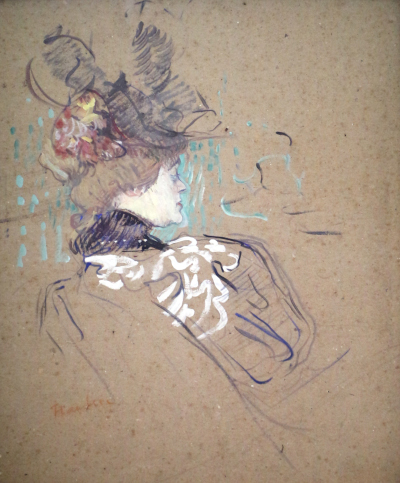
A pale face turns towards the right beneath an elaborate hat, while a few strong white strokes describe decoration around the shoulders. Much of the brown support remains exposed. Henri de Toulouse-Lautrec's Woman in Profile depends on the unequal weight of its marks: a small area of luminous face, a busy concentration of headwear and an upper body that opens into spare lines.
The Musée d'Orsay records the painting as Femme de profil, with Madame Lucy as an alternative title. It dates the work to 1896 and identifies oil on cardboard, 56 × 48 centimetres. The Spanish wording retained in this page's address, Mujer de perfil, describes the same subject; the current English display title follows the museum's principal French title. [1]
At a Glance
- ArtistHenri de Toulouse-Lautrec.
- Principal museum titleFemme de profil (Woman in Profile).
- Alternative titleMadame Lucy.
- Date1896.
- Mediumoil on cardboard.
- Dimensions56 × 48 cm.
- CollectionMusée d'Orsay, Paris.
- Inventory numbersRF 1937 39 and RF 28828. [1]
This work across Henri de Toulouse-Lautrec’s career
Contents
- The face provides a small centre of light
- A hat larger than the face
- White marks across the shoulders
- The exposed cardboard matters
- The marks beside the profile
- A name and a collection history
The face provides a small centre of light
The sitter's face is turned towards the right edge. Its pale colour contrasts strongly with the brown surface and the darker marks around the head. The nose and lips project into an open area, making the profile easy to distinguish even though the figure occupies only part of the painting.
The head sits slightly left of the centre. This leaves space in front of the face, giving the direction of the gaze a visible extension. The sitter does not meet our eyes. Instead, we look across the side of her head towards a part of the picture that contains very little firmly described information.
That relationship changes the character of the portrait. A frontal gaze might make an encounter with the viewer its main subject. Here the turned head preserves a sense of attention directed elsewhere. The image does not establish what the sitter is watching, and the spare surrounding marks do not justify inventing a conversation or a particular room.
The face itself is comparatively compact. Its clarity comes from the contrast between pale paint and the adjacent darker collar and hair. Lautrec does not need a long passage of detailed modelling to make the head readable. A limited area of light becomes enough to organise the larger, more scattered arrangement.
A hat larger than the face
The headwear extends far above the sitter's forehead. Loops, curves and upright strokes create an elaborate silhouette, while touches of warmer colour gather around the hair. The hat occupies more space than the visible face and makes the head a much larger visual event than facial features alone would provide.
Some marks are enclosed shapes; others rise or sweep out without forming a completely continuous edge. This mixture gives the headwear a shifting degree of solidity. We recognise an elaborate hat, yet remain aware of the separate strokes from which it is assembled.
The uppermost marks also take the eye towards the top of the support. They counter the downward spread of the torso and keep the figure from appearing simply as a small head above a large coat. The hat has its own upward energy, while the shoulders create a broader, lower movement across the picture.
Its darker passages are important beside the pale face. Without them, the face might seem less sharply set within the composition. The hat and hair provide a surrounding concentration of marks from which the profile emerges. Clothing and headwear therefore participate in the portrait's definition of the sitter, even where their material details remain incomplete.
White marks across the shoulders
The most conspicuous paint below the face is white. Short, curved strokes suggest bows, ribbon or ruffled decoration across the upper garment. Their irregular spacing gives them a lively rhythm that differs from the longer lines defining the body.
These bright marks do not fill the whole torso. They sit on the brown surface as separate accents, directing attention towards the neck and shoulder line. The contrast lets the clothing remain lightly indicated while still giving the upper body a clear visual presence.
The darkest collar passage strengthens this effect. Between pale face and white decoration, a compact band of dark strokes separates head from shoulders. The figure becomes legible through a sequence of contrasting areas rather than through an evenly modelled transition from one body part to the next.
Looking down from the shoulder, the outline becomes more open. Long blue-violet lines suggest the sleeve and the turn of the torso, with broad intervals left between them. The paint does not need to occupy every part of the body for us to understand its orientation. A few structural strokes carry the pose.
Watch: Toulouse-Lautrec
Choose an artist introduction, a film about graphic design or a closer look at At the Moulin Rouge.
The exposed cardboard matters
The warm brown field is present throughout the picture. It appears between marks in the hat, around the white decoration and across most of the lower half. It is therefore more than a background placed behind an otherwise complete portrait. It is the continuous surface across which the figure is selectively established.
The museum's material description identifies cardboard, rather than leaving the support to be guessed from its appearance. That distinction is useful when the painting is reproduced: thin paint and open drawing-like lines can make an oil painting look like a pastel or coloured-pencil study on a screen. [1]
The visible support gives distant parts of the image a shared colour. Face, sleeve and scattered background marks all emerge from the same warm field. Their differing density becomes a way of distinguishing importance. The eye stays longest where the paint gathers, then moves through the more lightly marked areas.
It would be too simple to describe every open area as evidence that Lautrec abandoned the painting. The museum identifies a painting with its own recorded history. What we can see directly is a deliberate-looking distribution of emphasis: the face and headwear receive concentrated attention, while the body and setting remain comparatively spare.
The marks beside the profile
A scattering of pale blue and darker strokes appears around the head and to its right. They do not resolve into a securely identifiable second person or a detailed furnishing. Their visual role is clearer than any proposed narrative explanation: they introduce colour into the open field and prevent it from becoming entirely uniform.
These marks also affect the profile's edge. The face turns into a space that has been touched by paint but has not been filled with an elaborate setting. The portrait consequently retains both direction and openness. We know which way the sitter faces, while the surrounding world remains only partly described.
Compare The Milliner for another profile in which headwear, hair and pale clothing carry much of the image's interest. There the shelves and dark hats establish a more specific interior. Here the exposed cardboard and dispersed strokes make the space around the woman far less bounded.
A name and a collection history
The alternative title Madame Lucy provides a name attached to the painting in the museum record. It does not establish a profession, personal relationship or complete biography. Those details should not be invented from the sitter's fashionable appearance. The portrait offers an individual presence without requiring an unsupported life story. [1]
The painting came from Antonin Personnaz's collection through his 1937 bequest to the French national museums. The record follows its subsequent museum allocations and its assignment to the Musée d'Orsay in 1986. This documented history is distinct from the comparatively open pictorial setting. The object can be securely located and identified even when the circumstances represented remain uncertain. [1]
What remains most memorable is the economy of the image. A pale profile, an extravagant hat and a handful of white strokes hold together a figure that occupies only selected parts of the support. The surrounding brown is allowed to remain visible, giving every concentrated passage of paint more weight.
Toulouse-Lautrec artworks directory
Browse 84 identified works and publications in this researched selection. Dates and titles follow the individual records; this is not a complete catalogue of the surviving oeuvre. Print impressions remain attached to their designs. Some listed works do not have a dedicated article. The Drawings guide also contains nine illustrated studies consolidated from former articles.
Discussion
Look again at the images and ideas explored in Woman in Profile by Henri de Toulouse-Lautrec. These editorial prompts invite your observations.
Reader Insights
How does the open space in front of the face direct attention?
Which marks make the hat seem larger than the face?
How do white decoration and exposed cardboard work together?
Join the Conversation
Share a detail, comparison or question about Woman in Profile by Henri de Toulouse-Lautrec below.
References
- Musée d'Orsay, Femme de profil: principal and alternative titles, 1896, oil on cardboard, dimensions, inventory numbers, Personnaz bequest and museum allocation history. Visual analysis follows the illustrated work. View source.
- Autoportrait, 1880 (in French). View source.
- ALBERTINA: Der Schimmel Gazelle,GE123DL. View source.
- Franka Blok, Portrait of Vincent van Gogh, 2024. View source.
- Art Institute of Chicago: Moulin Rouge, La Goulue. View source.
- Art Institute of Chicago: At the Moulin Rouge. View source.
- Jane Avril, 1893. View source.
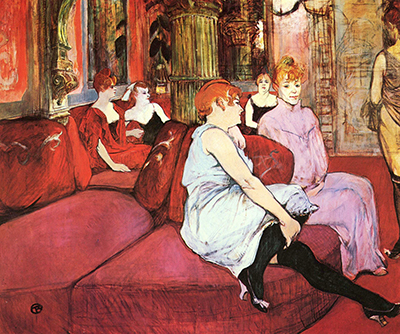
- Au Salon de la rue des Moulins (in French). View source.
- Colta Ives, Toulouse-Lautrec in The Metropolitan Museum of Art, 1996. View source.
- Maurice Joyant (in French). View source.
 Henri de Toulouse-Lautrec.jpg)